 |
 572B Breadboard Linear Amplifier – oh, the insanity!
 21 February 2011 | by
 Today I bring you a video by “bob4analog” on YouTube. His version of a breadboard is slightly different from mine!!!!
Really detailed description of his project and a great tour of it in operation. I have a 572 based amp and found this quite interesting. Others, may just find the layout utter insanity! I really thank him for posting this video, it was interesting and I did indeed learn a few things while watching this video.
From his video description:
An experimental ‘Breadboard’ Linear Amplifier for 80m, using two 572B tubes.
Jonathan Hardy, KB1KIX, is a regular contributor to AmateurRadio.com and writes from Connecticut, USA. Contact him at [email protected].
2011 ARRL DX CW Contest
This past weekend was the ARRL DX CW Contest, one of the biggest contests in all of radiosport. The object of this contest is for stations in the US and Canada to contact stations anywhere else. (In this particular contest, there is no credit for US & Canadian stations to work either country). Contestants may use 6 different bands, 10m, 15m, 20m, 40m, 80m, and 160m. As you might have guessed from the name, this is a CW (morse code) only contest. I’ve done this contest a few times in the past years, and as I’ve become more comfortable with using CW, I’ve participated more. The band conditions for this year looked to be pretty good, with the sun finally starting to wake up from the very long trough between solar cycles 23 and 24. The solar flux remained over 100 for the entire contest, and the sunspot number was over 100 as well for a time, then dropped back to around 79. (This will all be gibberish for non-hams, but for contesters and DXers, this is great news.) I figured that I’d try to spend a reasonable amount of time operating this year, and I wound up spending 17 hours (out of the 48 possible) in front of the radio.
I usually try to set some kind of goal to keep me going, though as I’ve admitted in the past, I tend to do it on the fly; I’ll see where I am at some given point and decide “ok, I can make another 30 contacts before turning in for the night” or “I think I can beat last year’s score”. I really did a lot of “on-the-fly” this year, though I decided after about 3 or 4 hours of operating that I wanted to be sure to beat my score from last year. Last year I wound up with a score of around 160,000 points after deductions for errors, and based on the early going I figured I’d be able to beat that. Not only did I beat it, but I actually doubled it (before error deductions, of course).
Band  QSOs  Mults
-------------------
  160:    5     5
   80:   53    36
   40:  189    67
   20:  172    68
   15:   81    47
   10:   25    19
-------------------
Total:  525   242  Total Score = 381,150
I should note that this year I entered in the new Single Operator All-Band Assisted Low Power Category (previously any assistance required you to be considered High Power), so comparing this to last year might not be 100% accurate, but I’m still pleased with my showing. I used the packet clusters to help find DX for me, and using the N1MM contesting program, I could easily move from station to station with a couple of keystrokes (or mouse clicks). There was enough activity and the band conditions were good enough that I didn’t have to tune for stations which, while perhaps a bit more “pure” (to some) in terms of the contest, dramatically slows things down in a busy contest like this, where I have to find a station, listen to get a callsign and then decide if I need to work that station. (I should say that I always use the packet cluster spots as a guide, since they are notorious for incorrectly identifying stations. If you log the wrong station callsign, it’s not only bad for you but also for the station that you contacted.)
The nice thing about the good band conditions were that for the most part, once I could hear a station I had little trouble working them. For some of the big stations that attract a lot of callers, it could be difficult, but I’ve learned that those guys will be around for the whole contest and it’s easier to just move off and work someone else, then come back when things are quieter. This is in contrast to a year or two ago when conditions were so bad that even when the other station heard me, or heard “something”, it could take several tries until we were able to both get the correct information that makes up the contact. This time for the most part once the station started a contact with me, we were able to complete it relatively easily. The most significant exception to this was with one station (who I’ll put in here when I can figure out who it was ) who spent almost 4 minutes working with me late at night on 80m to complete the contact. (A normal contact takes anywhere from 15 to 30 seconds, tops.)
Although I didn’t work any “all-time” new countries, I did pick up a few new band-countries: PJ2, V4, XE, and OM on 160, EU on 80, and J5 on 10. (Interestingly, as I was writing this on Sunday evening, the J5, which is Guinea-Bissau, was spotted on 80m and I was able to work him there as well, post-contest.) I was a little surprised that I only worked 87 different countries given the number of overall contacts that I made, but part of that is accounted for by the fact that I worked many, many stations on 2, 3, 4, 5, and even 6 different bands. (I worked PJ2T and V48M on all six, and I believe that’s the first time I’ve ever worked any station on all six contest bands.)
I did have a small visit from Murphy of course: We’ve had a couple of very windy days here, and Sharon commented that she thought she hear my antenna (it’s actually where the ladder line connects to the coaxial feed line) hitting the roof. (That particular portion of the roof is over the room where the TV is.) Sunday morning I took a look outside and realize that my G5RV had dropped about 10 feet from where it should be, the result of the winds blowing. I have it connected via bungee cords in such a way that they’ll take up some slack, but after a while it will drop a bit from the constant “pulling”. Fortunately, it was easy to fix and just required a quick trip up the ladder to both ends of the antenna to pull it back up and things were back to normal.
So, now that I’ve completed this blog entry, that wraps up my post-contest activities, having submitted my log to the ARRL, uploaded my contacts to Logbook of the World, eqsl, and Clublog, and submitted my score to the 3830 contesting reflector.

Longlands Fell, LDW-179
Today Geoff GM4WHA became the first Wainwrights On The Air (WOTA) chaser to claim a certificate. He worked me on Longlands Fell (LDW-179) thereby completing Wainwright’s Northern Fells having made contacts with stations operating from each of the fells in that book.
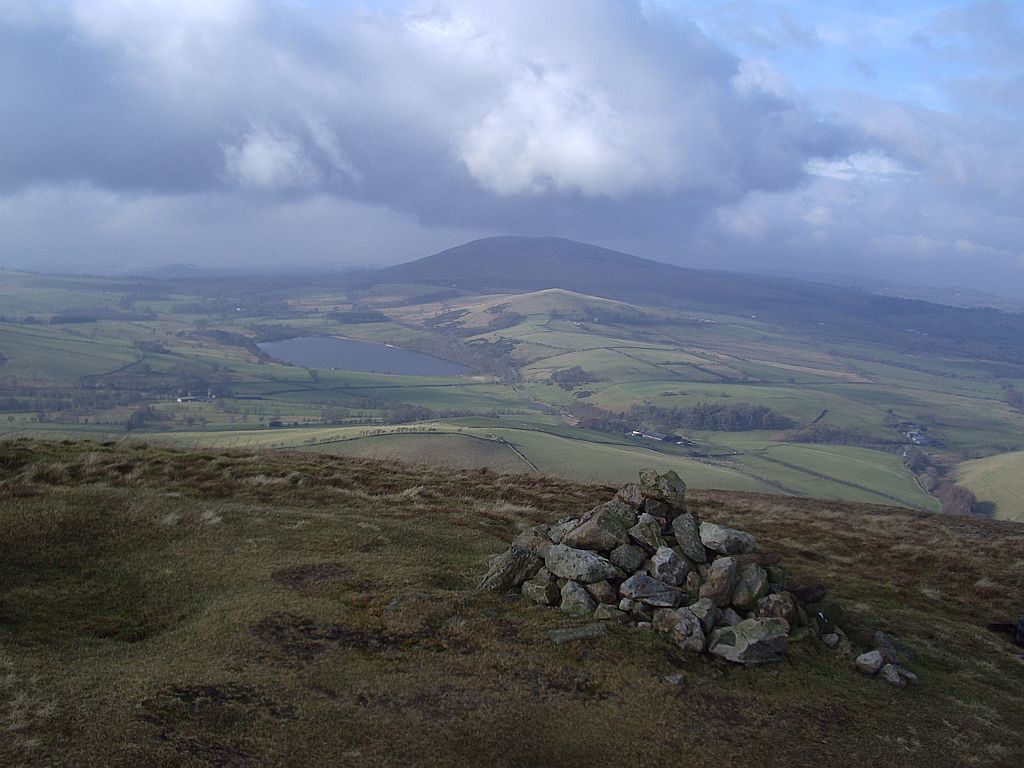
Noticing that a few chasers were just a few fells short of completing a book, I suggested in the WOTA forum that chasers should post the fells they need, which might motivate some activators to go out and activate them. Geoff duly posted, and Longlands Fell was one of the ones he needed. As it is only about 20 minutes drive from here and an easy walk, I thought it would be a good idea to blow away the cobwebs of more than two months of slothful inactivity by activating it. So I did.
Despite an early start (for me) I was lucky to find a place to park at Longlands near the Uldale Common track. The ascent is quite easy up a grass path, but due to the long period of inactivity (and having put on a couple of kilos since Christmas) I had to stop for a breather rather a lot. The photo shows the view from the top with the summit cairn in the foreground, Over Water in the middle distance and the often visited summit of Binsey (LDW-190) in the background. What it doesn’t show was the bitingly cold strong wind which numbed my fingers and made it too difficult to use the 5/8 telescopic antenna.
Despite using a 7in. helical antenna (which tests have shown to perform comparably to a 19in. quarter wave whip and much better than the dummy load supplied with the handheld rig) I made 9 contacts from the summit including the all-important one with Geoff, which is good going from such a summit which is well screened to the south.
I have probably said this too often, but WOTA keeps on getting more and more popular. I’m hearing new chasers all the time – the latest recruit is Steve, M6CDX – and even people who originally said they were getting too decrepit to climb the fells have been heard operating from some of the lower ones. So far this year I have worked 50 different summits and made 72 WOTA contacts from home, not far short of my total for the whole of 2010, and we’re only a bit over half way through the second month. I’m sure others have also noticed the greatly increased activity.
There is great camaraderie among all the participants, too, many of whom feel like old friends even though most of us have never met. I think it is fair to say that the success of WOTA has exceeded my wildest expectations. Combining two of my favourite activities – walking in our wonderful mountains and making contacts on the radio – it doesn’t get much better than this!

Julian Moss, G4ILO, is a regular contributor to AmateurRadio.com and writes from Cumbria, England. Contact him at [email protected].
Catching up on the week (Harwell rally, hands-free and 70MHz FM)
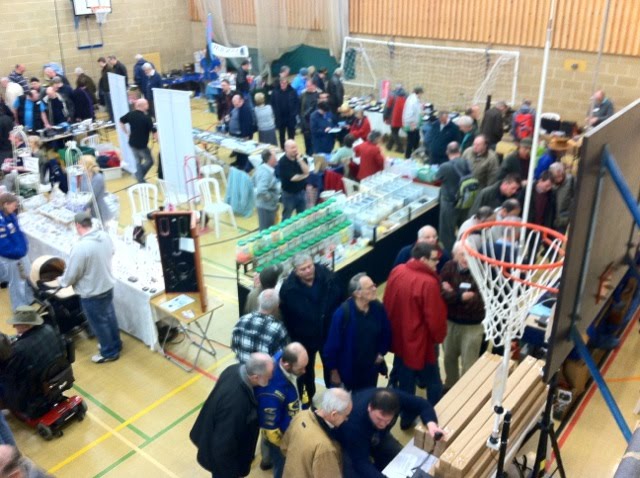
What no blog posts this week? It’s been a busy week with one thing and another and I don’t seem to have got around to it.
Last Sunday I enjoyed going to the Didcot rally. It was well attended – better, I think, than for some years. As far as I was concerned it was a mostly social event and it was good to see a number of friends face to face and have a quick chat. I didn’t spend too much money, but grabbed a 70MHz quarterwave mobile antenna for the car from the Garex stand and an audio lead to help Julie with her presentation about ‘Earthwatch, Cheetah’s and Me (her!)’ which she did for the local WI this week.
Coming back from the rally, I felt my foot go! Just an attack of tendonitis, but it’s been painful through the week and I’ve been avoiding walking which is unlike me!
What else has been happening? I noticed a conversation on Twitter about Digi-interfaces and noted that someone recommended Alan, M0AQC as being a good source of reasonably priced interfaces. His web page has the details. I also noticed that Alan makes hands-free kits. I’d hoped to see one at the Didcot rally but didn’t. I was conscious that if you are operating mobile these days, a hands-free kit is considered essential. I checked with Alan that one of his would work with the FT8900R – he said yes – so one has arrived and been installed.
The unit is a clip on microphone which could go on the sunvisor, although I just clipped it onto my collar to get a better audio level and a switch box with LED which I’ve attached to the dashboard. Reports so far have been good. The only downside is that I’ve lost the ability to scan or change power levels from the program keys on the microphone. No big deal, it’s something I can manage in different ways.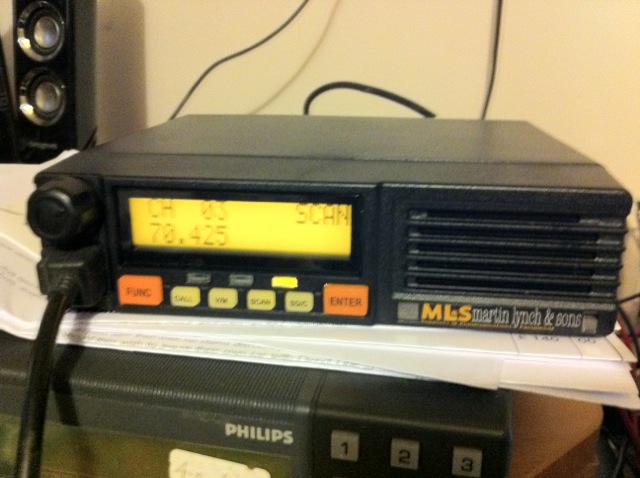
I’ve got a MyDel-5189 70MHz FM mobile rig in to review for Practical Wireless magazine. I’ve got it set up in the shack and it’s been working well. I’ll save the details for the review, BUT – something I immediately enjoyed was the ability to scan various channels on 70MHz. That was something that I’d never done with my Philips FM1000 converted rig.
I wondered if it was possible and after a quick look at the manual for the PA4DEN conversion I was able to store frequencies and scan them. Result!

Tim Kirby, G4VXE, is a regular contributor to AmateurRadio.com and writes from Oxfordshire, England. Contact him at [email protected].
Proud to be in a ’40 top blogs about ham radio’ list
I was a little surprised when I was looking for something just now, to find this blog listed in Satellite Dish’s ’40 top blogs about ham radio’
Just a bit of fun – and it was nice to discover some new and interesting radio blogs by going through the list – equally, there are a couple of my favourite radio blogs which aren’t on the list, so I think I’d better suggest a recount!

Tim Kirby, G4VXE, is a regular contributor to AmateurRadio.com and writes from Oxfordshire, England. Contact him at [email protected].
APRS aggro
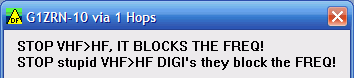
I like to think APRS is a haven from the aggravation often found on the rest of the bands, but unfortunately we have our problems too. This afternoon an APRS message appeared on my screen from G1ZRN-10 that clearly had been addressed to ALL.
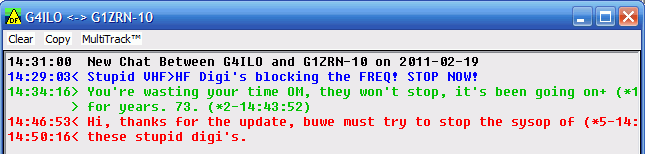
It obviously wasn’t intended for me personally. I don’t gate from one band to another. In fact at the weekend I leave my HF IGate receive-only because I don’t want to add to the mayhem. But there is a lot of traffic gated from VHF to HF by stations in the south of France. It serves no useful purpose for me in the UK to receive information about French repeaters or French radio club meetings nor is there any point in gating position beacons from French VHF stations on to 30m. But what can you do?
I don’t think getting your blood pressure up and acting like a band policeman will solve the problem. Unfortunately the language barrier doesn’t help here. Because of that there are no common forums where European APRS users meet, where an approach could be worked out. A direct approach to the offenders would need to be made by a native speaker who could gauge the individual’s attitude, find out why they are doing this, and tactfully dissuade them from it. Blunt emails in capitals and in English could easily have the opposite of the desired effect.
I think it is one of those things we just have to live with. Actually I’m not sure the effect is really that bad. I’m running just 10W to a magnetic loop in the attic and my beacons are reliably gated throughout most of the day by stations in Germany. When European HF mobiles are about I often gate them, so the network still works. But it would be nice to have a blacklist function in my IGate software so that I can refuse to pass traffic for the offending stations. If everyone did that, it might get them to mend their ways or get off the air.
Some folks have set up an alternative APRS network on 20 metres called Net14. I don’t think that’s the answer. Sure, you get away from the idiotic VHF to HF gateways, but you get away from all the other activity too. I tried it a couple of times and it was even more boring than VHF is here most of the time.
If anyone has any serious suggestions as to how to solve the problem of cross-band gating on 30m I’d be glad to hear them. Or even non-serious ones. Right, I’m off to bid for a GPS-guided missile on eBay!

Julian Moss, G4ILO, is a regular contributor to AmateurRadio.com and writes from Cumbria, England. Contact him at [email protected].
Enough of yahoos
What is it about ham radio that encourages boorish behaviour? Or is it just the internet? Whenever you post in any forum or specialist group suggesting that something about a particular radio is not a very good design and could be improved you will usually get several responses that amount to “I don’t think there is anything wrong, so there can’t be anything wrong.” If you attempt to defend your statement you will eventually end up on the receiving end of insults. Yahoo groups are aptly named it seems.
If you want a VHF radio that can be used simultaneously as an APRS gateway and for voice there aren’t a lot of choices. The Kenwood TM-D710 is really the only option given that Yaesu’s FTM-350 doesn’t have an accessible TNC. Like most radios capable of 50W output the TM-D710 has a fan. Unfortunately Kenwood’s fan logic is dumb. The fan comes on the instant the transmitter starts, no matter how long you transmit for or what the power level, and runs for about two minutes. This means that it runs for two minutes out of ten, triggered by my one second five watt APRS beacons. This is completely unnecessary as no significant heat is generated by such a short transmission. The noise is an annoyance – it’s significantly louder than the computer, or my K3’s fans – but more importantly this must also reduce the working life of the fan unnecessarily. One day the fan will fail when it is needed because of all the times it ran when it wasn’t.
When somebody complained in the Kenwood D710 group about the fan noise because he was using the D710 in his quiet living room, I agreed, saying it was just cheapskate engineering for Kenwood not to have incorporated a thermostatic fan controller. This upset the yahoos. I was told that it was better for the fan to run than for it not to run, that if there was a bad antenna mismatch the fan running in those first few seconds could save the PA transistors, that it was necessary for the fan to run all the time because some users install the radios in tight spaces in vehicles where the temperature reaches over 100 degrees F, that group members had equipment with other fans that were even noisier, and so on. None of which, if true, actually invalidated the argument that a thermostatically controlled fan would be an improvement over the present dumb logic. It was just “It isn’t a problem for me, therefore there is no problem.”
It was also suggested that a thermostatic control would add $10 to $40 to the cost of the radio. I’m not an electronics engineer but I doubt that it would add more than a couple of dollars to the manufacturing cost, which would not make a significant difference to the retail price given these aren’t cheap radios to begin with. Even my power supply, which cost a third the price of the Kenwood, has a thermostatically controlled fan. If Diamond could fit one without making the price of the product uncompetitive I’m sure Kenwood could have done.
Sadly, online groups have ceased to be a place where you can intelligently discuss the strengths and weaknesses of various products due to the activities of the yahoos who will brook no criticism of the thing they have purchased. I could regale you with another recent encounter, this time on the Elecraft reflector, over the stupidity of having the K3 change mode to the one last used on a band when a program sends a change frequency command, overriding the mode set by the program so you may end up in USB in the CW part of the band or vice versa. Needless to say, the Elecraft Way is The One True Way and it is the developers who won’t modify their programs that are wrong, even though by making this one change Elecraft could enable the K3 to work properly with N3FJP and several other programs whose developers won’t change them just to suit Elecraft. In fairness I should point out that Elecraft didn’t refuse to make the suggested change (they didn’t respond to the thread) it was the fanboys who defended the status quo as usual.
Frankly I’m getting tired of engaging with hams over any subject at the moment. So I have decided to unsubscribe from the majority of ham radio groups and will restrict myself to posting my thoughts here in future. I’m sure that will please many people who don’t like seeing points of view they don’t agree with. Commenters to my blog are welcome to disagree, as long as they do so intelligently and politely. Boorish comments that amount to “I don’t agree, therefore you’re wrong” without providing any supporting evidence as to why I might be wrong will be unceremoniously deleted.

Julian Moss, G4ILO, is a regular contributor to AmateurRadio.com and writes from Cumbria, England. Contact him at [email protected].
 Ham Radio Deluxe |
 W5SWL Electronics |
 Ham Radio Prep |
 KB3IFH QSL Cards  Hip Ham Shirts  HamRadioAuctions HamRadioAuctions Reliance Antennas Reliance Antennas Enigma Shop Enigma Shop |  morseDX  Ni4L Antennas  R&L Electronics R&L Electronics antennas.us antennas.us QRV QRV |
- Matt W1MST, Managing Editor
