 |
 Appalachian Trail Dreaming
 13 March 2011 | by
 Now that the snow has melted and ice fishing season is over, I’m looking forward to doing some Summits On The Air (SOTA) operation on the Appalachian Trail (AT). This video I found from Kevin Gallagher beautifully summarizes a six month AT journey into a few minutes and got me thinking about SOTA operation from the trail.


A nuclear disaster
I’m taking a bit of a break from radio. Perhaps it’s because I’m feeling a bit run down or perhaps I’m suffering from radio burnout but at the moment I can’t even be bothered to turn on APRS or WSPR or something that will run even when I’m not there.
I think the events unfolding in Japan may have an influence on my feelings too. We are used to seeing disasters on our TV screens but the scale of this one seems to eclipse anything in living memory. Hobby activity seems frivolous when you consider how the inhabitants of north eastern Japan must be feeling. The floods that hit my own home town seemed devastating at the time and after more than a year many people are still not back in their homes. But by comparison with what has happened in Japan, what happened to us pales into insignificance. It will take many years before life returns to normal for many people there – if it ever can for the tens of thousands who will have lost family members and loved ones in the disaster. My heart goes out to them. It is yet another reminder that the works of man are as nothing compared to the forces of nature.

If the earthquake and tsunami were not bad enough there is also the impending threat of a nuclear disaster. One is eerily reminded of the Chernobyl disaster, the 25th anniversary of which is only just over a month away. Though the nuclear power experts assure us that everything is under control and there is no risk of another Chernobyl, the headlines scrolling across the screen still scream “Meltdown.” This is a disaster that is going to have repercussions across the world, and I’m not talking about the economic shockwaves from such a big blow to the world’s third largest economy though I’m sure we will soon feel them.
The Three Mile Island nuclear incident in 1979 halted the development of nuclear power in the USA for thirty years. It is unrealistic to expect that what is happening to the Japanese nuclear plants won’t have an impact on how people here feel about nuclear power. Engineers have and will continue to argue that the Japanese plants were 40 years old, that actually they coped with the effects of this major disaster pretty well, and that the UK is not in an earthquake zone so we would never experience such problems. But for as long as these images are fresh in people’s minds, nobody will want a nuclear power station in their back yard. And in a country as small and crowded as the UK if we are going to have nuclear power someone will have to.
This is a disaster, not just for Japan, but for the entire nuclear industry.

Julian Moss, G4ILO, is a regular contributor to AmateurRadio.com and writes from Cumbria, England. Contact him at [email protected].
ICQ Podcast S04 E06 – Radio Play Night (13 March 2011)
Series Four Episode Six of the ICQ Podcast has been released. News Stories include :-
- ARISS inspires students to study science
- Humber Fortress DX ARC to activate GB0BB
- Radio amateurs killed by Somali pirates
- RAYNET member gets funding
- IC-9100 transceiver now available for orders
- UK Propagation charts for March 2011
- Microwatt ERP 9 kHz signal copied at 45km
- New look for radio charity
- VHF activity on the increase
Your feedback, Propagation Report from Steve Nichols (G0KYA) and Colin (M6BOY) reviews a Radio Play Night.
Colin Butler, M6BOY, is the host of the ICQ Podcast, a weekly radio show about Amateur Radio. Contact him at [email protected].
ICQ Podcast S04 E06 – Radio Play Night (13 March 2011)
Series Four Episode Six of the ICQ Podcast has been released. News Stories include :-
- ARISS inspires students to study science
- Humber Fortress DX ARC to activate GB0BB
- Radio amateurs killed by Somali pirates
- RAYNET member gets funding
- IC-9100 transceiver now available for orders
- UK Propagation charts for March 2011
- Microwatt ERP 9 kHz signal copied at 45km
- New look for radio charity
- VHF activity on the increase
Your feedback, Propagation Report from Steve Nichols (G0KYA) and Colin (M6BOY) reviews a Radio Play Night.
Colin Butler, M6BOY, is the host of the ICQ Podcast, a weekly radio show about Amateur Radio. Contact him at [email protected].
QSY
It’s been a fun ride in the amateur radio blogosphere these past few years. I’ve had some good discussions with intelligent people and had fun along the way. I shared ideas, some good and some half-baked. I had some folks believing that the LORAN network was being saved by radio amateurs, organs were going to be harvested from radio amateurs for universal healthcare, and the Red Hot Chili Peppers liked to jam on amateur radio. I analyzed, complained, praised, and ranted, and a lot of you listened. Several of you presented alternate points of view that provoked thought and sometimes changed my opinions.
Unfortunately, I find it increasingly difficult to write about topics that are consistent with the original intent of this blog. As I’ve often mentioned, I wanted to do something different from the normal “I did this today” blog. A lot of folks like to do that, and that’s OK. A blog is what you want it to be, it’s your creation. There’s only so much I can write about regarding what’s broken or can be improved in amateur radio, and writing about it doesn’t really do anything to fix it. Often in this online world we amass an audience that agrees with our viewpoints and opinions, and critical topics on blogs tend to preach to the converted. Those who really need to read such topics aren’t reading blogs.
Rather than have this blog go on a life support system with periodic and annoying “I’ve been really busy” posts as many amateur radio blogs have done, I’m retiring The K3NG Report and have launched another site entitled Radio Artisan which will focus on projects and operating events, mainly outdoors. While technically it’s hosted with WordPress and essentially is a blog format, I’m not treating it as blog so I don’t feel an obligation to post regularly or write about the amateur radio crisis du jour.
See you over at Radio Artisan…
Thanks for reading and 73. Dit dit.


Welcome
Welcome to Radio Artisan, and a special shout out to former K3NG Report readers. This is my new creation which will focus on projects and operating activities. Links to projects and “sticky” articles are over on the right. I will generally post articles when some new project page has been created or if there’s an update to an existing one.
A few of the pages are past postings from the K3NG Report. The PIC Keyer is a project that I’ve had published for several years now. My newest creations are the Arduino CW Keyer and the Arduino Computer Rotator Interface / Yaesu Rotator Interface Emulator. Both are being actively developed with new features, but are fully functional.
I’m currently on an Arduino kick as you may be able to tell. I also have in the works a frequency counter which will interface with the CW keyer, and a DDS chip controller which may become the basis for a larger project. I also have in the works an Arduino controlled balanced antenna tuner.
If you have any interests in these projects, please be sure to drop me a line.
73


Happy birthday, ZX81
Thirty years ago today the Sinclair ZX81 was introduced to the world. The world’s first affordable personal computer, it wasn’t in fact the first home computer I had owned. That had been a Nascom 1, a Zilog Z80 based machine with just 1Kb of RAM, which I built from a kit – all 1,400 soldered joints of it, using the same Antex soldering iron I still use today.
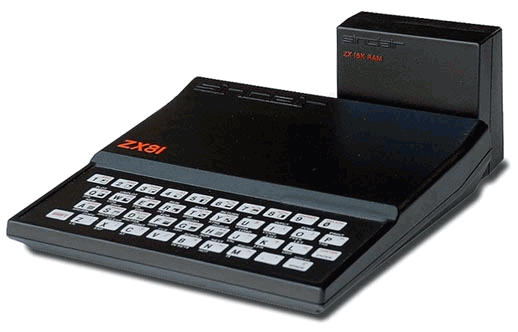
The ZX81 was also offered as a kit as well as a ready built version, so naturally I ordered the kit. I seem to remember it cost £49 – much less than the Nascom. I don’t remember how many soldered joints there were, but there were only four main chips. It was a much easier project to build. The ZX81 also came with just 1Kb of RAM. But unlike the Nascom, it had a built-in BASIC interpreter so you could still do more with that 1Kb and you didn’t have to program it in assembly code.
Innovative design was used to cut the cost of the ZX81. For example, instead of a dedicated display processor the Z80 CPU generated the display. Whenever your program executed, the screen went blank. The screen was an ordinary black and white TV. Programs were loaded and saved using a cheap cassette recorder. That was read and written by the CPU too, which generated wild patterns on the screen while it neglected its display duties. The keyboard was a plastic membrane type. It was horrible to type on.
Later I upgraded the memory to 48Kb using a third party RAM pack (the standard RAM pack sold by Sinclair was only 16Kb.) This, too was built from a kit. Like the Sinclair one, it fixed to the rear of the machine using an edge connector, with no other fixing. Every ZX81 owner is familiar with the term “wobbly RAM pack”. One accidental jolt could interrupt the connection and crash the computer losing all your work. Ah, those were the days!
As a radio ham, I naturally was interested in writing ham radio software for the ZX81. I wrote several programs including a morse tutor, which used a machine code routine for sending the actual code. I think I have written morse tutors for every type of computer I have owned – it’s amazing that I am still so bad at reading the code! An article describing the morse tutor and a memory keyer for the ZX81 was published in Short Wave Magazine and was one of my first published articles.
I can still remember the excitement of home computing in those early days. Today’s PCs, vastly more powerful and capable though they are, just aren’t as interesting. Back then, home computing was very much a hobbyist’s game. We were pioneers. Now everyone and his granny has a computer, and programming has become more or less a job for professionals. I do miss those old days!
Thank you, Clive Sinclair, for bringing us these wonderful toys. Happy 30th birthday, ZX81!

Julian Moss, G4ILO, is a regular contributor to AmateurRadio.com and writes from Cumbria, England. Contact him at [email protected].
 Ham Radio Deluxe |
 W5SWL Electronics |
 Ham Radio Prep |
 KB3IFH QSL Cards  Hip Ham Shirts  HamRadioAuctions HamRadioAuctions Reliance Antennas Reliance Antennas Enigma Shop Enigma Shop |  morseDX  Ni4L Antennas  R&L Electronics R&L Electronics antennas.us antennas.us QRV QRV |
- Matt W1MST, Managing Editor
