 |
 Simple AM transmitters
 3 April 2011 | by
  I had a lot of good response from some bread board based projects in the past. so, here is a neat little AM transmitter I stumbled on Instructables.
It’s simple enough that you may already have most of the spare parts, yet detailed enough to allow you a little room for modification. I like building transmitters like these and sending audio to my old broadcast radios or even amateur receivers like my old Hallicrafters gear.
Want to really freak people out? Build one of these and hook it up to an MP3 player or portable CD Player (not like we have a massive use for these) and use it to stream old time radio. Tons of resources online. it just seems right to listen to classic radio on…… a classic radio. I have an old American Bosh console with great woodwork, classic styling and such. Hooked it up to my MP3 player and listened to the entire broadcast day of CBS on “D Day”. Really kewl! The Shadow hasn’t sounded this cool in quite some time.
Here is a link to the AM transmitter in the photo:
http://www.instructables.com/id/Easy-AM-Transmitter/

Here is a slightly different approach. Lets say you have found a great condition cabinet at a tag sale, but the parts inside are truly destroyed. I, don’t like modifying a restorable gem. But……. If you want, you could take an MP3 player, load it up with your favorite shows and have a great tabletop discussion piece. You can get MP3 players REALLy cheap even at a drug store for ten bucks or so and load quite a bit of audio.
Here is the link for the MP3 player in a classic radio project:
http://www.instructables.com/id/Vintage-Tube-Radio-Restoration-MP3-Upgrade/
Don’t think I left you guys out with some neat radios from the 70′s and such. Especially those radios that came out around the time of the great Sci-fi flicks. Ohhhh, I wish I had one of those vintage Welltrons!!!!!!!!
Below is a neat FM transmitter project. I like this because it gives you a different dimension into the different modes and won’t cost a lot of money to truly learn a lot. This title is called “How to build the simplest FM transmitter”:
http://anarchy.translocal.jp/radio/micro/howtosimplestTX.html
Jonathan Hardy, KB1KIX, is a regular contributor to AmateurRadio.com and writes from Connecticut, USA. Contact him at [email protected].
Getting the plot
A few years ago I read about a program called Radio Mobile which was supposed to be able to plot maps showing your VHF or UHF station coverage using actual terrain data. I downloaded it but couldn’t figure out how to get it to work so I gave up. A few days ago someone mentioned that it is possible to hook the program into an APRS server so I thought that I would try again. I was given a hint that for UK users the G3TVU Quick Start package was the easiest way to get Radio Mobile going.
The default setup is for a location in the Derbyshire Peak District so I followed the instructions on Changing Location to try to create maps centered on G4ILO. I got as far as producing an elevation map but was then baffled by the sentence: “Which can then be ‘Merged/Copy’ with a road map and ‘Kept in new picture’ to produce.”
James VE6SRV came to my assistance with an explanation in English: “On the menu select EDIT then in the drop down menu select MERGE PICTURES… F7. You’ll get a dialog box opened up. It will have a list of various sources on the left, detailed choices about the source in the middle and operation controls on the right.Try picking OSM, and then clicking DRAW. After the merge is complete, you’ll be asked how you want to keep the resulting image, or to discard it. The four options equate to SAVE, SAVE AS, LET ME LOOK AT IT FOR NOW, and TOSS IT. If you chose copy, the OSM tiles will overwrite the relief map. ADD, MULTIPLY, and BITWISE are 3 different methods of merging the shaded relief map with the OSM tiles. Depending upon the colours, and the type of output you want, you’ll need to play a bit with the choices to see how it looks for you. You can also play with contrast and brightness sliders to try and get the output just how you like it.” This was just what I needed, and after a bit of experimentation I soon had a road map of my area merged with the relief map showing the mountains.
The next step was to try to plot the coverage of my station on the map. I believe the default setup had a dummy base, mobile and hand-held station predefined but they were now outside my area and in any case I must have deleted them. Creating a “unit” for my own station was simple enough, but when I selected one of the tools to plot coverage the Draw button was disabled. Eventually I worked out that you have to have at least two stations (“units”) defined and they must both be members of the same network. The program will then plot the coverage for your station as received by a station of the same type as the other one.
I thought the coverage plots were rather optimistic judging by experience so I had to change some of the parameters and choose the “worst case” to get a plot that looked reasonable. This being VHF, it’s possible that the fact of my antenna being located in the attic could result in some degradation of the signal. I felt the default colouring of green for 3dB over noise or better and yellow for 3dB below noise to 3dB above didn’t give a realistic picture so I changed the colouring so that green depicts 10dB or more over noise and yellow shows between 0 and 10dB.
The first plot shows a wide area view:
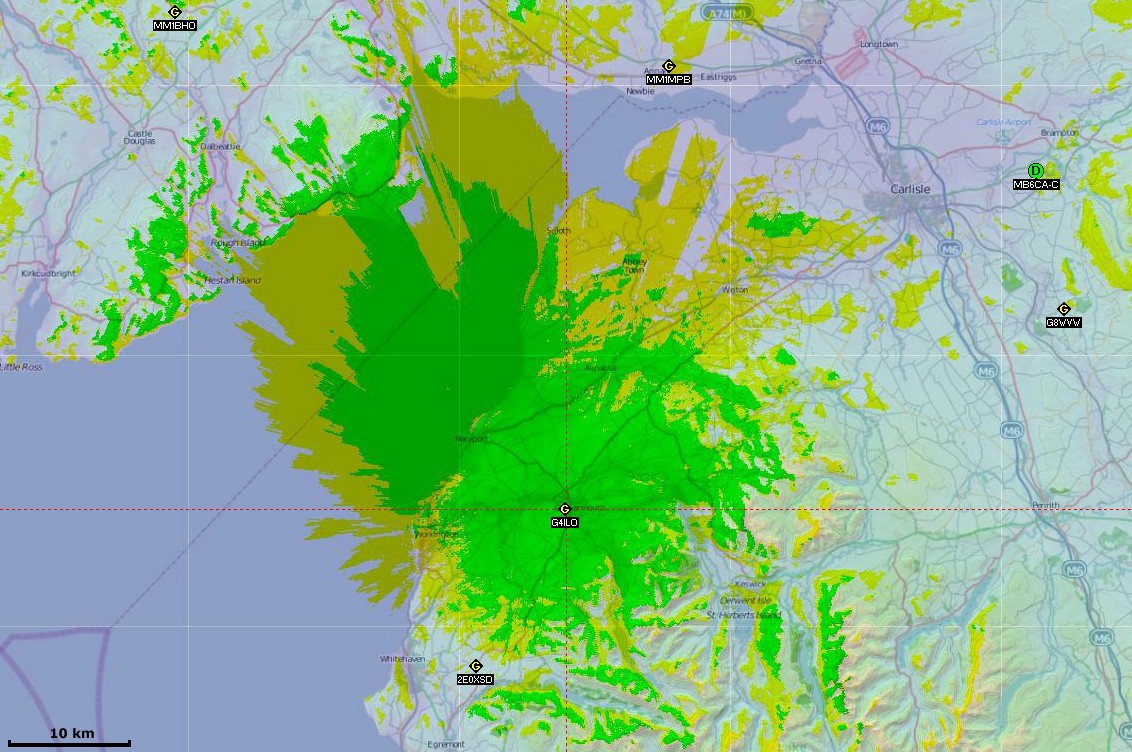
Click to see the map full-sized. I did a second plot at a larger scale to show the local coverage in more detail:

The plot shows really clearly how my VHF range is limited by the surrounding hills.
Connecting Radio Mobile to an APRS server has limited use. The program doesn’t seem to handle objects very well so for example the GB3CA object put out by MM1MPB shows as MM1MPB and moves that station’s position. But it is a useful way to get other local stations into the system instead of manually entering their details.
The objects sent out by WOTA to show the position of a Wainwrights On The Air activation are shown as WOTA not the name of the object. The Radio Link option can be used to plot the path between two stations and estimate the received signal strength, as in this example showing the path between me and Phil G4OBK/P on the summit of Seatallan.
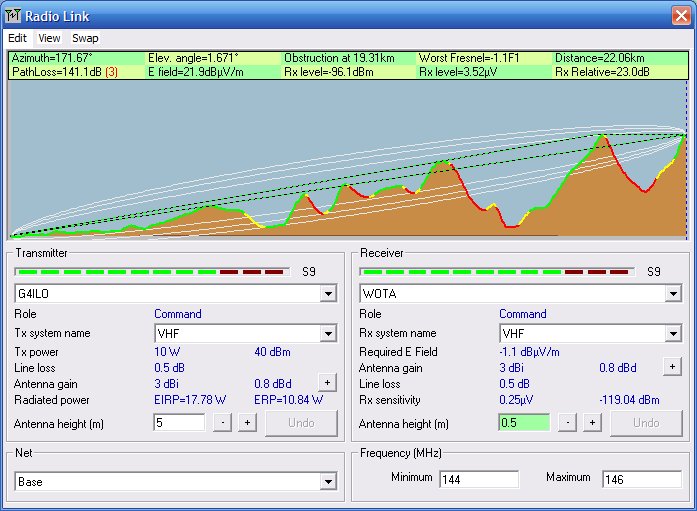
The estimated S9 signal strength is somewhat more than I actually received from Phil and I was running 50W not 10W. As mentioned earlier my antenna gain is also downrated over reality to try to get a more realistic picture.
Radio Mobile is a clever piece of software and it was interesting to play with it. It was quite hard work to get going, but it was useful to see how the nearby hills affect my VHF coverage.

Julian Moss, G4ILO, is a regular contributor to AmateurRadio.com and writes from Cumbria, England. Contact him at [email protected].
Congratulations SV2DCD and ZS6WAB: 70MHz first
Just catching up with the week’s VHF news. Really good to see this video of the first ever 70MHz TEP QSO between Greece and South Africa.They start out on WSJT but stick with the video and you’ll hear them work on SSB.Congratulations to you both!And I wish I could get my FT847 to work *that* well on 70MHz. I’ve seen the receive board advertised on eBay. Interesting that Leo, SV2DCD’s 847 will run about 70W output!

Tim Kirby, G4VXE, is a regular contributor to AmateurRadio.com and writes from Oxfordshire, England. Contact him at [email protected].
Congratulations SV2DCD and ZS6WAB: 70MHz first
Just catching up with the week’s VHF news. Really good to see this video of the first ever 70MHz TEP QSO between Greece and South Africa.They start out on WSJT but stick with the video and you’ll hear them work on SSB.Congratulations to you both!And I wish I could get my FT847 to work *that* well on 70MHz. I’ve seen the receive board advertised on eBay. Interesting that Leo, SV2DCD’s 847 will run about 70W output!
Tim Kirby, G4VXE, is a regular contributor to AmateurRadio.com and writes from Oxfordshire, England. Contact him at [email protected].
10m DX
Ten metres has been open this afternoon. I was alerted to this when someone on the Transmission1 radio forum mentioned that 27MHz was full of Russian taxis. I had a listen and sure enough their FM transmissions were clearly audible well up into the lower end of the amateur 10m band. This is one of the penalties of having CB radios that are easily modifiable for use outside their allowed band, I guess. And there’s no chance of anything being done about it in Russia, the land where the Kalashnikov and the bribe determine the rules.

I switched to SSB and quickly worked A61AM. One of the things I love about 10m is the number of times you hear a DX station, give your call and they come right back. I was not even running full power – 80w is normally all I use. True there were a couple of pileups apparently of pirates using calls that consisted of just two letters 🙂 but I avoided those. By the way, why is it that DX stations so rarely give their own call? Sometimes you have to listen for five minutes to hear it again and verify that you logged it correctly.
Propagation was obviously good into Russia but I also worked Mike, SV5BYR on Rhodes, Barney ZS6TQ, Burhan TA1BX and Norman 5B4AIF. It’s really great to hear 10m opening up, that’s for sure!

Julian Moss, G4ILO, is a regular contributor to AmateurRadio.com and writes from Cumbria, England. Contact him at [email protected].
IC-9100 USB audio issue
No, I haven’t gone and bought an Icom IC-9100. Nor am I planning to. However, through the JT65-HF Google group I learned of an issue that could be a serious annoyance to anyone who owns one of these radios and wishes to use it for digital modes on a computer that runs Windows XP. The issue is that the audio output from the radio is at a fixed level and cannot be altered. I thought it deserved wider publicity, because if I had been thinking of buying an IC-9100 I would have found this out the hard way, and I don’t think many people would be happy at having to buy a new computer to go with their £3000 radio.
The IC-9100 (and the IC-7600) both have USB connections between the rig and the radio. Hailed by many as the way to go (though not by me) this single connection provides both a virtual serial port for rig control and a USB sound device for digital modes. Unfortunately under Windows XP when you select the Icom sound device and open the mixer settings to set the audio level from the radio there is no slider. It is fixed. I’m told there isn’t a control in the radio itself to change the level either.
Most digital mode programs don’t have a level control within the software, they expect you to use the Windows level controls. So if your waterfall is bright yellow because the audio level is too high there is nothing you can do if you own one of these Icom radios (except, presumably, use the good old-fashioned analogue audio connections.)
Progress. Don’t you love it?

Julian Moss, G4ILO, is a regular contributor to AmateurRadio.com and writes from Cumbria, England. Contact him at [email protected].
Death of short wave imminent
Amateur radio as we know it could be extinct by the year 2020. That is the only possible conclusion to draw from an unpublished EU policy document that has been leaked to several ham radio bloggers including myself. The document proposes that existing RFI standards protecting the short wave frequencies be torn up as “preventing the use or increasing the cost of essential technology in order to protect the activities of a small number of hobbyists makes no political sense.” This policy has already been unofficially in place at the UK’s Ofcom, which was one of the major contributors to the report.
The report suggests that withdrawing the standards relating to short wave RFI would save significant costs by removing the need to deal with complaints about interference. It also suggests that the UK Telecommunications Act (and similar laws in other EU countries) be amended to remove any right to protection from interference of the broadcast, amateur or CB services.
To support its recommendations the report claims that “short wave broadcasting is in rapid decline, with most broadcasters moving to the internet” and that “the intended use of Citizens Band as a personal communications service has largely been replaced by cellphone usage.” Amateur radio, it says, carries “little communication of any importance that could not be made using the telephone, cellular network or the internet.” The main use of ham radio, it suggests, is “largely recreational” and could be replaced by “online simulations and VOIP chat services.” Hams could also make more use of the largely interference-free bands above 400MHz which otherwise could be sold to commercial users. Radio amateurs “could still experiment with radio in the time-honoured manner, they just should not expect to be able to enjoy interference-free reception on the short waves.”
The reason for the desire to remove the protection of our frequencies becomes clear when you read the part of the report that describes forthcoming technologies that are expected to cause problems with RFI compliance. In order to meet carbon emissions targets and deal with expected power shortages caused by the early closure of nuclear power plants in countries such as Germany, the EU plans to introduce smart grids in all European nations by 2020. These smart grids use BPL technology to communicate with smart meters in each individual home. The smart meters, in turn, use PLT technology to communicate with smart devices in order to regulate their use. When demand for electricity is high, power cuts or the switching on of expensive standby power stations can be avoided by shutting off inessential devices instead. Examples of inessential devices given in the report include amateur radio linear amplifiers – assuming it’s still possible to hear anything on short wave over the BPL and PLT QRM in the first place.
The EU is also proposing that 80% of properties in member states should be equipped with solar panels by 2020. To achieve this target, installation costs will be heavily subsidized by governments, which clearly want to cut costs as far as possible. Estimates produced by a Chinese manufacturer of solar power systems suggest the cost saving that would result from eliminating the need for RFI suppression circuits in the power converters would amount to 4 billion Euro for the whole of Europe.
The report concludes that “the cost of protecting the short wave spectrum from interference from technologies that are essential to be installed throughout Europe in the next decade to meet emissions targets and maintain the well-being of all European citizens is quite simply prohibitive” and urges that EU Commissioners pass the necessary laws by 1st April 2012.


Julian Moss, G4ILO, is a regular contributor to AmateurRadio.com and writes from Cumbria, England. Contact him at [email protected].
 Ham Radio Deluxe |
 W5SWL Electronics |
 Ham Radio Prep |
 KB3IFH QSL Cards  Hip Ham Shirts  HamRadioAuctions HamRadioAuctions Reliance Antennas Reliance Antennas Enigma Shop Enigma Shop |  morseDX  Ni4L Antennas  R&L Electronics R&L Electronics antennas.us antennas.us QRV QRV |
- Matt W1MST, Managing Editor
