 |
 Handiham World for 13 April 2011
 13 April 2011 | by
 Welcome to Handiham World!

Have you ever participated in a poll or survey about a product or policy?
There are plenty of surveys out there, covering everything from political candidates to laundry soap. They are used to help make decisions about how to best improve and market candidates and products. It would be unthinkable for a company to refuse to poll its customer base about product preferences. By querying the consumers, the company finds out what is working and what is not, so that they can fine tune a product or service and ultimately sell more of it.
Recently my local radio club sent out a survey designed to find out what the club members think is most important in terms of club activities. In all my years of belonging to all sorts of clubs, especially radio clubs, this is the first club I have encountered that conducts such periodic surveys. What a great idea!
Some clubs are focused on a very specific mission and stray very little from a path toward their goal, but most radio clubs at least have some flexibility in their mission and can happily sponsor a variety of activities that might include on the air nets, ARES training and deployment, SKYWARN, classes in amateur radio, hidden transmitter hunts, Field Day, a club repeater, and… Well, you get the idea. Where the survey comes in is when the club has so many ideas for projects that they cannot all reasonably be given enough time and support to be successful. While the club leadership may decide for the entire group, it is always better to gain the confidence and support of the membership in deciding which projects to put at the top of the list and which might be better off tabled until some later date.
A properly designed survey can be a valuable tool to help a club chart its future. It is not going to be enough to simply ask for ideas in an open meeting. Not every member is present at every meeting, and some members may speak more persuasively than others, even though a survey done in private, when each member has a chance to think about what he or she really would prefer the club to do, might be entirely different. Another thing a survey can do is to lay out a variety of choices as well as to solicit original ideas from members. When I looked at the well-designed survey our club sent out, I was reminded of many good and worthy projects that our club has supported over the years. If pressed to remember all of that stuff on my own, I know I would have forgotten many projects, which would have made it more difficult for me to help the club make decisions on what to do. When I wanted to comment on a couple of items, I found comment space available so that I could put my thoughts down in my own words. Our survey asked for members to “rate” each project idea from one to five, based on whether the item was of no importance all the way up to great importance to the member. A couple of entries were blank, allowing each member to add a couple new items in the rate by number list. Although I can see the survey to complete it on paper if I wish, it was nice to see that the survey was available via email in an accessible format. That method also saves printing costs.
I realize that my preferences on the club survey may not be what others want, but I know I had my say and that it is likely at least some of what I like will become club policy. If your radio club seems to be stuck in a rut and lacking in direction, why not suggest that the club conduct a survey to find out what club members would like to do for projects and activities? It is a great way to stimulate thinking and bring out new ideas. Everyone will have more fun and the club and the greater amateur radio community will be the better for it.
For Handiham World, I’m…
Pat Tice[email protected]

Pat Tice, WA0TDA, is the manager of HANDI-HAM and a regular contributor to AmateurRadio.com. Contact him at [email protected].
Ukrainians lose 30m and part of 20m
The Ukrainian government has confirmed new rules for its radio amateurs. Since 11th March 2011 Ukrainian amateurs may no longer use the following frequencies: 10100-10150kHz, 14250-14350kHz, 1240-1300MHz, 2300-2450MHz, 5670-5850MHz, 10-10,1 GHz, 10,15-10,5GHZ, 24,05-24,25GHz,76-77,5 GHz , 78-81GHz, 122.25-123.0 GHz, 134-136 GHz, 136-141GHz, 241-248GHz, 248-250GHz. Note the first two – that is all of 30m and half of the phone portion of 20m the Ukrainians can no longer use!
This is very sad for a country whose amateurs are among the most active on the HF bands. What is the point of denying the use of frequencies that will still be used throughout the world including by Ukraine’s neighbours? If it is intended to give these frequencies to other services (in defiance of ITU frequency allocations) then these services will find them unusable because of activity from elsewhere.
It is crazy. As my Ukrainian-born wife Olga would agree, surely the Ukrainian government has more important things it could be doing than meddling with amateur frequency allocations?
I’m hoping that this is just an April Fool that has got out of hand. I cannot find any information confirming this other than a few forum posts. Certainly someone in Ukraine kept enough of a sense of humour to make this little video about it in English. Hopefully some comments to this post will provide more details.

Julian Moss, G4ILO, is a regular contributor to AmateurRadio.com and writes from Cumbria, England. Contact him at [email protected].
Mapping the grid squares you’ve worked on VHF/UHF
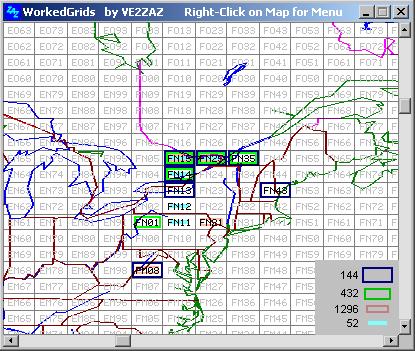 I was playing around in the RSGB’s 432MHz activity contest last night (enjoyable but no-one terribly distant worked) when I saw a tweet go by, from AI4RI, I think, asking if anyone knew any tools for mapping the grid squares that they’ve worked at VHF.I use the Winlog32 logging program, written by Colin, G0CUZ which has some grid mapping capability built in – although it does not overlay the squares onto a map.Another tweet from AI4RI quickly appeared saying that he’d found the WorkedGrids software from VE2ZAZ. I’d seen it mentioned before but not tried it. The software installed quickly and I was able to point it at an ADIF file that Winlog32 had created. If you have a logging program that keeps the log in plain text, ADIF or Cabrillo then you can use WorkedGrids to scan the file automatically and plot your grids on a map. Winlog32 keeps the log in an Access database so I had to create an ADIF export and point WorkedGrids at that.WorkedGrids setup allows you to select which bands you are interested in, I chose 50,70,144 and 432MHz, but you could just as easily select other bands. Having done that, a basic but effective map was displayed, showing the grid squares I’d worked on each band.I seem to remember that DX Atlas by Afreet Software – as used by the FSDXA’s 3B9C expedition some years ago has a similar capability.

Tim Kirby, G4VXE, is a regular contributor to AmateurRadio.com and writes from Oxfordshire, England. Contact him at [email protected].
Mapping the grid squares you’ve worked on VHF/UHF
I was playing around in the RSGB’s 432MHz activity contest last night (enjoyable but no-one terribly distant worked) when I saw a tweet go by, from AI4RI, I think, asking if anyone knew any tools for mapping the grid squares that they’ve worked at VHF.I use the Winlog32 logging program, written by Colin, G0CUZ which has some grid mapping capability built in – although it does not overlay the squares onto a map.Another tweet from AI4RI quickly appeared saying that he’d found the WorkedGrids software from VE2ZAZ. I’d seen it mentioned before but not tried it. The software installed quickly and I was able to point it at an ADIF file that Winlog32 had created. If you have a logging program that keeps the log in plain text, ADIF or Cabrillo then you can use WorkedGrids to scan the file automatically and plot your grids on a map. Winlog32 keeps the log in an Access database so I had to create an ADIF export and point WorkedGrids at that.WorkedGrids setup allows you to select which bands you are interested in, I chose 50,70,144 and 432MHz, but you could just as easily select other bands. Having done that, a basic but effective map was displayed, showing the grid squares I’d worked on each band.I seem to remember that DX Atlas by Afreet Software – as used by the FSDXA’s 3B9C expedition some years ago has a similar capability.
Tim Kirby, G4VXE, is a regular contributor to AmateurRadio.com and writes from Oxfordshire, England. Contact him at [email protected].
UK amateurs have the opportunity to use special callsigns to celebrate the Royal Wedding
UK radio amateurs have the opportunity to apply for a special callsign to mark the occasion of the forthcoming royal wedding.It’s all quite simple. G4VXE would become GR4VXE, GW5NF would become GR5NF, MM3JFM would become MR3JFM and so on. In order to do this, you need to apply, through the RSGB to OFCOM for a Notice of Variation (NoV). The only information you need to provide is your callsign and a contact e-mail address.The special callsigns can be used between 29th April and 9th May 2011.You can read about how to apply and the conditions of the variation hereI’ve applied, so it will be a bit of fun to use GR4VXE for a few days. Who knows, I may even fire up the HF transceiver…

Tim Kirby, G4VXE, is a regular contributor to AmateurRadio.com and writes from Oxfordshire, England. Contact him at [email protected].
UK amateurs have the opportunity to use special callsigns to celebrate the Royal Wedding
UK radio amateurs have the opportunity to apply for a special callsign to mark the occasion of the forthcoming royal wedding.It’s all quite simple. G4VXE would become GR4VXE, GW5NF would become GR5NF, MM3JFM would become MR3JFM and so on. In order to do this, you need to apply, through the RSGB to OFCOM for a Notice of Variation (NoV). The only information you need to provide is your callsign and a contact e-mail address.The special callsigns can be used between 29th April and 9th May 2011.You can read about how to apply and the conditions of the variation hereI’ve applied, so it will be a bit of fun to use GR4VXE for a few days. Who knows, I may even fire up the HF transceiver…
Tim Kirby, G4VXE, is a regular contributor to AmateurRadio.com and writes from Oxfordshire, England. Contact him at [email protected].
Wedding celebrations
The RSGB has negotiated with Ofcom to allow UK radio amateurs to use a special call to celebrate the wedding of H.R.H. Prince William and Catherine Middleton. The call may be used during a period of 11 days from the date of the wedding, 29 April 2011, until 9 May 2011. The call will use the letter “R” after the first letter of the call, replacing the regional designator for Scotland, Ireland, Wales etc. where used. So G4AAA would become GR4AAA, 2E0ABC would become 2R0ABC, GM3ZZZ would be GR3ZZZ and so on.
UK licensed amateurs wishing to use the special call must apply for a Notice of Variation (NoV) to their license. This NoV may only be applied for online using a simple online form and the NoV will be delivered by email. Who says that the RSGB is not progressive?
Personally I will be trying as much as possible to avoid all the ballyhoo over this wedding so I shan’t be applying, but I thought that the information may be of interest.

Julian Moss, G4ILO, is a regular contributor to AmateurRadio.com and writes from Cumbria, England. Contact him at [email protected].
 Ham Radio Deluxe |
 W5SWL Electronics |
 Ham Radio Prep |
 KB3IFH QSL Cards  Hip Ham Shirts  HamRadioAuctions HamRadioAuctions Reliance Antennas Reliance Antennas Enigma Shop Enigma Shop |  morseDX  Ni4L Antennas  R&L Electronics R&L Electronics antennas.us antennas.us QRV QRV |
- Matt W1MST, Managing Editor
