 |
 Station Rearrangement
 3 May 2011 | by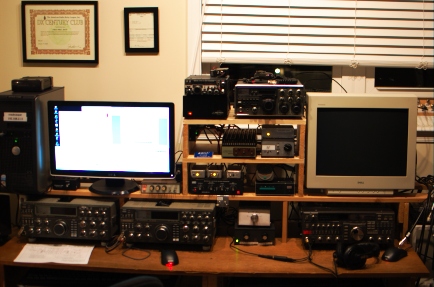
For while, I had three computers stuffed into two operating positions at K8GU and things were just getting out of hand as far as keeping the software updated, the clocks synchronized, and LoTW uploaded—as well as just plain having space on the operating table. So, I moved the venerable sakhalin into backup, spent $18 on USB-to-RS232 adapters and a few hours over the past two weekends reorganizing the operating table.
The new arrangement replaces a monitor with two small shelves (which are designed, I might add, to hold exactly two T2X control boxes). I moved the DC power distribution system to be more centrally located and made room for some accessories that I’ve been meaning to move into arm’s reach.
Software is a different story. I have been test-driving N1MM in VHF contests which are slower-paced than their HF counterparts. As a die-hard TR-Log user, it’s difficult to make the switch. I decided I had to go cold turkey. I am presently trying TR4W, which is a very good clone. However, it does have idiosyncrasies—the biggest of which is the behavior of two-radio mode. When CQing on Radio #1 in TR-Log, ALT-D lets you dupe a station on Radio #2 then hit the SPACE bar to call that station on Radio #2. With TR4W, ALT-D changes the focus to the Radio #2, but does not dump your call in, a step which requires you to hit ENTER. The other small thing is that the delightful emacs key-bindings CTRL-W and CTRL-K do not wipe the present and both (call and exchange) entry fields in TR4W. But, I’m getting the hang of using ESC.
Another thing that will take some getting used to is the fact that if the TR4W window loses focus, I can’t use the CW memories! Fortunately, the paddles are close at hand! For serious operating without sidetone, this won’t work, though. Speaking of paddles, I’ve found that putting the paddles on the keyboard tray and the mouse up on the operating table is actually good as far as keeping mouse usage low. Plus, the paddles remain at a comfortable height for sending. Great arrangement!
Lots of other little projects around the station remain…
Ethan Miller, K8GU, is a regular contributor to AmateurRadio.com and writes from Maryland, USA. Contact him at [email protected].
Win 1,000 Color QSL Cards

AmateurRadio.com is offering a free prize drawing!
Deadline to enter: 9 May 2011 18:00 UTC
Matt Thomas, W1MST, is the managing editor of AmateurRadio.com. Contact him at [email protected].
Two biography books for engineers

The F-117 Nighthawk, designed by the Lockheed ‘Skunkworks’. (Image in public domain from Wikimedia Commons)
I have just finished reading ‘Skunkworks’ by Ben Rich and Leo Janos and it should be one of those books that engineers, students of engineering and those that like technology should read. The book details the secret Lockheed Martin aircraft design branch, set up and run by Kelly Johnson, which became known as the ‘Skunkworks’. Out of this special projects group came the F-104 Starfighter, the U-2 spy plane, the SR-71 Blackbird and the F-117 Nighthawk (also called the stealth fighter), amongst other aircraft. The book starts out with the development of the Nighthawk which was developed by a team led by Ben Rich, who replaced Kelly Johnson as the head of the Skunkworks. After telling that story of the stealth fighter development over the first few chapters it goes back in time to when Ben Rich first joined the special projects unit and how he became involved in the development of some of the most advanced military aircraft of the 20th Century. The book is an exciting insight in to how advanced engineering projects can be run. ’Skunkworks’ was allowed to be free from the usual corporate bureaucracy and therefore it could move quickly in development. There was also a philosophy of using off-the-shelf parts as much as possible, including engines, so reducing delays from manufacturing new parts that would then need to be continued to be produced. Although this philosophy was challenged with the development of the Blackbird which was designed to achieve Mach 3 speeds and so needed to be constructed with large amounts of titanium.
Combining details of how the planes were developed, the challenges and uses of the planes, as well as some insight into management styles and how to obtain multimillion dollar contracts make the book extremely interesting. When you read about the uses of the U-2 in the Cuban Missile Crisis, the shooting down of Gary Powers, and the use of the F-117 in Iraq you can see these aircraft had influencial and important roles in the the Cold War period and beyond. It was also interesting to read about the irony of how a relatively obscure Russian paper on electromagnetic theory lead a young mathematician at the Skunkworks to propose how they could devise an aircraft that was almost invisible to radar.
Check out your library or bookstore to find a copy of ‘Skunkworks’ and read about engineering at its best. To illustrate the performance of the U-2 here is a video from the BBC where presenter James May gets a flight in the two seater version of the U-2. You can see how the U-2 could fly so high it was out of range of fighter jets and missiles (although there is a report of an English Electric Lightning F3 intercepting one at 88,000ft during a NATO excercise in 1984).

Onto the second engineering biography book to read. This is ‘iWoz’ by Steve Wozniak and Gina Smith, which I read a year or two ago and should have written about sooner. This is the story of Steve Wozniak, co-founder of Apple and the real technical brains behind the development of the first Apple computers, including the massively successful Apple II. This is a very personal account, and more like a traditional autobiography than ‘Skunkworks’, but there are some interesting insight into how ‘the Woz’ come come up with the design for computers that effectively started the microcomputer revolution. It is fascinating to read how in high school he collected minicomputer manuals and with the help of catalogues and datasheets of newer components he would redesign the circuitry of those computers to use fewer components. Also interesting is his interest in using components in more than one way on the same board. Here you can see the real engineering genius coming through. Below is a short clip of Wozniak talking about the ‘economy’ of the design of the Apple II at book signing event for ‘iWoz’.
Summer is not far away so chase down one or both of these books for your Summer vacation. Lots of engineering inspiration is contained within the both books.
Alan Steele, VA3STL, is a regular contributor to AmateurRadio.com and writes from Ottawa, Ontario. Contact him at [email protected].
Celebrating the Royal Wedding as GR4VXE
I think I mentioned a few weeks ago that OFCOM had offered us the chance to use a special prefix to celebrate the wedding of Prince William and Kate Middleton (have you noticed how she’s become Catherine recently!). The special call can be used from the date of their wedding, 29th April for 11 days.On the day of the wedding my QSOs were all on 70MHz – but it was nice to catch up with some of the locals as I was using the special call. I was out and about a little from the mobile on both 144MHz and 433MHz too, so fun to use the call there too. Tried a few CQs on 29.600MHz FM, but no luck!Today, I caught a little sporadic E on 50MHz this morning, so worked I0JX and I0WTD from the Rome area. Once again, tried a CQ on 70.200MHz but no luck. Also had a really nice DSTAR QSO with Gordon, G8PNN from Northumberland who I’d not spoken to for years. It was really good to catch up and hear about some of the interesting QSOs that he’s been having recently – including optical ones!This afternoon, after some pleasant 70MHz FM QSOs, I biked over to Windmill Hill taking the FT817 and whip as well as the Icom IC-E92. 28MHz was quite interesting and I was pleased to hear some African DX coming through; ZS1AX, ZS1ACH and a 5R7 (I think) all on phone. Heard a I3 working into Brazil (PP5) on CW and A61Q on 24MHz CW before switching over to VHF/UHF.I called through GB3UK on Cleeve Hill and worked Mike, G4UXC a friend from a long way back. We were licenced around the same sort of time and it was good to work him with the special call. Last but not least, before pedalling back to Longworth was a QSO with John, G4SRE/M in Swindon. John’s a great 70MHz FM enthusiast so we swapped news about the band. John’s a native of South Wales and I’m hoping that I’ll be able to work him on 70MHz FM from a mountain top in Wales at some point! Ought to be able to do it from here…And this evening, I was pleased to work the Camb-Hams expedition to the Isle of Arran, GS3PYE/P on 7MHz – probably my first 7MHz SSB QSO in a couple of years!

Tim Kirby, G4VXE, is a regular contributor to AmateurRadio.com and writes from Oxfordshire, England. Contact him at [email protected].
Celebrating the Royal Wedding as GR4VXE
I think I mentioned a few weeks ago that OFCOM had offered us the chance to use a special prefix to celebrate the wedding of Prince William and Kate Middleton (have you noticed how she’s become Catherine recently!). The special call can be used from the date of their wedding, 29th April for 11 days.On the day of the wedding my QSOs were all on 70MHz – but it was nice to catch up with some of the locals as I was using the special call. I was out and about a little from the mobile on both 144MHz and 433MHz too, so fun to use the call there too. Tried a few CQs on 29.600MHz FM, but no luck!Today, I caught a little sporadic E on 50MHz this morning, so worked I0JX and I0WTD from the Rome area. Once again, tried a CQ on 70.200MHz but no luck. Also had a really nice DSTAR QSO with Gordon, G8PNN from Northumberland who I’d not spoken to for years. It was really good to catch up and hear about some of the interesting QSOs that he’s been having recently – including optical ones!This afternoon, after some pleasant 70MHz FM QSOs, I biked over to Windmill Hill taking the FT817 and whip as well as the Icom IC-E92. 28MHz was quite interesting and I was pleased to hear some African DX coming through; ZS1AX, ZS1ACH and a 5R7 (I think) all on phone. Heard a I3 working into Brazil (PP5) on CW and A61Q on 24MHz CW before switching over to VHF/UHF.I called through GB3UK on Cleeve Hill and worked Mike, G4UXC a friend from a long way back. We were licenced around the same sort of time and it was good to work him with the special call. Last but not least, before pedalling back to Longworth was a QSO with John, G4SRE/M in Swindon. John’s a great 70MHz FM enthusiast so we swapped news about the band. John’s a native of South Wales and I’m hoping that I’ll be able to work him on 70MHz FM from a mountain top in Wales at some point! Ought to be able to do it from here…And this evening, I was pleased to work the Camb-Hams expedition to the Isle of Arran, GS3PYE/P on 7MHz – probably my first 7MHz SSB QSO in a couple of years!
Tim Kirby, G4VXE, is a regular contributor to AmateurRadio.com and writes from Oxfordshire, England. Contact him at [email protected].
Life on 6m
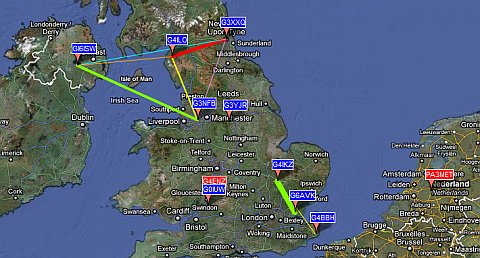
The 6 metre band is showing signs of life, as this map of WSPR activity from this afternoon shows.
However, some of the traces on the WSPR application screen look a bit odd.

I don’t claim to be an expert but I think what I am seeing is the result of doppler shift on the signals being reflected by fast-moving Sporadic-E clouds. In several cases what seems to be a trace has not been decoded.
I’ve said this before, but I wonder if WSPR mode with its 110 second transmit periods and tiny frequency shift encoding is really suitable for detecting Sporadic-E propagation. But no-one has ever commented on this, leaving me to wonder whether they think I’m an idiot who doesn’t know what he is talking about or whether nobody knows.
The digital mode most people seem to use on 6m is JT6M, however this entails using the WSJT program which I find rather confusing. I’m interested in trying JT65A but I’m not sure if it is any more suitable than WSPR for this type of work.
In the absence of any expert advice I’m going to try JT65A using a dial frequency of 50.276MHz. With the JT-Alert accessory to tell me when anyone replies I can leave the rig calling CQ whilst I am otherwise occupied. It will be interesting to see what we can work on 6m with the JT65A mode.

Julian Moss, G4ILO, is a regular contributor to AmateurRadio.com and writes from Cumbria, England. Contact him at [email protected].
Life on 6m
The 6 metre band is showing signs of life, as this map of WSPR activity from this afternoon shows.
However, some of the traces on the WSPR application screen look a bit odd.
I don’t claim to be an expert but I think what I am seeing is the result of doppler shift on the signals being reflected by fast-moving Sporadic-E clouds. In several cases what seems to be a trace has not been decoded.
I’ve said this before, but I wonder if WSPR mode with its 110 second transmit periods and tiny frequency shift encoding is really suitable for detecting Sporadic-E propagation. But no-one has ever commented on this, leaving me to wonder whether they think I’m an idiot who doesn’t know what he is talking about or whether nobody knows.
The digital mode most people seem to use on 6m is JT6M, however this entails using the WSJT program which I find rather confusing. I’m interested in trying JT65A but I’m not sure if it is any more suitable than WSPR for this type of work.
In the absence of any expert advice I’m going to try JT65A using a dial frequency of 50.276MHz. With the JT-Alert accessory to tell me when anyone replies I can leave the rig calling CQ whilst I am otherwise occupied. It will be interesting to see what we can work on 6m with the JT65A mode.
Julian Moss, G4ILO, is a regular contributor to AmateurRadio.com and writes from Cumbria, England. Contact him at [email protected].
 Ham Radio Deluxe |
 W5SWL Electronics |
 Ham Radio Prep |
 KB3IFH QSL Cards  Hip Ham Shirts  HamRadioAuctions HamRadioAuctions Reliance Antennas Reliance Antennas Enigma Shop Enigma Shop |  morseDX  Ni4L Antennas  R&L Electronics R&L Electronics antennas.us antennas.us QRV QRV |
- Matt W1MST, Managing Editor
