 |
 More on IC-290A disappearing display
 6 May 2011 | by
 See original post here. Convinced that I had it working, I put the IC-290A aside and worked on some other projects. But, when I came back to it a few weeks later, the display was still disappearing. So, armed with the schematic and the block diagram, I began narrowing it down.
The display digits and tuning A/D converter are both driven off the same bus. But, since the disappearance of the display did not bring loss of receive, that gave me some confidence that it was not affecting the synthesizer. In order to simplify the analysis, I elected to assume that it was a single component (almost certainly a cold solder joint or an electrolytic capacitor) at fault.
Another clue was that the VFO dial ceased to operate once the display started acting up. Taking the single-point-of-failure assumption into account, this strongly implicated the microprocessor on the LOGIC board as a starting point. The only suspicious device that I could find on the schematic was C9, a 1000-uF, 6.3-volt electrolytic capacitor on the Vcc line of the microprocessor. So, I replaced it with a similar value unit from my junk box.
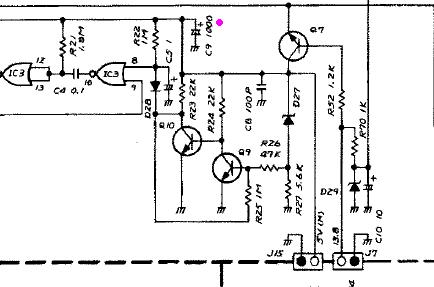
And, the radio seems to be working…for now. I did park it on WA1ZMS/B overnight and it is still running.
Ethan Miller, K8GU, is a regular contributor to AmateurRadio.com and writes from Maryland, USA. Contact him at [email protected].
Iowa High Altitude Balloon Launch #4
The iHAB-4 launch last Saturday was oddly enough close enough to my QTH (51 miles away– in Oxford, IA just east of Iowa City, IA) to justify taking the kids to. It also happened to be sponsored by the Marion Home School Assistance program (Marion, IA) that my children happened to be open enrolled in. Yes, on top of everything else (having four, young, non-genetically related South Korean adoptees) we homeschool our children.
This was a great way of trying to interest kids in Amateur Radio. I’ve been taking my oldest two boys (9 and 10) to a Technician Class with the hopes that eventually between that class and me teaching them the material that at least one of them would get a Technician license. Yes, they are a little young, but I think they could do it. (After all, they are homeschooled.) Unfortunately, they have been very antsy.. I think I will get at least one to pass.. but maybe that will take months more.. maybe years more?
They like hamfests… but they LOVED this launch…
It is difficult to keep kids interested in DXing, Contesting, building antennas, etc. But launching a balloon is a different story.
This should remind us all that Amateur Radio is a very diverse hobby with many aspects. Marshall Dias, W0OTM of Ottumwa, IA I believe became a ham to fly the types of communications payloads that he does fly on the iHAB missions.
You can see what this leads to:

Serious hardware for the balloon experiments
And, you can see a “Serious ham’s” equipment inside of the trailer:

Inside of the iHAB Communications Trailer
Of course, the payload boxes are even more interesting than the trailer. Again, this shows how serious even this unusual aspect of the hobby can be technically!

iHAB-4 Top most payload - APRS 2m Beacon and 20m CW Beacon
As you can tell, Marshall W0OTM is an extremely positive guy and one could genuinely tell he enjoyed the involvement of the children. My kids, with the important task of keeping the payload boxes from blowing away in the 25 MPH (with gusts over 30) Iowa nasty spring winds we thrilled to have the task.
The picture above showed my 9 year old son helping steady the top payload from blowing away.. the picture below shows my 10 year old (yes he’s shorter and smaller) doing the same with the bottom payload. One of the experiments on this launch were separating the two payloads and running the antennas vertical between the two payloads. It was probably a success on 20m, but it proved to be a bad idea on the parrot repeater (and maybe the APRS?) because when the balloon was above about 10,000 ft. the stations on the ground in Iowa were in the antennas deep null!

The payloads are a clever version of simple technology: Here is an example:

iHAB-4 20m CW Beacon inside the payload box
The equipment inside the payload is decidedly low-tech. I actually decided to show the 20m beacon as it is probably the most custom piece of hardware in the whole balloon. The repeaters and APRS transmitters are literally Alinco small Handi-Talkies.
Marshall is not an electrical engineer. He’s willing to fly payloads that the ham community provides. (So build something for him!) Personally, if I had time (which I don’t) I’d like to do a SDR ARISSat-1 style linear transponder with the APRS beacon as the transponder beacon. Marshall also said that he has most or all of the equipment to do a crossband FM repeater. But he believes the “parrot” repeater is more accessible to hams. I think it’s rather awkward to operate through. Maybe the community can convince him not to fear 70cm. I worked the parrot repeater with a $99 TYT dual band HT. Dual band FM rigs are cheap now!
The main point, though is the science and the “WOW!” factor of the event for the kids. Actually the iHAB-4 launch was probably the least technically successful launches that he did– really.. almost nothing on it worked fully correctly! But the specific involvement of the children on this launch made the event really special. Marshall, W0OTM should be lauded for his willingness to cooperate with the homeschool assistance program and his utter excitement and positive energy was an inspiration to my kids– and all of the kids at the event.
He also reminded me, now 25 years into the hobby and — even though I am only 42 years old– I am definitely a curmudgeon and a OF… the excitement I had early in my ham radio experience. I suppose I need to try to recapture some of that.
The event was covered by the local newspaper (the Cedar Rapids Gazette) and their associated TV station KCRG-TV (Channel 9) in Cedar Rapids. So there was very good positive advertising for the hobby with this event.
KCRG-TV 9 report on iHAB-4 launch — video on You Tube
Yes, my children and I seriously get our 15 seconds of fame here.
There are a lot of primary source info about this event on the http://www.ihabproject.com website at the following link: http://www.ihabproject.com/iHAB-4/
Of course who are these goofy people posed by the fully inflated and ready to go:

The Motley Balloon Observation crewe
4/6 of the Spinner clan. My youngest son and my wife stayed home to be the remote “mission control” for us!
Fred Spinner, WØFMS, is a regular contributor to AmateurRadio.com and writes from Iowa, USA. Contact him at [email protected].
Baofeng in my shirt pocket
Only a few days after I had ordered the little Jin Ma Tong JMT-227 145MHz transceiver from China, news began to appear of a new miniature Chinese transceiver from Vero Telecom called the UV-3R which was a dual band (136-174 and 400-470MHz) transceiver. Eventually these began to appear from eBay sellers under the Chinese brand name Baofeng. The price was an astonishing £25 plus postage from Hong Kong. I ordered one from the seller hk360radio and it arrived in just over a week.

The Baofeng UV-3R comes in a colourfully printed box. Together with the radio the box contains the battery (Li-ion 3.7V 1500mAH), a charger with two-pin socket and adapter for UK mains sockets, two antennas (one for VHF and one for UHF), an earpiece/microphone similar to a mobile phone hands-free kit and a manual written completely in mostly pretty good English. There is also a blue carrying strap carrying the seller’s name which is so cheap and nasty it is unlikely anyone would use it.
Not mentioned in the manual’s list of included accessories but also supplied was a cradle that can hold the radio while charging the battery externally. Why you should wish to do this when you can charge the battery installed in the radio I have no idea. There are no charging contacts on the radio, you have to charge it by inserting the small barrel connector into the socket in the side or by taking the battery out. There is also a short cable with one of these barrel connectors on each end, the purpose of which no-one figured out yet.
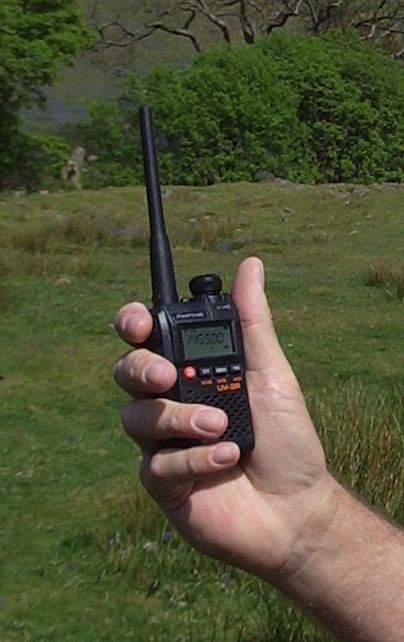
The UV-3R makes the JMT-227 look a quality product. This is the first new electronic product I’ve had that didn’t come with a peel-off protective film over the display. The plastic casing is extremely thin and the plastic belt clip that can optionally be attached looks as if it would easily break. To be fair, the flimsiness of the Baofeng may not be due to cheapness but to save weight. The radio is extremely small and very light, just 125 grams (5 oz) with battery inserted and antenna attached.
The provision of two separate antennas for VHF and UHF may be a cost saving measure or it may be for efficiency reasons (a single band antenna is usually more efficient.) However it is not convenient for a user who wishes to make regular use of both bands. The antenna connector is an SMA female, as used by all the Japanese ham radio manufacturers. Frequent changing of the antenna will result in wear of the connector and ultimately a poor contact as the centre pin of the antenna rotates in the socket. Some eBay sellers are now supplying this radio with a single, dual-band antenna. This is something to look out for when buying.
I had originally intended fitting an SMA to BNC adapter to the Baofeng as I have with all my other handheld radios but the UV-3R is so small and light that it seems inappropriate. I doubt that the radio is ruggedly enough constructed to take the stress of using one of the larger BNC antennas in any case.
Confusingly, the rotary switch on top of the radio must be pulled up before it can be rotated. Once you have realized that, the UV-3R is easy to use and easy to program the simplex channels and local repeaters into the memories by hand. There is free programming software available on the web. Programming cables are becoming available to buy on eBay but it isn’t necessary to use the software, unlike with early models of the UV-3R which had very limited menus that did not allow the changing of things like step size or power level except through the programming software. (This is something to bear in mind if considering buying a used one.)
But this radio is evolving rapidly. The manual that came with mine describes 12 different menu settings but the radio actually has 18. Every setting you would want to change can now be set through the keypad. The settings are also stored in the memories – even the selected power level, so that I can have the radio use low power whenever I use it to communicate with my Echolink node. Perfect!
The one thing it does not seem to be possible to do without the software is to program cross-band splits, such as listen on UHF and transmit on VHF. This could be useful for working FM satellites. But I am not very bothered about this.
All the usual RX and TX tones are supported for repeater access. A 1750Hz tone burst is generated by pressing PTT + VOL. The radio also receives Band 2 FM. The quality is not very good, but on the plus side FM reception is interrupted if a signal is received on the currently selected amateur frequency.

The performance of the little radio seemed to be well within spec. On a fully charged battery the output power on 2m was 3W on my QRP power meter. On low power it was 400mW. The sensitivity is also excellent. The box and some advertisements claim the UV-3R uses DSP. As no schematic is available I have no idea. All I can say is that the received audio is very clear and pleasant and that the signal to noise ratio receiving a distant repeater on the UV-3R with its short VHF antenna was better than on the Kenwood TH-D72 with its dual band antenna standing in the same place.
Newer versions of the UV-3R including this one now have an S-meter on receive, though it works in coarse steps. I also checked the strong signal handling performance of the receiver the same way I did recently with my other hand-held transceivers. It was on a par with the VX-8GR and the JMT-227, at the poor end of the spectrum.
The transmitted audio is very good, if slightly lower in level than some of the ham rigs. One local said my audio sounded “just like my normal audio.” The LED on the front of the radio is supposed to glow red on transmit and green when a signal is received. Mine does not glow red, although the S-meter goes full scale to indicate power out. This appears to be a fault, but not one worth sending the radio back to Hong Kong to fix. However, this perhaps tells us something about the level of quality control you can expect for this price.
I have recorded an audio sample off-air, together with one of the Kenwood TH-D72 for comparison:
The earpiece/hands-free mic supplied with the radio is not useful. I had some trouble with the audio but the main problem is that after you press PTT the radio locks in transmit. This appears to be due to RF feedback into the earpiece/mic cable as it doesn’t happen on the low power setting.
Using the supplied VHF antenna I can access from indoors a repeater 50 miles away. Not bad for such a tiny radio running 2 – 3 watts. Several people who have bought the UV-3R have commented favourably on the performance of the supplied single-band antennas. I tested the VHF antenna and found an extremely sharp response curve with a perfect 1:1 SWR at about 143.5MHz. At 145MHz the SWR was 1.5:1. The antenna has a high Q which no doubt accounts for its surprisingly good performance for its size. It’s a pity the resonant point isn’t exactly on 145MHz but that would be difficult to achieve with a mass produced antenna.
It isn’t perfect, but all in all I am pleased with the tiny little Baofeng UV-3R – for the price. However there are indications that where quality is concerned you are getting what you pay for. If I was a UK dealer thinking of importing a batch to sell I’d think twice. I think fussy British consumers would send quite a few back because of niggling faults like the non-working TX indicator or the problem with the headset/mic. But if you don’t mind taking a bit of a gamble on buying a radio from Hong Kong then the UV-3R would be a good bet for £25.

Julian Moss, G4ILO, is a regular contributor to AmateurRadio.com and writes from Cumbria, England. Contact him at [email protected].
Accept credit cards and sell more at hamfests with free credit card reader

A new electronic payment processing company called Square, named after the shape of their credit card reader that plugs into the audio jack of your smartphone, makes it possible for hams to inexpensively accept credit cards at hamfests. They charge a flat 2.75% of the transaction, but there is no per transaction fee, monthly fee, or equipment to buy or rent.
It’s brilliantly simple. Download and install the free app for iPhone, iPad or Android. Attach the reader to the audio jack of your phone. Enter the amount of the transaction on the screen, swipe the card, and have them sign on the touchscreen with their finger. Done. That’s it.
I think it’s a no-brainer. Apparently, so does Visa who made a “strategic investment” in the company just last week.
Here is a video demonstration:
Why is this great news for small-time sellers at ham radio swapmeets? Until now, it’s been prohibitively expensive and somewhat complicated for occasional sellers to setup for credit card processing. Anyone who has tried to price it out knows the drill: statement fees, gateway fees, transaction fees, and on and on. You simply had to do a certain amount of business each and every month to make even having the capability of accepting credit cards worthwhile. With Square, there is no transaction fee or monthly charge of any kind.
Without fail, it seems that I always run out of cash just about the time I spot a great deal on a piece of gear. The seller could accept a personal check, but if we’re talking about a pricey item then that’s a pretty risky proposition. They could use one of those “knuckle buster” card imprinters, but with those there is no real-time authorization and by the time you realize there is a problem a crook could be long gone. With Square, lack of available funds isn’t an issue. You’ll know if there is a problem right away.
Some people might balk at paying $13.75 in fees to sell a $500 radio. Compared to cash, it does cost more. But, think of it this way: accepting credit cards will give you access to a much wider selection of buyers. You’ll likely get a better price for your radio gear making the fee irrelevant.
Sign up for an account on their website and they’ll FedEx you a free credit card reader.
Editor’s note:
Some reader comments have expressed concern about chargebacks. Here is the relevant info from their website:
How Square protects you from disputes
One part of building any payment service is dealing with cardholder disputes. As with everything else at Square, we strive to make dealing with these as simple as possible and we’ll certainly never charge you for it. Read below for a guide on how this works.
- If one of your customers sees a charge they don’t recognize on their statement, they can call the toll-free number in the payment details that goes straight to us. We have all the information needed to look up the payment and help them get a better idea of what was sold. If we can’t find enough information about the purchase in your account, we’ll reach out to you and ask for more details so we can let your customer know.
- Sometimes, the customer may go straight to their bank before calling the number and dispute the charge. If that happens, we’ll get a letter from the customer’s bank telling us that this payment is in dispute. We will then contact you to gather more information so we can provide the issuing bank as many details as possible to get it resolved successfully.
Some of the information we can provide in order to resolve disputes are:
- Customer’s signature
- Description on what was sold
- Precise location data
- Whether the reader was used for the payment or not
Because descriptions help describe purchases to customers, we always recommend our users add a description for the item or service sold as well as issue receipts. Also, make sure that your Account page accurately represents your business name. A customer may not remember the charge if it reads “Joe Smith” instead of “Joe’s Coffee Shop.”
(via KB2MOB @ AmiZed Studios)
Matt Thomas, W1MST, is the managing editor of AmateurRadio.com. Contact him at [email protected].
Handiham World for 04 May 2011
Welcome to Handiham World!
It’s May, and for many amateur radio clubs, the end of the regular meeting schedule. The summertime months are filled with other activities, and ham radio meetings are not really right up there on our list of priorities. When the weather finally gets nice, we want to head outdoors and forget about meetings.
That said, it does not mean that amateur radio disappears in the summertime. Consider the following ham radio highlights:
 | May and June are the traditional months when the six meter band perks up and band openings make it a lot easier to collect 6 meter QSOs toward “WAS”, or “Worked All States”. Listen on 50.125 MHz USB. Wikipedia tells us more: The 6-meter band is a portion of the VHF radio spectrum allocated to amateur radio use. Although located in the lower portion of the VHF band, it nonetheless occasionally displays propagation mechanisms characteristic of the HF bands. This normally occurs close to sunspot maximum, when solar activity increases ionization levels in the upper atmosphere. During the last sunspot peak of 2005, worldwide 6-meter propagation occurred making 6-meter communications as good as or in some instances and locations, better than HF frequencies. The prevalence of HF characteristics on this VHF band has inspired amateur operators to dub it the “magic band”. In the northern hemisphere, activity peaks from May through early August, when regular sporadic E propagation enables long-distance contacts spanning up to 2,500 kilometers (1,600 mi) for single-hop propagation. Multiple-hop sporadic E propagation allows intercontinental communications at distances of up to 10,000 kilometers (6,200 mi). In the southern hemisphere, sporadic E propagation is most common from November through early February. Read the entire article on Wikipedia; just search for “6-meter band”. |
| Dayton Hamvention® is in May, and will attract tens of thousands. Get details on Hamvention.org. This year’s show is May 20-22. The summer may bring other shows and fests, or perhaps ham radio flea markets near you! |
| ARRL Field Day is the last full weekend in June, which turns out to be the 25th and 26th this year. There will be many clubs, small groups, and individuals participating. Find a club or group with Field Day goals that fit your own idea of having fun, and go for it! You can always run your own single op station if you have an independent streak. |
| Ducting and Sporadic E propagation can come and go all summer long, and are usually surprising when they pop up unexpectedly. You may hear a two meter repeater from hundreds of miles away, or even farther. Communications beyond the line of sight are possible. |
| Public service events like parades and races are common in the summer months. They may provide opportunities for you and your radio club to provide volunteer communications. |
| Summer ham radio events like hidden transmitter hunts can combine being out of doors with ham radio direction finding fun. |
| Radio Camp! It’s August 8 through 23. Even if you can’t attend camp yourself, you can work us on the air and get a QSL card. |
| Vacation time? Take ham radio along. If you are taking a road trip, learn to use the tone search feature in your radio so that you will be able to find the repeater subaudible tones. The ARRL Repeater Directory is a must, too. |
| Skywarn! ARES®! The hot, humid summer days bring those dew points into the danger range and severe weather is a real possibility. Generally the severe weather season begins in the southern United States in the Spring and migrates northward, reaching the northern states in late Spring and early summer. Severe weather or other emergency situations can happen anytime, though. Amateur radio operators can make the difference in providing vital communications services. |
| Antenna projects: The best time is in the summer, not during a sleet storm in November or a blizzard in January. Get those antenna projects out of the way when the gettin’ is easy! |
| Back indoors… Yes, there will be some days when it is hot and humid outdoors, or raining buckets. Might as well get the ham shack cleaned up or work on a kit or other building project. |
| Those lazy days on the deck or patio? Spend at least part of them studying for your license upgrade. You folks studying for General will have to test using the old pool before July 1. |

With all the potential ham radio stuff going on in the summertime, who needs radio club meetings? Take some notes on the things you do all summer and you can give a report at your September radio club meeting: “What I did on my summer vacation.”
For Handiham World, I’m…
Pat Tice
[email protected]
Troubleshooting 101: Technology and obsolete media – some further thoughts.

Last week we posed this dilemma:
Help! My old computer died – and it really wasn’t that much of a surprise, since it was nearly 10 years old and didn’t really owe me anything. I love my new, faster replacement machine, but recently I decided that I needed to set up the memories in my trusty HT, and two things were pretty much deal-killers:
- My rig software was installed on the old machine, which is now dead, and the original installation disk is a 3.5″ floppy. My new machine doesn’t have a floppy drive!
- The interface cable that came with the rig uses a DB-9 serial interface, but my new machine doesn’t have one of those, either.
What can I do?
Several of you wrote to remind us that USB sticks are really coming down in price and going up in storage capacity. They make good substitutes for old media like floppy discs and can easily substitute for compact discs or DVDs when you are using netbook computers that don’t have DVD/CD drives. In addition, you can buy USB extension cables and “hubs” that add multiple USB jacks in case you have more USB devices than jacks to plug them into. USB stands for “universal serial bus”, and this type of serial port has overtaken the less-versatile DB-9 serial jack on many new machines. Universal means that there are technical standards applied across a broad range of uses for USB cables. You can get USB to DB-9 converters.
Our readers are correct – those little USB storage sticks are a substitute for traditional disc media. But there are some potential “gotchas”:
| Easy to lose because of small size, which can result in data loss with possible security and privacy implications. |
| Hard to label because of small size. |
| Because they stick out of the side of a laptop computer, they are easily bumped and that can result in the computer’s USB jack being damaged. |
| Prone to damage (such as going through the washing machine because of being forgotten in a pocket.) |
| The computer will attempt to reinstall drivers for the USB storage device if you plug it into different USB ports. This isn’t a big deal, but it can be annoying. |

Pat Tice, WA0TDA, is the manager of HANDI-HAM and a regular contributor to AmateurRadio.com. Contact him at [email protected].
Handiham World for 04 May 2011
Welcome to Handiham World!
It’s May, and for many amateur radio clubs, the end of the regular meeting schedule. The summertime months are filled with other activities, and ham radio meetings are not really right up there on our list of priorities. When the weather finally gets nice, we want to head outdoors and forget about meetings.
That said, it does not mean that amateur radio disappears in the summertime. Consider the following ham radio highlights:
| May and June are the traditional months when the six meter band perks up and band openings make it a lot easier to collect 6 meter QSOs toward “WAS”, or “Worked All States”. Listen on 50.125 MHz USB. Wikipedia tells us more: The 6-meter band is a portion of the VHF radio spectrum allocated to amateur radio use. Although located in the lower portion of the VHF band, it nonetheless occasionally displays propagation mechanisms characteristic of the HF bands. This normally occurs close to sunspot maximum, when solar activity increases ionization levels in the upper atmosphere. During the last sunspot peak of 2005, worldwide 6-meter propagation occurred making 6-meter communications as good as or in some instances and locations, better than HF frequencies. The prevalence of HF characteristics on this VHF band has inspired amateur operators to dub it the “magic band”. In the northern hemisphere, activity peaks from May through early August, when regular sporadic E propagation enables long-distance contacts spanning up to 2,500 kilometers (1,600 mi) for single-hop propagation. Multiple-hop sporadic E propagation allows intercontinental communications at distances of up to 10,000 kilometers (6,200 mi). In the southern hemisphere, sporadic E propagation is most common from November through early February. Read the entire article on Wikipedia; just search for “6-meter band”. |
| Dayton Hamvention® is in May, and will attract tens of thousands. Get details on Hamvention.org. This year’s show is May 20-22. The summer may bring other shows and fests, or perhaps ham radio flea markets near you! |
| ARRL Field Day is the last full weekend in June, which turns out to be the 25th and 26th this year. There will be many clubs, small groups, and individuals participating. Find a club or group with Field Day goals that fit your own idea of having fun, and go for it! You can always run your own single op station if you have an independent streak. |
| Ducting and Sporadic E propagation can come and go all summer long, and are usually surprising when they pop up unexpectedly. You may hear a two meter repeater from hundreds of miles away, or even farther. Communications beyond the line of sight are possible. |
| Public service events like parades and races are common in the summer months. They may provide opportunities for you and your radio club to provide volunteer communications. |
| Summer ham radio events like hidden transmitter hunts can combine being out of doors with ham radio direction finding fun. |
| Radio Camp! It’s August 8 through 23. Even if you can’t attend camp yourself, you can work us on the air and get a QSL card. |
| Vacation time? Take ham radio along. If you are taking a road trip, learn to use the tone search feature in your radio so that you will be able to find the repeater subaudible tones. The ARRL Repeater Directory is a must, too. |
| Skywarn! ARES®! The hot, humid summer days bring those dew points into the danger range and severe weather is a real possibility. Generally the severe weather season begins in the southern United States in the Spring and migrates northward, reaching the northern states in late Spring and early summer. Severe weather or other emergency situations can happen anytime, though. Amateur radio operators can make the difference in providing vital communications services. |
| Antenna projects: The best time is in the summer, not during a sleet storm in November or a blizzard in January. Get those antenna projects out of the way when the gettin’ is easy! |
| Back indoors… Yes, there will be some days when it is hot and humid outdoors, or raining buckets. Might as well get the ham shack cleaned up or work on a kit or other building project. |
| Those lazy days on the deck or patio? Spend at least part of them studying for your license upgrade. You folks studying for General will have to test using the old pool before July 1. |
With all the potential ham radio stuff going on in the summertime, who needs radio club meetings? Take some notes on the things you do all summer and you can give a report at your September radio club meeting: “What I did on my summer vacation.”
For Handiham World, I’m…
Pat Tice[email protected]
Troubleshooting 101: Technology and obsolete media – some further thoughts.
Last week we posed this dilemma:
Help! My old computer died – and it really wasn’t that much of a surprise, since it was nearly 10 years old and didn’t really owe me anything. I love my new, faster replacement machine, but recently I decided that I needed to set up the memories in my trusty HT, and two things were pretty much deal-killers:
- My rig software was installed on the old machine, which is now dead, and the original installation disk is a 3.5″ floppy. My new machine doesn’t have a floppy drive!
- The interface cable that came with the rig uses a DB-9 serial interface, but my new machine doesn’t have one of those, either.
What can I do?
Several of you wrote to remind us that USB sticks are really coming down in price and going up in storage capacity. They make good substitutes for old media like floppy discs and can easily substitute for compact discs or DVDs when you are using netbook computers that don’t have DVD/CD drives. In addition, you can buy USB extension cables and “hubs” that add multiple USB jacks in case you have more USB devices than jacks to plug them into. USB stands for “universal serial bus”, and this type of serial port has overtaken the less-versatile DB-9 serial jack on many new machines. Universal means that there are technical standards applied across a broad range of uses for USB cables. You can get USB to DB-9 converters.
Our readers are correct – those little USB storage sticks are a substitute for traditional disc media. But there are some potential “gotchas”:
| Easy to lose because of small size, which can result in data loss with possible security and privacy implications. |
| Hard to label because of small size. |
| Because they stick out of the side of a laptop computer, they are easily bumped and that can result in the computer’s USB jack being damaged. |
| Prone to damage (such as going through the washing machine because of being forgotten in a pocket.) |
| The computer will attempt to reinstall drivers for the USB storage device if you plug it into different USB ports. This isn’t a big deal, but it can be annoying. |
Pat Tice, WA0TDA, is the manager of HANDI-HAM and a regular contributor to AmateurRadio.com. Contact him at [email protected].
Dodd [LDW-174] all to myself
The weather forecast suggests that the fine spell we have enjoyed for the last few days – which has caused the G4ILO shorts to be brought out of the wardrobe unusually early – is going to end soon. So I thought I would try an activation this morning of the small summit of Dodd, LDW-174 for Wainwrights On The Air. Being a tightwad, I didn’t want to pay the Forestry Commission’s exorbitant charges to park at the visitor centre so I parked off the road at a spot about a mile north of the official car park. I’ll happily walk an extra two miles to save £6.50!

I was afraid this well-known parking spot would be full but in fact there were only two other cars there, a silver Nissan and an old BMW that was very dusty and looked suspiciously as if it might have been there a while. I set off along the path and had hardly walked a few paces when I saw some car keys in the undergrowth beside the path. “I bet they are BMW keys” I thought to myself as I picked them up and sure enough they were.
Now I had a dilemma. Perhaps someone had dropped their keys and would be coming back to look for them, so I should leave them where they were. It was just a gut instinct that made me suspect the BMW had been stolen and some thief had left it in this quiet spot and thrown away the keys before switching to another car. If it wasn’t a stolen car, surely it soon would be if I left the keys so close to the vehicle itself. So I decided to walk to the visitor centre and hand the keys in, explain what had happened and suggest they called the police to investigate.

This I did, before beginning the ascent of Dodd up the forestry road. It is a rather dull plod until you reach the col between Dodd and the Ullock Pike ridge and the path curves round Dodd’s conical summit until this view over Derwentwater opens up. Then it is another short upward plod until you reach the summit (top picture.)
As I reached the higher altitudes it was clear that the stiff cold wind that has been a feature of the entire weekend and made conditions a lot less pleasant than the photos suggest was still with us. The WOTA Pole was still broken (and probably won’t be repaired) so in its place I was using my new rucksack mounted telescopic 5/8 vertical. This is the old telescopic 5/8 BNC antenna with a new more robust whip fitted to the spring/loading coil. Because the weight of the whip makes the spring bend over it is encased in a piece of plastic electrical conduit which is Araldited to the base of the telescopic whip. This fits into the base section of conduit using one of the famous fragile jointing pieces. A female BNC plugs into the BNC base of the antenna, with the coax and a 19in pigtail counterpoise. This gave a perfect 1:1 SWR at 145MHz when tested at home using my antenna analyzer. It fits nicely in the rucksack with the telescopic whip sticking up above my head, the ultimate fashion accessory for the keen WOTAphile.
The radio was the Kenwood TH-D72 stuck on my belt. The headset I first tried on Carrock Fell proved itself once again, both in helping me to hear the other stations in the howling gale and in keeping the wind noise out of my audio. Regular readers can probably detect a trend here. I think the Kenwood is finally coming into its own as my APRS radio of choice.
I called CQ WOTA a couple of times, with no replies! Was this going to be a failed activation? Eventually to my great relief Mark MM1MPB came back. He gave me only a 5 by 5, which I improved to a 5 by 9 by walking a short way to the other side of the summit. I was concerned that perhaps something was wrong with the antenna so I swapped to the Nagoya NA-701 short dual band flexy-whip and Mark gave me only 5 by 3 so the 5/8 seemed to be doing its stuff. Dodd is quite a hemmed-in summit and although I could see across the Solway to Scotland it’s possible that the path to Annan was blocked by the Ullock Pike ridge and the northern flanks of Skiddaw.
A few more calls and I was pleased to be answered by Colin G4UXH in Milnthorpe who had noticed the website spot placed by Mark, and then Steve M0IGG from Walney Island. Both stations were beyond the southern boundary of the Lake District and so at a fair distance. Clearly I was getting out, just not many people were listening. I also worked M6BDV/P on Little Mell Fell for a summit to summit contact, who confused me at first by using the call MW6… his home area being Wales. But that was it. None of the Workington mob or the Penrith crew. I guess everyone was WOTAed out after all the activations over the weekend.

I didn’t even see another person on the summit, which is quite unusual. Not that I minded that at all, in fact I always prefer to have a summit to myself than have hordes of people wondering what I am doing.
The views as always from Dodd on a clear day were stunning. But it was damn cold no thanks to that icy wind, so I was pleased to pack up and head back down to the car again. The BMW had gone by the time I returned. How it came to be there with its keys tossed in the undergrowth will probably forever remain a mystery.

Julian Moss, G4ILO, is a regular contributor to AmateurRadio.com and writes from Cumbria, England. Contact him at [email protected].
 Ham Radio Deluxe |
 W5SWL Electronics |
 Ham Radio Prep |
 KB3IFH QSL Cards  Hip Ham Shirts  HamRadioAuctions HamRadioAuctions Reliance Antennas Reliance Antennas Enigma Shop Enigma Shop |  morseDX  Ni4L Antennas  R&L Electronics R&L Electronics antennas.us antennas.us QRV QRV |
- Matt W1MST, Managing Editor
