 |
 LHS Show Notes #060
 18 May 2011 | by
 Promo:
- The 3rd annual Southeast Linuxfest is scheduled for June 10-12, 2011 in Spartanburg, SC.
Topic 1: JT65
- Richard enjoys the digital modes. Recently, he came across a signal he could not immediately identify, and found it was JT65.
- JT65 is one of the suite of programs in the WSJT package written by Joe, K1JT, and was originally developed for weak signal Earth-Moon-Earth (EME) contacts.
- It’s easier to install than WSPR (Weak Signal Propagation Reporter); simply download, extract, and go.
- Because the software is designed to achieve a weak signal contact, information is sent repeatedly. If everything is working well, a simple contact will take about 7 minutes.
- Like WSPR, stations transmit on a two-minute interval, so the computer clock must be accurate.
- One station will “transmit on the ones” meaning he is transmitting on the odd number minutes. Each transmission is usually about 50 seconds. Then, the other station sends on the even minutes.
- Typical contacts are callsign, signal report, and location.
- Signals sound a bit like weather fax, usually a bit above the PSK area on 20m.
- Richard was able to make 10 contacts in 15 minutes with 5 watts into his G5RV at 30 feet, on the 10m band, no less. He then made 5 contacts in 30 minutes on 15m, one of which was to South America.
- WSJT and WSPR are both developed by Joe, K1JT, a physicist and amateur radio operator.
- WSJT and WSPR can be found at http://www.physics.princeton.edu/pulsar/K1JT/index.html.
- One of the best websites Richard found for learning to use JT65 on HF is “The Complete Bozo’s Guide to HF JT65A by Andy, K3UK”. It hasn’t been updated in a while, but is still a good resource.
- The manual included with the program is very good, too.
- Richard recommends using the second set of messages provided in the program, rather than the default set, as the default does not include a signal report.
- Richard has prepared an “Intro to JT65″ video, available at the RF Podcast website.
Topic 2: Codec2
- Bruce, VE9QRP, back in January, suggested we talk about Codec2.
- From the Codec2 website:
“Codec2 is an Open Source and patent-free audio codec, currently in alpha testing. It provides good voice rendition at 2550 bits per second, and we expect that its bandwidth will be reduced with continuing development. Its voice quality and latency are an improvement over Speex, when Speex is run at a similarly low bandwidth rate. The original motivation for its development was to provide a completely open codec to replace AMBE+, MELP, and other proprietary codecs for use in Amateur (“Ham”) Radio communications. However, the codec is potentially useful for commercial two-way radio, telephony, and other applications.” - Russ plays some audio samples, and our hosts discuss how this might be used in ham radio applications.
- The resulting file is in a .wav container and thus can be played by any program that plays .wav files. While the result is adequate for voice, it’s not suitable for music.
- More links:
- History of the project
- More background and some how-to information from the author.
- A PowerPoint presentation by the author.
Feedback:
- We received donations from Dan W., Matt M., Andrew H., and Paul G. Thank you!
- LHS will be at the Dayton Hamvention, in the North Hall, booth 131. We hope to see you there!
- Jim, N2ENN, linked to us on his blog site. Thanks, Jim.
- The Panhandle ARES group linked to LHS on their website. Thanks, guys.
- regexorcist of The Daemon and Penguin Oggcast linked to LHS. Thank you.
- Gary, KE2YK, has syndicated the LHS RSS feed on his eHamStore.net site. Thanks, Gary.
- Burt, K1OIK, thought the clip art of the foo dog (episode 55) looked like Russ.
- B.B., sent a long email, which we’ll discuss in an upcoming episode.
- Danny asked about the podcast that Gene has about Apple. That’s the Tech Night Owl Live program with Gene Steinberg.
- Dave, KI6ZHD, just found the LHS podcast website. Dave has written some documentation for various Linux topics and is a recent ham. His distro of choice is CentOS. He has been documenting his adventures at his blog and thought our listeners might be interested. He asked if we talked about TrustedQSL on Linux, and we did in episodes 43 and 46.
- Leif, KC8RWR, commented about dual-booting a computer with Windows if Linux has already been installed. He suggests using gparted to shrink the Linux partition, creating a Windows partition in the free space, and then installing Windows. Of course, it’s best to just use a spare computer or another hard drive. (We talked about all this in episode 56.)
- Richard points out that version 1.0 of CQRLog has been released.
- Jim, N2ENN, just installed straight Debianand offers a few hints:
- Extra repositories: In the system/administration tab, there’s a package called software sources. Check them all and click close.
- Flash vs gnash: don’t worry about gnash. Once the nonfree repositories are selected, open the Synaptic package manager and install flashplugin-nonfree, or from a terminal, type “apt-get install flashplugin-nonfree”.
- Regarding codecs: all the codecs are already installed, or should be. If not, again in Synaptic, tick good, bad and ugly plugin modules, along with the base plugin.
- Russ received this from a radio club: Steve, N1NXU, wrote that he had a Tripp-Lite power supply that needed repair and he asked them for a schematic. They declined to provide one, so he recommends Astron power supplies, as schematics are included. These are available a most of the ham radio stores.
- John, KF6EFG, attended Indiana LinuxFest and asked Russ for a copy of his presentation from that event. Look for that information on the LHS website in the near future.
Announcements:
- Some listeners have requested a calendar of upcoming LHS events. So, if you have a calendar program that uses ICS calendar feeds, go to the LHS site and on the right side, look for the ‘Follow Us’ heading. Click at the third icon that looks like a calendar. Or, to see the information in your browser, click this https://zmx.bcef.info/service/user/[email protected]/LHS-Podcast.html.
- Again, LHS will be at the Dayton Hamvention on May 20-22. We’ll be giving away a computer, so drop by the booth and say hello. Please donate at the website to help defray the costs. Thanks.
Contact Info:
- Contact Richard at [email protected], Russ at [email protected], or both at the same time at [email protected].
- Listen to the live stream every other Tuesday at 8:00pm Central time. Check the LHS web site for dates.
- Leave us a voice mail at 417-200-4811, or record an introduction to the podcast.
- Sign up for the LHS mailing list.
- Sign up for the MAGNetcon mailing list.
- LHS merchandise is available at the SHOP! link on Web site. Check out the Badgerwear or buy one of the other LHS-branded items at PrintFection.com/lhs or Cafe Press. Thanks!
- Thanks to Dave from Gamma Leonis for the theme music.
Music:
- To be added.
Russ Woodman, K5TUX, co-hosts the Linux in the Ham Shack podcast which is available for download in both MP3 and OGG audio format. Contact him at [email protected].
The Joy of Homebrew
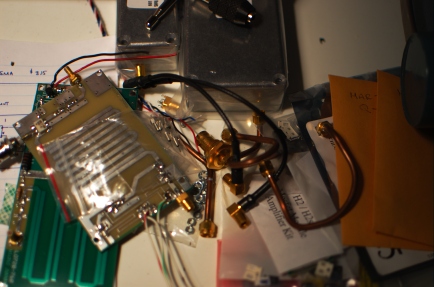
This is about building electronics, not making beer, at home; although, I am sure there are parallels. Three things brought me to writing this: 1. an eHam forum thread I responded to a few weeks ago; 2. the June 2011 issue of IEEE Microwave magazine (has articles by K2UYH, N2UO, and KK7B, perhaps others? thanks to W3KL via the PVRC reflector for bringing it to my attention since I let my IEEE/MTT membership lapse); and 3. a few minutes spent last night resuming a partially-completed Softrock kit gifted to me by a friend who decided to buy a FLEX-3000 instead.
Every once in a while, a thread appears on an amateur radio forum that goes a little bit like this, “Hi, I’m a new ham and I don’t have a lot of money to spend so I want to build an HF SSB station from scratch” or something similar. Somehow, somewhere, somebody has given the impression that it is less expensive to build your own amateur radio equipment than to buy it. That’s true in some circumstances, but certainly rarely for anything that is mature, mass-produced, and readily-available on the second-hand market. After all, there is nothing novel about a 100-watt superheterodyne HF SSB transceiver these days. The principal uncounted cost is the “engineering cost” associated with getting your first few projects working and keeping them working.
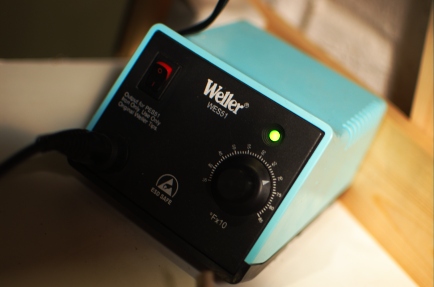
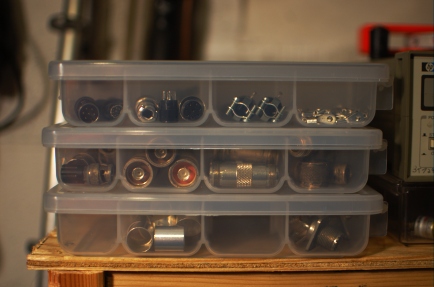
One of the first construction projects I undertook as a new ham was to build a Ramsey Electronics HR-20 (NE602-based) 20-meter receiver—$20 at a hamfest. It did actually work eventually—but this was a simple kit with maybe two dozen parts. Next, I built a ONER transmitter kit from now defunct 624 Kits. I think that was another $20. I never made any QSOs with that combination because I was always afraid of blowing out the receiver with the transmitter. The first thing that I built that I actually managed to make a QSO with was a Small Wonder Labs SW-40, which I still have. That set me back $55 and it did not work immediately. Suddenly, that’s over $100 by the time you include the money I spent on a soldering iron and solder. That’s one-third to half-way to a “real” used HF transceiver and I had two bands at 1 watt on CW only. Furthermore—these are all kits—they leverage economies of scale in purchasing parts from various vendors and they have instructions to help you along. And, I’d like to think that I was a relatively representative example of a recently-minted ham who had more ambition than money or skills…
As I soldered down 1206-size (easy ones) SMT capacitors last night, I was thinking of times that I rushed through a homebrew or kit project just to get it on the air. In those instances the process was often, as I have belabored above, about saving money, not about the act of creating something. Last night was about creating, not saving, and that is the joy of homebrew.
Ethan Miller, K8GU, is a regular contributor to AmateurRadio.com and writes from Maryland, USA. Contact him at [email protected].
LHS Episode #061: I Am Cornholio
 One final notice before Hamvention is here. We’d sure like to visit with all of our listeners out in Dayton if you can make it. Hopefully we’ll be able to turn a bunch more ham radio enthusiasts onto the benefits of Linux while we’re there.
In this episode, your fearless hosts tackle some of the hard questions concerning Open Source, namely: 1) Can anyone in free software agree on a set of standards for documentation and development in order to help newer users join the community, and 2) If it is possible, would anyone want to do it? When we’re all done philosophizing, send us your thoughts. We want to know what YOU think.
Russ Woodman, K5TUX, co-hosts the Linux in the Ham Shack podcast which is available for download in both MP3 and OGG audio format. Contact him at [email protected].
PLT a threat to British intelligence gathering?
A report produced for the British intelligence gathering organization GCHQ claims that noise from power line networking devices is causing a detectable increase in interference at its monitoring stations and could adversely affect its operations. The report, which can be found on the website Ban PLT, was originally released by GCHQ’s Director of Engineering and Technology but has since been disowned by GCHQ which now claims it contained “inaccuracies.” The government organization also forced the online tech news journal The Register, which published an article containing details of the report, to remove the author’s identity from the article using measures designed, ironically, to suppress information that could be considered a threat to national security. So much for freedom of speech.
Ofcom meanwhile continues to deny that PLT devices cause a problem, stating that there have been “only” 272 complaints of interference (all from radio amateurs) and that of 233 cases referred to BT all but one have been resolved so there is nothing to worry about. Has pressure been brought from on high to force GCHQ to disown the report which is embarrassing to BT which has a couple of million of the Comtrend PLT devices installed nationwide? It is blatantly obvious that Ofcom couldn’t give a damn about the possible effects on a few hobbyists who don’t even pay a license for the spectrum they use. But a threat to the country’s ability to monitor the short waves to gather intelligence about potential security threats is something they would have had to take seriously.

Julian Moss, G4ILO, is a regular contributor to AmateurRadio.com and writes from Cumbria, England. Contact him at [email protected].
PLT a threat to British intelligence gathering?
A report produced for the British intelligence gathering organization GCHQ claims that noise from power line networking devices is causing a detectable increase in interference at its monitoring stations and could adversely affect its operations. The report, which can be found on the website Ban PLT, was originally released by GCHQ’s Director of Engineering and Technology but has since been disowned by GCHQ which now claims it contained “inaccuracies.” The government organization also forced the online tech news journal The Register, which published an article containing details of the report, to remove the author’s identity from the article using measures designed, ironically, to suppress information that could be considered a threat to national security. So much for freedom of speech.
Ofcom meanwhile continues to deny that PLT devices cause a problem, stating that there have been “only” 272 complaints of interference (all from radio amateurs) and that of 233 cases referred to BT all but one have been resolved so there is nothing to worry about. Has pressure been brought from on high to force GCHQ to disown the report which is embarrassing to BT which has a couple of million of the Comtrend PLT devices installed nationwide? It is blatantly obvious that Ofcom couldn’t give a damn about the possible effects on a few hobbyists who don’t even pay a license for the spectrum they use. But a threat to the country’s ability to monitor the short waves to gather intelligence about potential security threats is something they would have had to take seriously.
Julian Moss, G4ILO, is a regular contributor to AmateurRadio.com and writes from Cumbria, England. Contact him at [email protected].
Opening the case on an Ascom SE-550
I was talking to Rob, G4XUT yesterday about getting the case of an Ascom SE-550 open – in order to make some adjustments to the internal squelch pot.Rob very kindly put together a list of instructions on how to get the rig apart which I thought someone else might find of use. Thanks Rob!To get into the Ascom:-Assuming that the mobile bracket has already been removed.Disconnect the rear connector by loosening the retaining screw.Remove the Mic plug connector.Unplug the code plug which is above the mic connector.Remove the screw behind code plug.Detach the front panel with is hinged on the L/H side.Remove the 4 screws at the front and 4 screws at the rear.Carefully pull apart the two main boards from the main housing.Carefully re-assemble the two boards.Replace the front panel, code plug and the mic plug.Power up and adjust sq or whatever as required. Simples!!

Tim Kirby, G4VXE, is a regular contributor to AmateurRadio.com and writes from Oxfordshire, England. Contact him at [email protected].
Opening the case on an Ascom SE-550
I was talking to Rob, G4XUT yesterday about getting the case of an Ascom SE-550 open – in order to make some adjustments to the internal squelch pot.Rob very kindly put together a list of instructions on how to get the rig apart which I thought someone else might find of use. Thanks Rob!To get into the Ascom:-Assuming that the mobile bracket has already been removed.Disconnect the rear connector by loosening the retaining screw.Remove the Mic plug connector.Unplug the code plug which is above the mic connector.Remove the screw behind code plug.Detach the front panel with is hinged on the L/H side.Remove the 4 screws at the front and 4 screws at the rear.Carefully pull apart the two main boards from the main housing.Carefully re-assemble the two boards.Replace the front panel, code plug and the mic plug.Power up and adjust sq or whatever as required. Simples!!
Tim Kirby, G4VXE, is a regular contributor to AmateurRadio.com and writes from Oxfordshire, England. Contact him at [email protected].
 Ham Radio Deluxe |
 W5SWL Electronics |
 Ham Radio Prep |
 KB3IFH QSL Cards  Hip Ham Shirts  HamRadioAuctions HamRadioAuctions Reliance Antennas Reliance Antennas Enigma Shop Enigma Shop |  morseDX  Ni4L Antennas  R&L Electronics R&L Electronics antennas.us antennas.us QRV QRV |
- Matt W1MST, Managing Editor
