 |
 LHS Episode #062: The Sound of Linux
 20 July 2011 | by
  Okay, so we managed to take a two month hiatus and we didn’t even know it was going to happen. Happen it did, though. Because of that, Episode #062 and #063 will have some dated information but most of it has been edited out and the stuff contained within that will be timeless has been left in.
I (Russ) will admit to shirking my duties to some degree. Many things are going on in my life right now and I just didn’t want to deal with editing or recording of late. Richard has also had his share of life problems and we’ve both been out of pocket a few times between Episode #061 and now. I suspect our absence is coming to an end and regular production of LHS will soon resume.
Thanks to everyone for hanging in there with us. We now return you to your irregularly scheduled podcast.
73 de The LHS Guys
Russ Woodman, K5TUX, co-hosts the Linux in the Ham Shack podcast which is available for download in both MP3 and OGG audio format. Contact him at [email protected].
Farewell to Gerry Gearing G3JJG
It wasn’t until yesterday, browsing the Southgate ARC site that I learned of the death, on 21st June, of Gerry G3JJG. It was good to see that the Gloucestershire Echo had published a nice obituary for him, although it didn’t mention his amateur radio interests!
I’d known Gerry since my days as a new licencee in Cheltenham. Particularly in those days, I was very much in awe of his ability in CW operating and learned a very great deal from Gerry and Derek, G3NKS in the 1980s and early 1990s as we took part in RSGB’s NFD on behalf of the Cheltenham ARA. I remember Terry, G3JFH marvelling at Gerry’s ability to dig out weak signals on the 40m band in the last hour or so of the contest when many other groups were working nothing!
Gerry’s obituary mentions that he was tenacious! I can confirm that and had cause to receive more than one ‘tenacious’ e-mail when I was RadCom’s Contest Columnist and therefore perceived to be responsible for the RSGB’s Contest Calendar and Rules. Suffice to say that Gerry was not impressed with something (I completely forget now and he probably had a point in any case….) and I was TOLD about it!
Tenacious he was, but in my experience he was never rude and always a gentleman. He was a proud member of the First Class CW Operators Club and had served on their committee for several years.
I shall miss hearing G3JJG on the bands. Gerry, it was a pleasure to have known you.

Tim Kirby, G4VXE, is a regular contributor to AmateurRadio.com and writes from Oxfordshire, England. Contact him at [email protected].
OAFS failure
One of the things I had intended to do this year was install the external frequency reference module in my Elecraft K3 in order to get the best possible frequency accuracy for digital modes. To this end I had ordered an Off-Air Frequency Standard (OAFS) kit from Spectrum Communications so as to avoid wearing out my rubidium frequency standard. I had completed populating the OAFS board a couple of weeks before I ended up in hospital. So I thought I would try to see if it worked, as that would simply involve connecting up a speaker, ferrite rod antenna and power supply.
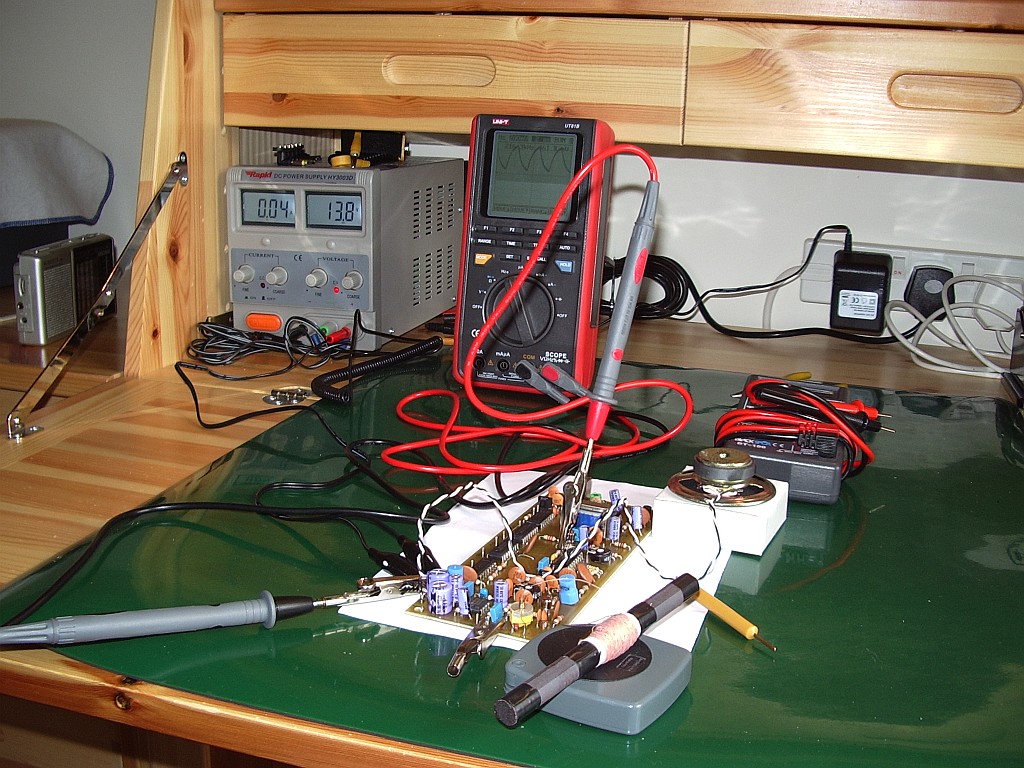
It began to look as if the predictions of the couple of people who commented or emailed when I first posted about the OAFS were going to be right. I could hear BBC Radio 4 long wave in the loudspeaker but it was very weak, presumably (as I had been advised) due to North Cumbria being a poor location to receive the transmission. When I checked the frequency of the phase locked loop it remained steadfastly on 216.4kHz regardless of the setting of the trimpot.
The instructions supplied with the kit suggested that it might be necessary to change a resistor value if the loop will not lock on to 198kHz so I wrote to Tony Nailer at Spectrum to see if he had a suggestion. Unfortunately his reply was that if the loop will not change frequency with the pot there must be a solder bridge or other assembly error. I checked my soldering as best I could and re-did any joints that looked suspect but the way my eyes are now any sort of cross checking between the schematic and the circuit board to look for errors is impossible.
I haven’t really figured out what is wrong with my eyes but it is as if they no longer have the ability to vary focus. I can only see clearly what is at the exact focal point of whatever spectacles I am wearing. When something is out of focus my head swims and I have to close my eyes for a few minutes to steady it again. So any sort of constructional work now is well-nigh impossible.
Tony offered to get the OAFS working for me for a fee if I sent it to him, but at this point I think it would be a waste of money. I can’t see myself installing the frequency reference boards in my K3 now even if I still had the same interest in doing so. So I think the OAFS is destined for the G4ILO junkbox.

Julian Moss, G4ILO, is a regular contributor to AmateurRadio.com and writes from Cumbria, England. Contact him at [email protected].
Revisiting the 50-MHz Transverter
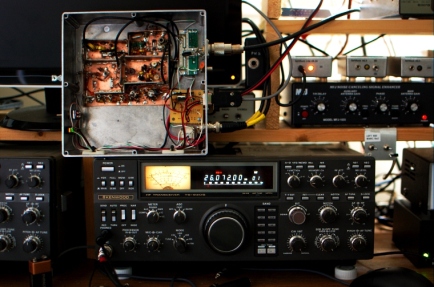
I recently resurrected the 50-MHz transverter project and have made good headway getting it working. On Friday night, I began the process of tapping holes in the PA module heat spreader. But, despite using plenty of “cutting fluid” (3-in-1 oil), I managed to break a (well-used) tap on the first hole. Since the maximum (linear) power out of the driver stage is 200 mW, I embraced my inner QRPer and put the PA project aside to give the transverter a try in the CQ WW VHF contest.
The 6-meter Yagi had come down in favor of Yagis for 222 and 432 when the loaner FT-736R showed up. So, I scampered up onto the roof and moved Yagis around. I had hoped that this moment would be accompanied by changing out RG-8 coax for LMR-600 and LDF4-50A that are taking up space in the shop and shack. But, I was not ready to commit to cutting that and I still don’t have LMR-600UF for the rotator loops. Plus, I should replace the rotator at the same time. That amounted to too much work for the available time. I really just need to bite the bullet and install a rotating mast for the VHF antennas that’s not so precarious.
Got everything hooked up late on Saturday afternoon, but had to tend to some domestic concerns and was QRT until later in the evening when I heard my neighbor W4EE calling CQ on six SSB. Did not know that he had six! Apparently, this is a new thing for him, too. He was surprised that I didn’t vibrate his radio off the desk like I usually do! Told him I was running 200 mW and everything made sense.
Ended up working a few other locals on Sunday including N3UM, who moved me from 6-meter CW to 2-meter SSB for a quick chat. He just completed the N1DPM active bias mod to his Mirage B2518G, so was eager for an audio report. Sounds good! He said my B3016G sounded good on-frequency, but I haven’t gotten the mod actually inserted into mine yet. Probably that Kenwood (TS-700S) audio making up for the amp’s inferiority…
Eventually, I will be posting more details on the circuit here. This is one of those projects that I would not encourage anyone to duplicate as I have constructed it. However, there may be useful features.
Ethan Miller, K8GU, is a regular contributor to AmateurRadio.com and writes from Maryland, USA. Contact him at [email protected].
K3NG Keyer Update
Hidden in a nondescript mountain location in eastern Pennsylvania, the highly trained squirrels at the Radio Artisan Lab have been working feverishly lately on the Arduino keyer code. Besides being amazed that squirrels can code in C or even operate computers in the first place, I’m amazed at some of the features they’ve been pumping out. Here are the highlights:
You can now plug a PS2 keyboard right into the keyer, no computer required.
The keyer interfaces with popular logging and contest programs with the new Winkey Emulation feature.
Iambic A and B modes are now available. Straight key and bug modes are also available as before.
Various timing niceties like wordspace adjust, keying compensation, autospace, and first element extension are now available, along with the existing PTT lead/lag and dit-to-dah ratio features.
There’s now a Dead Operator Watchdog. If you keel over mid-QSO and one of the paddles gets stuck, the keyer will stop transmitting so you won’t be QRMing the frequency until your unfortunate (or fortunate) XYL finds you.
A few months ago one of the bright-eyed and bushy-tailed new guys wrote some Hellschreiber code on his lunch break. I’m not sure anyone will use it, but it’s there if some one wants to build a hell beacon or respond back to an unsuspecting CW op in hell. [insert joke here]
The little rodents tell me there’s more coming.


ICQ Podcast S04 E15 – Mini Holiday DxEpedition (17 July 2011)
Series Four Episode Fifteen of the ICQ Podcast has been released. News Stories include :-
- RS-ID via linked repeaters results
- Space trash misses hams
- Amateur Radio Satellites 50th Anniversary
- New Whipbeater antenna
- Portugal allocates additional 5 MHz frequency
- 500 kHz for Malta
- UK spectrum management
- Rare satellite grid squares activated
- Satellite Beginners Workshop
- Scottish Scout New Horizons Expedition
- Olympic tests on 70cm
- Amateur radio repeater falls silent
- Amateur bags classic callsign
Your feedback, North American HamBrief with Chris Matthieu (N7ICE), American licence system by Jon Hawkes (VK2TCW and K2TCW) and Martin (M1MRB) discusses our mini holiday dxepedition.
Colin Butler, M6BOY, is the host of the ICQ Podcast, a weekly radio show about Amateur Radio. Contact him at [email protected].
ICQ Podcast S04 E15 – Mini Holiday DxEpedition (17 July 2011)
Series Four Episode Fifteen of the ICQ Podcast has been released. News Stories include :-
- RS-ID via linked repeaters results
- Space trash misses hams
- Amateur Radio Satellites 50th Anniversary
- New Whipbeater antenna
- Portugal allocates additional 5 MHz frequency
- 500 kHz for Malta
- UK spectrum management
- Rare satellite grid squares activated
- Satellite Beginners Workshop
- Scottish Scout New Horizons Expedition
- Olympic tests on 70cm
- Amateur radio repeater falls silent
- Amateur bags classic callsign
Your feedback, North American HamBrief with Chris Matthieu (N7ICE), American licence system by Jon Hawkes (VK2TCW and K2TCW) and Martin (M1MRB) discusses our mini holiday dxepedition.
Colin Butler, M6BOY, is the host of the ICQ Podcast, a weekly radio show about Amateur Radio. Contact him at [email protected].
 Ham Radio Deluxe |
 W5SWL Electronics |
 Ham Radio Prep |
 KB3IFH QSL Cards  Hip Ham Shirts  HamRadioAuctions HamRadioAuctions Reliance Antennas Reliance Antennas Enigma Shop Enigma Shop |  morseDX  Ni4L Antennas  R&L Electronics R&L Electronics antennas.us antennas.us QRV QRV |
- Matt W1MST, Managing Editor
