 |
 Quick update on TI7/K2DBK
 8 July 2011 | by
 I just wanted to post a very quick update regarding my TI7/K2DBK operation that’s coming up in a few days. I see that my announcement to the various DX Publicity sources that I’ve collected has done the job, as I’ve been mentioned in most of the major DX announcement lists. As mentioned, this is a “holiday-style” operation which means that operating will take place when I’m at the QTH where I’m staying (as opposed to sightseeing, etc.) and not otherwise occupied with other important things, like working on my suntan, swimming, or consuming the occasional “adult beverage”. (Come to think of it, I could do at least some of those while operating, but I think I’ll skip trying to operate from the swimming pool.)
Although I wasn’t home to take advantage, I noted that 6m was open today and if that happens again while I’m there, I’ll try to get on the air on that band. However, unless there’s some indication of a band opening I probably won’t spend much time just CQing since the lower bands should be more productive overall.
I had intended to post several updates this week, but as luck would have it this was an extremely busy week at work and I got home significantly later than usual and just haven’t had the time to update. I may post a few updates from Costa Rica when I’m there at which point I may have a better idea of when I’ll actually be on the air.
Until then, I’ve got to get back to packing.
The Anytone AT5555 28Mhz rig
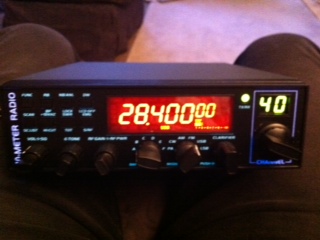
I mentioned a few weeks ago that I’d been looking at these rigs. Well, I have had the chance to play with one and I must say I’m not disappointed.
Quite obviously the rig shows its CB heritage. It’s quite big too. Certainly it wouldn’t fit in the centre console of my VW Polo in the same way that the FT8900 does.
The rig comes with a mounting kit for the car (which I made double as a stand) since the loudspeaker is on the bottom of the case, not ideal if you want to place it on a shelf in the shack.
I’ve found the rig fun and easy to use. As supplied in the AT5555N configuration from Nevada, the rig is 28MHz amateur band only. I quickly got used to the channel change moving me up or down 10khz and using the clarifier to tune in between in either 1, 0.1 or 0.01 KHz steps. This is only of significance on CW/SSB of course.
So far, I have had the rig connected up to the Butternut HF6V at home and have had a number of contacts around Europe using Sporadic E propagation. Some more distant signals have been heard from South America and the Middle East.
Output power is around 10W FM and a little more on SSB. Entirely adequate to make some fun contacts. Haven’t tried it on CW yet, but it should work with an external keyer.
I like the fact that the rig is available through Amazon making it easily accessible to someone who might be new to the hobby or getting back into it again.
If you’ve not played on 28MHz before then with rising solar flux, this is the time to do it!

Tim Kirby, G4VXE, is a regular contributor to AmateurRadio.com and writes from Oxfordshire, England. Contact him at [email protected].
Rest and recreation
As I have written in my other blog, I am currently in a period of recuperation from my brain surgery prior to beginning treatment to try to stop the cancer. I’m feeling better every day, if still rather weak and living as if in a dream – in part no doubt due to my difficulty in sleeping.
Since I can’t go anywhere much – we sold the car to a neighbour yesterday – I need things to keep me amused here, so inevitably I am once again becoming more interested in my radios. But I do have a different outlook on the hobby now. The computer gives me a headache in more than small doses so digital modes are out for the time being, as is the APRS gateway. The simple approach to ham radio now seems far more appealing. Perhaps I’ll even spend some time trying to improve my CW.
I managed to set up my Kenwood TM-D710 as a digipeater and it can be heard and gated by Mark MM1MPB’s station at Annan, Scotland. So my weather station G4ILO-5 and my Kenwood handheld TH-D72 G4ILO-7 still appear on the map and I can do limited messaging via the keypad on the handheld.
This burst of activity is only a sign of recovering from the operation (and of coming to terms with the fact of my mortality) not of beating the cancer. The treatment will not begin for a couple of weeks or so and I have been reliably informed that it may make me feel so tired that I won’t feel much like blogging or radio. So my main intention during these next couple of weeks is to try to enjoy them as much as possible.

Julian Moss, G4ILO, is a regular contributor to AmateurRadio.com and writes from Cumbria, England. Contact him at [email protected].
Amateur Radio Antenna Review Form
Amateur Radio Antenna Review Form Version 1.0
Name of Antenna________________________
Reviewer Callsign_________

Type of Antenna: (check all that apply)
( ) Commercial dipole that seems to work better than any dipole I've ever built
( ) Off center fed dipole that works better than a regular dipole
( ) Vertical that doesn't need any radials
( ) 6 foot whip that works great on 6m - 160m
( ) Old design from Handbook someone is selling as a new idea
( ) A dipole or dipole variant I'm selling to unsuspecting people
( ) I don't know
( ) Other _________ (specify)

Owned Antenna For:
( ) 0 - 6 Months
( ) 6 - 12 Months
( ) More than 30 years
( ) Never owned one but I think it's great

Why Antenna is Great: (check all that apply)
( ) Got a 59 / 599 report from several stations
( ) Is stronger in comparison tests against my old crappy antenna
( ) Worked a guy in ____________ (print country)
( ) Neighbor / XYL can't see it
( ) Antenna annoys Neighbor / XYL
( ) Manual good translation from Chinese large help in assemblage
( ) Antenna gain specification is in dBd and not evil dBi
( ) Heard on 80m roundtable it was good
( ) Can be fed with: (check all that apply)
              ( ) Any length of coax
              ( ) RG-58 or RG-8
              ( ) Specific length of "special" coax (included in box)
( ) Low SWR (1 to 1) across entire:
              ( ) Band
              ( ) RF Spectrum
              Antenna Tuner Required To Get Low SWR: Yes / No (Circle all that apply)
( ) Antenna has a cool name
( ) Antenna as good as multiple stacked four element yagis when condx are good
( ) Repels lightning
( ) Antenna includes mystery black box

Overall rating: ( ) Fine Business   ( ) Magic   ( ) Dead Full Quieting  ( ) 5 out of 5


Handiham World for 06 July 2011
Welcome to Handiham World!
…And welcome to a new era of challenges for radio clubs.
What do I mean by that?
Well, if you have to ask, you might not be that tuned in to your local club’s activities. Radio clubs provide a means for you and I to get together with like-minded folks who appreciate amateur radio and who enjoy learning new things through club programs, keeping up their operating skills through club nets and activities, socializing with other radio amateurs, or being part of public service activities – to name just a few of the more obvious ones. I know that I have learned a lot about useful things that have helped me out in ham radio, thanks to the presentations at my local radio club.
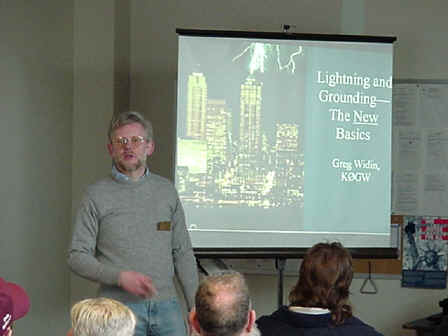
Pictured: Greg Widin, K0GW, ARRL Dakota Division Director, gives a club program presentation on lightning and grounding.
“A club is an association of two or more people united by a common interest or goal.” Thanks, Wikipedia! Of course we seldom think of clubs in terms of only two people. Usually a radio club is larger – sometimes much larger – and there may be several distinct interest groups within the club. The club may own some equipment, such as special tools for antenna work, a repeater system, a club station, training materials and equipment, and more.
The challenges:
Meeting space. If you have a club of only a few members, this isn’t a big deal. Clubs of a dozen or fewer members have lots of choices, up to and including private homes. Typically, a radio club will have a membership that is too large to be accommodated anywhere but a more formal meeting space, and that means casting about for a venue. With a demographic that includes aging baby boomers, a club definitely wants to have a meeting space that is accessible to those who might use wheelchairs or who are unable to climb stairs. You also want electricity, good lighting, and quiet space. Internet is a bonus, but if it is not available, it isn’t exactly a deal-killer. The challenge is finding the space at an affordable price! Back in the day, meeting spaces were plentiful and free for the asking, especially to small public service or special interest clubs like ham radio groups. Venues might include the local school, church halls, service organization halls, and municipal or county buildings. It is not so easy today. The economy is down. Every venue is looking to raise extra cash, so the days of free meeting space might just be in the rear view mirror! And permanent space with room for a club station – wow, that is REALLY hard to find these days. I know that several clubs have either lost or given up their space for club meetings and stations due to the press for more revenue or other activities related to the needs of the landlord or host organization.
Apathy. This one drives club officials nuts. And it’s nothing new, of course. There have always been club members who would rather jump out a window than put together a club program or write an article for the newsletter. But it’s worse now than ever before, and it’s related to number three on my list, which I’ll tell you about shortly. Suffice it to say that there are all too many hams out there who think it is a major hassle to even join a club, much less actively participate.
Overworked club members. Yes, this one has always been around because some club members take on way more than their share of club duties. But the reason it is worse than ever before goes back to the world economic downturn that started in 2007. As the economic woes gathered, companies and organizations began trimming their workforces. Everyone seemed to be affected, no matter what the industry, and those who were still working felt lucky to have jobs. Those who lost their jobs, ham radio operators among them, tightened their belts and didn’t spend anything extra on their radio hobby. Back at the workplace, those who still had jobs were doing the work of their old job plus that of a co-worker or two, since there were now not enough people on staff to get everything done. That meant longer, harder hours at work, and less time for amateur radio club activities. I have been a ham since 1967, and this is the first time I have been hearing about this phenomenon from other hams who feel too pressed to participate in club activities as they once did.
Recruiting. A club will fade away if it does not attract new members to replace those who die, lose interest, or move out of the area. Yet this aspect of club life is often left on the sidelines, going unnoticed until all of a sudden it seems as if there is no longer a reason to have regular club meetings. Recruiting is challenging in a world of worldwide internet connectivity with VoIP and other activities that mimic worldwide radio communication.
What can be done?
Remember that whatever needs doing, you do not have to do it all yourself. Leverage the manpower you do have by using the resources available at ARRL, which has lots of advice and ideas about clubs, club organization, and recruiting. Let’s take a closer look at each challenge:
A strategy to make meeting space more available is to make your club stand out above and beyond the others who might be competing for the same space. For example, if you are meeting in the county law enforcement center, you can make a better case for meeting space because your club supports emergency communications, Skywarn training and weather spotting, and public service communications. You are making sure that your club’s mission is aligned with that of the meeting space owner! No matter who hosts your meeting space, remember that it is wise to give back to your host in some way. If you are using a church hall for your meetings, perhaps the church needs volunteers for a clean up day or help at the church picnic. If you are lucky enough to get a special meeting room at a restaurant, everyone should buy a meal or at least spend a reasonable few bucks to make sure the restaurant owner turns a profit. The key? Be the best meeting space user you can be, and you will have more choices!
Apathy is hard to cure. In fact, I don’t even care anymore.
Ha, ha, I am just kidding about that not caring part, of course! I look at the programs and activities as the “good stuff” associated with a radio club. The other more pedestrian activities like the business meeting don’t really interest many of us. It’s the program on the DXpedition or the special event station that draws club members to the meetings. If your club has apathy oozing out of every nook and cranny, I’m willing to bet that your club doesn’t host good programs. Finding good presenters isn’t a given; the really good ones make the rounds but have limited time and resources. Most of your club’s programs and activities will ultimately come from within the club itself, and that means finding the right club member – one who is a really enthusiastic and positive go-getter – to do the going and getting. By that I mean they need to observe the membership, noting what areas of interest and expertise there are within the club. Then they have to recruit the guy who knows about antennas to give a talk. Apathy is something you chip away at by slowly building your circle of presenters. The more varied the topics, the better. Like the offerings on a menu at an excellent restaurant, there will soon be something for everyone at the club meetings.
The problem of club members who are stressed out by their work schedules will not be solved at the radio club, but I think it is reasonable for those members who are retired or who have a bit more time to step up to the plate and take on some of those extra club duties. We need to appreciate that those in their working years are trying to stuff 10 pounds of potatoes into a 5 pound bag these days, and are often also raising families with all of the obligations and demands on their time that those things require. Yes, those people are sometimes willing to take on club duties, but they are subject to “burn out” if they don’t get a little help. Next time you are at your radio club meeting and something needs doing, raise your hand. Lead by example.
Recruiting is vital, but how does a club go about it? I have seen several once active and vital radio clubs fade into obscurity and finally disband. Others have been successful in maintaining and growing their membership numbers. What is the secret?
Well, there are several, really. You have to understand the world around you – no small feat, that. What it means is knowing that amateur radio has a lot of competition for hobbyists who want to experiment with electronics. It means understanding that on line video gaming, so-called massively multiplayer online role-playing games (MMORPG), include elements of world-wide communication, cooperation, competition, scoring points, and community-building that are found in traditional amateur radio. There is, in other words, a lot of competition out there. Knowing what you are up against makes it easier to figure out how to package amateur radio and your radio club to better draw people in. If you want to make ham radio attractive to anyone under 100, you’d better start thinking of some interesting activities, outreach to school science teachers, high-profile cooperative ventures with other groups… I think you get the idea. My own local club drew some university students in by participating in tracking high-altitude balloon flights via APRS.
Another recruiting strategy is to offer Technician courses to the general public. We schedule ours right after a Skywarn course in the Spring, just before severe weather season kicks in. The classes are free, but the participants buy their own books. Graduates are invited to join our club. Education is one of the most important indicators of a club’s health. Show me a club without an education program, and I’ll show you a meeting room that will soon be available for a group of rock hounds or stamp collectors. Seriously, you have to offer classes or your club is toast. Again, check out the excellent resources on the ARRL website for tips on teaching and for resources like math help. Most importantly, say “YES!” when asked if you will be part of your club’s education and training team.
Your job? Make getting on the air with amateur radio sound like it’s at least as much fun as World of Warcraft®.
Go get ’em, tiger!

Pat Tice, WA0TDA, is the manager of HANDI-HAM and a regular contributor to AmateurRadio.com. Contact him at [email protected].
Jan Mayen DXpedition
The JX5O DXpedition crew is in route and you can view their progress and latest news here and on The Facebook. I’ve often thought a DXpedition to Jan Mayen or Svlabard would be cool, quite literally. They’re not super rare like Bouvet or Heard Island, but for mere mortal radio artisans like me who can’t take three months off work and drop $30K or 40K of life savings on playing radio, they’re attainable DXpeditions. Sure, they’re not tropical like the popular VP prefix destinations, but that would be too easy :-)

Svalbard is Cool
(Photograph by Hannes Grobe, Shared under Creative Commons)


Making the Contacts
Inevitably each year the debate over just what is Field Day erupts in club meetings, on the air, and in Internet forums. One side calls it a contest while the other classifies it more as a casual operating event. I can argue this both ways, but regardless of which side you’re on one of the objectives of Field Day is simply to make contacts. If you consider Field Day a contest, more contacts means a higher score. If you’re in it as just a casual operating event, making more contacts is naturally more fun than making less. Here are some tips for making more QSOs, not only during Field Day, but really any operating event or contest:
The other station knows his callsign. The only time you should say or send the other station’s call is when you are calling CQ and giving the other station his report. A possible exception to this is if you’re replying to a CQ and there are multiple stations on the frequency calling CQ. Otherwise, sending the other station’s call is unnecessary and it just wastes time. It often messes up CW operators calling CQ because they’ll start typing the first callsign they hear. Once they realize it’s their own call coming back, they have to backspace and type in your call.
Adjust your syntax based on the number of stations you have piled up. If things are slow going, you can be more generous with the verbiage. If you know you have a pileup going, be more sparse so you can turn around the QSOs more quickly.
Hold your ground on a frequency. If you have had the frequency for a long time and a LID pops up on your frequency or nearby causing interference, just hold your ground and it’s likely that they will go away shortly. Often I’ll make longer CQ calls or do a string of QRLs or say “the frequency is in use” and they’ll get the message. When operating QRP this strategy may not work so well and QSYing may be your best bet.
Switch between CQing and search-and-pounce. Often people will pick one over the other. I tend to favor CQing as much as possible and then switch to search-and-pounce periodically to scan the band and harvest QSOs from those calling CQ who haven’t worked me yet. Keep an eye on your QSO rate while you’re CQing and watch for declines; this is your cue to go into search-and-pounce mode.
Use phonetics when it makes sense and use standard ones when you do. Much has been said about the use and abuse of phonetics, but there’s a reason there are standard phonetics. They have the most clarity and are less apt to be confused with other letters over the air. Cutesy phonetics can be problematic and actually aggravate the problem phonetics is supposed to help.
Make good use of air time. If you didn’t get a station’s full callsign, you don’t need to give them a 30 second monologue on how you didn’t get their callsign, what letters you exactly heard, and the five combinations of letters you think their call might be. Just say ‘again?’ and they’ll repeat their call. The same goes when you have a messy pileup. Just say ‘again?’ or if you were able to pick out one letter of a callsign, say that letter so you can thin out the pack and get a full callsign.


 Ham Radio Deluxe |
 W5SWL Electronics |
 Ham Radio Prep |
 KB3IFH QSL Cards  Hip Ham Shirts  HamRadioAuctions HamRadioAuctions Reliance Antennas Reliance Antennas Enigma Shop Enigma Shop |  morseDX  Ni4L Antennas  R&L Electronics R&L Electronics antennas.us antennas.us QRV QRV |
- Matt W1MST, Managing Editor
