 |
 TI7/K2DBK Post-event wrapup, part 1
 22 July 2011 | by
 It’s been a very busy week for me both at work and at home following my vacation, so it’s taken me a while to find the time to start writing this. I’d hoped to provide a few more updates while I was in Costa Rica but I never found the time so I’ll do my best to try to remember what happened. I’m going to try write a number of shorter postings so hopefully I can get them all out over the next couple of days.
In my last posting, I’d talked about how it had been rainy all week. That weather continued, but I finally did figure out a way to get on the air for more than 10 minutes at a time.
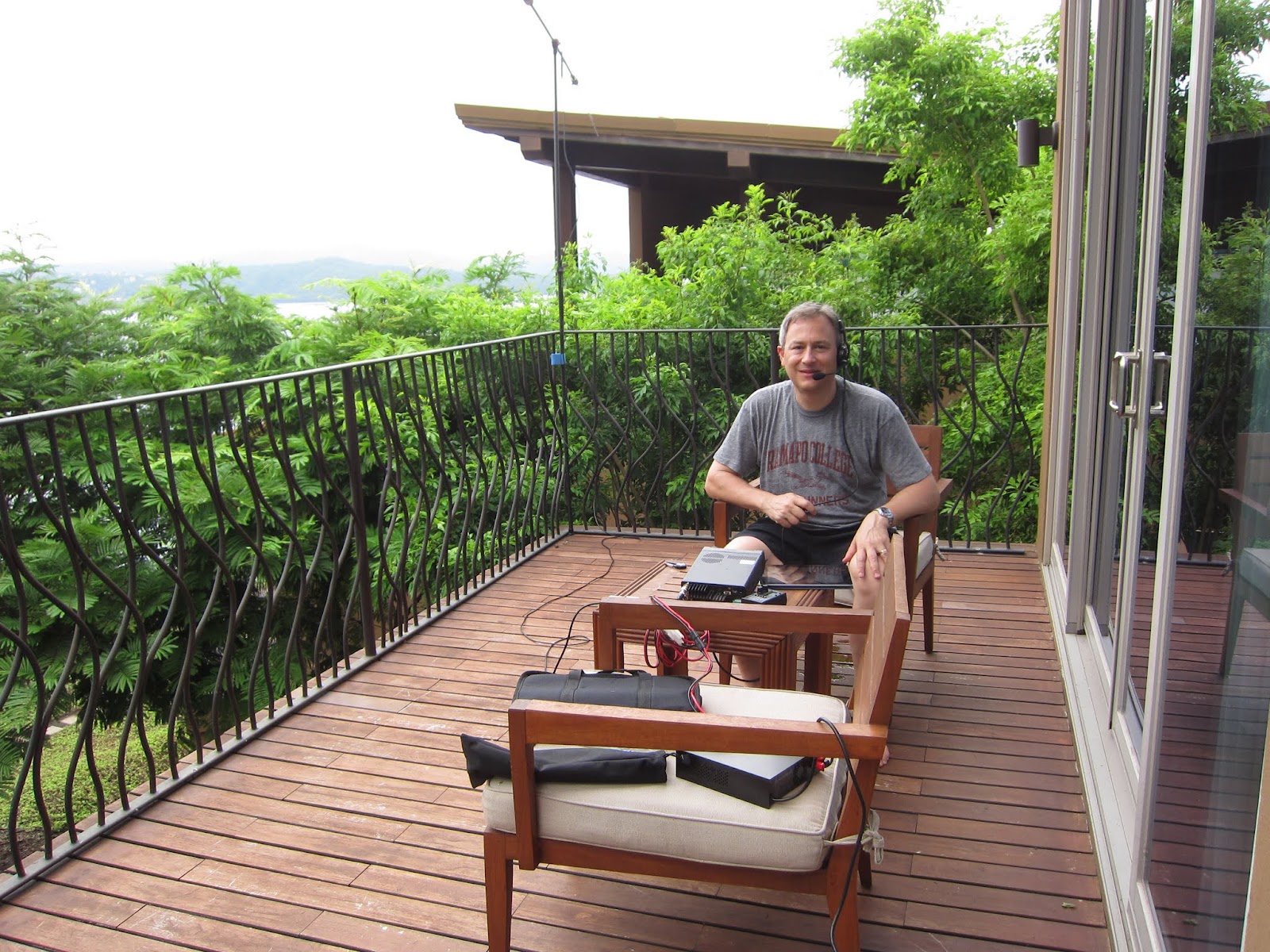
The problem was that my initial setup was on part of the outdoor deck with everything exposed to the elements. I would have been happy to bring the feedline inside, but the air conditioning system in the house we were staying at has sensors such that you can’t leave the sliding doors open even a little without the system shutting down. Considering the temperature and humidity, that wasn’t a realistic option, so I had to operate outside and hope for the best. In the picture, you can see the antenna in the background and I’ve got the power supply sitting on the chair with the radio on a little table. As long as it was dry, this worked out fine. Unfortunately, it didn’t stay dry long enough for me to spend any significant time on the air.
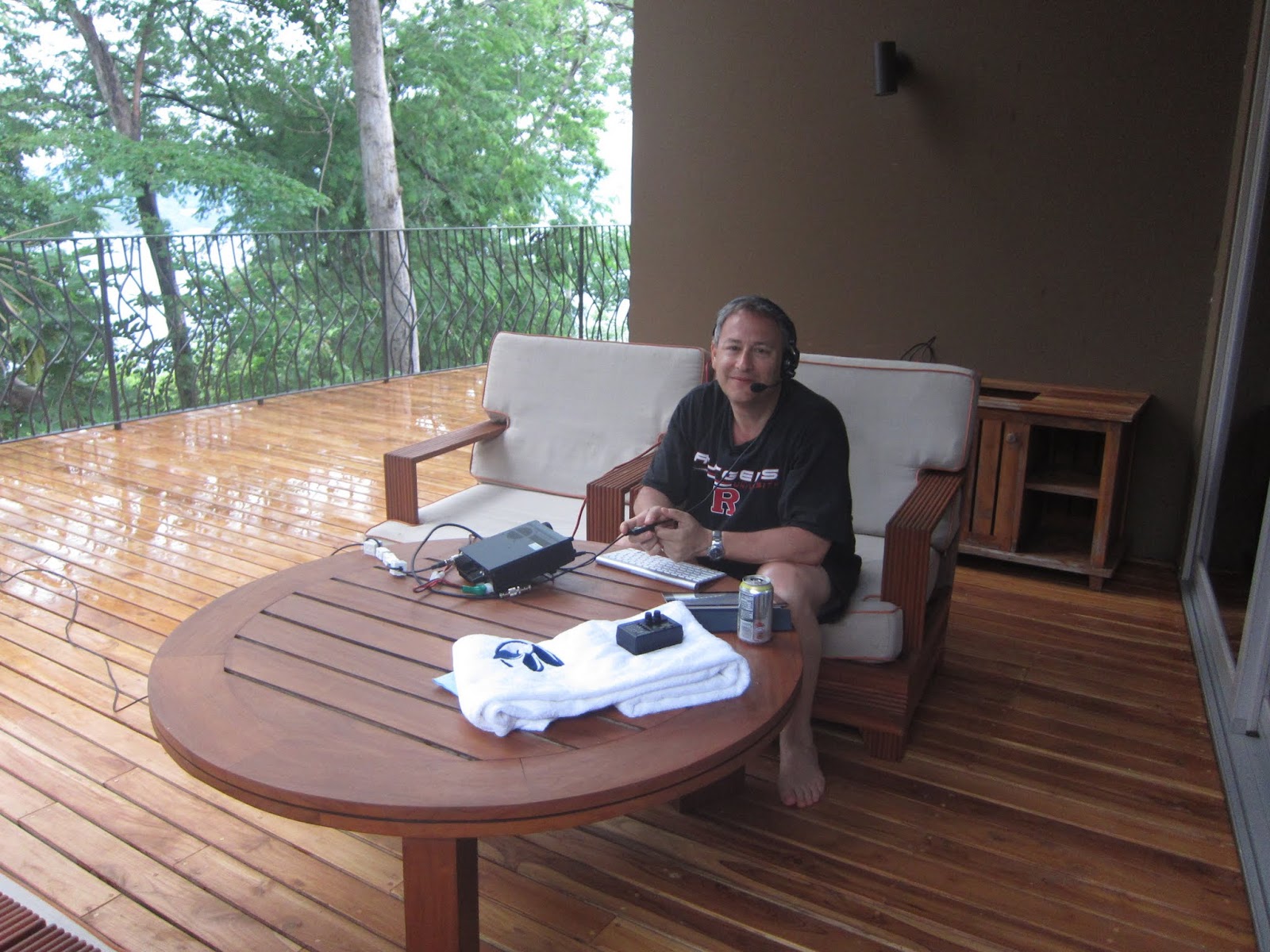
On Friday afternoon, the weather was once again uncooperative, and I was starting to think that I’d wind up leaving Costa Rica with only about 5 QSOs. However, Sharon pointed out that the deck next to the common area of the house had a pretty big overhang, and I realized that even with some of the really torrential downpours we’d had that area had stayed dry. I moved down to that location and set up the antenna there, configured for 15m, and brought out the rest of the gear to the new location.
Sure enough, after a few minutes of respite the skies opened up again, but although the antenna was getting wet, the radio, power supply, and my iPad (used for logging) were dry. (As you can see from the photo, I did have a towel ready, just in case.) I got on 15m at just about 21:00Z and called CQ and was answered by a station in Brazil. Being in Costa Rica, that wasn’t quite the DX that I was hoping for, but very shortly after that I got spotted on the DX Clusters and started getting a lot of calls from Europe. All told, I was on the air for about 40 minutes (we had plans and I had to get ready) and worked 33 stations that day. (I’ll have some details about the countries I worked in a future posting.) Although I’ve worked from a DX location before (as ZF2DK), this was the first time that I ever had what I would consider to be a full-blow pileup. I think that I did fairly well in managing things, managing to at least get enough of a partial call so that I could respond back with “the station ending in xyz only please” on almost every call. I don’t have enough experience yet to be able to pull full callsigns out of a pileup every time, but I know that’s something that comes with experience. By the second day of running stations, I could tell that I was doing better.
Part 2 of this series continues here.
Back to QRP
In a comment to one of my posts on my other blog, Roger G3XBM wondered whether exposure to materials used in electronic construction such as PVC, lead solder, flux etc. might have contributed to my having a malignant brain tumour. I have never worked in the electronics industry and it was mainly during my teens and in the last few years that I have melted solder to any great extent. I suspect my exposure has been quite a lot less than that of professional engineers and many other hams, so personally I doubt this is the cause, though I guess it could be one of those things like smoking and lung cancer where if you’ve done it at all you increase the risk.
The other thing Roger mentioned was exposure to RF. This was something I kept on thinking about during the days I was in the hospital bed staring at the ceiling. Could using antennas in the attic a few feet from my head have caused the tumour to develop? Or perhaps it was using hand-held VHF radios?
With the logic of the ignorant I was inclined to dismiss the fears. I have never been a particularly prolific operator and only in the last couple of years have I run more than 10 watts to my attic antennas. I suppose my liking for digital modes may have increased the strength of the RF fields I was subjected to. 40W of PSK31 is probably a more intense exposure than 100W PEP of SSB.
As a right-handed person my HTs are usually held on the right hand side of my face – the side the tumour was. Coincidence or not? On the other hand, most people on the planet use mobile phones far more than I do and they aren’t all dying of brain tumours. Would doctors use radio waves to kill cancerous tumours if exposure to RF caused them? I don’t know.
Mike G4GOC found an extract of an article “Increased mortality in amateur radio operators due to lymphatic and hematopoietic malignancies” which appears to suggest a link between RF exposure and myeloid leukemia. So I guess getting as much distance between yourself and a transmitting antenna is always going to be a good idea, hard though that is to achieve for people living on postage stamp sized plots like so many of us on this small island.
There may be no proof that anything I did in pursuit of my hobby contributed to this brain tumour, but ever since returning home and getting some of my interest in ham radio back again I have felt uneasy about being close to an RF field. Yesterday I took the K3/100 and the Kenwood 50W 2m rig off the shack desk and put them away. Perhaps I’ll have a change of heart but it’s going to be QRP for me right now. If I could go back in my life and do anything different that would have avoided getting this brain tumour I would do so. I just don’t know for sure that carrying on as I did before won’t harm my chances of beating the bugger or at least keeping it at bay for a while longer.

Julian Moss, G4ILO, is a regular contributor to AmateurRadio.com and writes from Cumbria, England. Contact him at [email protected].
Ham Nation 9
Teaching ham radio to kids in school, comparing ham radio to modern internet services, and George shows us the dos and don’ts of soldering.
Guests: Carole Perry, WB2MGP and George Thomas, W5JDX
Download or subscribe to this show at http://twit.tv/hn.
We invite you to read, add to, and amend our show notes at wiki.twit.tv.
Thanks to Joe Walsh who wrote and plays the Ham Nation theme.
Thanks to Cachefly for the bandwidth for this show.
http://dts.podtrac.com/redirect.mp4/twit.cachefly.net/video/hn/hn0009/hn0009_h264b_864x480_500.mp4
http://dts.podtrac.com/redirect.mp4/twit.cachefly.net/video/hn/hn0009/hn0009_h264b_640x368_256.mp4
http://www.podtrac.com/pts/redirect.mp3/twit.cachefly.net/hn0009.mp3
Dr. Bob Heil, K9EID, is the founder of Heil Sound and host of TWiT.tv's Ham Nation which streams live each Tuesday at 6:00pm PT (9:00pm ET) at http://live.twit.tv. Contact him at [email protected].
Handiham World for 20 July 2011
Welcome to Handiham World!

It looks like we will meet our goals for Radio Camp this summer. We have a healthy level of participants, and most have completed their paperwork and made their travel plans. Quite a bit remains to be done in preparation, though. We have an excellent tower and beam antenna on a hill behind the camp’s “Rotary Building”, where we plan to set up an HF station using a Kenwood TS-570SAT and a TS-2000. Having these rigs to choose from should help make more operators comfortable. Since the beam has not been used this past year and things have been moved around, I will need to locate the rotor control box and dress the wiring back into the shack for a test run. One thing I have learned about antenna systems over the years is that unexpected problems can show up at the most awkward times. It pays to do a little footwork in advance. In this case, I will need to do real footwork, too. The main Handiham Headquarters building rests in a storybook-like clearing surrounded by forest at the base of a hill. Built on and into the side of the hill is the Rotary Building, named for its benefactors, the Rotary Clubs. Long ago, when the Handiham System was very young, there was a ham radio station in the Rotary Building, which was used during the shorter “May Convocations” that would ultimately evolve into the full-fledged Radio Camps.
So you can imagine that there would need to be an antenna system near the Rotary building, and sure enough, there was. A 50 foot self-supporting tower and beam antenna were installed up at the top of the hill behind the building. The entire system fell into disrepair when the Radio Camps moved to Courage North, and it wasn’t until recent years that the antenna and wiring were refurbished as part of an Eagle Scout project by Peter Widin, KC0ENI. This excellent resource will once again be used at Radio Camp, and should provide us with the opportunity to work some real DX! What is different this year is that we plan to install a permanent station in the library of the Rotary building, an excellent gathering space with plenty of room for operating skills participants. In preparation for the use of this area, I have completed the installation of wireless Internet and done some preliminary planning of the station setup. Although we could set up temporarily as in the past, this year we will have one of the familiar equipment desks that we have used at Courage North. This cabinet will provide a place to lock up the stored equipment when non-ham radio users are in the space.
Meanwhile, back on the Woodland side of camp, which is where we will enjoy living in the modern cabins during the week, I have checked the Internet and done my walk through of the buildings. I am thinking that we may have only one HF station, if that, set up at the Woodland cabins. After all, we will have stations on the pontoon boat, at the Rotary Building, and at the Headquarters. We do plan to have a JAWS computer with Echolink and the Remote Base software available as a training tool. Since there are wireless Internet hotspots available in Woodland, the Rotary, Lakeside dining hall, the Lakeside Gazebo, and Handiham HQ, there should be no shortage of places for us to use the Internet-enabled stations. Furthermore, the camp repeater will be on the air and it is Echolink-enabled. One of our goals is to teach the use of these new tools to as many of our campers as possible. If we are successful in getting our new IRLP node that has been configured by Lyle, K0LR, set up on our Woodland Internet connection, we will be able to use that to connect to IRLP node 9008, the Vancouver BC system.
By the way, this month marks 60 years since the FCC created the Novice class license. I was reminded of this by Ron, K3PID, my co-editor of our local radio club newsletter, who was asking club members to send in stories about their Novice days. I thought that was such a good idea that I would like to steal it, so how about some of those Novice stories? I will tell you one of my own next week.
Patrick Tice
[email protected]
Handiham Manager
Thanks for your support!
The Owatonna Steele County (Minnesota) Amateur Radio club recently sent in a gift of $50 in support of the Dr. Dave Challenge Grant. Dr. Dave Justis, KN0S, has challenged us to raise at least $5,000, which he will match.
Help us win the Dr. Dave Challenge!
Money is tight these days and we desperately need your support. Now, thanks to a generous challenge grant by Dr. Dave Justis, KN0S, we have a chance to help fill the budget gap. Dr. Dave will donate $5,000 to the Handiham System if we can raise a matching amount. That means we need to really put the fund-raising into high gear! If you can help, designate a donation to Handihams, stating that it is for the “Dr. Dave Challenge”. We will keep you posted in our weekly e-letter as to the progress of the fund.
Nancy can take credit card donations via the toll-free number, 1-866-426-3442, or accept checks sent to our Courage Center Handiham address:
Courage Handiham System
3915 Golden Valley Road
Golden Valley, MN 55422
Be sure to put a note saying “Dr. Dave Challenge” somewhere in the envelope or on the note line of the check.
Thank you so much for your support!

Pat Tice, WA0TDA, is the manager of HANDI-HAM and a regular contributor to AmateurRadio.com. Contact him at [email protected].
K1OIK: Hamspeak
More levity from our friend Burt, K1OIK…
Matt Thomas, W1MST, is the managing editor of AmateurRadio.com. Contact him at [email protected].
LHS Episode #062: The Sound of Linux
 Okay, so we managed to take a two month hiatus and we didn’t even know it was going to happen. Happen it did, though. Because of that, Episode #062 and #063 will have some dated information but most of it has been edited out and the stuff contained within that will be timeless has been left in.
I (Russ) will admit to shirking my duties to some degree. Many things are going on in my life right now and I just didn’t want to deal with editing or recording of late. Richard has also had his share of life problems and we’ve both been out of pocket a few times between Episode #061 and now. I suspect our absence is coming to an end and regular production of LHS will soon resume.
Thanks to everyone for hanging in there with us. We now return you to your irregularly scheduled podcast.
73 de The LHS Guys
Russ Woodman, K5TUX, co-hosts the Linux in the Ham Shack podcast which is available for download in both MP3 and OGG audio format. Contact him at [email protected].
Farewell to Gerry Gearing G3JJG
It wasn’t until yesterday, browsing the Southgate ARC site that I learned of the death, on 21st June, of Gerry G3JJG. It was good to see that the Gloucestershire Echo had published a nice obituary for him, although it didn’t mention his amateur radio interests!
I’d known Gerry since my days as a new licencee in Cheltenham. Particularly in those days, I was very much in awe of his ability in CW operating and learned a very great deal from Gerry and Derek, G3NKS in the 1980s and early 1990s as we took part in RSGB’s NFD on behalf of the Cheltenham ARA. I remember Terry, G3JFH marvelling at Gerry’s ability to dig out weak signals on the 40m band in the last hour or so of the contest when many other groups were working nothing!
Gerry’s obituary mentions that he was tenacious! I can confirm that and had cause to receive more than one ‘tenacious’ e-mail when I was RadCom’s Contest Columnist and therefore perceived to be responsible for the RSGB’s Contest Calendar and Rules. Suffice to say that Gerry was not impressed with something (I completely forget now and he probably had a point in any case….) and I was TOLD about it!
Tenacious he was, but in my experience he was never rude and always a gentleman. He was a proud member of the First Class CW Operators Club and had served on their committee for several years.
I shall miss hearing G3JJG on the bands. Gerry, it was a pleasure to have known you.

Tim Kirby, G4VXE, is a regular contributor to AmateurRadio.com and writes from Oxfordshire, England. Contact him at [email protected].
 Ham Radio Deluxe |
 W5SWL Electronics |
 Ham Radio Prep |
 KB3IFH QSL Cards  Hip Ham Shirts  HamRadioAuctions HamRadioAuctions Reliance Antennas Reliance Antennas Enigma Shop Enigma Shop |  morseDX  Ni4L Antennas  R&L Electronics R&L Electronics antennas.us antennas.us QRV QRV |
- Matt W1MST, Managing Editor
