 |
 UV-3R programming cable
 25 July 2011 | by
 Today I made a programming cable for the Baofeng UV-3R. Until now I couldn’t be bothered, as the radio is easy to program manually and neither the cost of sending off for a programming cable nor the complexity of building one of the programming interfaces published on the web seemed worthwhile. But it turned out to be very easy.
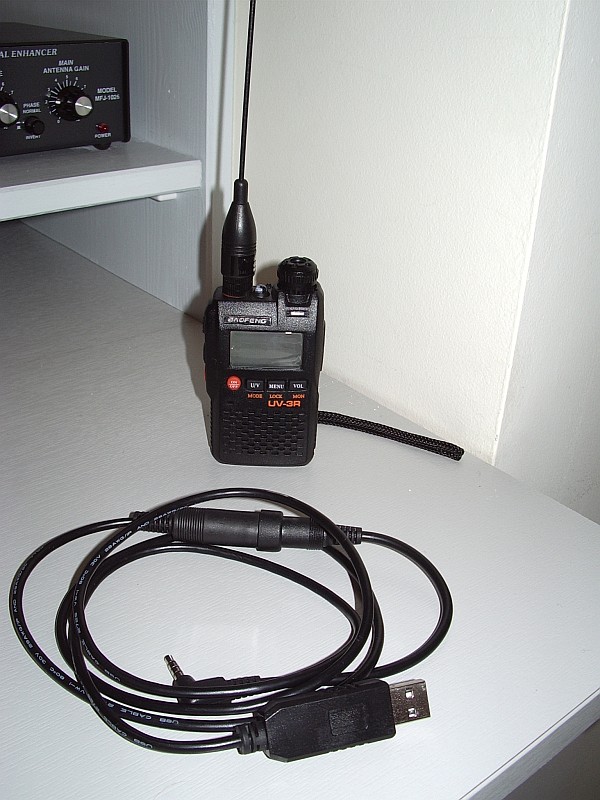
A few months ago, with other purposes in mind, I ordered on eBay two USB/TTL/RS232 cables. If you search eBay for “PL2303” you should find a couple of sellers: one from Hong Kong is currently selling a single cable with free shipping for £3.99. These are USB plugs with the serial converter built in to the plug. At the other end there are four wires: GND, TXD, RXD and +5V. The logic level is 3.3V (at least mine are) so it can be used directly with the UV-3R. Just solder the appropriate wires to a 4-way 3.5mm jack plug.
The connections (and the wire colours for my cables) are:
- GND (black) – base of the plug
- TXD (green) – first ring
- no connection – second ring
- RXD (white) tip
Cut off the red +5V wire and make sure it doesn’t short out against anything.
In the photo you’ll see that there is something else in the middle of my cable. That’s because I used a 4-way 3.5mm to mini-DIN adapter sold for use with various Yaesu radios such as the VX-1R, VX-3R, VX-5R, FT-60R and VX-150 instead of a simple plug. I bought that at the same time I bought the radio as I thought it might be useful if I wanted to try connecting other things such as a TNC. Plus the simple 4-way 3.5mm jack plugs are a bit hard to find.
Mini-DIN plugs can be a bugger to solder, especially with my hands shaking as they do now. But the inline socket I used today had terminals that would hold the tinned end of a thin wire pushed into it even without soldering, which made the job easy for me.
I tested the new cable with the UV-3R programming software and it worked, so that was a good result.
By the way, I saw on the UV-3R Yahoo group that the free cross-platform cross-radio programming tool CHIRP will soon be supporting the UV-3R. I can claim a little bit of credit for that as I was instrumental in persuading a UV-3R user who had been investigating the programming protocol to share his findings with CHIRP’s author. So soon you’ll be able to upload memories from other radios into your UV-3R.

Julian Moss, G4ILO, is a regular contributor to AmateurRadio.com and writes from Cumbria, England. Contact him at [email protected].
I am thinking Flight of the Bumblebees in STYLE this year !

K4UPG demonstrates how to get to FOBB in STYLE!
While everyone is thinking about antennas, staying cool and planning for the upcoming FOBB, I been checkin out a new ride! What do you think? Buzz- Buzz! Does this shout FOBB or what?
Now I can settle down and get ready for FOBB action with my untested top secret antenna. It will be all out for me again this year! Lookin’ for my friends out there on the ether and praying we don’t get lightning again like we did in 2009.
The last few years 20 meters has been the go to band, but it sure has not sounded very good here in Central Florida during the contest hours, so it will require being ready to shift bands to take advantage of the conditions.
BumbleBee #010 is gonna be listening for you all and lookin’ for the promised post of last year’s results too. CUL and 72– K4UPG
Kelly McClelland, K4UPG, is a regular contributor to AmateurRadio.com and writes from Florida, USA. Contact him at [email protected].
Almost a fellwalk
It has been yet another fabulous summer day here in Cumbria. I’m in good spirits and physically feeling fitter by the day. I think the balance issues and “jelly legs” are more an effect of the brain operation than a lack of fitness. Perhaps the same reason my hands often shake badly and cause frustration when trying to attempt soldering.
We decided to go for a walk over the fields to the north of Cockermouth and have a picnic lunch. I took the Taiwanese twins in the hope of making a few radio contacts whilst we were out.
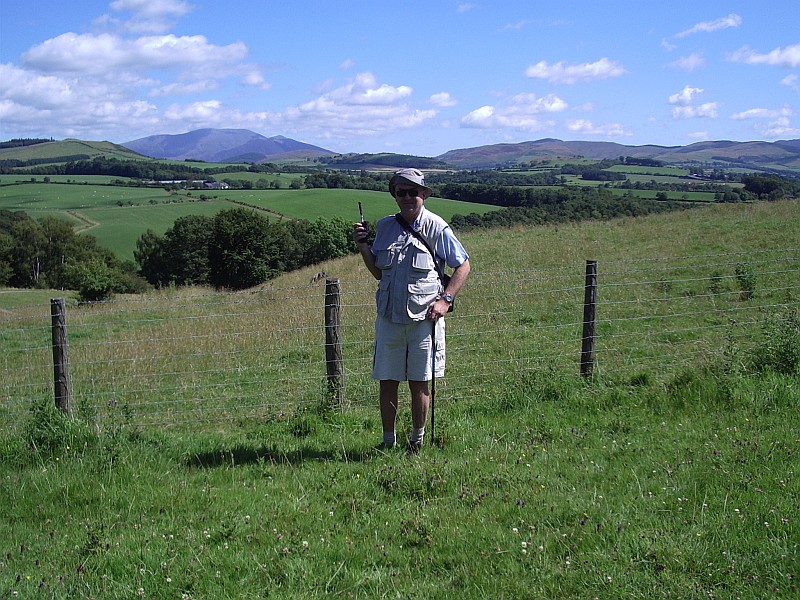
The walk involved some gentle climbing up from the valley. On the way I heard Alan M1EYO/P call on 2m to activate the SOTA summit of Watch Hill G/LD-054 which is almost literally in my back yard. You can see it on the far left of the picture behind me. When I was fit I could walk to Watch Hill though I never did as there was not much attraction in walking for an hour and a half to reach the summit when I could park the car within 15 minutes walk of the top. With no car unfortunately even Watch Hill is out of bounds.
After I worked Alan we carried on walking until we almost reached the Carlisle road, where we found a grassy south facing slope to have lunch. This is probably the only portable site that I can reach on foot from here, though it isn’t a very good site as it is still within the Derwent valley or “Cockermouth black hole” as I call it.
Checking 2m from time to time with a 5/8 telescopic whip on the 2m radio I heard Richard G1JTD/P activating Illgill Head G/LD-029. With a bit of help from Tony G1OAE Richard heard me and we made a contact. I had to use the monitor button to disable the fixed squelch on the H112PLUS which is set far too high. The receiver on the 5/8 telescopic seemed quite poor possibly due to intermodulation or overload. These really are terrible radios!
Alan was going to activate Binsey G/LD-041 a favourite of mine which was in fact the last summit I activated so we waited until he called on 2m and I had another contact. Alan told me he had discovered Rob G4RQJ on the other side of Binsey summit working 40m and setting up to try 4m. I pricked up my ears at the mention of four metres and about a minute later I heard Rob calling on the other H112PLUS so I was able to make my second-ever contact on 70MHz. Binsey is also line of sight from where I was so it was not a DX contact but it was still nice to make a contact on the 4m band.
After that we packed up and walked home. It was a pretty tiring day’s outing for me, definitely the furthest I have walked and the highest I have climbed since my operation. But it was quite a morale booster to get out on such a nice day and do some portable operation. There are even some trees there I could try to get some wire over for some HF operation with the FT-817 in the future, so that’s something to look forward to.

Julian Moss, G4ILO, is a regular contributor to AmateurRadio.com and writes from Cumbria, England. Contact him at [email protected].
Improving 50-MHz Receive Capability
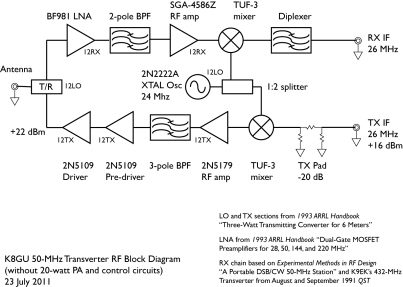
As I mentioned previously, the receive capability in my 50-MHz transverter seemed to be a little bit anemic. So, I decided to add a little bit of gain. Looking at the block diagram for the transverter (shown below in updated form—jumper across the SGA-4586Z to understand what the circuit looked like initially—by the way, full-sized PDF versions of all of my notes and schematics will eventually be available here), I reasoned that I had the following losses and gains: +10 dB for the LNA (this might be as much as +15 dB, but 10 seems more realistic, if not generous), -3 dB for the bandpass filter, -7 dB for the mixer conversion loss, and -3 dB in the diplexer, leaving me with -3 dB overall conversion gain.
So, I endeavored to find some more gain in the form of a MMIC (which is really what all gain blocks in this transverter would be if I were to do it again). I have a nice (but dwindling) supply of SGA-4586Z’s that produce about 20 dB gain with a 1-dB compression point around 16 dBm, which is probably a good part for this location. The idea is to overcome the losses in following stages with robust gain in earlier stages (in order to keep system NF low). So, I ripped out the existing two-pole BPF and replaced it with this:
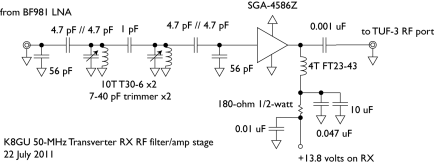
I was relatively satisfied that I had everything working with the cover of the transverter off to peak the BPF on the W3APL beacon. So, I replaced the cover and surprise! To borrow a poetic description of RF circuit doom from N3UM, the MMIC “amplifier burst into song.” Bursting into song is a bit of a charitable description for something that sounded more like S9 power line noise in the IF receiver. I did not actually know that it was the MMIC oscillating at first, but I started wiggling cables and finally found that if I touched the 12RX (+13.8 volts on RX) line, the problem disappeared. So, I added the 0.01-uF bypass capacitor to ground on the supply side of 180-ohm bias resistor and the problem was solved.
With the completion of the HF SoftRock with Si570 LO, I now have a tunable IF to play with the transverter. We had a nice opening to the Southeast and Gulf this morning and I even heard my first DX with the transverter and SoftRock combination—CO2WF. With the appropriate software, I can configure a the SoftRock as a panadapter with the TS-930S as the transmitter. More on this in the future. Best of friends:
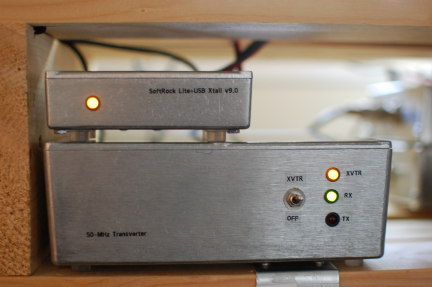
The real next step in making the transverter useful is building a 20-watt PA stage. This should be good for driving a Mirage or TE Systems brick or even something bigger like a 3CX800 or 50-volt solid-state amp…
Ethan Miller, K8GU, is a regular contributor to AmateurRadio.com and writes from Maryland, USA. Contact him at [email protected].
SoftRock v9.0 Lite+USB Xtall QRV
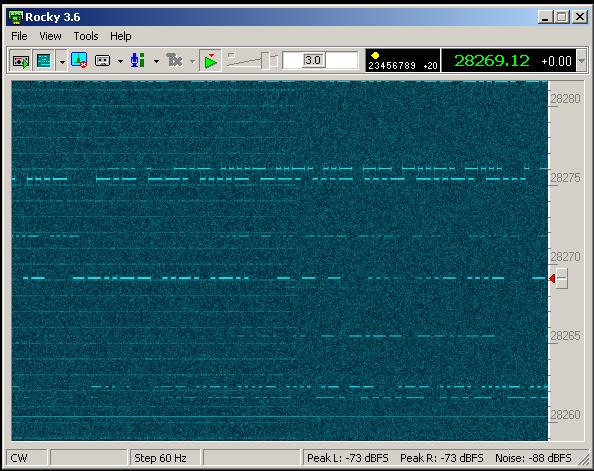
Got the SoftRock v9.0 Lite+USB Xtall working last night. I’m not 100% sure what the problem was, but I think it may have been due to me programming an ATTiny85 with the latest SoftRock firmware (V15.14), rather than using the supplied ATTiny45 with V15.4. So, I’m sticking with old version for now. Not sure if it was cockpit error on my part programming (more likely) or an incompatibility with the new firmware which is designed to work with the Ensemble series of SoftRocks.
As shown in the screenshot from Rocky above, there appears to be a spur that repeats every 1 kHz (see left side of the waterfall). The right side of the waterfall is with the USB cable unplugged from the computer. I’m 99% certain this is something internal to the SoftRock because I wrapped a few turns of the USB cable around a big type-31 ferrite toroid and the spurs are still there. So, need to play with that.
I’m listening to a Es opening to the south on 50 MHz right now using the SoftRock as the RX IF. Yes, that means that I got the RX on the transverter souped up a little hotter. I will post something about that later today and place a non-causal link in this post.
Ethan Miller, K8GU, is a regular contributor to AmateurRadio.com and writes from Maryland, USA. Contact him at [email protected].
ARRL Midwest Division Convention
Sorry about the infrequency of posts this summer from me. Summers are a bad time for the amateur radio hobby for me every year and this one is particularly bad.
It’s been complicated by a storm that came through 5:15 AM CDT July 11th, with 70-90+ MPH sustained winds (for, I’m not kidding, 15 minutes) and took down *ALL* of my wire antennas. (Trees fell through their paths, so my designs were still mechanically solid, right?) So I’ve been very QRT and have spent the last several weekends cleaning up the lot and fixing storm damage to my house. At least the tower and aluminum antennas seemed to have survived the ordeal.
Because of all of this the amount of time I’ve had to dedicate to the hobby has been minimal for the last couple of months. I’ll get back to it when I can. I had a bunch of antenna work planned before winter anyway.. now I have twice as much! :O(
However, I am involved in a minor way on the committee that is handing the ARRL Midwest Division Convention and I am specifically handling Kit Building at the event.
Also I’m sort of the publicity guy too.. but I’m getting plenty of help for others for that role!
But, nonetheless.. I should still publicize… So here is a shameless plug for the event.
http://convention2011.cvarc.rf.org/
I’d like to personally invite all of my ‘blog readers to attend our convention in Cedar Rapids. If you are within a 250 mile one way drive.. it will be a no-brainer for a really fun and interesting weekend devoted to ham radio.
The convention will be held at:
Clarion Hotel and Convention Center – Cedar Rapids, Iowa
525 33rd Avenue S.W.
Cedar Rapids, Iowa 52404
Mention the “ARRL Midwest Convention” when booking
Reservations: 877-949-2992 Fax: 319-362-1420
If there are issues at the Clarion, since it’s getting close to the event, don’t worry..the area is “hotel row” and there are plenty of options.
On Friday August 5th, we have an educational, hands-on tutorial on getting stated with the TI OMAP processor based BeagleBoard (Rev C) and BeagleBoard XM for Amateur Radio uses. It’s the intent of a group of mostly Collins ARC guys to eventually evolve this board into a SDR but many other projects (such as D-RATS/APRS gateways, portable HF digital mode units, etc.) have also been contemplated and input on this project will be welcome. The fee is $10 for this if you are registered for the convention also, $20 if not.
On August 6th we have a plethora of interesting speakers in an “operating” and “technical” track. There is also a Youth forum (12 and under is free for the convention). In addition, Ed Hare W1RFI and Kay Craigie N3KN ARRL President will be attending. Kay will be the banquet speaker. Since this is an ARRL convention an official “Wouff Hong” ceremony will also take place. This is a grand opportunity to become a part of this “official” fraternity! The list of speakers is on the schedule page, http://convention2011.cvarc.rf.org/schedule.html
I will also personally be the master of the kit building session that includes a cute little PIC based keyer that would work wonderfully in a Rover (AA0ZZ design) and a 40m NM0S (locally designed) HamCan two transistor regenerative 1/2 to 1 W PEP output transceiver.
WA0ITP of 4SQRP fame and K0NEB the “kit building” columnist for CW magazine are scheduled to attend and have stated their intention on assisting me if needed. The kits are suitable for beginners and I will NOT let you fail building one.
Then if you are smart enough to stay the night at the Clarion, you can attend one of the region’s best hamfests on Sunday August 7th (which is an annual event even on non-convention years)… Cedar Valley ARC “Summerfest” near the hotel at:
Teamster’s Hall
5000 J Street SW
Cedar Rapids, IA 52404
Which is about 1 mile from the convention.
Hopefully I will see some of the regular viewers of the ‘blog at the event.
The day of the event is getting close. If you want to come it would be highly appreciated if you mail your registration (from the website .PDF) as soon as possible.
Fred Spinner, WØFMS, is a regular contributor to AmateurRadio.com and writes from Iowa, USA. Contact him at [email protected].
Never Say Die: Better Youngsters
 My search for a way to generate more young hams has taken a strange turn. My original goals were to (a) provide a solid excuse for our hobby to be kept alive, despite the pressures for our valuable spectrum by rapidly expanding commercial interests and (b) help provide the high-tech work force our country is going to need to compete against the other industrial countries.
If we’re going to do this we have to get kids interested in hamming. This brought me head-to-head with the mess our schools are in. And that, in turn, got me to reading about our educational system. I’ve found that I’m not alone in criticizing our schools.
Now, before I get really started on how lousy our schools are, let’s just consider what you might do if you were interested in having the very best child or grandchild you could. First, let’s talk about what can go wrong, and then we can discuss how to fix the situation. I’m presuming, of course, that you might have a shred of interest in giving your children the best start in life that you can. Maybe you don’t give a damn. Many parents obviously don’t.
By the time your kids are seven the largest part of their characters will have already been formed. The child at seven won’t be very different fundamentally from the teenager at 15, or the grown-up at 30. Maybe you’ve seen the movie they made about that. If not, rent it.
Your child starts with the sperm and the ova. Anything you do to screw up your DNA before conception is going to affect your kid, and not positively. If you mess your sperm up enough, there’ll be a miscarriage. But a lesser disturbance of the DNA message will just burden your child with problems. There may be health, behavioral, or even cosmetic birth defects.
So what can we do to give our kids the best possible start? Well, research has shown that there are a lot of things that affect our sperm. There are drugs such as caffeine, nicotine and alcohol. There are magnetic fields such as we find with electric blankets or living near power lines or power sub-stations. There are poisons such as mercury, silver, and nickel, which we can get from amalgam fillings in our teeth and inoculations, such as for flu. Most of us already know about crack babies, and terrible problems from cocaine, pot, and the hard stuff.
So let’s say that you and your wife go out of your way to give your kid the best start you can. Then comes birth. I’ve got to get you to read The Continuum Concept by Liedloff. That’ll keep you from letting the hospital put your baby in their nursery. This is a wonderful guidebook for the first year of life.
Next comes the pre-school era from one to five. This is a time of incredibly rapid learning. It’s a wonderful time to teach babies several languages, if you have a way to continue and develop their use later on. Use it of lose it.
Unfortunately, even if we’ve done everything the best we can until we send them to public school, this is when we can permanently screw up the rest of their lives. I hope I can get you to get the book by John Gatto, the New York State Teacher Of The Year, Dumbing Us Down, The Hidden Curriculum of Compulsory Schooling. It’s inexpensive and a humdinger. Of course, since you are an alumni of this school system, the chances are great that you do not have any interest in reading books. Do you know that the average American schoolteacher only reads one book a year. And then, even if you do read Gatto’s book and get all upset when you find out what’s been going on in schools, you have been so conditioned by your own school experience so the odds are that you have been made into a gutless wimp and won’t have the initiative to even try and do anything about it.
Heck, I’ve discussed the major problems facing our society and proposed inexpensive, creative solutions to them in my Declare War book. Several thousand people have bought it, yet I’ve seen no movement to try and implement any of my proposals. “It can’t be done. It’s hopeless.” Until I read Gatto’s book I hadn’t realized why I was getting verbal and written support, but not seeing any sign of people actually doing anything.
I was around eleven when it finally dawned on me that kids had no more rights than slaves. By law I had to go to school. The only rights I had in school were those the authorities let me have, and they have been backed up by the Supreme Court in this. I was forced to comply by the use of embarrassment and humiliation. You do nothing unless the teacher tells you to—which stifles thinking and makes you dependent on the teacher. I see this pattern in most of the youngsters I’ve hired, who are unable to think for themselves. They sit and wait until they’re told what to do. They are unable to plan work. They’ve always been stopped before finishing something by the bell, so they’re not familiar with the concept of completing work.
Gatto says, “It is the great triumph of compulsory government monopoly mass-schooling that among even the best of my fellow teachers, and among even the best of my students’ parents, only a small number can imagine a different way to do things. Only a few lifetimes ago things were very different in the United States. Originality and variety were common currency; our freedom from regimentation made us the miracle of the world; social-class boundaries were relatively easy to cross; our citizenry was marvelously confident, inventive, and able to do much for themselves independently, and to think for themselves.”
Gatto points out that it only takes about one hundred hours for a person to learn to read, write and do arithmetic, as long as they’re willing to learn. From then on they can teach themselves. “Schooling, through its hidden curriculum, prevents effective personality development. Indeed, without exploiting the fearfulness, selfishness, and inexperience of children, our schools could not survive at all, nor could I as a certified teacher. Nobody survives the curriculum completely unscathed, not even the instructors. The method is deeply and profoundly anti-educational. No tinkering will fix it—don’t be fooled into thinking that good curriculum or good equipment or good teachers are critical determinants of your son’s or daughter’s education.”
He points out that before television children had enough time to themselves to learn about self-motivation, perseverance, self-reliance, courage, dignity, and love. Now kids, on the average, spend 55 hours a week in front of the TV. That’s one-third of their time. Add to that the stresses of a two-income or single-parent family, and our kids have too little time to learn to become human.
Is it any wonder that our engineering universities are running out of potential students, and are having to continuously lower their admission standards? Only 7% of the high school graduates in America have enough math and science background to be accepted by an engineering college. The colleges have responded by turning to foreign students. That’s great for other countries, but it sure leaves ours in a fix. Here we are heading into a high-tech future and we’re turning out fewer and fewer American engineers, technicians and scientists.
The time was, 60 years ago, that youngsters wanted to be hams so badly that they’d put up with learning the code as a barrier. I did, even though I hated being forced to do something which did not make sense to me, even then. Very few of the kids these days have the passion to surmount obstacles, so we’ve instituted the no-code license. Well, we’ve been lowering the standards for school grades in order to get our kids through school, which is the same thing. They’ve even had to lower the SATs because our kid’s scores have dropped so much. Now I see some hams pleading that we lower the technical exam standards so kids won’t have to memorize so much to get a ham license.
There may be some American schools that are pretty good. I’ve read about a few. But most of the better educated children today are being schooled at home by their parents. Maybe you’ve read about it in Newsweek.
Home schooling will be a lot simpler once we have a good video educational series parents can use. These would use top-notch performers, plenty of graphics, and be fun to watch. PBS has been producing some superb educational videos. Now we need to have them to cover everything being taught in the K-12 years, plus everything that should be being taught. And also plus everything kids might want to learn, but which aren’t being taught. We need thousands of these videos.
We’ll still need schools to provide the hardware and facilities to teach skills. You can teach a lot about driving with a simulator, but then you need a car. Ditto flight simulators, etc. You can’t learn to juggle with a simulator, or to throw a boomerang. Or do glass blowing.
College? There may be some that are okay, but if you read the books on education you’ll find that most aren’t much good. Most of the “teaching” is done by student instructors. Get a copy of Thomas Sowell’s Inside American Education, 2003, Free Press, $25.
If you learn much about nutrition you won’t let your kids near a McDonalds. Granted, it’s difficult to get the facts on nutrition. The field is overgrown with fads and scams. But if you want to raise healthy, happy, intelligent children, you’d better learn.
Though it’s far from perfect, the best school I’ve found so far is the Sudbury Valley School in Framingham, Mass. Here’s a school that accepts children from 4 through 20. It has no curriculum! No classrooms. No tests. No grades. The kids learn what they want, when they want, and if they want. The results are spectacular. I’ve read eight books about the school and visited it personally. It turns out that kids, if give the opportunity, love to learn and run circles around those forced to take courses. My Secret Guide to Wisdom reviews the books about the school and explains where to get them. I wonder what I might have been like and accomplished in life if I’d been able to go to a school like that.
Wayne Green, W2NSD, is a special contributor to AmateurRadio.com and writes from New Hampshire, USA. Wayne is the former publisher of 73 Magazine and author of the popular column "Never Say Die." Contact him at [email protected].
 Ham Radio Deluxe |
 W5SWL Electronics |
 Ham Radio Prep |
 KB3IFH QSL Cards  Hip Ham Shirts  HamRadioAuctions HamRadioAuctions Reliance Antennas Reliance Antennas Enigma Shop Enigma Shop |  morseDX  Ni4L Antennas  R&L Electronics R&L Electronics antennas.us antennas.us QRV QRV |
- Matt W1MST, Managing Editor
