 |
 File: Batteries, What Not To Name Them
 19 August 2011 | by
Do you ever look at a product and wonder if someone was asleep at the switch when they named it?
Trust Fire? For batteries? REALLY?
Believe it or not, they actually get great reviews:
Matt Thomas, W1MST, is the managing editor of AmateurRadio.com. Contact him at [email protected].
TWiT.TV Special Event Station W6KB On The Air Aug 20 and 21
With the new opening of the TWiT Brickhouse studios, Leo Laporte, W6TWT is going to be hosting a special event station to celebrate the opening of the new studio, with the help a few area Hams.

Photo Courtesy of Leo Laporte – W6TWT
The Redwood Empire DX Association, who have been helpful in getting the new Amateur Radio station setup in the TWiT studios, will getting part of the special event station where visitors will be able to see the new studio and the classic Collins AM Broadcast station that will be on display and available for Hams to use 10am to 7pm on Saturday and 10am to 3pm on Sunday. The news release says each day, so I am assuming this is only for the special event. But I do remember Leo saying something about the station being available for other times, during an episode of Ham Nation. I’m sire someone will clarify this info.
The special event will use the call sign W6KB, but no word on specific frequencies to watch for the station, just that it will be on 40 and 20 meters in the afternoon and evenings. If any new info comes out, I would think it’ll show up on either Leo’s Ham Radio page or on the thread discussing this on QRZ.com.
Anyone who does make a contact with the station, can QSL direct to W6TWT, P.O. Box 1018 in Petaluma, CA. 94953 .
Wish I could work these, but I still don’t have HF and will be out of the loop for a couple days because of my other job in broadcast radio. But hey, I get to hang out with some real kick ass bands this weekend. So it’s not a total wash.
73.
Rich also writes a Tech blog and posts stories every Tuesday and Thursday on Q103, The Rock of Albany’s website, as well as Amateur Radio stories every Monday thru Friday here on AmiZed Studios.
Rich Gattie, KB2MOB, is a regular contributor to AmateurRadio.com and writes from New York, USA. Contact him at [email protected].
5V noise generator
An increasing number of electronic devices can be powered or charged from a USB socket. To charge them independently of the computer they usually come with a small switched mode wall-wart. Finding enough wall sockets for these broadband noise generators – in addition to all the wall-warts that already exist in the ham shack – can be a challenge. It would be nice if ham radio power supplies had a few 5V DC outputs.
When I started using my HTC Touch Pro smartphone as an APRS iGate I wanted to avoid using the HTC charger as I knew it created a few warblies on some of the HF bands. I wondered if I could power the phone from the shack supply instead. In the junk box I found a car charger for an old satnav that had the same mini-USB plug and fitted the cigar lighter type socket on my Diamond GSV3000 power supply. That seemed to do the job very well and didn’t appear to generate any RF noise (though the noise level here is now so high that the incremental difference made by one more switched mode device is hard to detect.) The only annoying thing about it was that it sticks rather a long way out of the front panel of the GSV3000, which is a bit of a nuisance on my narrow operating desk.
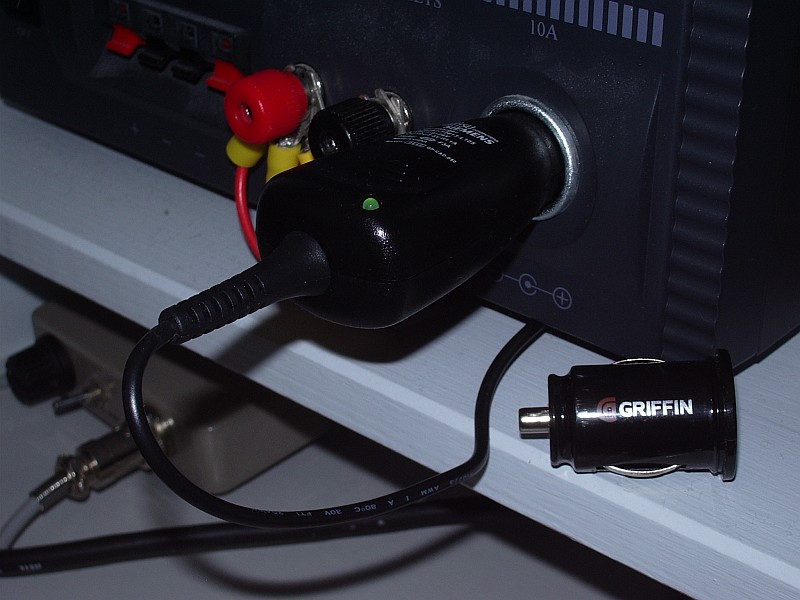
My next thought was that it would be nice to have more than one 5V outlet, perhaps in USB format, to occasionally charge other devices without requiring the computer to be on or plugging in another wall wart. Browsing eBay I saw a Griffin Dual Power USB Car Charger. This would give me two 5V USB outlets. And it was also designed to be flush with the top of the cigar lighter socket so it would look like an integral part of the GSV3000 once installed.
When it arrived I was quickly disappointed. As soon as I plugged a USB cable into one of the outlets, even with no load attached, broadband HF noise jumped up about 3 S-points. The device also got surprisingly hot even though nothing was drawing any current from it. I guess I should have anticipated that a device that size would use some kind of switching regulator and that this might result in noise. For the typical user wanting to power or charge two USB devices from their car, the noise is unlikely to be a problem. So I guess this particular solution to eliminating wall-warts is a non-starter.

Julian Moss, G4ILO, is a regular contributor to AmateurRadio.com and writes from Cumbria, England. Contact him at [email protected].
Fascinating signals: AA1TJ/QRPp
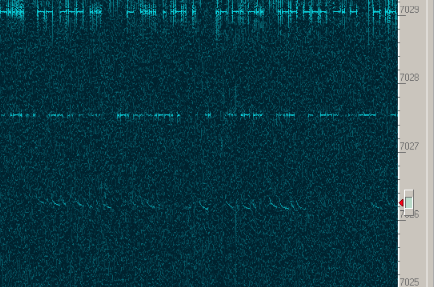
Last night, as I have been doing lately in both the evenings and mornings, I was trawling the bands with a SoftRock (a dual-band v6.0 built for 40 and 80 meters—my first SoftRock) and Rocky. Without fail, the waterfall enables me to see something interesting, which brings me to the point that I really need to integrate these receivers into my station. But, I digress. The really tantalizing, fascinating signals are the weak ones, especially when they are weak and unusual.
The subject weak and unusual signal is shown in the figure headlining this post. Rocky’s cursor shows the approximate bandwidth of the CW filter (250 Hz, if I recall correctly) and the center frequency (7026.25 MHz). I tuned it in and caught a CQ from “AA1T…” Recalling that I head read about Mike, AA1TJ‘s, Das DereLicht transmitter built mostly from parts scavenged from a dead CFL, I suspected it was him. After a moment the QSB came up and I caught the ‘J.’ Thanks to the fact that the SDR is not fully integrated into the station, I scrambled to plug my 15-year-old Small Wonder SW-40 in and get it online. Mid-scramble, Sarah handed Evan off to me for a diaper change, but I did manage to snap the screenshot above. By the time I returned to the shack awhile later to close things down, AA1TJ had disappeared.
Through the (ubiquitous) magic of the Internet, I sent Mike an apologetic e-mail QSL, which yielded a nice response. It turns out that he was trying a 40-meter version of the first transistor transmitter described in the amateur literature. The design for 146 MHz by K2AH appears in March 1953 QST. If you are an ARRL member, pull up those old QSTs in the archives and read about it. K2AH is on the cover of February 1953 QST with the same transmitter. Mike figures he was making 20 mW, or 20650 miles/Watt on the path from his station to mine. The more remarkable thing is that he was using a 1956-era point-contact transistor (the same type as in the K2AH article). Fascinating stuff! Hopefully, we’ll connect for a real over-the-air QSO sometime soon.
Thanks, Mike, for making my day by doing something interesting and sharing it on the air!
Ethan Miller, K8GU, is a regular contributor to AmateurRadio.com and writes from Maryland, USA. Contact him at [email protected].
Ham Nation 13
W6TWT unveils his new setup and makes his first QSO, Shorty explains WIN System, George shows one of the most valuable things in ham radio, and more.
Guests: Ray Novak, N9JA, Bill Hillendahl, KH6GJV, Bill Smith, AB6MT, Shorty Stouffer, K6JSI, and George Thomas, W5JDX
Download or subscribe to this show at http://twit.tv/hn.
We invite you to read, add to, and amend our show notes at wiki.twit.tv.
Thanks to Joe Walsh who wrote and plays the Ham Nation theme.
Thanks to Cachefly for the bandwidth for this show.
http://dts.podtrac.com/redirect.mp4/twit.cachefly.net/video/hn/hn0013/hn0013_h264b_864x480_500.mp4
http://dts.podtrac.com/redirect.mp4/twit.cachefly.net/video/hn/hn0013/hn0013_h264b_640x368_256.mp4
http://www.podtrac.com/pts/redirect.mp3/twit.cachefly.net/hn0013.mp3
Dr. Bob Heil, K9EID, is the founder of Heil Sound and host of TWiT.tv's Ham Nation which streams live each Tuesday at 6:00pm PT (9:00pm ET) at http://live.twit.tv. Contact him at [email protected].
Low power portable on HF
If you’ve been reading this blog recently, you may have got the impression that I’ve rather lost interest in HF operation. That’s not entirely true. But I do think that DXing in general has lost its appeal on HF for me. There’s the antisocial behaviour which dogs a lot of DX operations these days. And also, once you’ve played with WSPR and JT65 on HF, there’s the nagging doubt that using CW or SSB at 100w or more is somewhat akin to fishing by lobbing a hand grenade into the water and seeing what floats to the surface. Of course, that’s completely unfair, but it’s a fun analogy! Nevertheless, it’s clear that efficiency of an ‘average’ HF DX contact is suboptimal compared to a few mW and a ‘decent’ mode.
All that having been said, I still love being able to connect up a simple HF transceiver such as my FT817 and a simple antenna like my MP1 vertical and make CW contacts over hundreds or thousands of miles. It’s particularly satisfying to do that from a portable location.
And so it was yesterday that I thoroughly enjoyed some 17 and 20m CW QSOs around Europe. It was good, too, to hear Mongolia coming in loud and clear on 30m. But I wasn’t remotely tempted to get involved with the pileup!

Tim Kirby, G4VXE, is a regular contributor to AmateurRadio.com and writes from Oxfordshire, England. Contact him at [email protected].
Adventures in programming the Anytone AT5555
As the Anytone 10m rig arrived, the different band segments were fine, but I thought it might be fun to reprogram it a little. One thing I was keen to do was to be able to listen (only listen, mind you) lower down on 27MHz ssb. I guessed that activity would be higher there than on 28MHz and that it might provide some useful propagation indicators.
I ordered the programming disk and lead which arrived quickly. However, I had an enormous amount of frustration getting the lead to install on my PC (and actually I tried pretty much every PC in the house). Sometimes the PC would detect it as a COM port and sometimes it wouldn’t. I thought it must be me doing something wrong. However in the end, I talked with Paul in the sales/service department at Nevada and we agreed that I would send it back. I completely expected him to say that it worked fine for him, but happily he declared it a faulty lead. Unfortunately, though they were out of stock so I had to wait for a replacement.
The replacement duly arrived last week and the PC immediately picked up the COM port. I still had to fiddle and faff somewhat as I didn’t realise that my Anytone had v4 software in it rather than v3. Once I ot that sorted out, I was able to retask one of the band segments so that I could listen around 27.555. This works well (on receive!).
And as I hoped, it has already shown that the band is open more often than activity on 28MHz would have us believe. Sadly, I have already heard music and mildly abusive language on there! Not much difference, in case anyone’s feeling smug, to your average DX pileup on the amateur bands.
Positively though, the Anytone has been a real favourite through the summer, listening for Es on 28MHz. With the reprogrammed segment, I’m certain that it will be a great indication of when to put a CQ out on 10m.

Tim Kirby, G4VXE, is a regular contributor to AmateurRadio.com and writes from Oxfordshire, England. Contact him at [email protected].
 Ham Radio Deluxe |
 W5SWL Electronics |
 Ham Radio Prep |
 KB3IFH QSL Cards  Hip Ham Shirts  HamRadioAuctions HamRadioAuctions Reliance Antennas Reliance Antennas Enigma Shop Enigma Shop |  morseDX  Ni4L Antennas  R&L Electronics R&L Electronics antennas.us antennas.us QRV QRV |
- Matt W1MST, Managing Editor
