 |
 T32C expedition – dxpeditioning never runs smoothly
 17 September 2011 | by
 The FSDXA who are putting on the forthcoming T32C expedition plan things enormously well. Even when you plan and plan again, things go wrong. And so it is that their container with 6 tonnes of equipment is stuck in Tarawa (T30) and not where it should be. A boat has broken down, but despite promises, it has proved impossible to get the container to T32. The container has all the equipment required for the station so this is a significant setback. However, Yaesu have sprung to the rescue by lending 10 FT450s which can be hand carried. Lightweight linears, masts, aerials and computer equipment all need to be carried by the expedition operators. Knowing the group as I do, I am confident they will make a success of this. Read the full story at T32C.com

Tim Kirby, G4VXE, is a regular contributor to AmateurRadio.com and writes from Oxfordshire, England. Contact him at [email protected].
Solar power in and outside the shack
 |
| Just kidding! |
It has always been a dream to power everything in my shack with sunlight. Unfortenately solar panels and batteries are too expensive at the moment and you would only do such a thing when no other power source is available, like in the new shack from fellow blogger VK2TPM Peter. A good inspirator is VK5SW Rob, he has his solar powered station in the Australian bushbush. But for the average hobby radioamateur his equipment is too expensive I think, look at the size of the batteries! Those are very expensive for shure. In a previous post I wrote I bought a cheap 1,8W solar panel. It’s not sufficient to charge the 7Ah battery actually, it’s just topping it when you’re not using it. If I would have my antenna tuner connected all the time the battery will be below the 12,4V that it needs as minimum supply within 2 hours or so. I measured the current that the tuner takes when just connected and it’s 430mA. That would be P=U*I > 12,4*0,43=5,3W you see that I need a panel that is much larger. As I want to supply the W5OLF TX as well with solar in the future I even need some more power and a bigger battery. I found a nice package including regulator at this german shop, it’s reasonable priced and delivers 30W at a sunny day. Together with a 45Ah car battery I think that will do. They also got all kind of other handy things to connect to your solar installation. Like a fluorescent lamps – potential transformer, a idea for the new shack, imagine free solar powered light in your shack. I like that idea. Unfortenately if you look at the costs of all these nice gadgets you better switch on your light from the mains, till now it will save you money. I think to power my future shack with sunlight the solarpanels need to be a lot cheaper.
Bas, PE4BAS, is a regular contributor to AmateurRadio.com and writes from Groningen, Netherlands. Contact him at [email protected].
LHS Show Notes #064
Introduction:
- Apologies for being late with this episode.
Announcements:
- LHS had planned on attending the Ohio LinuxFest on September 9-11 in Columbus,OH, and the Huntsville, AL hamfest Aug 21-22, but it’s just too expensive. To address that, LHS has started the LHS Ambassadors program where listeners of the show act as representatives for LHS at events. If you’re interested, please contact us at [email protected]
- When you make a donation to LHS, you can choose to appear on the Sponsors page on the LHS website.
- Linux Format magazine, the producers of the Tux Radar podcast, recently reviewed various Linux-related podcasts, and LHS wasn’t even mentioned! Ouch!
- Richard announces the demise of Resonant Frequency: The Amateur Radio Podcast. Richard is looking for a place to post the articles and other content. The podcast episodes are saved at the Internet Archive, and the videos will remain on YouTube.
Topics:
- WinLink and AX.25
- Richard describes his trials and tribulations getting a WinLink packet gateway working under Ubuntu Linux.
- For the most part, Richard followed the instructions provided by Charles, K4GBB: How to install RMS Gate.
- Richard and Russ describe the steps in the Howto and possible pitfalls. Richard notes that you’ll probably want to run the commands as the root user, either by logging in as root or using sudo.
- (Note, near the end of Section 4 of the Howto, it appears the author left out the “wget” in the command to retrieve the script. On the page it reads:
Get Script – Bernard has written a little Housekeeping script...
http://f6bvp.free.fr/logiciels/ax25/rc.init.script && ...
- I think that command should be:
wget http://f6bvp.free.fr/logiciels/ax25/rc.init.script && ...
Note that I’ve shortened the lines with ellipses here. -Ed.)
- Other useful links:
Feedback:
- Andy, KB1OIQ, tells us of his Ham Radio Linux CD, based on Ubuntu Linux 10.10, and includes many ham radio programs.
- Rich, KD0BJT, of the LowSWR podcast, is working on a ham radio-related Linux distribution, too.
Contact Info:
- Contact Richard at [email protected], Russ at [email protected], or both at the same time at [email protected].
- Listen to the live stream every other Tuesday at 8:00pm Central time. Check the LHS web site for dates.
- Leave us a voice mail at 1-909-LHS-SHOW (1-909-547-7469), or record an introduction to the podcast.
- Sign up for the LHS mailing list.
- Sign up for the MAGNetcon mailing list.
- LHS merchandise is available at the Merch link on Web site. Check out the Badgerwear or buy one of the other LHS-branded items at PrintFection.com/lhs or Cafe Press. Thanks!
- Thanks to Dave from Gamma Leonis for the theme music.
Music:
- “Mendes” by Assembly Line Gods from the album “Control: Volume 1.”
- “Pound of Flesh” by Assembly Line Gods from the album “Control: Volume 1.”
Please note that the music in this episode is neither Creative Commons nor podsafe. To support the artist, please visit Assembly Line Gods on Facebook, iTunes or at http://www.assemblylinegods.com.
Russ Woodman, K5TUX, co-hosts the Linux in the Ham Shack podcast which is available for download in both MP3 and OGG audio format. Contact him at [email protected].
Texas Club Flies High with 10 Meter Balloon [VIDEO]
The North Texas Balloon Project is going to be launching mission number 19 tomorrow, at about 8:30am central time. The balloon will have a few payloads attached with different sensors and a 10 meter beacon aboard. It’s expected to go up to 100,000 feet, which will take approximately 90 minutes and return by parachute in about 50 minutes. A recovery team will track and retrieve the balloon using it’s on board APRS. All the particulars for mission 19 can be found on the group’s website. There is also information on their past flights as well. Below, I found a nice little video for a 2009 flight they did. This kind of thing is still on my bucket list to do. Maybe I should take the time this winter to start planning something out. Do some research and get some stuff together for it. And if I wasn’t already going to be running around Upstate NY all day tomorrow, I would be trying to listen for this on 10 meters and watching on APRS.
73.
Rich also writes a Tech blog and posts stories every Tuesday and Thursday on Q103, The Rock of Albany’s website, as well as Amateur Radio stories every Monday thru Friday on AmiZed Studios and hosts a podcast called The Kim & Rich Show with his fiance’ Kim Dunne.
Rich Gattie, KB2MOB, is a regular contributor to AmateurRadio.com and writes from New York, USA. Contact him at [email protected].
Who the…..???
I usually meet fellow hams on air and then continue our contact via the web. Last night was the other way around and it was a bit embarrassing. I am member of FISTS, the International Morse Preservation Society. I am a bit of a loner, not much into clubs, but do enjoy meeting like-minded folk, so I joined them. FISTS is nice because it encouraged learning Morse code and using it on air. FISTS has some chapters and I joined the East Asia chapter, which is comprised mostly of Japanese members. I offered to help edit and proofread the newsletter and Nao (JO3HPM), the editor-in-chief, took up the offer. For the last couple of months we have had a pleasant exchange via e-mail.
So last night I decided to practise my CW on air and answered a CQ on 30 meters, 10118 kHz to be precise. You may have already guessed it: the CQ came from JO3HPM and 10118 kHz is the FISTS calling frequency in the 30 meter band. Totally oblivious to both facts I started the QSO and only after Nao alerted me who he was it dawned on me whom I was having a QSO with. After my embarrassment faded away we had a very enjoyable 20 minute QSO. I am still a CW beginner and rely on Fldigi as a decoding back-up if my decoding skills fail. But with Nao this was hardly necessary, as he decreased his speed and repeated the more difficult words. That is the spirit and makes being a member of FISTS all the more worth while.
The only other thing……please don’t tell the NCC I had this QSO, because the band allocation for 30 meters here in Taiwan is 10.13 to 10.15 MHz only. Don’t ask me why. 73 de Hans (BX2ABT)
Hans "Fong" van den Boogert, BX2ABT, is a regular contributor to AmateurRadio.com and writes from Taiwan. Contact him at [email protected].
The Elecraft KX3 a need or a WANT
- KNB2 noise blanker
- KDSP2 DSP module
- KIO2 serial interface
- KAT100 auto turner (to be built and for home use)
- KPA100 watts module (for home use)
- KAT2 internal 20 auto tuner
- KBT2 internal gel cell battery
- The KX3.....................................800.00
- Battery..........................................80.00
- Paddle..........................................90.00
- Mounting bracket..........................30.00
- Filter..............................................60.00
- Mike..............................................60.00
Shipping....................50.00 (approx)
Total cost...............1339.00
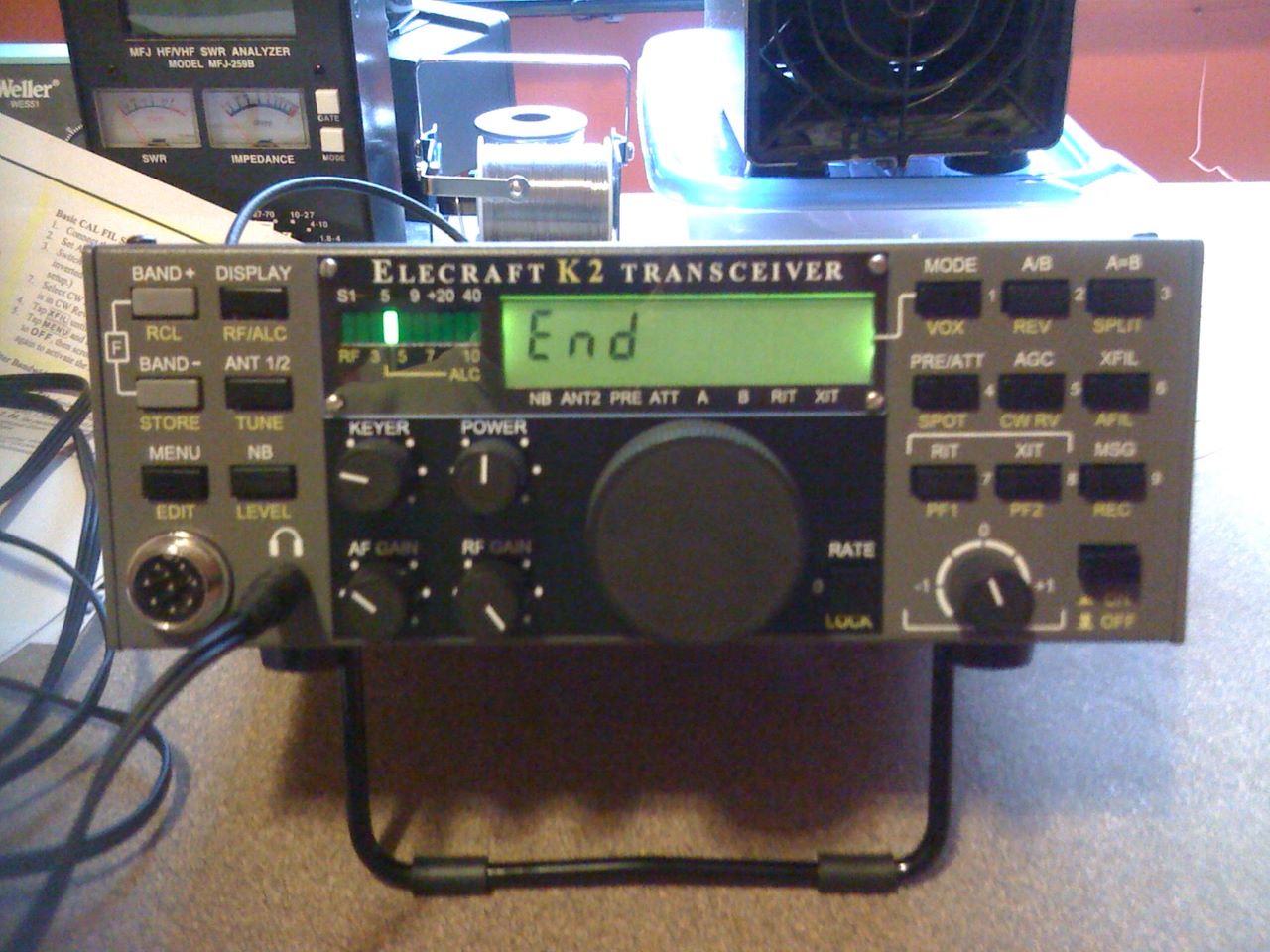
So again I asked my self "Do I need the KX3 or do I just WANT it!"
Don't get me wrong the KX3 is a GREAT radio and has many many things the K2 does not and will not ever have. I do have the cash on hand to purchase the KX3 it was all earned selling equipment around the shack. But after looking over what I already have....a fantastic fully loaded Elecraft K3 for home use. An equally fantastic portable rig being the K2 I am afraid I have to bow out of the KX3 race for now. I can't say the KX3 may never darken the shack but at this time my radio smarts tell me...."not now"

Mike Weir, VE9KK, is a regular contributor to AmateurRadio.com and writes from New Brunswick, Canada. Contact him at [email protected].
Balloon foxhunt 2011
It was balloon foxhunt day today. A yearly event I always try to participate in you can find some more information on  http://www.ballonvossenjacht.nl. I always try to improve my station to connect via the balloon transponder. And as always try to get my call into the logbook on 80m. Well, the propagation was very low today on 80m I could hardly copy PI4VRZ/A who was this time on USB instead of the normal LSB. But I finally managed to get my call into the log. I wanted to improve a little since last year so I removed the rotor from below my vertical and placed it on a tripod with on top horizontally my dual band Maspro beam with about 5 degrees elevation. Overall I noriced about 3dB improvement in favor of the Maspro beam. Not bad considering it was on about 4 Mtr above ground behind the house and the vertical nearly 6 Mtr above ground with free sight to the south. Last year I recorded a QSO between PD5DP and G4RUL, this year I succeed to make a QSO via the transponder with G4RUL. So I made a improvement for shure. I did use both radios to see the difference between the two antennas instantly. I noticed that all radio equipment was covered by a pile of dust an the Icom gets very old it switched off twice without touching anything and FM output was only there after 30 minutes. But who cares, I’ve been radio active again.
You can find a small video here
Bas, PE4BAS, is a regular contributor to AmateurRadio.com and writes from Groningen, Netherlands. Contact him at [email protected].
 Ham Radio Deluxe |
 W5SWL Electronics |
 Ham Radio Prep |
 KB3IFH QSL Cards  Hip Ham Shirts  HamRadioAuctions HamRadioAuctions Reliance Antennas Reliance Antennas Enigma Shop Enigma Shop |  morseDX  Ni4L Antennas  R&L Electronics R&L Electronics antennas.us antennas.us QRV QRV |
- Matt W1MST, Managing Editor
