 |
 Yet another fake Diamond antenna
 27 September 2011 | by
 I ordered a Nagoya NA-771 antenna on eBay. I was impressed with the shorter NA-701 and wanted something with a bit more gain that was not poke-you-in-the-eye long. The NA-771 had mostly good reviews on eHam.
I ordered from an eBay seller that shipped from the UK. The price was £4.99. When it arrived, I found the packaging and the antenna itself claimed to be a Diamond RH-771 not a Nagoya NA-771.

But this is clearly another fake Diamond. The lettering is white whereas the real Diamond product is lettered in blue. The lettering also contains nonsense. It claims “144/430 MHz & VDE BAND HECEMNG COVERAGE JAPAN.” Eh??? Perhaps it was supposed to say wide band general coverage? And the antenna is only 36cm long whereas the real RH-771 (and the NA-771) are supposed to be 39-40cm long.
None of this would matter if the antenna was any use, but in fact its resonant frequency is just below 120MHz. At 145MHz the SWR is more than 4 to 1 and it radiates a poorer signal than the shorter Nagoya NA-701 antenna.
Anyone want an air band antenna? Yours for a fiver. And can anyone recommend a seller that has the genuine Nagoya NA-771?

Julian Moss, G4ILO, is a regular contributor to AmateurRadio.com and writes from Cumbria, England. Contact him at [email protected].
CQWW RTTY 2011 with open 10m band
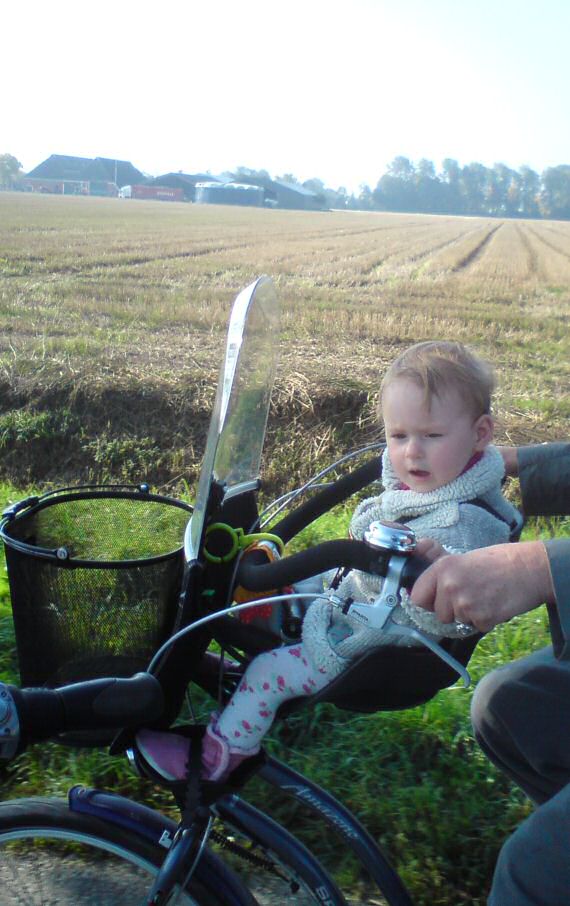
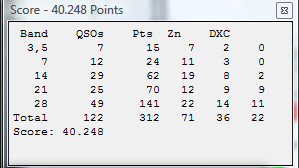
First of all you all probabely think I lost my mind and did paste the wrong photo. But it is just to show you that I did not contest the whole weekend as that would be absurd. We had the finest weather since weeks or actually months. So we took Anneli for some nice cycling in the morning and a walk in the Eemshaven in the afternoon. Well, besides the nice weather we all enjoyed I did some RTTY in the CQWW-RTTY contest. Luckely my computer has been repaired, it was the power supply that failed just like I thought. Unfortenately my colleague’s computer had a broken motherboard. So after all the hardware conspiracy I thought of was just a case of coincidence. Anyway, I had to install N1MM contestlogger again and immidiatly encountered a problem. The DXcluster frequencies did not match those of my receiver, I knew I had that problem before but forgot the solution. After a few minutes of trying and making some QSOs I finally found the simple solution: in the digital interface -> setup -> Turn autoTRX Update on. Now I was finally ready to go, although it was already evening. The strange thing was it was really quiet on 20m, I mean not as crowded as usual with this kind of contest. I probabely discovered why, the 10 mtr band was wide open. I really can’t remember that I made so many 10 Mtr DX QSO since I am on HF at the end of 2005. I remember my first USA QSO in 2007, but that was with my 6 element log-per antenna on the versatower. Now, I’m only using my Alu tape vertical on a temporarely mast. What can I tell I spend most of my contesting time on 10 Mtr, it was incredible. I finally made 122 QSOs not that much as last year, about 40% were made on the 10 Mtr band. I made 16 QSOs /10 diffirent states with the USA only on 10 Mtr and that was not the best DX yet. Here some DX results:
40m: OJ0X (Market Reef)
20m: P49X (Aruba)
15m: VP9I (Bermuda), NP4BM (Puerto Rico), YV5AAX (Venezuela)
10m: JH4UTP (Japan), 4J9M (Azerbaijan), LR9D (Argentina), PT5T (Brazil), UN8LWF (Kazakhstan), RG9A (Asiatic Russia), NR4M (USA), HI3TEJ (Dominican Rep.), OD5PL (Lebanon), 6V7X (Senegal), PZ5RA (Surinam), 5K3R (Colombia), CE3PG (Chile), VE3RTU (Canada), P49X (Aruba)
Bas, PE4BAS, is a regular contributor to AmateurRadio.com and writes from Groningen, Netherlands. Contact him at [email protected].
QSO Party Texas Style
 Just a few weeks ago I blogged about QSO Party Colorado Style, being that Texas is my birth state and where I lived until around the age of 32 (I’m a few days away from 45) I decided I would spend some time operating in the contest. While I do realize after operating in two QSO parties in less than four weeks, what I’m going to say next may not make sense, but I don’t consider myself a serious contester. In the four years I’ve been licensed, I’ve only ever operated in a handful of contests and have only submitted logs two or three times. Perhaps I’m more of a casual contester.
The reasons for my lack of contest involvement could be the same as anyone else’s. I don’t always have hours and hours to dedicate to operating a contest and when I do I may not want to spend all the time operating in a specific mode or band. But both the Colorado and Texas QSO parties occurred when I had several hours to devote and I enjoyed operating in both to represent my home state and birth state proudly.
Unlike the Colorado QSO party, the Texas QSO party is two days long (12 hours on Saturday and 6 hours Sunday). Of the total 18 hours, I estimate I operated about 5-6 with the majority of that time spent on Saturday.
Being the casual contester that I am, I eased into my Saturday morning just like any other Saturday. I grabbed my first cup of coffee and followed up on the news. Of course the BIG news was where did the bus sized satellite crash? Since I didn’t hear anything crash through my roof I assumed it was not anywhere near Colorado. I quickly read through my Facebook, Twitter and Google+ threads and by that time it was time for cup-o-coffee #2 and a more suitable time to turn on the HF rig and get the computers fired up.
Over the past few weeks, HF conditions have been extraordinary and the week leading up to the Texas QSO party weekend was no exception. I’ve read tweets and other blog postings talking about openings on 10, 12 and 15 meters. This is great news for those US technician class hams who have an HF rig. Remember you have HF phone privileges on 10m from 28.300 to 28.500. Listen around the 10m calling frequency of 28.400. In addition to phone, you also have RTTY and data privileges from 28.000 up to 28.300 including the JT65 frequency of 28.076. There is no reason you can’t get in on the fun as well. Want to know more about JT65? Check out my practical amateur radio podcast episode #46 you’ll find tips and links for this awesome mode.
Anyway, as I said HF conditions have been amazing and fingers crossed I would have no trouble working Texas from Colorado. As I was applying my second cup of coffee, I tuned around 20m listening for other Texas stations. I figured I would start off by using the “search and pounce” method and then find an open frequency and “run” for a while. As I tuned up the band and then back down all I heard was static and the occasional high powered net controller running whatever net happened to be taking place at the time. I checked Twitter and even tweeted that it appeared band conditions were really poor and the contacts were just trickling into the log book. Keith, G6NHU shared with me a blog article he had written earlier explaining why the HF bands weren’t playing well. By the way, if you don’t follow Keith’s blog….you should. Keith has an ongoing project called QSO 365, as he strives to have at least one QSO per day in 2011.
After stepping away for a few hours to get a few projects done around the house, I returned to find the afternoon conditions much improved. I quickly worked the stations up and down 20m and then found me a spot around 14.280 and began calling CQ Texas. I found I could get brief runs going, but it was mostly still slow going. At the end of Saturday evening I had managed to work 40 Texas stations in 28 unique counties. The stations I worked all commented on my strong signal. I was running 100w into my hamstick dipole. I must also admit their signals were all fairly strong as well with true 59+ readings. I only had trouble with a couple of mobile stations, but worked them in the end.
My two most memorable stations worked on Saturday would have to be NA5DV and NU5DE but of course for two different reasons. NA5DV was operating from the Battleship Texas which is anchored just beside the busy Houston ship channel and near the San Jacinto Monument. As a child we would visit the Battleship Texas every few years and I have very fond and dear memories of climbing on and exploring around this incredible ship. The Battleship Texas was commissioned in 1914 and served proudly defending the United States of America and representing the great State of Texas in both WWI and WWII. Working a ham station on board this beautiful lady and eventually getting the QSL card for my collection was the highlight of the day.
Yes, I said I had two memorable moments on Saturday, NU5DE (yes that is a vanity call sign) is a naturist amateur radio club near Austin, Texas. After working this station, I tweeted “Just worked NU5DE. This is a naturist ham club. I’m not sure how they were dressed, but I kept my clothes on”. Hey…amateur radio is for anyone and everyone. If this is the lifestyle they enjoy…then I’ll only take my hat off to them. ha ha

After a somewhat sleepless night and getting up/staying up from midnight to about 3:30 AM, I worked some RTTY stations and then got started with the Texas QSO party again on Sunday mid morning. I worked another 15 stations to top out at 55 total stations worked and earning a total score of 3,740. My total Texas county count was 32 of 254. I did manage to work my birth county (Henderson) and the county where I grew up (Anderson) along with counties I’ve lived in including Smith, Dallas, Travis and Williamson. But I’m not really a county chaser. 
I’ll have to check the contest calendar to see what future contests catch my eye and match my available time. But the Colorado and Texas QSO Parties are a must for 2012.
Until next time…
73 de KD0BIK
Jerry Taylor, KD0BIK, is a regular contributor to AmateurRadio.com and writes from Colorado, USA. He is the host of the Practical Amateur Radio Podcast. Contact him at [email protected].
Basic CW Operating Procedures
Back when I first got on the air in 1978, CW QSO’s had a pretty standard format. That format didn’t change much until the last few years. But today there’s quite a hodgepodge of operating procedures out there. Most of the time it works, but it’s not uncommon to hear a downright jumbled mess — even from a CW operator who has been on the air long enough to send and receive at 10 wpm or more.
It’s important to learn good operating procedure, not just because it sounds polished but because it serves a practical purpose. You can get away with sloppy operating procedure under perfect conditions, but not if your signal is weak or if there’s much QRM, QRN, and/or QSB. Even under perfect conditions, you’re making the person at the other end work harder if you’re constantly surprising him with your own odd way of operating. Under poor conditions, he may miss some of what you’re trying to say. And even if he succeeds at copying what you’re saying he may well be relieved when the ordeal is over.
I’m not going to get into all of the details of good operating procedure here, but I would like to discuss some basics.
General structure
There is a general structure to a CW QSO that most operators expect. After establishing contact, the first transmission should stick to the basics — RST, QTH, and name. You don’t know yet how well the other fellow is copying you; if you’re a 329, you’re going to torture him if you go on and on about your rig, your power, your antenna, the weather, etc. Furthermore, you might lose the opportunity to hear even the basics from the other fellow if band conditions deteriorate while you’re sending all this on the first transmission. So stick to the basics — and do send them. Here’s the way we all used to do it years ago:
NØART DE NØIP R TNX FER CALL OM BT UR RST RST 579 579 BT QTH QTH GRANITE FALLS, MN GRANITE FALLS, MN BT NAME NAME TODD TODD BT SO HW CPY? AR NØART DE NØIP KN
Note the use of BT. That seems to have fallen out of favor, but once upon a time it was the standard way of changing the subject. The most important thing I want to point out here is to preface each of the three major elements of this first transmission with their labels: RST, QTH, and NAME. It takes a few seconds longer than sending something like, “UR 579 IN GRANITE FALLS, MN OP TODD,” but it is worth it. As the FISTS club puts it, “Accuracy transcends speed.”
The operator replying to this first transmission sends the same three basics in the same way. If he’s inclined (and if he’s received a reasonably good RST) he will probably go on to talk about his station, the weather, etc. As it turns into a ragchewing session you can pretty much send whatever you want.
Procedure signals
Just as the use of BT has fallen out of favor, so have other procedure signals fallen on hard times. I often hear them sent incorrectly and used improperly. Remember what these are — they are procedure signals. Learn to send them well and to use them well, and your operating procedure will improve substantially. The ones most commonly used are AR, AS, BK, BT, K, KN and SK.
Notice the line that appears over each one of the two-letter procedure signals. That means you send the two letters as if they are one character. For instance, KN isn’t sent as dah-di-dah dah-dit (KN) but dah-di-dah-dah-dit (KN).
- AR End of message: Send this after you are completely done sending everything — everything, that is, but call signs and KN. If it’s your last transmission, use SK instead.
- AS Wait:You might hear this if you’re working an experienced operator. If you hear this, the next thing you hear will probably be silence — maybe he has to answer the phone or something. Or maybe you’ll hear him hold his key down while he fiddles with his antenna tuner. Don’t start sending — he’ll start sending when he’s ready. This is a handy procedure sign to know, if you ever need to take a break yourself.
- BK Break: This might be used by a station who wants to enter an ongoing QSO — he’ll send BK between transmissions to see if they’ll let him in and turn their QSO into a “roundtable.” With the advent of full QSK keying, this also became popular among experienced CW operators who could interrupt one another right in the middle of a transmission (perhaps to answer a question or clarify something). But most commonly BK is used to rapidly turn the conversation over to the other station without sending any call signs. For instance, an operator might send something like “HOW CPY? BK” and then cease his transmission. If this happens to you, reply by simply sending BK and answer his question. You can go back and forth in this manner for as long as you want, but don’t forget to obey the law by identifying yourself with your call sign at least every 10 minutes.
- BT Separator: Usually used to change the subject, even if it’s just to go from sending RST to sending QTH. (If you hear the other fellow sending BT several times, it’s because he’s trying to think of what he wants to say next!)
- K Over: This invites anybody listening to reply. Send this after you’re done calling CQ. But if you’re in a QSO, you almost always want to use KN, not K.
- KN Over (to specific station): Send this after signing over to the other station in a QSO, e.g. NØART DE NØIP KN. KN tells other listeners that they’re not welcome to call you yet — you just want the station you’ve named to reply. Don’t send this after calling CQ — send K instead.
- SK End of contact: This lets the other operator know that you want to end this QSO, and this is your last transmission. Usually sent in place of AR right before signing over to the other station.
The Handshake
It has long been customary to send “dit dit” at the very end of a QSO, like a final handshake. On the very last transmisssion, the sending station sends “dit dit” and then the other station replies “dit dit,” and that’s the end. Or (like we did in the old days) you’ll hear the first station send “dit di-di-dit dit” and wait for the second station to send “dit dit” (“shave and a haircut, two bits!”).
But this is often fumbled. Here’s how it usually goes wrong. The first station to send his final farewell, e.g. TNX FER QSO HPE CU AGN 73 73 SK NØART DE NØIP KN, knowing full well that the other station still plans on bidding him farewell in the same manner, goes ahead and sends “dit dit” at the end of his transmission. Naturally, the other station ignores this faux pas, goes on to send his last transmission, and only when he is done does he finally offer “dit dit” for the other operator to send his own “dit dit” again.
Now, this is obviously not the most important point of operating procedure, but why not do it right? No need to be socially awkward at the end of a good QSO!
I’ve only covered a few basics here. For more on CW operating procedures, it’s worth checking out something like http://www.fists.org/basiccw.html. But the best way to learn good operating procedures is simply to pay attention to what proficient operators are doing — especially as you get into more advanced operation, like handling DX pileups. The more listening you do before you wade in, the better operator you will be.


Todd Mitchell, NØIP, is a regular contributor to AmateurRadio.com and writes from Minnesota, USA. He can be contacted at [email protected].
When did 28 MHz get good?
I noticed a few tweets this afternoon about 28MHz being good. It wasn’t until just now that I listened on the little Anytone rig. Sure enough there was some SSB coming through and some good signals on CW too. Now, so far I haven’t connected up a keyed to the Anytone. Somehow it didn’t seem right to hear conditions like that and not try to make a QSO or two. I quickly diverted the coax from the Anytone to the HF port on the FT847, my VHF rig which has a built in keyer. Despite being after 1930z there was still plenty coming in. Some quite big pileups as I suspect a lot of people, like me, wanted to get on and make some contacts. KG9N was first in the log. YV8AD next and then the band started to fade. But one last spin up the band and there was NE0X finishing off a QSO. Very happy to work Ron for the best DX of the day. Good to hear 28MHz in such great shape.

Tim Kirby, G4VXE, is a regular contributor to AmateurRadio.com and writes from Oxfordshire, England. Contact him at [email protected].
The Practical Wireless 70MHz contest
I almost forgot! But I popped upstairs to have a quick listen just after lunch and decided to call CQ on 70MHz FM. I was pleased to be called and then a little surprised when a serial number was sent! I worked about 3 stations on FM and then decided to QSY onto the SSB end. As you know by now, the FT847 with the poor receiver and a vertical antenna is not an ideal tropo system. I was pleased to work G5RS/P in JO00 for a new square. One entrant who I suspect will feature in the leading stations made rather hard work of things by gabbling a report and locator and not sending a serial number! It took ages to get it out of them – long enough to make a quick QSO with a local in the meantime!Back on FM later, it was interesting to listen to Walt G3NYY/P operating from Broadway Tower. He was a great signal and it was good to be able to hear stations such as 2E0UAC in Coventry and even something from a station further north in Tamworth. Not bad for FM. I could also hear some fragments of a GW portable near Merthyr but sadly not enough for a QSO. A good afternoon on 70 MHz though.

Tim Kirby, G4VXE, is a regular contributor to AmateurRadio.com and writes from Oxfordshire, England. Contact him at [email protected].
1000 miles per watting
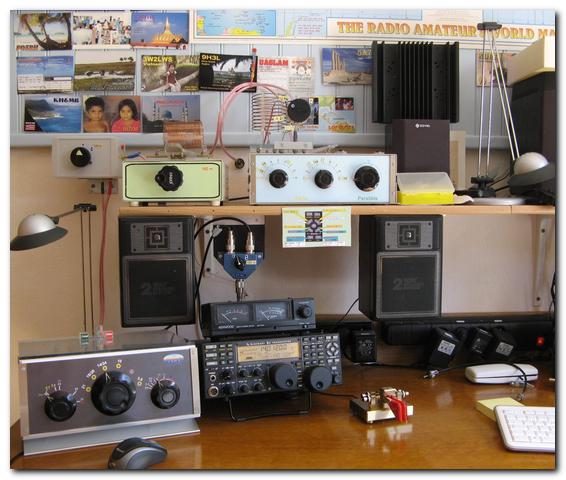 |
| F5HY station |
I then heard OZ3NP calling CQ on 20 meters and 3 watts just did not seem to cut it so I eventually cranked it up to 10 watts. Ben now heard me in Denmark and I was not sure if he was copying me at times but I'm in his log and I did get an email from him thanking me for the contact. That surprised me as this contact was plagued with propagation gremlins. AT QRZ.COM Ben has a great setup and with his son now a ham radio history goes back three generations in his family. It was time to shut things down as there was other things that had to be down around the house plus Julie and I were going to have Chinese takeout yummy.
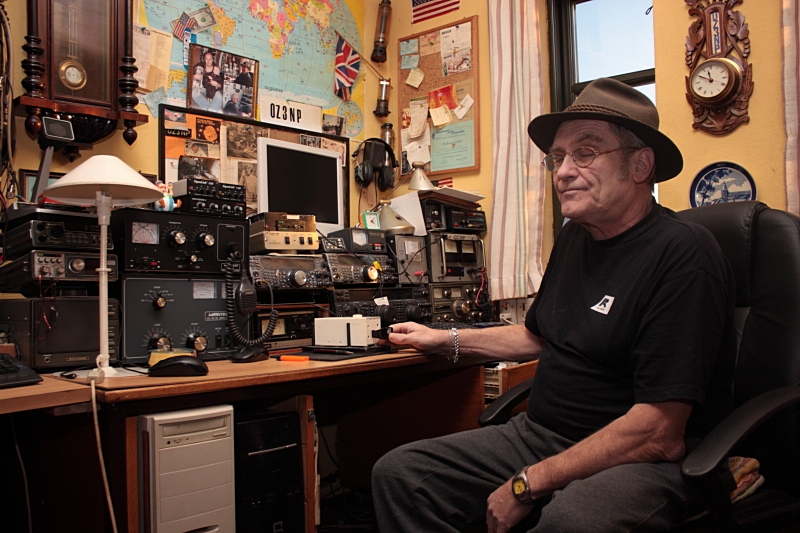 |
| OZ3NP |
I was able to get back on the radio again Saturday afternoon. I checked out 10 meters but it was dead there was some action on 15 so I thought I would give it a go. Rudy IK4VFD was calling CQ so I pumped my 3 watts into my attic dipole. Rudy came back to me and gave me a 529 this was strictly giving out RST, name and QTH as Rudy had a pileup waiting for him. There was a couple of repeats on my behalf as the 3 watts was struggling at times. With this contact my distance into Parma Italy was 1,412 miles per watt.
It was back to 20 meters as 15 seemed to be shutting down here I ran across UR4UC calling CQ Val came back to me on my first call. I received a 449 RST for some reason my keyer was acting up.....well at the time that was what I blamed it on. In fact it was my nerves getting the better of me during the contact. Not sure why but I can copy most QSO's when they are not a contact. As soon as I engage in a contact for some reason the code copying in my brain goes all funky. I also get all jumbled up with the sending at times as well. I could not understand why Val kept sending me "UC UC UC"....it was not until almost the final 73's that I realized I was sending UR4NC!!! If you read the blog Val sorry about that. This contact netted me my best miles per watt contact of 1,620 miles per watt.
It's now Sunday and I hope to get some radio time in this afternoon.

Mike Weir, VE9KK, is a regular contributor to AmateurRadio.com and writes from New Brunswick, Canada. Contact him at [email protected].
 Ham Radio Deluxe |
 W5SWL Electronics |
 Ham Radio Prep |
 KB3IFH QSL Cards  Hip Ham Shirts  HamRadioAuctions HamRadioAuctions Reliance Antennas Reliance Antennas Enigma Shop Enigma Shop |  morseDX  Ni4L Antennas  R&L Electronics R&L Electronics antennas.us antennas.us QRV QRV |
- Matt W1MST, Managing Editor
