 |
 Ham Radio Rocks at 700K Strong, YO!
 14 October 2011 | by
 According to a report from the ARRL, the number of Amateur Radio operators in the U.S. has grown over the past 12 years. From 677,000 in 1999 to a new all time high of 700,000 operators in 2011 according to ARRL VEC Manager Maria Somma, AB1FM.

A chart showing the number of licensed Hams for the past 12 years. Courtesy of ARRL
“At the end of September, I saw that the number of hams in the US was high,” she said. “When I started comparing that number with other years, I found that it was an all-time high.” Over the past 40 years, the number of Hams has been growing. In December, 1971 there were 285,000 Ham Radio operators, and the numbers increased dramatically. After another decade, in 1981, 443,000 Hams in the US. That’s a little under a 50% increase. And as the decades rolled on, the number of Hams grew still.
In the report, Somma went on to say,
“When looking at the three current license classes — Technician, General and Amateur Extra — these numbers are impressive,” Somma explained. “The number of Technicians peaked in March 2011 at 342,572, while in September 2011, we saw both Generals and Extras peak at 159,861 and 125,661, respectively. As new Technicians earn their Amateur Radio licenses, and current Technician licensees move on to General and Generals upgrade to Extra, this can cause up-and-down fluctuations for these totals.”
The question then turns to how many of these licensed Hams are still active. In a recent ARRL survey of members, more than 80% of the respondents are active. That’s still an impressive number. Somma continued to say these high numbers mean that hams are upgrading and renewing in larger numbers and staying interested in hobby. “As technology changes and advances, it is especially vital to keep up or be at the forefront,” Somma said. “I believe that Amateur Radio has done just that! The measurable results are our indisputable license numbers. It amazes me after all these years how important and relevant Amateur Radio remains. I am proud to be one of the 700,221 licensees and to see this historic and important milestone.”
73.
Rich also writes a Tech blog and posts stories every Tuesday and Thursday on Q103, Albany’s #1 Rock Station website, as well as Amateur Radio stories every Monday thru Friday on AmiZed Studios and hosts a podcast called The Kim & Rich Show with his fiance’ Kim Dunne.
Rich Gattie, KB2MOB, is a regular contributor to AmateurRadio.com and writes from New York, USA. Contact him at [email protected].
Amateur Wiring
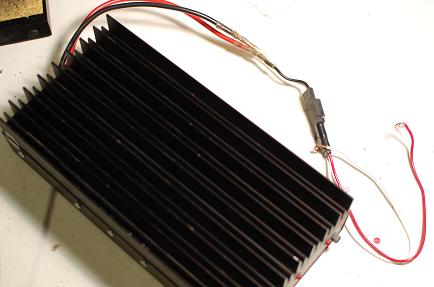
I’ve picked up a couple of Mirage “brick” amplifiers over the past few years. I’ve also rewired the DC cable on each and every one. Here’s the latest. AWG 10 to AWG 16 transition? Seriously? I know it technically doesn’t matter too much for a short run, but these amplifiers suck down a lot of current and I just don’t see cutting corners on that. Maybe I’m a purist…
Ethan Miller, K8GU, is a regular contributor to AmateurRadio.com and writes from Maryland, USA. Contact him at [email protected].
JT65A QSO on 10m


Julian Moss, G4ILO, is a regular contributor to AmateurRadio.com and writes from Cumbria, England. Contact him at [email protected].
JOTA from SPAAAAAAAAACE!
Fire up your sat tracking software, because the ISS will be live for Jamboree on The Air. An article at Southgate Amateur Radio Club’s website reports that Astronaut Mike Fossum, KF5AQG, will be participating in Jamboree on The Air from the International Space station this weekend, using the callsign NA1SS. Mike is also a scout master.

Photo Courtesy of NASA / Southgate ARC
While he won’t be available for every pass, you may hear him from 0800-1930 UTC as this is the usual work time for the crew, but they could also stay on a little later as well. When Mike is on he will be working ITU 1, which is Europe, Africa and Russia, with the uplink of 145.200 MHz FM and ITU regions 2 & 3, which is every one else, using the uplink of 144.49 MHz. Downlown for all will be 145.800 MHz FM. Be sure to be using a wide filter if your radio supports it, as the station uses a 5 Khz FM deviation, so 25 khz channel spacing is recommended.
If you don’t have satellite tracking software installed, you can track the Space Station online at NASA’s Spaceflight website. And, AMSAT UK has a wonderful article on getting started with satellites as well. This is should a fun Jamboree this year. To all the scouts and scout masters, enjoy!
73.
Rich also writes a Tech blog and posts stories every Tuesday and Thursday on Q103, Albany’s #1 Rock Station website, as well as Amateur Radio stories every Monday thru Friday on AmiZed Studios and hosts a podcast called The Kim & Rich Show with his fiance’ Kim Dunne.
Rich Gattie, KB2MOB, is a regular contributor to AmateurRadio.com and writes from New York, USA. Contact him at [email protected].
A deaf VX-3R
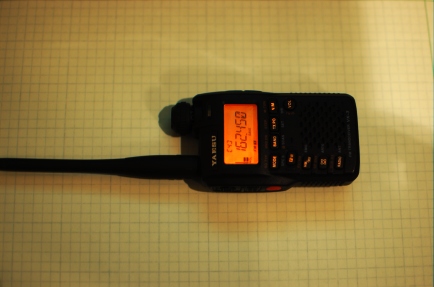
I do not spend a lot of time on VHF/UHF FM and have not for many years. My first radio in 1993 was an Alinco DJ-580T handheld and I’ve thought at various times that a new handheld might suit me well, especially for receiving. A few weeks ago, as I tend to, I came across a Yaesu VX-3R offered “for parts or repair” on attractive terms and so acquired it—my second handheld ever. The problem seemed straightforward enough: full TX power, but no RX on amateur bands. RX on FM broadcast OK. The seller assured me, after I had agreed to purchase based on his description, that “somebody” had told him that this problem occurs when “only one component is bad.”
Based on the seller’s description of the problem and a thorough reading of the Technical Supplement, I developed a short list of candidate failure modes, components, and sources. Fortunately, all of the components could be sourced easily from the usual sources.
When the radio arrived, I gave it a functional check and it indeed exhibited the problem that the seller had advertised. I quickly popped it open and noticed a small red sticker in the lower right-hand (when facing the device like you would operate it) corner of the Main Unit (Side A, per the Technical Supplement’s notation). A neatly hand-drawn arrow pointed to component Q1025, which upon closer inspection, was clearly damaged.
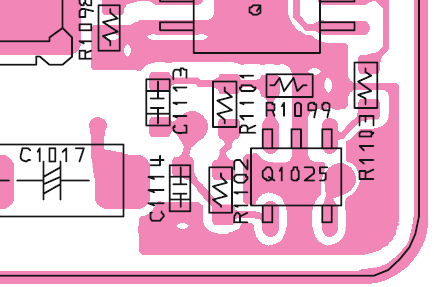
So, I quickly set about identifying the component and procuring a replacement. It was a NJU7007F3 operational amplifier. Huh…it did not contribute to any of the failure modes I had initially suspected. However, a careful reading of the Technical Supplement indicated that this op amp drives varactor diodes in a tracking preselector—so, if it does not work, the radio will exhibit varying degrees of deafness in the amateur bands. I found out later that the “somebody” was actually a Yaesu technician who had seen the radio for repair at the behest of a previous owner and left the sticker for me. At any rate, this component clearly would have to be replaced if I were to fix the radio, so I set about looking for a source.
Mouser listed it in their catalog but wanted me to buy a reel of 3000. No thanks. At least they had it listed. So, I did the next most logical thing—I made a list of other parts that I needed and called Yaesu. The part was back-ordered to Japan for 4-6 weeks, but only cost 0.42 USD. I bought three.
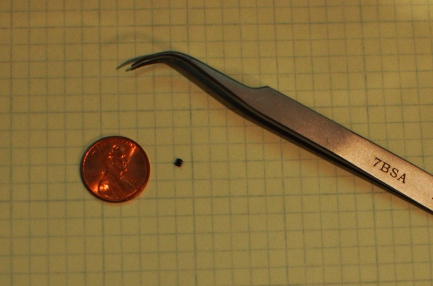
After however many weeks it has been, a package from Yaesu showed up on my doorstep tonight. After repairing a damaged PCB trace (non trivial on something this small), I was able to replace it. The little black speck in the middle of this photograph is the removed component. For my non-US readers, the US 0.01 USD coin (“Penny”) is about 19 mm in diameter.
The radio fired right up and received NOAA/NWS right away. The entire repair once I had the parts was about 30 minutes. There are still two unbuilt SoftRock kits, an IC-290A with an unlocking PLL, and W1GHZ transverters for 903 and 1296 to be worked on…maybe tomorrow…
Ethan Miller, K8GU, is a regular contributor to AmateurRadio.com and writes from Maryland, USA. Contact him at [email protected].
Ham Nation 21

Hosts: Gary Pearce (KN4AQ) and George Thomas (W5JDX)
Special cameo appearance by Joe Walsh! Plus National Electronics Museum, things to consider when buying a radio, building a speaker with a Dixie cup, and more.
Download or subscribe to this show at http://twit.tv/hn.
We invite you to read, add to, and amend our show notes at wiki.twit.tv.
Thanks to Joe Walsh who wrote and plays the Ham Nation theme.
Thanks to Cachefly for the bandwidth for this show.
http://dts.podtrac.com/redirect.mp4/twit.cachefly.net/video/hn/hn0021/hn0021_h264b_864x480_500.mp4
http://dts.podtrac.com/redirect.mp4/twit.cachefly.net/video/hn/hn0021/hn0021_h264b_640x368_256.mp4
http://www.podtrac.com/pts/redirect.mp3/twit.cachefly.net/hn0021.mp3
Dr. Bob Heil, K9EID, is the founder of Heil Sound and host of TWiT.tv's Ham Nation which streams live each Tuesday at 6:00pm PT (9:00pm ET) at http://live.twit.tv. Contact him at [email protected].
Antenna-Day #1, in My Son’s Words
As my son’s homeschool teacher I’m giving him plenty of writing assignments this year. Yesterday I asked him to write an essay, and I told him he could write it on anything he wanted. Here’s what he wrote:
Helping Dad Build His Antenna
by Antonio Mitchell, Tuesday, October 11, 2011My dad has been meaning to build his antenna for his radio for a while. We (my dad and I) finally got motivated and had some free time as well to build the antenna. We began yesterday to build it. Some complications slowed us down.
Yesterday, we went to Wilmar. The first stop was Walmart. When we were in Walmart I got my glasses back. After that we began our search for parts at Menards. It took us a while to find some parts. The whole trip to Wilmar, shopping, and going home took quite a few hours. My dad had to meet with a church member. While he was gone he got a piece of metal cut for the tripod legs.
When he came home several hours later my mom and I were raking leaves. He began to put together a jig to help hold the poles together. We began to drill holes into the poles. It took both of us to do it. The bit finally broke. After supper my dad worked on making a balun. He also made a new shopping list of parts. It will be a great joy to see the antenna up on our roof.


Todd Mitchell, NØIP, is a regular contributor to AmateurRadio.com and writes from Minnesota, USA. He can be contacted at [email protected].
 Ham Radio Deluxe |
 W5SWL Electronics |
 Ham Radio Prep |
 KB3IFH QSL Cards  Hip Ham Shirts  HamRadioAuctions HamRadioAuctions Reliance Antennas Reliance Antennas Enigma Shop Enigma Shop |  morseDX  Ni4L Antennas  R&L Electronics R&L Electronics antennas.us antennas.us QRV QRV |
- Matt W1MST, Managing Editor
