 |
 Time issues again
 24 November 2011 | by
 A few months ago I wrote about a time issue I had with a program called meinberg NTP. It suddenly stopped sync time on my laptop. I went back to Dimension4 and have no problems since. Now, I installed meinberg NTP on my desktop as well, using it for JT65-HF, WSPR and other digi mode programs. But last week it stopped sync the time on the desktop as well. So back to D4 I thought, so I downloaded it and installed but although it told the clock has been synchronized it didn’t really update the computer clock. I’ve tried everything to get it working, installed it again, did a restore of Win Vista, seaarched on the internet. But could not solve the problem. I wanted to get active again with JT65, but with the clock out of sync that is impossible. I found a atom time clock on the internet and updated the clock myself. But found that was not the solution. I came across NetTime then and just thought to give it a try. It seems to be working as I can make and receive JT65 again. Strange things happen if you use windows…..
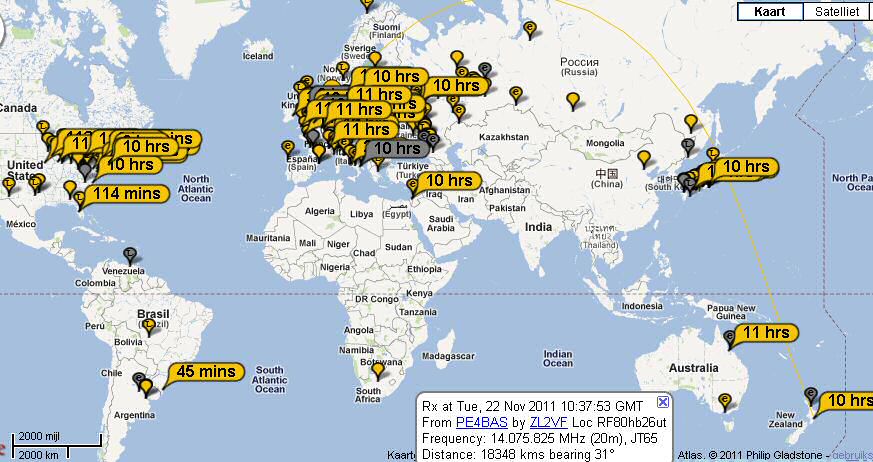 |
| Results after a QSO with Japan and USA on 20m with 5W on the loop antenna. |
Bas, PE4BAS, is a regular contributor to AmateurRadio.com and writes from Groningen, Netherlands. Contact him at [email protected].
Happy Thanksgiving!
First, the obligatory “my apologies for the lack of posts recently” statement. The usual excuses apply: work, family, sleep, more work, and my forty-something mind and body just doesn’t seem to have the get-up-and-go like it used to sometimes. But I digress. While I have the floor here, let me take a moment to wish everyone Happy Thanksgiving!
On the topic of radio, Oscar, DJ0MY, has created a professional quality keyer using the Arduino Nano module and my open source keyer code. Here’s a video of Oscar’s creation:
Oscar has been a big help in suggesting and testing features of the keyer code. He’s encouraged me to go out on a limb and code features I probably otherwise wouldn’t have, making the code what it is today. Oscar says that he will be creating a webpage detailing his work, probably around Christmastime.
I haven’t been on the air much recently, but I did build and start testing a beta release of the OpenQRP OQtransceiver1 rig.
The rig and the OpenQRP project is the brainchild of Steve, K1EL, the creator of the venerable Winkey. The OQtransceiver1 is a monoband CW 40m unit, featuring NE602s in a superhet design with a narrow CW crystal filter in the receive chain. The radio control is Arduino / ATMega328 based and the firmware is open source. The OQ1 features a CW keyer, frequency counter, RIT, memory keying, two line backlit LCD display, and a CW decoder. Output power is slightly more than 5 watts. The PC board and case is very professional looking and well designed. I’m hoping to contribute to the OpenQRP project with firmware code updates and new features in the coming months. I think the OpenQRP project is a nice concept that will likely produce some neat and innovative gear in the coming years, and provide another outlet for learning in this great hobby of ours.


I don’t care about SWR anyway!
 Did you read about W2LJ’s rookie mistake? Want to read about another one? Had some afternoon time yesterday and fired up my TS-440S with a fresh battery. Yes, full 100 Watt output this time.
I had no laptop, so I decided to do some just plain old CW/SSB again. 21 MHz was open to southern Europe, so I logged EA6UN in CW. He was quite strong, but some Japanese on the same frequency kept calling him even though he clearly stated “BX2?”. He still got me in the end, though, and I got him. The next nice QSO was CX2TQ in SSB on 14 MHz. Weak but readable when the local QRM was gone. First time CX in the log, so that was nice.
A little later I turned to 18 MHz and CT3FT came in very nicely in CW. I totally forgot to tune up and set the beat tone first and in my enthusiasm I answered him right away. When I looked at my SWR Meter I realised my mistake and started to fiddle with my antenna tuner. No need: he came back to me right away and gave me a 559 report. SWR on my side 1:5, output from my rig 12 Watts, reflected power 7 Watts. Does that mean I worked the Madeira Islands using QRP power? (12-7=5 Watts). Never mind, because I scored three new entities in one afternoon! Not bad at all for a cold and rainy afternoon.
Hans "Fong" van den Boogert, BX2ABT, is a regular contributor to AmateurRadio.com and writes from Taiwan. Contact him at [email protected].
Signalink = fantastic…getting it to work….frustrating
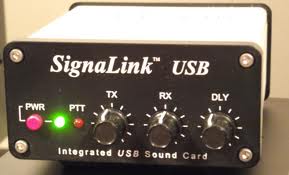 This week has been dedicated to setting up for the CQ WW DX CW contest this weekend. Making sure the contest logger works (N1MM), try out the CW macros along with the K3, test out the antenna on all the bands and finally make up some goals. I find by doing some prep work before the contest Murphy does not rear his head as often during the contest. Early last week my Tigertronics Signalink USB came in and it was my ticket to get into the digital world. Years ago I had a Yaesu FT-1000MP MKV I had the Rigblaster Pro along side it. I dabbled in PSK and was into RTTY contesting at that time. I had hopes of setting things up and getting on the surf board of Digital communications last weekend.
 Well that dream was short lived, the memories came back of sound card setup, adjusting the ALC level and basically getting everything just right for the digital engine to purrrr. Over the weekend the setup was not purrrring at all it was more of a hisssssss. The connections between my K3 and Signalink were smooth going. The PC recognized the on board sound card in the Signalink. At first I ran into some trouble setting up the CAT connection between the K3 and software (Ham radio delux's digital master 780) I was able to decode PSK signals with Digital Master, in transmit with the K3 set at 100 watts I was able to use the TX control on the Signalink to raise the output power to what I wanted (5 watts). The unresolved problem is I am not able to get any ALC reading on the K3. I know the ALC is very important to a clean signal. I have given up trying to solve this problem at this time. I am as I said concentrating on the CQ WW DX CW contest.

Mike Weir, VE9KK, is a regular contributor to AmateurRadio.com and writes from New Brunswick, Canada. Contact him at [email protected].
Handiham World for 23 November 2011
Welcome to Handiham World.
[email protected]
Handiham Manager

Early Winter Reading: Becoming a Ham (Part 10)

Becoming a Ham – Part 10
By T. A. Benham (SK – formerly W3DD, a callsign which has been reassigned.)
Tom Benham, now a silent key but who most recently held callsign W3DD, was a ham radio pioneer, and being blind didn’t even slow him down! Join us now as W3DD recalls more about satellites in the early days.
The Trailer
During April of ’59, the students and I heard of an offer from the Government. If we went to Indian Gap, near Harrisburg, we might be able to pick up some surplus equipment. Two boys and I went and we found a fully equipped trailer that was designed for tracking aircraft. It had a parabolic six-foot dish on top that was driven by a sophisticated system from inside. The trailer was 20 feet long and about 8 feet wide. We could have it for the price of getting it hauled to Haverford, which turned out to be $200. The college comptroller authorized the expense and the trailer was parked in a little lot behind the Physics building. With the help of several students, chief among them Amateur Ridgley Bolgiano, the trailer was converted into a satellite tracking station. The 6-foot dish was too small, so we set about finding a larger one. I had heard that ITT, in Nutley NJ, might be interested in giving a hand, so three of us went to visit. We were received most cordially and I asked my contact if they had any parabolic dishes that were due to be scrapped. He paused a minute, looked out the window, picked up the phone and called the Disposal Department. “Hey Jim, you know that 12-foot dish outside my window? Well, it looks like hell, cluttering up the lawn. Please send it to Haverford College, attention T. A. Benham and get rid of the unsightly thing.” That was more than we could have hoped for, but it wasn’t all. He next called his wife. “Dear, I have three very interesting fellows in my office and I want to bring them home to dinner so you can meet them.” We went to his house, had a very nice lobster dinner and a pleasant visit. In a week or so, an ITT truck appeared with the dish. The boys and I got it put together and mounted on top of the trailer. Then Ken from Gerald Electronics came out and helped get the equipment inside the trailer in good operating condition. Since it was intended to track planes, it was nowhere near ready for satellites. When the trailer was ready to be installed in a location suitable for tracking, it was moved to the middle of a large field about a quarter-mile behind the Physics building. We drove two stakes into the ground and strung a string between them to provide an exact north-south line so the tractor driver could point the trailer as nearly north as could be arranged. He had to maneuver the trailer several times to get it lined up to our satisfaction. We had built a heavy platform for it to rest on so it wouldn’t settle in the ground and perhaps alter its position. It was very interesting and exciting. We had electric, telephone and teletype lines buried from the nearest pole, which was about 300 feet away. One of the interested boys paid the monthly charges for the phone, another paid for the teletype, I paid the electric.
Linkup with NASA
Now we became a significant link in the NASA tracking chain, at least until they got their multimillion dollar system going. Ridgley built a remote control system so we could turn on functions in the trailer from anywhere. For example, I was coming home from Washington one evening and knew we had to track something about midnight. We stopped in Baltimore and by telephone I turned on the heat, and the receivers to give them time to stabilize. At that time it was illegal to use phone lines for private purposes, but we dodged the rules. One afternoon, there was a knock on my office door and a man entered saying, “I’m from the FCC. I have a complaint from the telephone company that you are running equipment by remote control through their lines.” “No, we’re not connected to their lines and are not violating the regulations,” I replied. “Well then, why have they complained?” I explained that we had mounted a coil on the wall under the wall phone in the trailer. When the phone rang, a voltage was induced in the coil which we used to control relays, timers, etc. He wanted to see, so I took him to the trailer and showed him. He was amazed and left saying “I guess we can’t stop you from that!” “No,” I agreed. “We do all this without removing the phone from the hook, so there is no way the phone company could know we’re doing it. If they allowed us to use the line, they could charge and it would be much easier for us to accomplish the task.” I never found out who complained to Ma Bell. Now days it would be no problem. Back in 1936 when I operated my transmitter from the College I had a dedicated line for which I paid, but it allowed control from only one location. The conditions under which this remote system were built had an interesting quirk. Ridgley was driving back to College from his home in Baltimore. Somewhere along the rather poorly lit route 926, he dozed a little and ran full tilt into the rear of a parked truck. Both of his knees were smashed. He spent many weeks in Bryn Mawr Hospital while they were mending. It was during this time that he and I designed the system, on the phone and in person. Then we got tools and parts together and took them to him. He mounted and wired all of the components on a piece of Plexiglas® measuring about two feet square. It was a beautiful piece of work and functioned like a charm. I was heart broken when it was destroyed in a fire! The operating code was simple. Call the number and let it ring once, then hang up. Within a minute, call and let it ring twice. This set two timers running. Then call again and let it ring three times to turn on the heat, or four times to turn on a receiver, etc. Timing was important. To turn things off, let the bell ring four times the second call instead of three and this would set things up for being turned off.
To be continued…

Pat Tice, WA0TDA, is the manager of HANDI-HAM and a regular contributor to AmateurRadio.com. Contact him at [email protected].
Powerline noise problem, resolved
As I mentioned in my previous post, I’d been having a problem with powerline noise recently. The noise started to improve after about 2 weeks, with it disappearing for periods but then returning, until gradually it stopped entirely around a week ago.
As I mentioned, I had reported the issue after about a week to the local power company and while it took a while (just under two weeks), I got a message yesterday from a technician who had been dispatched to check out the problem. He said that he was at my house at the time (I was at work) and wasn’t hearing any unusual noise but asked me to call him to discuss the problem. When I first listened to his message it sounded like he had just listened with his ears (not with any kind of equipment) and my first thought was that I’d have to go through and re-explain the situation to him. I didn’t have a chance to call him back until today, but when I spoke to him I discovered that he did understand the issue and worked in the department that deals with, among other things, RFI and TVI problems.
He asked me whether I’d had issues like this in the past (I haven’t) and I talked about how the noise seemed to start right after the power was restored to some nearby houses after the freak snowstorm in October. He said that what may have happened is that in situations like this, when they initially restore power they’ll do so in a temporary manner just to get people hooked up then come back later and and do a more permanent job. His thought was that the temporary fix was noisy, but as they went back to “clean up”, they may have found and corrected the issues. So while I don’t know exactly what caused the problem, the good news is that the problem is gone.
The other good news is that he gave me his contact information and told me that if the problem returns that I should call him directly, at which point he’d come right out (instead of me having to wait a couple of weeks) to investigate.
Why do we need a radio…or, is this the end of amateurradio?

I had a little sked last Sunday morning with PA3GNZ. And although this sked didn’t work out I had my HT on receive at the 70cm coversity channel. Now at a certain time I received 2 radioamateurs, the conversation went on and seems that one of them did not hear about the coversity channel before. He, like many others, thought he was being repeated by the PI2HVN repeater. It was the case as you can verify it at the internet and the other amateur told him that. It seems they had a chat before because the one mentioned earlier wishes to know more about coversity. Now, the other amateur told him to go back to skype so he could explain. And gone they were.
So what do we need radio for? Or is this the end of amateurradio (as we know it)?
Bas, PE4BAS, is a regular contributor to AmateurRadio.com and writes from Groningen, Netherlands. Contact him at [email protected].
 Ham Radio Deluxe |
 W5SWL Electronics |
 Ham Radio Prep |
 KB3IFH QSL Cards  Hip Ham Shirts  HamRadioAuctions HamRadioAuctions Reliance Antennas Reliance Antennas Enigma Shop Enigma Shop |  morseDX  Ni4L Antennas  R&L Electronics R&L Electronics antennas.us antennas.us QRV QRV |
- Matt W1MST, Managing Editor
