 |
 First Digital-Mode QSO!
 28 November 2011 | by
 Tonight I made my first digital-mode contact! Using PSK-31, I worked special event station VE3FRST (“UN International Year of Forests”) on 40 meters. Michael, VE3NOO, kindly emailed me this screenshot of the moment:

A few things had me fumbling around, but over the next few contacts I started to get the hang of it. After VE3FRST I went on to work another station in Ontario, one in Alabama, and one in France with PSK-31 before retreating to my key and working Costa Rica with CW.
I highly recommend the DigiMaster PRO PLUS! It comes with a USB soundcard and was very easy to hook up and get going with Ham Radio Deluxe/Digital Master 780. It performs both as a CAT interface and as a data interface, and works great.
I learned the hard way that not all CAT cables are worth buying. Buy cheap, and you’ll buy twice like I did. My first one was a cheap cable from “affordableradio” on ebay. It uses the Prolific chipset for the serial-to-USB interface. Stay away from Prolific! The only thing prolific about it was the prolific number of spontaneous disconnections and “Blue Screen of Death” crashes. I tried everything — every driver I could get my hands on, I/O buffer adjustments, etc. but it was junk. I couldn’t bring myself to sell it to another ham, so I returned it. No refund yet, but here’s hoping.


Todd Mitchell, NØIP, is a regular contributor to AmateurRadio.com and writes from Minnesota, USA. He can be contacted at [email protected].
The Zen of Arduino
Well, I shoulda gotten out into the detached garage this weekend and worked DX.. but the weather was nice on Thanksgiving and the day after (when I had to do family stuff thankfully) and freaking cold and windy the rest. (I can heat it but it takes some planning…)
So instead, I decided to catch up on building/hacking projects from the past and ones on a weird tangent to my current construction project the BATC DigiLite.
The past project is rebuilding my ORIGINAL 1998 Dallas Semiconductor “iButton” WS-1 One Wire weather station w/humidity and the tipping rain gauge (it’s been ten years since I had it up and running last– it took me several hours to find it!). I plan on stripping all of the one-wire garbage (sorry, it never worked reliably with any cable length at all) except for the temp sensors out of both units and embedding an AVR and running RS-485 to the units.. and connecting to an Ethernet connected Arduino to report to APRS and/or Weather Underground. My kids are interested and I’m also adding a Real Time Clock and a Barometric Pressure sensor (to the inside unit since my house isn’t pressurized) and having a fairly complete station. No PC will be required and the little 8-bit processors are misers when it comes to power usage!
I want to get my older boys interested in the systems engineering aspect and the coding and the weather station is starting to peak there interest a bit. Keeping my fingers crossed!
This is actually connected to the BATC project in that I want to use the Arduino development system and the extensive library of code instead of taking time I don’t have and writing everything from scratch on a PIC or AVR (non-Arduino). I discovered that except for the bootloader and the sometimes bloated code in some of the libraries (most are very good) that it is not that much less efficient than straight-C on the AVR’s. (The Arduino environment conceals a full open source GCC C++ complier and yup, you can write in C and C++.. you actually are even under the “sketch” environment– but they conceal that well to beginners.) Yes they are small, and slow.. but at $2.50-$6 a pop for DIP IC’s that you can hack together in a hurry.
Here is a picture of some of the AVR based toys I’ve bought and put together over the years. The “real” Arduino shields are recent.. for prototyping your own stuff they suck (since one header isn’t on 0.1″ centers.. DUH!).. but since they are a standard certain modules are cheap (at least the non-Italian “bad labor condition” clones from China) and readily available. You can put together relatively inexpensively and quickly since most of the core code can be borrowed from libraries.
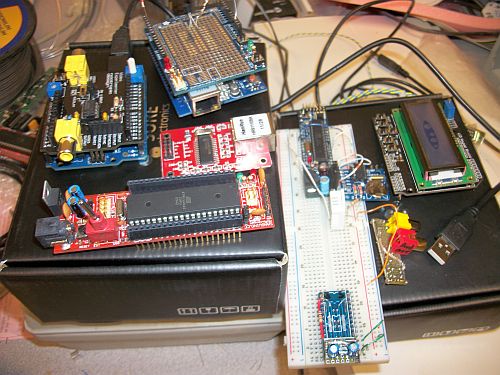
Some AVR based "Arduino" toys-- Arduino 2009 clone with a Nootropic Designs Video Experimenter's Shield, a Sanguino board, an Ethernet module, a Adafruit Proto shield on top of a Clone W5100 Ethernet/SD card shield, a "Boarduino" board with a humidity/temp sensor DHT-22 on it, and a DS1307 Adafruit RTC board attached.. and a homemade video/audio out and a e-bay "DFRobot" LCD Shield 16x2 -- "Unknown" proto card at bottom will be a 5V to 3.3V bidirectional 8-bit I/O board with a 3.3V regulator on it for prototyping.
In relearning the coding, I wrote a lot of odd stuff. Here is an example of a ATMega644 (in an Sanguino PCB) doing a bunch of stuff.. talking to a LCD (via the library in 4-bit mode) and shifting data to a 74HC595 driving the LED’s in a row.. reading from a Dallas (yes, one-wire) Temperature Sensor (those are great units if not parasite powered!) with two debounced switches… doing math for the PLL synth (the numbers in the left bottom corner).. Here is a video:
Sanguino board doing all sorts of stuff
Anyway.. I am going to use the ShiftOut function on the Arduino to program the "Ultram Technologies" PLL board (That I bought preset to 1255 MHz) for the DigiLite LO on the DVB-S modulator. I was going to use that Arduino 2009 / "DFRobot" (clone) LCD Shield to do a GUI. But most of the time the little AVR will be idle. So sad. So I came across the Nootropic Designs Video Experimenters Shield and I thought… really since the BATC project needs the real time MPEG-2 chip in the Hauppage PVR-150 board.. I might as well also do a callsign overlay.
Since the Arduino 2009 has a FTDI chip on it.. it has USB to Serial functionality on it. I can poll the UART at the Vertical Blanking interval and if it receives a PLL tune command, that can be sent to the PLL and displayed (for a short time?!?) on the Video overlay as well. For now, the video overlay shows a callsign message and the system timer in ms for debugging.
Here’s a shot of that too:
Arduino/Nootropic Designs Video Experimenter Shield Overlay Example Video
The video callsign overlay is done with this "sketch":
#include <TVout.h>
 #include <fontALL.d>
 #define W 136
 #define H 104
 TVout tv;
 char s[32];
 unsigned int n = 0;
 int index = 0;
 int messageLen = 34;
 char message[] = "...W0FMS Digital Amateur Television";
 char saveChar;
 void setup()  {
 tv.begin(NTSC, W, H);
 initOverlay();
 tv.select_font(font6x8);
 tv.fill(0);
 }
 // Initialize ATMega registers for video overlay capability.
 // Must be called after tv.begin().
 void initOverlay() {
 TCCR1A = 0;
 // Enable timer1.  ICES0 is set to 0 for falling edge detection on input capture pin.
 TCCR1B = _BV(CS10);
 // Enable input capture interrupt
 TIMSK1 |= _BV(ICIE1);
// Enable external interrupt INT0 on pin 2 with falling edge.
EIMSK = _BV(INT0);
EICRA = _BV(ISC11);
}
 // Required to reset the scan line when the vertical sync occurs
 ISR(INT0_vect) {
 display.scanLine = 0;
 }
 void loop() {
 saveChar = message[21];
 message[21] = '\0';
 for(int x=6;x>=0;x--) {
 if (x<6) {
 tv.delay_frame(3);
 }
 tv.print(0, 92, " ");
 tv.print(x, 92, message);
 }
 message[21] = saveChar;
 saveChar = message[0];
 for (int x=0; x<messageLen; x++)
 message[x] = message[x+1];
message[messageLen] = saveChar;
 sprintf(s, "%dms    ", millis());
 tv.print(0, 0, s);
 }
Assuming that you’ve downloaded the Enhanced TVOut Library into the \arduino\libraries directory.. the code above is how simple something like this can be with Arduino and the libraries. This compiles to less than 10K or 1/3 of the ATMega328P (on the Arduino 2009, or 1/6 of the ATMega644 on the Sanguino).
This is why I like Arduino. It took me less than an hour to build the shield and write the example code. I am not easily impressed and even that isn’t that impressive.. but the Closed Captioning decoder example is impressive. It works really well.. and is so simple really for what it is.
I know that hopefully some day the TV input portion of the BATC project will go from SD analog to SD/HD full digital and a little hack like this won’t be appropriate anymore. But I’ve had a blast with it and I really hope I can leverage it into a learning experience for the kids also.
Pick up a few of these Arduino gadgets (now you can buy them at Radio Shack if you are in a hurry– and want to pay 3x the clone price from e-bay/China) and give it a try– it’s quick fun experimentation and I can now see the ZEN.
73, Fred W0FMS
Fred Spinner, WØFMS, is a regular contributor to AmateurRadio.com and writes from Iowa, USA. Contact him at [email protected].
CQWW CW 2011

Saturday: Well, I did switch on the radio this Saturday morning. But had only limited time. First QSO was made late in the afternoon on 10m. But 10m did close early, so down to 15m. Only 9 QSOs made till now only with the USA and Canada. Hopefully I do have more time for it at Sunday.
Sunday: Switched on the radio and computer late Sundaymorning. But no time till about 14:30 UTC. I concentrated on the 10m band and made some QSOs. Most of them with the USA and Canada again. CW is more luck then wisdom for me, the computer does most of the work. Then I came across the signal of 5X1NH Uganda, a couple of calls later I made the QSO. New DXCC all band and on 10m. 10m closed early again at about 19:30 UTC, so I end with 29 QSO. 23 on 10m and 6 on 15m. Did unfortunately not have much time for this international event this year. But after all am lucky with the new DXCC.
Bas, PE4BAS, is a regular contributor to AmateurRadio.com and writes from Groningen, Netherlands. Contact him at [email protected].
Post-Thanksgiving Leftovers
As most folks know, we had the Thanksgiving holiday here in the US last week. It’s a tradition to not only eat turkey with “all the fixin’s” but also have have some leftovers for a few days after that. I’ve got the same for my blog mostly with respect to things that were still around after Thanksgiving. So, in no particular order:
I did my usual “playing around” in the big CQ World Wide DX contest this past weekend. This is one of the “main events” in the ham radio contesting world, and while I didn’t really have time for more than just a few hours of making contacts, I did note a few interesting/amusing/annoying things. In this contest, you get points for working stations in other countries (not your own) with what’s called a “multiplier” based on the country and something called a zone. (The term “DX” refers to a station from another country.) Without going into too much detail, it’s relevant to know that there are 3 zones within the US. Your score is calculated by multiplying your points (number of contacts with stations outside your country) by the zone and country multipliers. You are allowed to work stations in your own country for the multiplier value, you just get zero points for doing so. It’s important to note that while you can get the 3 zone multipliers that are available for the US by working stations in Canada, if you want the country multiplier credit for working the US you must work a station in the US. Since it’s a zero-point contact, what I try to do is to find a US station that’s not busy and work them, since I don’t want to take them away from working their DX. Most operators understand this and have no problem with it, but on at least one occasion I called a US station who was CQing (repeatedly) with no responses only to have him respond “SRI ONLY DX”. In other words, he was telling me that he would not make a contact with me.
As noted, I only work US stations when they aren’t busy which was the case here. A complete contact with both stations exchanging information during a CW contest (which this was) takes around 20 seconds or less. So instead of helping me out by just completing the contact, he probably saved maybe 10 seconds by sending that other information. So much for good sportsmanship. (For what it’s worth, I noted his call and will avoid making contact with that station in the future, even in contests where non-DX contacts “count”.)
Also during the contest, I was working stations on 20 meters just calling stations and tuning up the band to find the next station. It’s not unusual, while doing this, to have another station that is doing the same as you are, and depending on what band you are on and the propagation conditions, you’ll sometimes be able to hear the other station. Sometimes, you wind up moving with that other station (sometimes more than one) and working the next station up the band either just before or just after that station repeatedly. Normally this isn’t a big deal, but I got stuck behind the equivalent of tractor-trailer truck on small road doing 20mph below the speed limit:
There was a station that would usually call the DX station before me and work him first. No problem. However, unlike the normal orderly contact sequence (which for this contest is very simple: a signal report, normally 599, then your zone, which is 5 for me, meaning my half of the exchange is send in CW as “TU 5NN 5”, with “TU” meaning Thank You, acknowledging that I got the contact information from the other station) he’d send something like “TU 5NN 4 4 4 TU DE (his callsign) (his callsign) (his callsign) 73″. You might send your callsign if you think the DX station didn’t get it, but the accepted way of doing it is prior to the other information and only if you think the other station might not have gotten it correctly. What wound up happening is that the DX station (who is normally working stations very quickly; remember that I mentioned it normally takes 20 seconds or less to complete a full contact) would hear the “TU 5NN 4 4” then assume that the other guy was through sending and send his “TU QRZ?” (meaning he got your info and is moving on), only to realize the guy was still sending. In one case I heard the DX start to send his final sequence 3 times “TU … TU … TU” before the other guy finished.
The problem with doing this is that you slow everyone down, and while it’s not against the rules to do this, it’s another example of poor sportsmanship. The station doing this had to know that he was slowing everyone down. (And before everyone jumps on me, this was definitely not a new contester, so it wasn’t a case of “not knowing better”.) I’m not sure why he was doing this, but finally I just gave up and jumped far enough up the band so that he was no longer “in front of me” anymore. (In fact, I went way up the band and started tuning down, meaning that while I might cross paths once more, it would be in opposite directions.
I’ve got a few more leftovers to go, but I think I’ll just put them back in the ‘fridge for next time.
Update on CQ WW CW contest
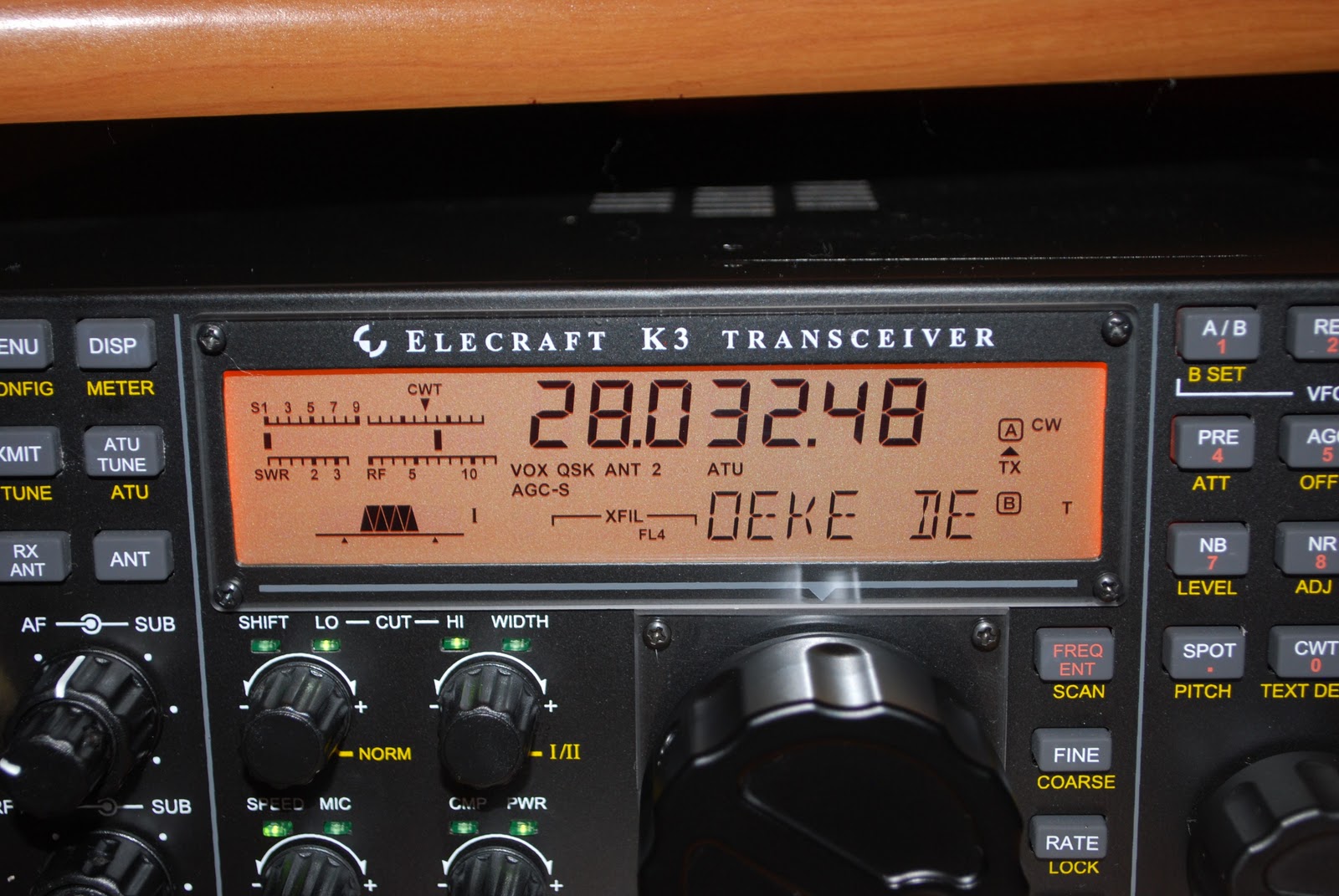 |
| The Elecraft K3 in action |

Mike Weir, VE9KK, is a regular contributor to AmateurRadio.com and writes from New Brunswick, Canada. Contact him at [email protected].
Activation Alert: W0/FR-107 (Green Mtn.) –2085m / 6841ft
Date: 27 November 2011
Time: Approx. 1700 UTC – 2000 UTC
Region: CO-Front Range
Elevation: 2085 m / 6841 ft – 1 Points
Call Sign: KD0BIK
Frequencies: 14.342.5-ssb, 18.157.5-ssb, 21.437.5-ssb, +/- 146.52-fm
Equipment: FT-817ND / Buddipole versatee vertical
APRS Track: On Road / On Trail
You might say I was planning my second SOTA activation before the ink was dry on the first. I know I had mentioned in a previous post that I would pace myself on activations and expected I would keep to a once a month activation schedule. While my first activation occurred last weekend, the weather this weekend is supposed to be gorgeous (especially Sunday) and winter weather will soon settle in. Again, I’m not opposed to winter activations…but I figure while I’m still learning and figuring our my complete setup…..a warm class room is better than a cold one. Plus it won’t hurt to burn off those Thanksgiving calories.
Since this is a holiday weekend, and I had just completed my first a week ago. I thought I would plan an easy and close activation to my QTH. Green Mountain is the closest SOTA peak to my QTH and will be a much easier hike than Mt. Herman. I should be able to get to the summit, enjoy some operating time and then back home early enough to get some things done before going back to work on Monday.
With the lessons learned from my first activation, I have a few new additions in my pack. I also packed a lot of things that I never used on my first and those items will stay home.
The first new item actually replaces another and will free up about 3 lbs. of weight. Yes, I’m talking about the Buddipole Nanophosphate A123 battery pack. I’m really looking forward to what this pack can do for me and the reduced weight.
The wind issues I experienced last weekend and the breaking zip ties have also been eliminated. I will be taking one from the wG0AT playbook and mounting my Buddipole versatee adapter directly to my hiking staff. My hiking staff has a removable knob handle with a standard tripod screw mount on top. I have an adapter that will adapt the 1/4” thread to 5′/8”. The versatee will screw down onto that adapter and create a much more secure connection. Finally, I also ordered the new Buddipole adjustable shockcord whip which can be seen in action in this youtube video.
Until next time….
73 de KD0BIK (Jerry)
Jerry Taylor, KD0BIK, is a regular contributor to AmateurRadio.com and writes from Colorado, USA. He is the host of the Practical Amateur Radio Podcast. Contact him at [email protected].
A Pretty Good List From K3NG
K3NG reposted one of his classic articles Things I Wish I Knew When I Was A Young Radio Artisan. Here’s a few items from the list:
With antennas, it’s not about the feet and inches (or meters), think in terms of wavelength.
Don’t worry about the orientation of a dipole when it’s less than a half wavelength above ground.
When the bands are open any goofy antenna will make contacts. People will think this makes a goofy little antenna a good antenna. Not so.
I don’t agree with everything on the list but it is still worth reading.
73, Bob K0NR
Bob Witte, KØNR, is a regular contributor to AmateurRadio.com and writes from Colorado, USA. Contact him at [email protected].
 Ham Radio Deluxe |
 W5SWL Electronics |
 Ham Radio Prep |
 KB3IFH QSL Cards  Hip Ham Shirts  HamRadioAuctions HamRadioAuctions Reliance Antennas Reliance Antennas Enigma Shop Enigma Shop |  morseDX  Ni4L Antennas  R&L Electronics R&L Electronics antennas.us antennas.us QRV QRV |
- Matt W1MST, Managing Editor
