 |
 Yaesu Digital Voice
 1 January 2012 | by
 Yaesu has been in the news recently for the digital salvo they fired over the bow of the D-STAR ship. In theory I think this is a great move, and others are praising Yaesu’s announcement. My concerns with D-STAR’s proprietary AMBE vocoder algorithm and hardware, the essentially one vendor market for D-STAR equipment (Icom), and the relatively dated and unscalable D-STAR protocol are no secret to anyone who reads this blog regularly. But looking at the Yaesu digital voice whitepaper, it’s somewhat a half-baked initiative, in my opinion, where Yaesu has a new hammer and everything looks like a nail.
Most of the paper focuses on the modulation technique of D-STAR, GMSK, and pits it against Yaesu’s (errr….. Motorola’s) C4FM. While better RF and data throughput performance can be had with better modulation techniques, the big issue with D-STAR isn’t its modulation technique, it’s the layer two protocol. Yaesu doesn’t even mention its layer two protocol and network that would presumably be used, Wires II.
Yaesu’s case for C4FM superiority beyond it being used in commercial networks falls flat. In the paper there are specifications of selected D-STAR and C4FM radios compared, with some highlighted parameters. There’s also a graph comparing various modulation techinques, but the big takeaway is D-STAR has a rate of 4800 baud versus 9600 baud for C4FM. I’ve used the somewhat archiac term of baud rather than kpbs intentionally to illustrate just how lame the comparison is. Furthermore, while D-STAR is clearly in the crosshairs of Yaesu, there is no mention of D-STAR’s 128kbs data mode or how Yaesu’s solution beats that data rate.
All in all this whitepaper and initiative which some are praising appears to me to be a rather sophomoric effort, and one more concerned with selling retreaded commercial rigs in amateur radio. Aligning amateur standards with commercial ones isn’t a bad thing especially when secondhand commercial gear can be re-purposed for amateur use, but there needs to be other compelling reasons to adopt a commercial modulation technique. Even with the best layer one modulation technique, if the layer two protocol and the supporting network is badly designed the digital voice standard is doomed for failure. Yaesu needs to be making a case for its system by explaining the entire network, how it is open and non-proprietary, and how it will scale in the future. I hope Yaesu does successfully launch a competing digital voice solution, and I hope organizations like ARRL and RSGB get involved and insure that the standard is consistent with the spirit of amateur radio. Unfortunately to me this new initiative looks like another D-STAR in the making.
(D-STAR is a registered trademark of Icom Incorporated.)


DV Wars in 2012?
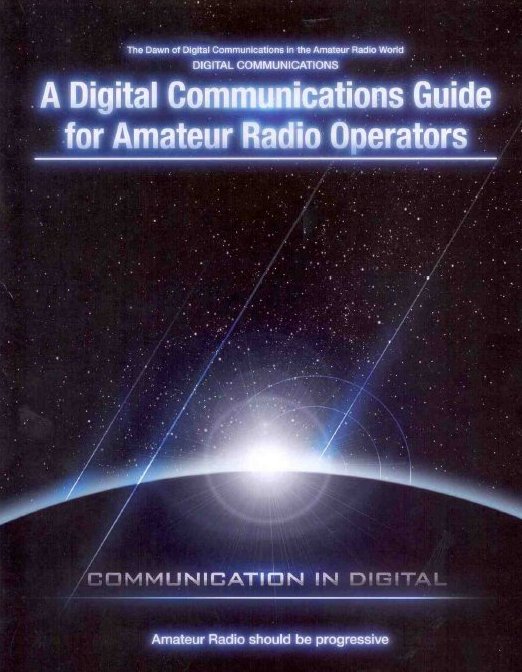
In 2012 Yaesu will introduce a range of digital voice radios to the amateur market. They have published a Digital Communications Guide for Amateur Radio Operators that describes their new system and answers some questions about it. Yaesu’s offering seems to be compatible with Motorola’s professional digital mobile radio system, which offers hams the possibility of a second source of compatible equipment on the surplus market – not that used professional Motorola radios have ever been cheap. But the Yaesu system will not be compatible with D-Star. No surprise there, then.
I have always believed it was a foolish move for ham radio organizations like our RSGB to allow themselves to be bamboozled by Icom into permitting the creation of a digital network that gave one supplier a monopoly. Repeater groups and their members who have made substantial investments in D-Star technology are not going to want to switch to a different digital mode that makes existing hardware obsolete. On the other hand, D-Star itself is becoming an outmoded technology in digital terms. Hams who have been sitting on the fence looking for an up to date alternative that doesn’t involve buying Icom are not going to plump for one system or the other while the future looks like being fragmented into rival factions. It will be like the video war between VHS and Betamax.
I think Yaesu’s announcement will kill the already lame duck of D-Star and ensure that analogue FM remains the dominant mode on the amateur VHF bands and up for years to come.

Julian Moss, G4ILO, is a regular contributor to AmateurRadio.com and writes from Cumbria, England. Contact him at [email protected].
ICQ Podcast S05 E01 – Powered SWR Meter Kit (01 January 2012)
Series Five Episode One of the ICQ Podcast has been released. News Stories include :-
- Amateur Radio Balloon crosses the Atlantic
- Radio Ham's invention seeing wide use
- EU threat to Amateur Radio kits
- 137kHz German signal received in Alaska
- Hams do their bit after disaster
- Australia to trial limited higher power
- Ofcom - 3400 MHz licence exemption
- Amateur radio operators to host kids day
- Beacon Maps and Beacon Spots
- Raspberry Pi moves towards production
Your feedback, Martin reviews a Power SWR Meter Kit.
Colin Butler, M6BOY, is the host of the ICQ Podcast, a weekly radio show about Amateur Radio. Contact him at [email protected].
2012
What would a blog be without the traditional year-in-review-and-here-are-my-New-Year’s-resolutions post? For a general overview of amateur radio in 2011, Jeff, KE9V, has a rather excellent summary over at KE9V.net worth reading. From a personal standpoint, it was a year that I spent less time on the air and more time tinkering with stuff.
Much of my activity was centered around the Arduino CW Keyer. I’m especially proud of the Winkey emulation mode which enables interfacing to many logging and contest programs and the PS2 Keyboard code. It’s been really satisfying to hear from folks, especially DX, who are using the code in their shacks.
Another project was the Yaesu Rotator Controller Emulator which interfaces most any rotator (not just Yaesus) to a computer for control via a terminal session or logging/contest program. It’s cool to be running Ham Radio Deluxe and just point-and-click to where you want to go and have the beam rotate automagically. Yea, I’m amused by simple things.
One of my 2011 resolutions was to do Summits On the Air or SOTA in a big way. I ended up doing only three SOTAxpeditions, but I’m finding outdoor operation much more interesting than sitting in a shack trying to bang out cookie-cutter QSOs.
I tried Weak Signal Propagation Reporter or WSPR. It’s an interesting novelty, but I’m not sure it will hold my interest for long.
My blogging suffered a bit. Quality over quantity has always been my goal and my post drafts folder continues to be littered with unfinished posts, half-baked ideas, and posts that never saw the light of day because I felt they were too controversial or critical for the intended tone of this blog.
My summary of 2011 wouldn’t be complete without acknowledging the influence of G4ILO on my daily thought. Julian’s announcement of a statistically-incurable brain tumor was a shock to all of us here in the amateur radio blogosphere, myself included. His writings in both his amateur radio blog and One Foot In The Grave have helped me remember what is really important in life and how valuable our time is. Now that I’m in my forties I’m realizing I need to start figuring out how to better spend my finite time here and do rather than just dream. Julian, I wish you the best for you and Olga in 2012, and know that your insights have helped this radio artisan.
So what’s on the roadmap for 2012?
Many more SOTA expeditions and outdoor operating in general. I’ve been talking for years about doing a spring Appalachian Trail overnight expedition. Time to just get some friends together and do it.
VHF Contest Mountaintopping. This goes along with the outdoor operation theme. Just do it.
Arduino CW Keyer. I may add more features in 2012, like LCD display support and CW decoding, but I’m probably going to focus my efforts on facilitating community efforts to build complete units. Oscar, DJ0MY, who has been helpful in suggesting and testing keyer functionality has recently been working on an “open source” design PC board and an enclosure. Perhaps kitting would be the next logical step.
Build an Az-El satellite antenna array using cheap homebrew yagis and a homebrew Frankenstein rotator setup with my Arduino rotator interface. That should make the neighbors wonder what I’m doing.
Develop the RadioCubeCache idea further and see where that goes.
Build an Arduino-based automatic antenna tuner. This one has been on my list for awhile. Like the keyer I think I can build something as good as commercial offerings and offer it to the community.
Try JT6M, JT65, and all the JT modes. I think this is going to be the bulk of my home on-the-air time in the new year.
Anyway, thanks for reading and have a Happy New Year!


Idea
I’ve been reading about the AMSAT Fox Project, an initiative to deploy small next-generation “cubesats”. The website includes several PowerPoint presentations on the design, testing, and engineering of these birds. A lot of work goes into building a satellite, and the number of considerations is just mind-boggling, with concerns about heat, materials, radiation, and resiliency to failures to name a few. This really is “rocket science.”
I’ve been thinking about a more down-to-Earth project for guys like me who aren’t rocket scientists but are intrigued with little devices like these. I’m not sure what to call this yet (perhaps “CubeCache” or “RadioCache”?), but the idea combines geocaching, fox hunting, beacons, microcontrollers, and a touch of repeaters all in one bundle. Imagine if you could build a tiny device similar to a cubesat and place it somewhere stealthy and have it act like a multi-purpose beacon, a simplex repeater, a fox transmitter, and a data gathering on-the-air geocache. The little box would have a small self-contained battery and be equipped with solar cells for charging them. A microcontroller would control all functions of the unit. During low battery times, the microcontroller would put the unit in power-saving sleep mode, turning off all modules. The unit would have a transmitter and receiver, and a second receiver for telecommand functions to comply with FCC rules.
The unit would have several modes. It would announce itself like a beacon periodically. It would act as a “radio geocache” and would receive digital callsign messages and acknowledge them, storing them in memory for later retrieval. The unit could also act like a real geocache, but with a twist. Users could activate fox mode and radio direction find their way to the unit.
Building such a unit would present some technical challenges. The first would be stuffing everything into a small, weatherproof package that can withstand the elements. Much like geocaches, the unit would have to be stealthy both in construction and placement to avoid being found by “muggles”, the geocaching term for people who are not geocachers. Power management is another challenge, with the need to keep track of battery capacity and make the best use of power. With an experimental project like this, it’s likely the microcontroller software would be changing quite frequently to improve performance and add new features, so a remote over-the-air firmware uploader and bootloader would be helpful.
I’m sure some will ask what the point would be of building such a contraption. Much like a lot of what we do in amateur radio, there often isn’t much of a point other than to experiment, learn, and have some fun. I may explore this idea further in 2012 and build a very simple prototype, place it in my backyard and see where this project goes. If anyone is interested in helping develop this idea, please let me know.


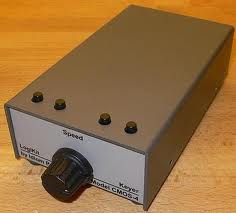
Idiom Press CMOS-4 Keyer………
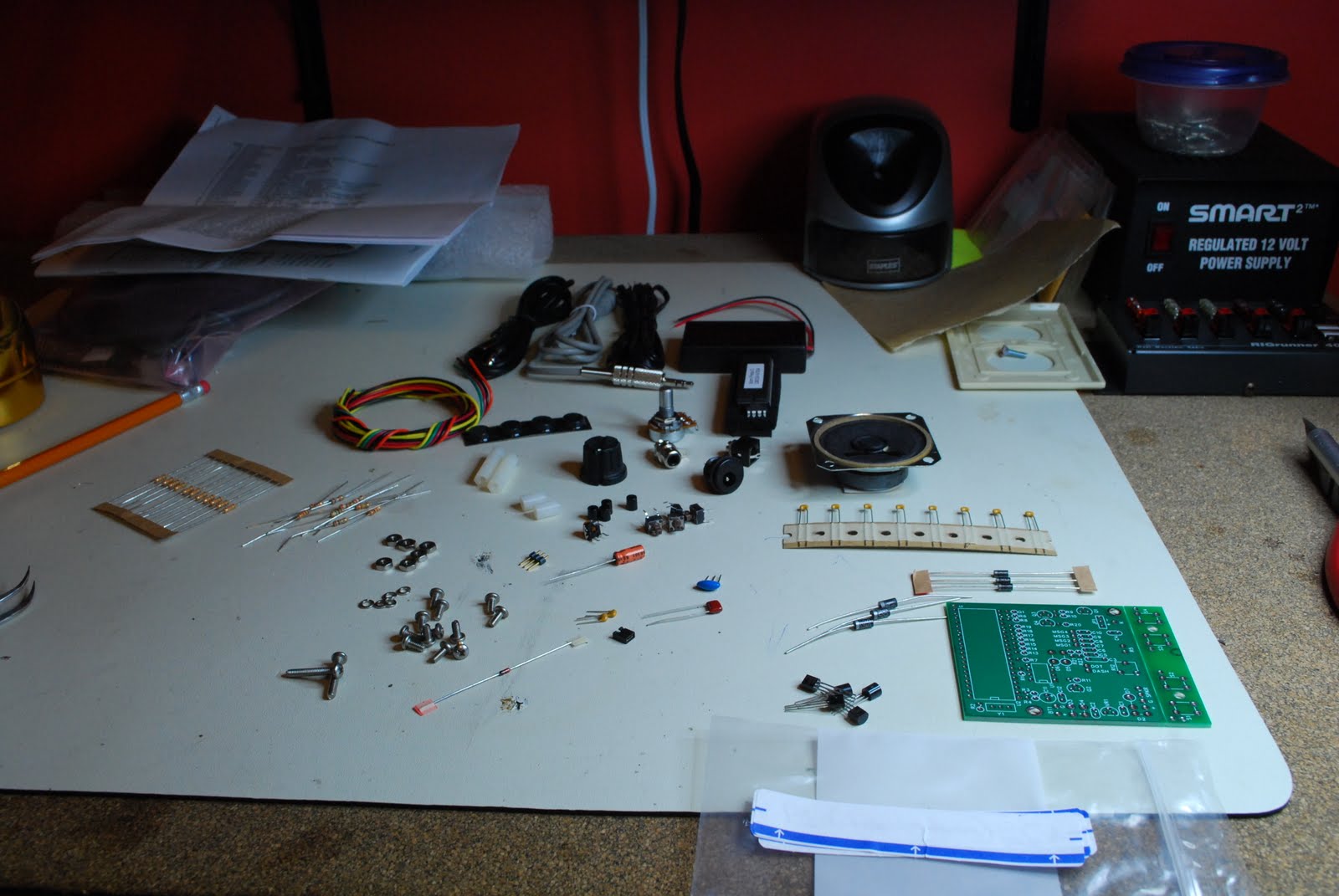 |
| Sorting the parts |
house one day. Anyway, I had read many great reviews about this keyer and has seen some YouTube demonstrations of it was well so I was eager to get it built and running. If you have read in
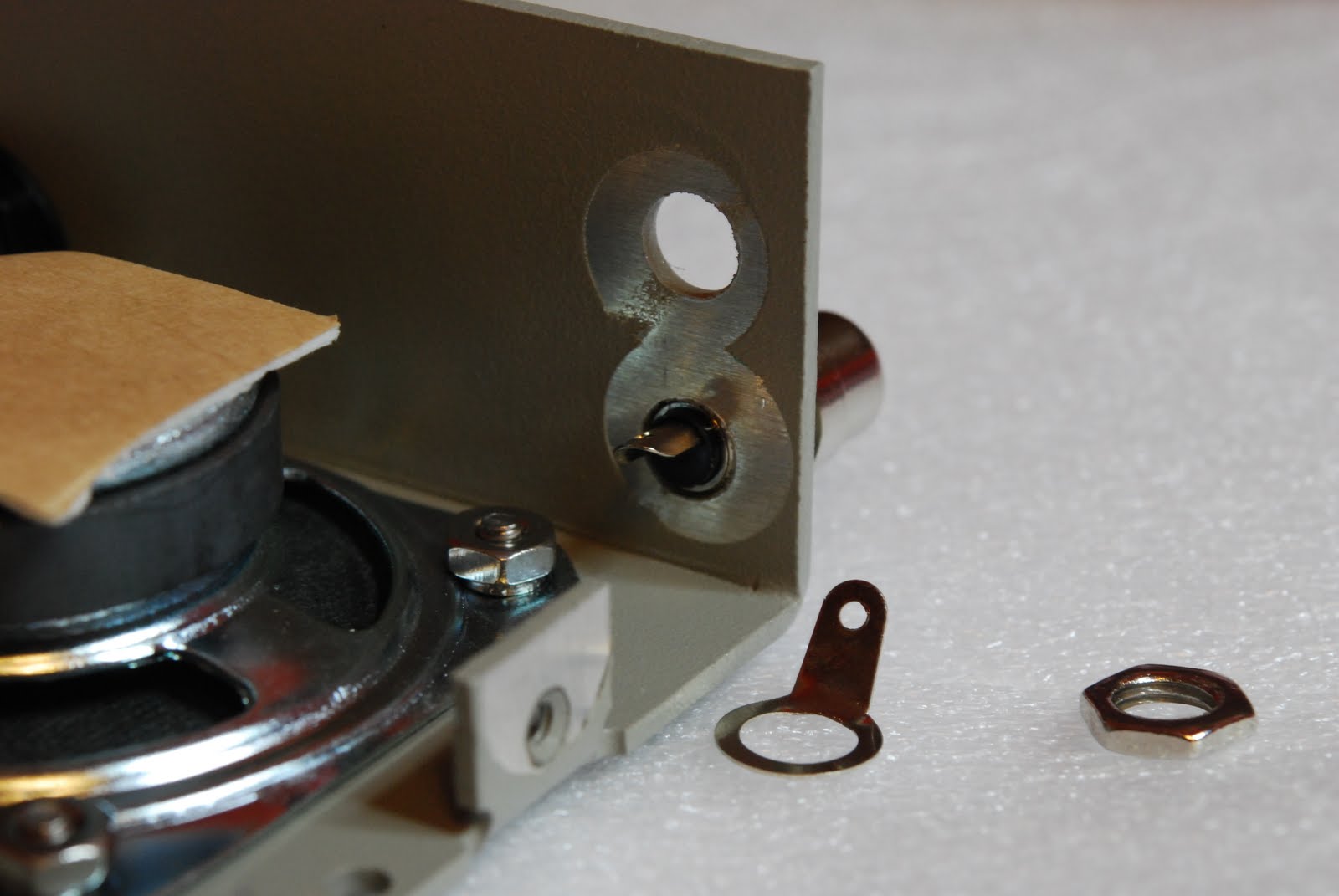 |
| RCA troubles |
my blog in the past the first thing I like to do with any kit I get is do the inventory of parts. It lets me know all is here as well familiarizes me with the parts. This kit like all the others had part numbers for the parts but for some reason the list gave you a part number and told you it was a 15 ohm resistor for instance and that there were 20 of them and that was it!! So these 15 resistors were they R1, R20, R3 or what, as the kit had other resistors with other part numbers and values assigned to them. So for all the parts I had to go through the build
 |
| Resistor and diode layout |
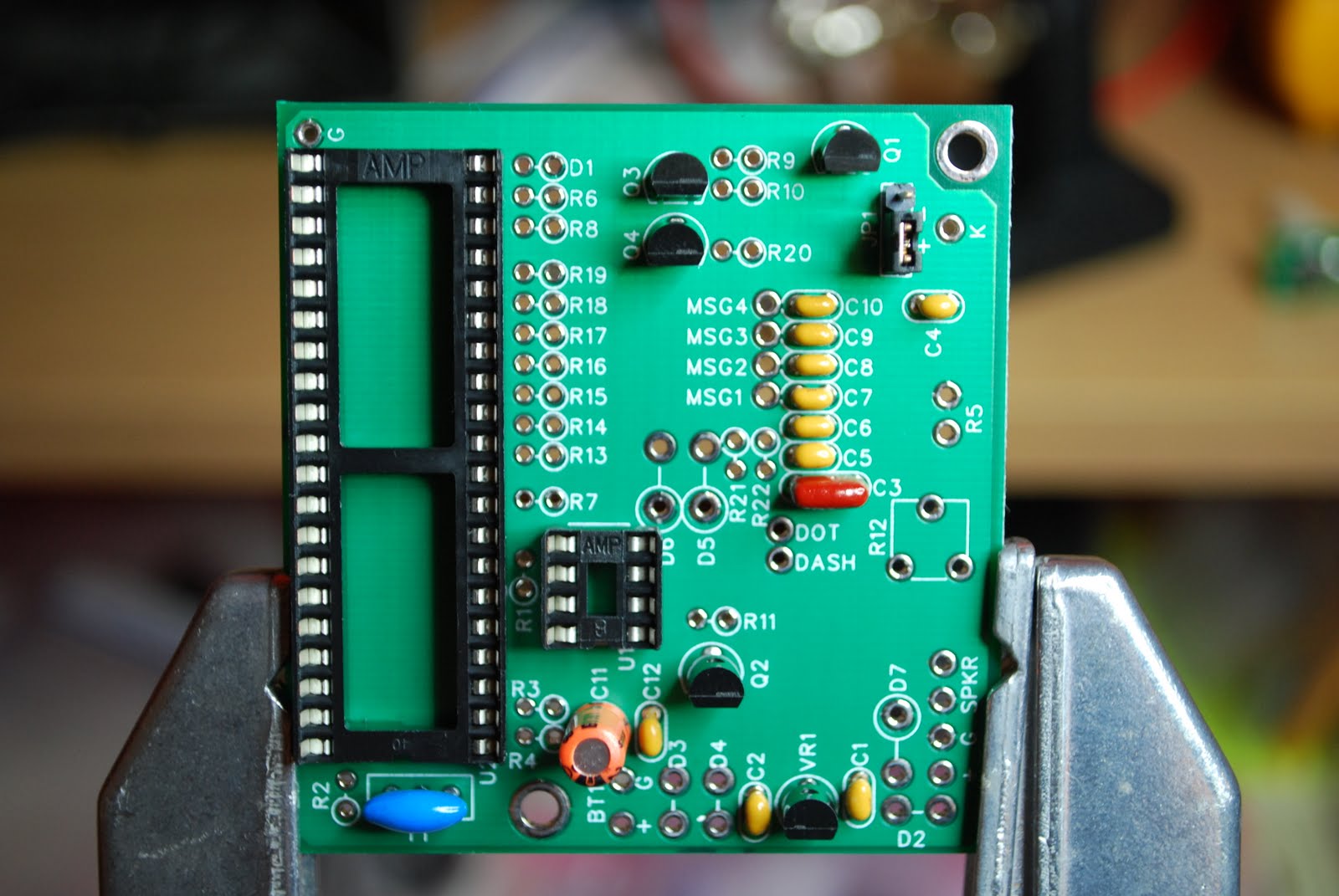
instructions and identify that transistor part number ZC4005 which was a MPSA92 transistor was in fact Q1 in the assembly instructions. Each part had to have this done and I then put the parts in a bag and labeled the bag with the assembly part number on it. The assembly instructions were very clear but more pictures would be very helpful during the build. Steps that involved an odd detail were marked out very clearly and at times in BOLD print. One part issue during the build was an RCA jack that would not fit through the per-drilled hole. This is not a disaster but a bit of a pain having to get the cordless drill out to open up the hole. The only other issue I ran into and should be rectified in my humble opinion is.....there are some diodes that have to be installed and there is a polarity to follow. To make this easier the
 |
| Diode circles missing at bottom |
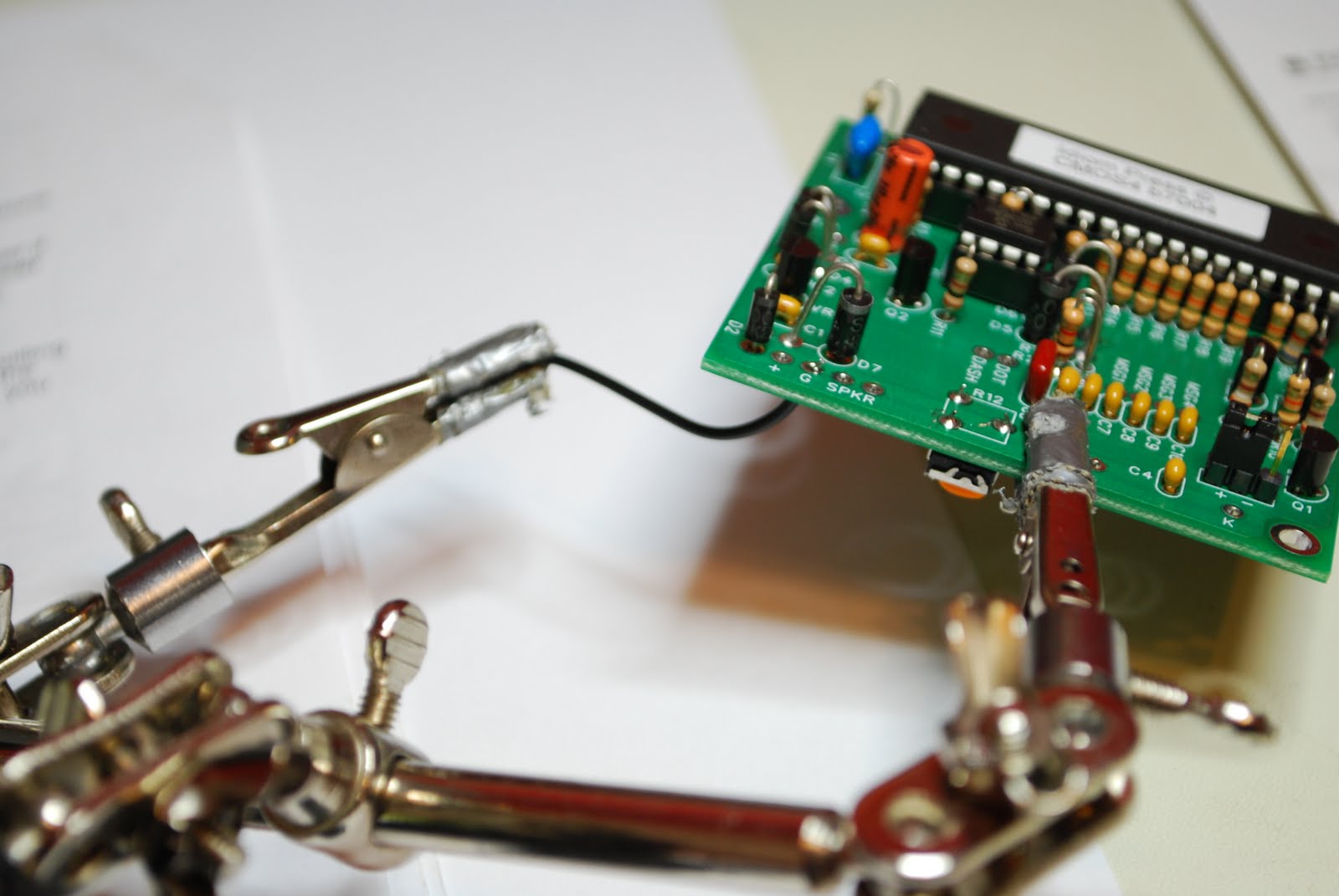
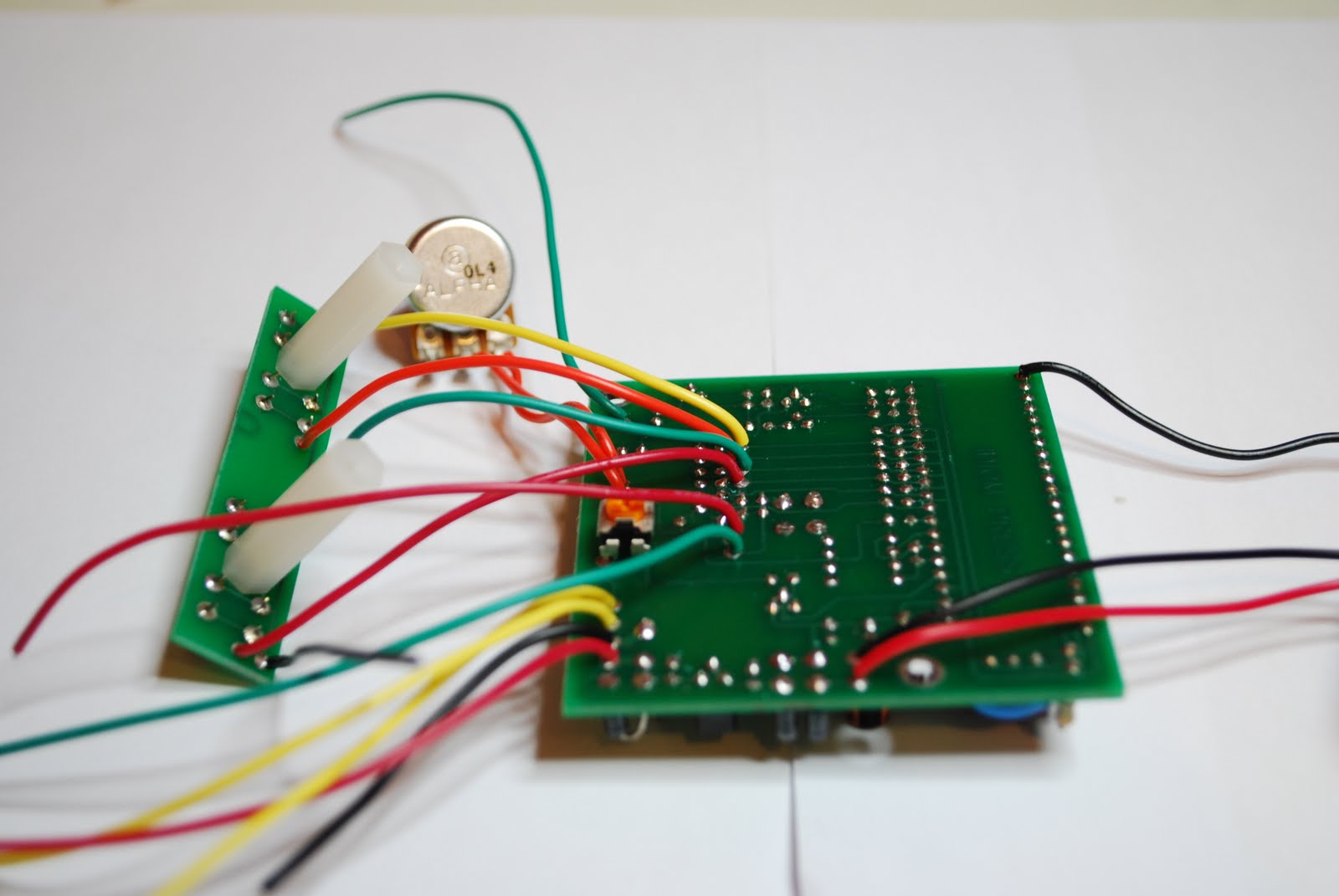
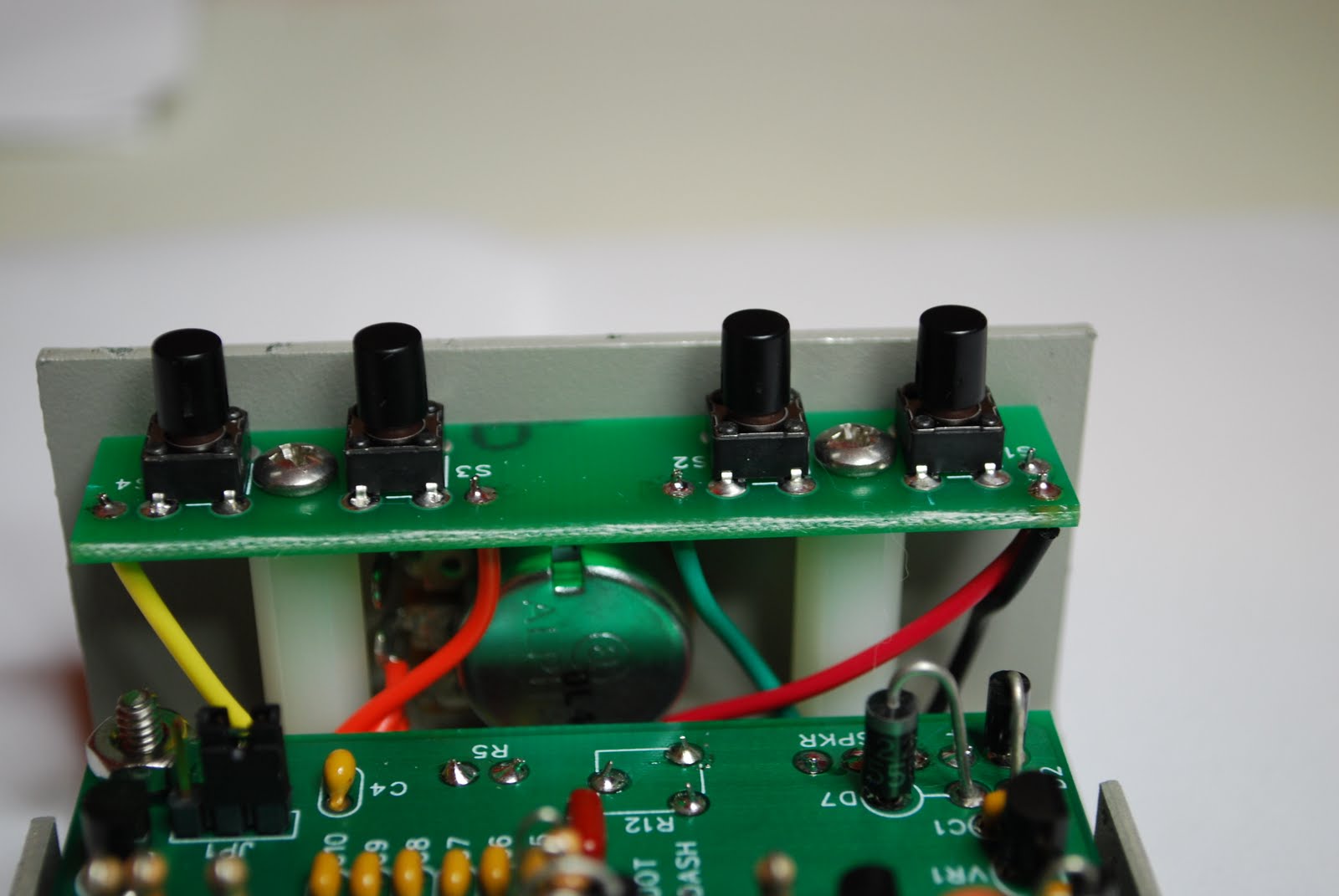
silk screen on the PC board has a large circle place over one of the diode holes. This is to help with placing the diode on the PC board with the right polarity. Well for some reason there are 3 areas D2,D3 and D4 were the circle did not make it onto the PC board. You are told of this in the instructions and shown on a layout diagram with the proper polarity. How about fixing the boards as well.........Those were the only issues I had with the build. The kit tested great once it was done and if you do order the CMOS-4 as a kit or already built make sure you read the operating manual cover to cover. This is were the kit really shines great detail has been put into the manual. Because this keyer is a real stand alone keyer all programing is done with your key no computer is needed. In the manual you are given exercises to do and make sure you do them!!! This will get you accustomed how the keyer works and how to program it as well. If you are in the market for a keyer this is one to take a close look at. In this post I wanted to include some assembly pictures as I found on the internet there were very few. As you are going through the build a picture would really help at times.
 |
| DC power jack very close to speaker |
 |
| Adding wires to board |
 |
| All wires added |
 |
| Push button setup |
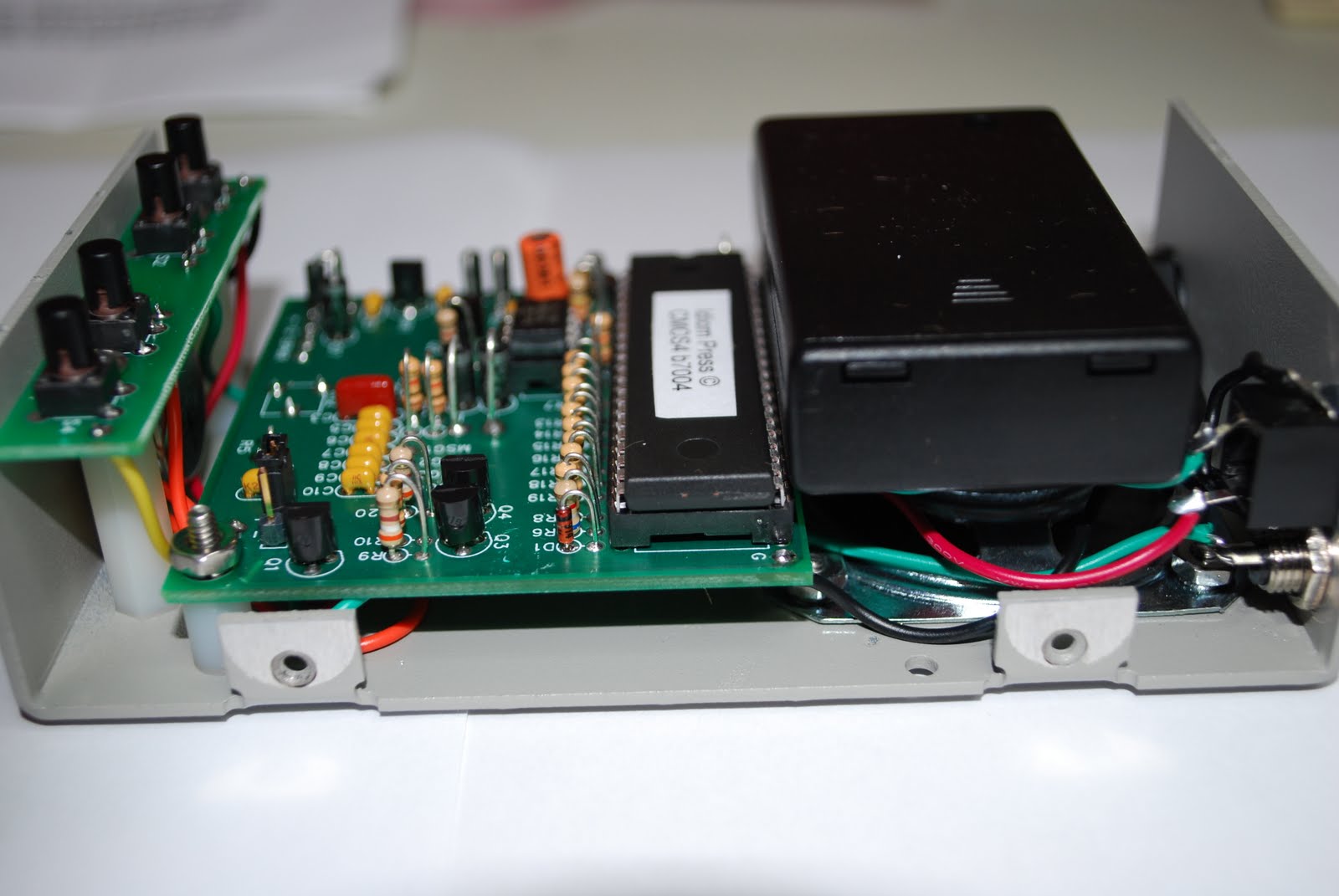 |
| Battery pack added |

Mike Weir, VE9KK, is a regular contributor to AmateurRadio.com and writes from New Brunswick, Canada. Contact him at [email protected].
Pinyon Airport
There is a small airport – one grass runway and a single windsock – a few miles from my home (and ham radio station) here in Glade Park. According to Google Maps (see graphic bel0w) this airport – Pinyon Airport – lies 5.586-km away as the crow, and presumably Piper, flies. I’ve seen a small propeller plane land here after passing rather low over my house on approach. A concern seeing as how I’ll be building ham radio antenna towers later this year.
I checked the FAA “TOWAIR” Website and plugged in the coordinates of my first likely tower location – 39.013949 N, 108.744371 W – and got the response “Structure does not require registration.” Nevertheless I’ll be registering my towers with the Federal Aviation Administration so they appear in a NOA (Notice To Airmen) and appear on FAA maps. I’ll also try to find out how owns the aircraft mentioned above and politely suggest they find a new approach or fly a bit higher.

Bill
Bill Hein, AA7XT, is a regular contributor to AmateurRadio.com and writes from Colorado, USA. He is co-owner of Force 12 and InnovAntennas. Contact him at [email protected].
 Ham Radio Deluxe |
 W5SWL Electronics |
 Ham Radio Prep |
 KB3IFH QSL Cards  Hip Ham Shirts  HamRadioAuctions HamRadioAuctions Reliance Antennas Reliance Antennas Enigma Shop Enigma Shop |  morseDX  Ni4L Antennas  R&L Electronics R&L Electronics antennas.us antennas.us QRV QRV |
- Matt W1MST, Managing Editor
