 |
 Ham Radio As Seen on TV Quiz on the ARRL’s Website
 9 January 2012 | by
 My morning surf has brought me to the ARRL’s website with a nice little quiz about Ham Radio that has been on TV and in Hollywood. The recent news in the community about Tim Allen’s new TV show giving Ham Radio some “props”, has inspired this.

Do Not Adjust Your Set..
This quiz is thanks in part to the websites of AD7DB, KB9MWR and AC6V for the references. As I went through looking at it, some were pretty easy, and some were a little tougher. I didn’t check my answers to see how I did. I wanted to see what you posted for your results first. I know this is a pop quiz, but hey, my teacher did it to me in school, and I’m sure he/she did it to you too. So take the quiz and let us know how you did.
73.
[adrotate group=”2″]
Rich Gattie, KB2MOB, is a regular contributor to AmateurRadio.com and writes from New York, USA. Contact him at [email protected].
More Operatics
Paul PC4T may be taking a rest from blogging but he is still active. Yesterday evening I spotted him using the new Opera mode.
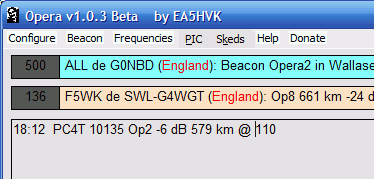
Andy K3UK has prepared a quick guide to using Opera which some may find helpful. As he points out, Opera is not a QSO mode. The only information that is sent in a beacon transmission is your callsign. Other information that is displayed in the software such as QTH, distance and bearing is sent over the internet back-channel by connected software clients.
Eldon WA0UWH has taken the Parallax Propeller code from my previous post and tried it out on the air. He has already received several reception reports.
Before I can do the same I will need to build a small PA / LPF with an output in the range 200mW to 500mW. Hopefully I can find a suitable circuit that uses standard components such as 2N3904 or 2N2222 which I have in my parts box. Suggestions welcome.

Julian Moss, G4ILO, is a regular contributor to AmateurRadio.com and writes from Cumbria, England. Contact him at [email protected].
Buy the Drop-In Charger
I’d like to pass along a tip that has taken me about 25 years of ham radio experience to figure out. I’ve owned many different models of handheld FM transceivers through the years and have always just used the standard “wall wart” charger to charge the batteries. 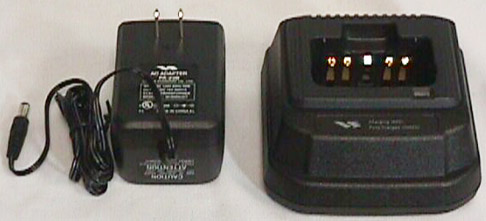
Recently, I decided to “splurge” and get desktop chargers for the pair of FT-60′s that inhabit our two-ham household. I never realized how handy the drop-in style charger could be until I had one…the HT is always sitting there ready to go. Most of these drop-in chargers are rapid chargers that sense the battery condition — charging them quickly but also dropping back to a trickle charge once they are full.
Since then, I’ve made it a point to always pick up a desktop charger with a new HT. Yes, it does cost $60 to 75 extra but it is well worth the convenience.
73, Bob K0NR
Bob Witte, KØNR, is a regular contributor to AmateurRadio.com and writes from Colorado, USA. Contact him at [email protected].
Down but not out!!!!!!


Mike Weir, VE9KK, is a regular contributor to AmateurRadio.com and writes from New Brunswick, Canada. Contact him at [email protected].
7-bit Barker Code and Matched Filter

Teaching Evan the basics of radar signal processing with this baby-block 7-bit Barker code and its matched filter.
Ethan Miller, K8GU, is a regular contributor to AmateurRadio.com and writes from Maryland, USA. Contact him at [email protected].
Horizontal loop repaired & contesting 2012
The horizontal loop has been repaired. I lost 3 glasfiber mast parts, they are broken and cannot be repaired. I can probabely use them to make a tripod or so, I’ve seen that somewhere on the web. The loop is now at 7m and I got a better feeling about the mechanical strength this time. I decided not to repair the beam, it is too heavy for a aluminium mast and although I didn’t test it I don’t think it gives me an advantage in for example working DX in any direction at low height compared to my vertical. I really need to get my versa tower up again so I can install a beam for 10m like it should be. Well, in January it’s time to have my agenda and that of my XYL filled with the upcoming contests I really want to take part in. This is my list:
- 11/12-Feb:PACC contest
- 24/25-Mar: CQWW WPX SSB contest
- 1/2-Sept: Fieldday contest
- 29/30-Sept: CQWW RTTY contest
- 27/28-Okt: CQWW SSB contest
- 11-Nov: PA-beker contest
- 18-Nov: Friese 11 steden contest
- 24/25-Nov: CQWW CW contest
- 4-Dec: 10m RTTY contest
- 10/11-Dec: ARRL 10m contest
Bas, PE4BAS, is a regular contributor to AmateurRadio.com and writes from Groningen, Netherlands. Contact him at [email protected].
Making yourself clear on the Radio
A few days ago I was putting together a piece of training for our local A.R.E.S. Group and it dawned on me that I should share it with everybody. So after I finished the net I took a little time to flesh out that training and what I ended up with was this article. You are welcome to use this as a basis for training in your group or as a reference for your own self training. Don’t forget to let everybody know where you got it.
Speak slowly and clearly
When we say speak slowly and clearly what we mean is sometimes at normal conversational speed words run together when you are talking on the radio. Most radio equipment doesn’t reproduce all the audio frequencies of human speech or hearing. This can make it difficult to understand what someone is saying on the air. When you have some hearing loss it is even worse. I have some low end hearing loss so most of the time I have to add a speaker to my rig that produces more low frequencies to make the speech ineligible to me in noisy environments.
Annunciate. Some people don’t consider that when they speak they are trying to convey information. I know several people that just engage there mouth and let the words fall out without giving a second thought as to if the person on the other end of the conversation is having to decipher the noises emanating from their mouth. It is sometimes difficult to understand a conversation when you are in the same room with someone if the are slurring and mumbling their words. It is even more difficult when you are on a noisy frequency or using a narrow band width mode like SSB, or D*STAR. When you add the stress of a net situation people tend to speak faster than they normally would. They also tend not to speak clearly. This makes the problem even worse.
Use Standard ITU Phonetics
Another consideration is the use of phonetics. In most cases phonetics can greatly increase your ability to understand and be understood when conditions a frequency are not optimal. Ham radio operators are as a rule a playful bunch so we do things to make talking on the radio more fun like making up funny phonetics for our call sign. Unfortunately during emergency and disaster communications play time falls by the wayside and these home brew phonetics become more of a problem than an asset. Most of the time these home brew phonetics in no way resemble any of the standardized phonetic systems. When These operators find themselves in a situation where they need to be understood their home brew phonetics really don’t help. That is why the ITU Phonetic alphabet is the agreed upon standard for amateur radio emcomm communications. Every radio operator should be able to at least spell their call sign with these phonetics. Memorization of these phonetics is not difficult. Some operators can jump to phonetics without even thinking about it. Since so many letters in the English language like E,B,V,C and others sound so much alike it is very important to know the standard ITU phonetic alphabet.
Do not yell, Don’t whisper
Yelling at a microphone is a problem that has propagated down through the hobby. Many of us have come into the hobby by way of the citizens band service. Operating AM on cheaply made and badly maintained equipment in that service. Many others use sideband radios on a regular bases. On AM and Sideband speaking louder into the microphone can give you a small increase in the output power of your radio. Since we are using primarily FM radio equipment this is not the case. Without going off into an explanation of how FM works lets just say that yelling at your microphone causes distortion making it difficult to understand the information you are trying to convey. Since the equipment that we use on VHF and UHF is Frequency Modulated the Amplitude of your voice can cause more problems than you would think.
Whispering into the microphone also has problems. There are some operators out there that speak very quietly into there microphone. This results in a full quieting signal and barely understandable audio. Some times the microphone gain or deviation on your radio may not be adjusted properly. if you do not speak up while transmitting this can make the problem worse. In the case of a Net Control located in a noisy environment it makes your transmissions unusable. It also waste valuable time while the Net Control attempts to take your traffic. We don’t always have the luxury of calling a net from the comfort of our home.
Don’t eat the microphone.
Eating the microphone or holding it to close to your mouth is another bad habit that has trickled down through the hobby from the days of carbon microphones and the poor quality microphones of the past. Today the microphone supplied with a standard piece of amateur radio equipment is very good. Eating the microphone presents its own set of problems. Holding the microphone to close to your mouth can overdrive the diaphragm in the microphone and audio stage of the radio causing distortion which most often results in muffled audio. You may also experience Flat Topping of your audio signal that is very similar to clipping in other audio equipment. Over deviation of your signal is also a problem you may experience. Over deviation is a problem because most repeaters are equipped with a band pass filter to eliminate unwanted noise on nearby frequencies. This means that in some cases you could be sitting under the repeater running a hundred watts and not be able to key the machine because your signal exceeds the width of the passband. Another problem that may occur from eating the microphone is known as P-pops or Clicks. These are most common when the microphone is held directly in front of the mouth. These are not only annoying but can also make it difficult for net control to understand the information you are trying to convey. It is always best to hold the microphone off to one side of the mouth. I also like to use what I call the “Thumb Rule”. If I am holding the microphone to transmit I should be able to extend my thumb and lightly touch my chin or lower jaw. This seems to be just about the right distance and works well with most radios including hand held transceivers.
Lastly a word on hand held transceivers. Most HT’s come from the factory with the microphone gain turned up higher that mobile radios. So the built in microphones are “Hotter” than one might expect. They are designed to be held a foot to eighteen inches away from your mouth. Eating the microphone on these will cause many of the problems listed above to be much worse. External microphones will depend on the design of the microphone.
Q signals, codes and jargon
Since from time to time we will be transmitting information for use by non-hams such as our served agencies we need to keep Q-Signals, Codes, and Jargon to a minimum. Our served agencies have there own language or jargon and in most cases it doesn’t even remotely resemble the jargon that we use as amateur radio operators. The National Weather Service has its own language for describing weather and that is the only possible jargon that we may need to use. That information will be covered at Skywarn School where it will be covered by the folks that know what they are talking about.
Codes and Ciphers are prohibited by part 97 so they are not appropriate for any reason.
Q-Signals are a problem in amateur radio today because everybody wants to sound like a professional radio operator and they think that Q-Signals help achieve that goal. Q-Signals were designed to make cw operation easier and have no place on a phone (Voice) frequency especially during an emcomm net where the transmission and reception of clear and concise information is critical. Lastly, There is a place for Over, Out and Roger in emcomm communications. Most amateur radio operators tend not to use them correctly. My personal opinion is that if you want to acknowledge a transmission the word “Received” works just fine.
These are just a few of the things that can help all of us improve our communications skills. Clarity in communications is always important. It is even more important when we start to deal with Emergency and Disaster communications. Remember we are not transmitting for ourselves. We are transmitting for everybody.
Russ Woodman, K5TUX, co-hosts the Linux in the Ham Shack podcast which is available for download in both MP3 and OGG audio format. Contact him at [email protected].
 Ham Radio Deluxe |
 W5SWL Electronics |
 Ham Radio Prep |
 KB3IFH QSL Cards  Hip Ham Shirts  HamRadioAuctions HamRadioAuctions Reliance Antennas Reliance Antennas Enigma Shop Enigma Shop |  morseDX  Ni4L Antennas  R&L Electronics R&L Electronics antennas.us antennas.us QRV QRV |
- Matt W1MST, Managing Editor
