 |
 The Spam Report
 8 January 2012 | by
 First of all, Happy New Year, loyal readers. I have been exhorted by several enthusiasts of the blog to write more. The months of November and December are busy around the Miller household with the CQ WWs, ARRL Sweepstakes, Thanksgiving, Christmas, and an annual professional conference on the West Coast between Thanksgiving and Christmas. So, this is a drought time of year for writing. A number of projects around the station have been started or completed and those will be written up as time allows. Travel and potential DX operation is on the horizon, etc, etc. However, today’s topic is WordPress comment spam.
I hadn’t checked the moderation queue on the blog comments for about six weeks until recently. There were some 1500 comments pending. Exactly two of them were from real commenters. (Thanks, by the way!) I could subscribe to a service (like Akismet) to stem the flow of spam, but I’m a cheapskate and skimming the spam is a bit like reading the police blotter in your local newspaper—a guilty pleasure.
The Internet democratizes the sale of nearly everything, legal or not, by providing a low-cost storefront for a business that can be based anywhere in the world, plus (semi-)anonymous payment. This is great for obtaining otherwise unobtanium surplus electronics and parts. But, it’s also great for anyone selling anything else that is high-risk (for vendor or purchaser) or low-volume in a standard retail setting. The difficulty for everyone is getting your business noticed. Enter search-engine optimization (SEO): techniques that game search engine algorithms to increase your visibility in a search. Google’s PageRank, for example considers the number of links to a site as a measure of its popularity. So, blasting every blog’s comment boxes with links to your site is a brute-force way to game that system (except the smart engineers at Google have weighted PageRank with the “quality” of the linking page and a whole host of other trade-secrets). Some SEO schemes appear also to develop trees of “link farms” to improve “quality.” But, this is just an arm-chair assessment.
Anyhow, the upshot is that there are a lot of keywords and links embedded in SEO spam. The keywords generally reflect what’s offered for sale and they seem to reflect typical black and gray market goods—counterfeit designer clothing (Ugg boots are the informal favorite in my spam tin, with sports jerseys a distant second), pornography, and dubious medical products and home remedies (“tattoo removal creams” was a recent example). Today, the bit bucket found a dozen or so messages such as these:
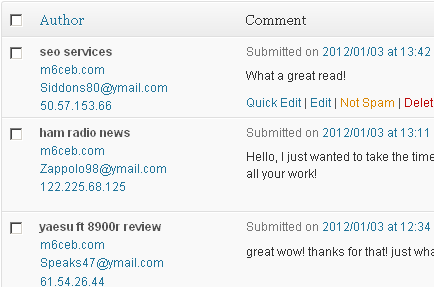
All point to the same site and contain keywords about amateur radio topics (except the SEO one at top). So, I can infer that one of several things happened: 1. The site owner’s site got hacked and the SEO scumbags wove their material into it to make the SEO look somehow more “legitimate.” 2. The site owner acted (paid…*shudder*) on one of those spam e-mails every domain owner receives that offer to “increase traffic to your site.” 3. The site owner is an SEO scumbag himself.
I’m leaning toward explanation #2, since the site itself makes him sound like the Homer Simpson line, “Oh, they have the Internet on computers now?!” Whatever the case, this is inappropriate behavior and I refuse to mention the site owner by name, callsign, or link, lest the action be successful. It’s the equivalent of splattering up and down the band on SSB when running high power to a good antenna. You’re a lid.
Ok, I feel better now.
Ethan Miller, K8GU, is a regular contributor to AmateurRadio.com and writes from Maryland, USA. Contact him at [email protected].
Kudos to CQ
Often I complain about what we’re doing wrong or what we should be doing. This time is one of those exceptions where I have to pass kudos along. CQ Magazine has announced a “Maker” column which will be edited by Matt Stultz, KB3TAN, and will appear in several issues this year. The so-called maker movement has always been around, it’s just recently become more “hip” with the “maker” moniker and like with amateur radio the Internet provides a means for tinkerers to network, exchange ideas and information, and come together as a more organized movement. In my opinion amateur radio missed two prime opportunities with techie movements in the past, that of the open source world / Linux, and the wifi boom in the late 90s, early 2000s that led to wireless ISPs and got a lot of geeks interested in wireless but without amateur radio.
It’s great that CQ recognizes the opportunity and is taking advantage of it to bridge the maker and amateur radio worlds, and it just makes sense from a technical standpoint to introduce amateur radio to makers. Maker projects often have an element of mobility or remote control — projects that need wireless for control or data telemetry. Rather than just purchasing a mystery “black box” radio unit off-the-shelf and incorporating it into a project, makers have the opportunity with amateur radio to understand what’s going on inside the box, or bettet yet build that black box themselves. Introducing amateurs to the maker world will be beneficial as well, hopefully encouraging more amateurs to build and perhaps build projects outside of the normal QRP rig projects we tend to do. Overall this is a win-win situation for radio amateurs and makers.


Operatic triumph
A new version of the Opera software has just been released which can output the bit code of a beacon signal so it can be programmed into a microcontroller such as a PIC or a Parallax Propeller chip. (You can find the download via the Links page of the Opera Yahoo group.)
I modified Eldon Brown WA0UWH’s QRSS program code to send the bit code generated by the Opera software and it was received by my K3 on 30m and successfully decoded. Not bad for 5 minutes’ work! You can download the code here.
Just as Eldon did I will have to build an amplifier to raise the output of the Propeller from a couple of milliwatts to something with a better chance of being received. Before it is worth doing that people will have to start using the Opera mode on the HF bands because with my antenna restrictions I have no hope of receiving or radiating a signal on LF or VLF. But I am quite excited at the possibility of building simple standalone beacon transmitters for this new weak signal mode which is much easier to generate than WSPR or QRSS.
Stop press: Just decoded G0NBD on 10.135MHz +1500Hz for my first real over-the-air Opera spot. And it appears my first transmission (using the PC software and my K3 at 5W) has been received by OM5NA at -21dB. This is fun!

Julian Moss, G4ILO, is a regular contributor to AmateurRadio.com and writes from Cumbria, England. Contact him at [email protected].
28MHz mobile
After getting the Sirio 10m antenna on the car last autumn, I’ve been switching the FT8900 over from the VHF/UHF aerial to use 10m, particularly at weekends as I’ve been driving around. On the FT8900 I’m restricted to FM of course, so I’d been thinking about getting the Anytone AT-5555 in the car to give me SSB capability.
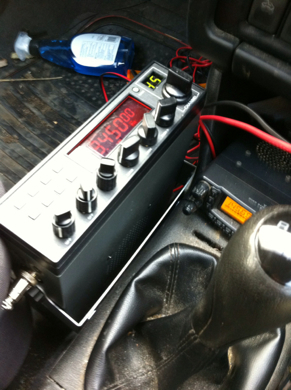
It was just a case of getting the bits together to do it, which in reality was just sorting out the power. I assumed that fixing would be easy, but actually as ever, there’s less room in small cars than you think. And the Anytone is actually quite a big rig! In the end, I managed to fix it securely to the left hand side of the centre console. It seems quite easy to operate and doesn’t impede driving.
On a test drive across to the next village, I listened and heard some activity; UA9XL and an EA8 on SSB as well as a UN9 down on CW. SWR of the antenna seems fine in the lower portion of the band.
Hopefully I shall be able to make some contacts in the coming weeks. 12W or so is quite low power for SSB but I am sure something will be possible and in any case, it’s always interesting to listen.
One thing I have already tried – whilst parked – is tuning the rig to 28.120 to receive PSK and decoding it on my iPhone with the ‘Multimode’ application. In theory, a QSO may be possible by ‘miking’ the output of the iPhone to the rig.
I’m looking forward to seeing what can be done

Tim Kirby, G4VXE, is a regular contributor to AmateurRadio.com and writes from Oxfordshire, England. Contact him at [email protected].
Back to the Lab
Here’s a project I’ve been working on which kind of started on a whim a few days ago. I’ve had two NJQRP DDS Daughtercards lying around, the older versions without the output amp update. I decided to interface one permanently to an Arduino and build a dual 10 and 6 meter beacon.

Is your lab as messy as mine?
The Arduino alternates the DDS frequency between 28 Mhz and 25 Mhz and CW keys the amplifier board. For the six meter transmitter chain I’m doubling the DDS 25 Mhz output to create the 50 Mhz six meter signal. Output power on each band will probably be around 250 mW. I’m probably going to put the unit in a weatherproof box, install it in the backyard, and attempt to power it with solar power. In addition to doing the CW keying and DDS programming, the Arduino will also measure and announce the battery voltage and perhaps the solar panel charge current. For antennas I’m thinking of simple wire loops.
Several years ago I ran a 100 mW ten meter beacon. I like lower power beacons; it’s more of a treat when people report hearing them. The previous ten meter beacon got quite a few DX reports from Europe during the last solar cycle.


Storm damage and what I have learned
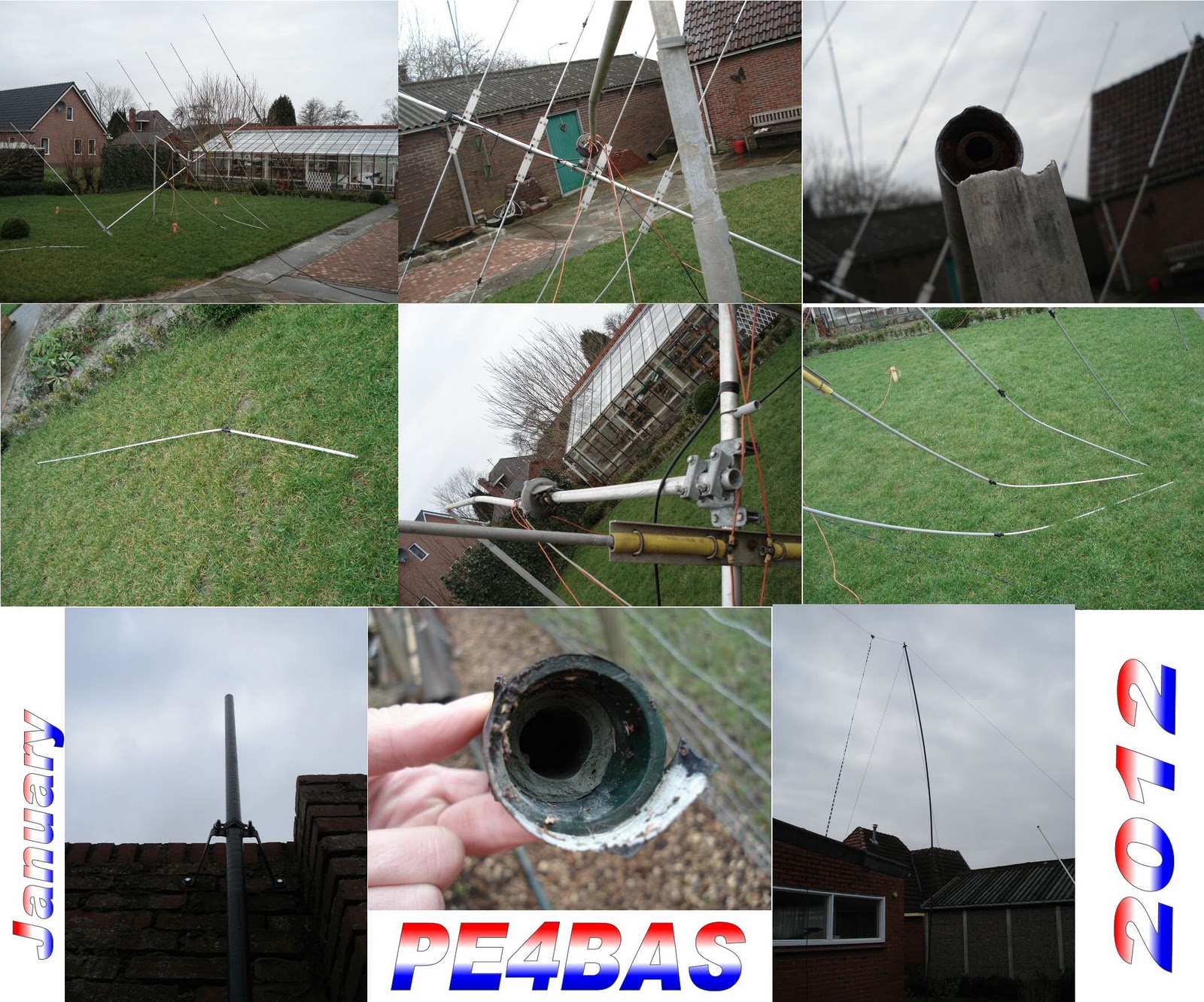 |
| Collage of photos, click to enlarge. |
Actually it’s a pity the beam has gone before I could make any tests. One of the loop antenna supports snapped and I had to cut the wire. But I can overlook the damage. My most important all band vertical is still working. And it’s nothing compared to the damage my “neighbour” station PA1A has. His 150ft (45m) Rohn tower with yagi antennas has snapped. He has been lucky it did not fall on his new house, don’t know what happened to the yagis exactly. Actually same thing (cause) happened to me if you take a look at the photo, although my “tower” was only 16ft (5m). What I learned already this new year is that “high towers catch much wind”. I extended my loop antenna from just 7m to 8m heigth last year and it didn’t work out. Sometimes a little difference has a huge impact on the construction. I’ll repair the loop and will take it to just 7m again to be on the safe side. We can’t joke with nature and since I live near the coast wind can sometimes be very malicious.
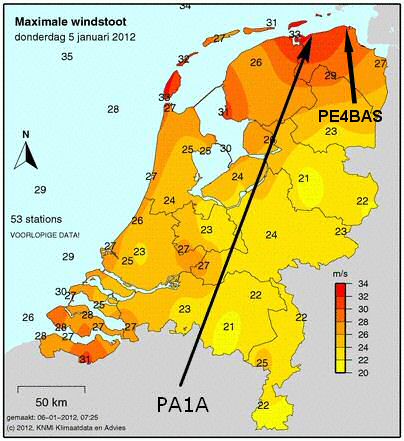 |
| Windchart from PA1A website: 34m/s=120km/h |
Bas, PE4BAS, is a regular contributor to AmateurRadio.com and writes from Groningen, Netherlands. Contact him at [email protected].
QRP ARCI Pet rock contest over…….
 |
10m, 15m gave forth some contacts but the best band was 20m. In this contest it was nice leisurely CW not like the world wide contests were CW sounds more like machine gun fire! Also during the occasional contact more was given than the required exchange info.....SAY IT AIN'T SO........we tossed around our names, rig and at times a hearty 72. ( that was not a typo 72 is the 73 of QRPers) This was the first time the Elecraft P3 was used in a contest and it was a great aid. It would show you what looked like just the noise floor but in the water fall below on the display a signal is made very apparent. Then along with the K3's APF (audio peak filtering) the signal just jumped out and a contact was made. This really was the first time I was able to see how great the APF was on the K3 I had tried it in the past and to be honest was not impressed but that has changed.
Power output 5 watts ( I can say I operated QRO compared to others)
Total contacts 9
Total points 2352
It's no record breaking contact count but this short contest was a blast there were some contacts I just could not put in the log as I did not get the full exchange due to fading. Also at times I got so excited about making a contact it wasn't until the contact was complete and it was ready to be entered into N1MM that I realized it was a Dupe!!! But not once did I get the CW sent to me B4...sorry for not paying closer attention gents and ladies regarding this but thanks for your understand.

Mike Weir, VE9KK, is a regular contributor to AmateurRadio.com and writes from New Brunswick, Canada. Contact him at [email protected].
 Ham Radio Deluxe |
 W5SWL Electronics |
 Ham Radio Prep |
 KB3IFH QSL Cards  Hip Ham Shirts  HamRadioAuctions HamRadioAuctions Reliance Antennas Reliance Antennas Enigma Shop Enigma Shop |  morseDX  Ni4L Antennas  R&L Electronics R&L Electronics antennas.us antennas.us QRV QRV |
- Matt W1MST, Managing Editor
