 |
 Simple keyer complete
 17 January 2012 | by
 At last, I finally got the QRP keyer using KD1JV’s Simple Keyer Chip boxed and working.
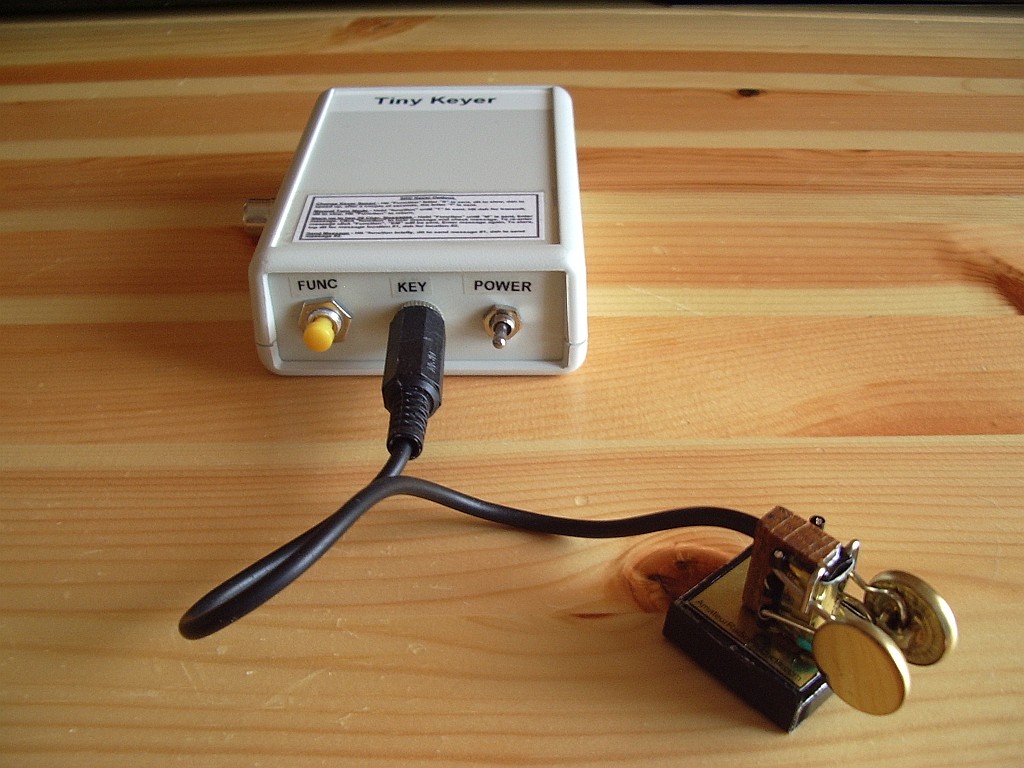 |
| The completed keyer |
As usual, nothing went according to plan. There must be some relative to Murphy’s Law that states for any homebrew project the case will be just too small for comfort. A related rule is the one which guarantees that after you have drilled the case, the position of one of the switches or sockets will be in just the place where it fouls one of the components.
After my first attempt at getting it into the box the keyer was dead as a dodo. This turned out to be because I had forgotten to break one of the tracks on the Veroboard.
After the second attempt the keyer responded to the function button but there was no keying. That turned out to be because one of the connecting wires had broken at just the point where it was soldered. With my eyes as they currently are that took a while to spot.
When I had resoldered the connection and put the board into the case for a third time I noticed that another connecting wire was hanging on by one strand of copper. Lesson: don’t use hookup wire from China, it is made from inferior grade copper.
 |
| View from the front |
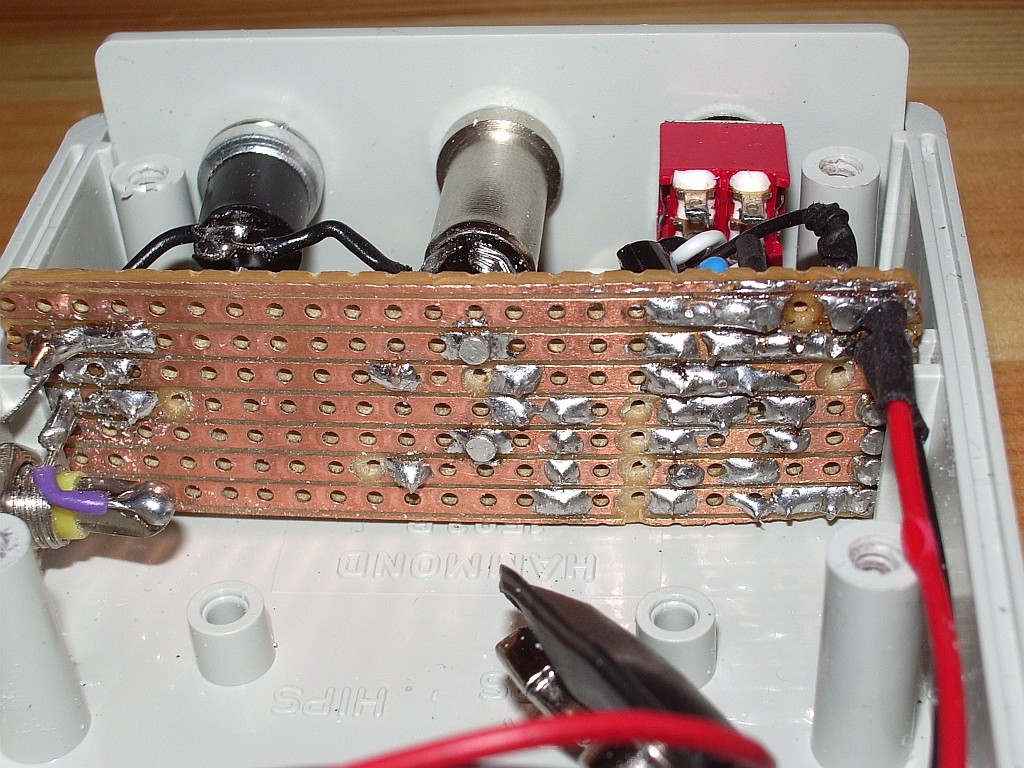 |
| View from the back |
This had taken me a day, so I decided to put the project aside until I felt calmer. The next day I re-made all the connections using new wire, put the board into the case one last time and it actually worked! But Murphy had one last laugh: Now I couldn’t find the four screws for the Hammond case I was using. We searched everywhere. Fortunately my parts box had another Hammond case which sacrificed its screws for the benefit of the keyer. Later, Olga and I managed to find suitable replacements in the local DIY emporium so the other case won’t be wasted.
This Simple Keyer is just what I need for the simple QRP rigs that only work with a straight key. The code speed is easily adjustable and there are two memories, one of which can be repeated as a beacon. I don’t need more sophistication than that for QRP work.

Julian Moss, G4ILO, is a regular contributor to AmateurRadio.com and writes from Cumbria, England. Contact him at [email protected].
SOS Radio Week
This year Workington and District are joining up with Barrow in Furness club to extend the amount of stations we activate. We are operating from Silloth GB1LBC, Workington GB2LBC, St Bess GB4LBC and Barrow GB5LBC lifeboat stations from the 21st to the 29th January in a relaxed style. hopefully making htis years SOS radio week a bigger event locally.
The purpose of our time on the air as special event stations is to promote the RNLI as a charity, something that costs £300,000 a day to run!
St Bees will only be running at the weekends and We are looking to be on mainly 40m and 80m but the Cobwebb is coming with me so there is a possibility of something on the higher bands but it really depends on the weather as high winds will certainly destroy it.
I hope to work as many as possible in between cups of tea and choccy biccies and if you would like to make a donation then it would be really appreciated. Keep an eye out on the status monitors to see when we’re up and running.
Alex Hill, G7KSE, is a regular contributor to AmateurRadio.com and writes from Cumbria, UK. Contact him at [email protected].
Raspberry Pi
The Raspberry Pi, which is a 700 Mhz ARM-based single board computer targeted at providing computing hardware to poor countries is going to be going into production soon. Two models called “A” and “B” are being offered, at approximately $25 and $35 (US). Options to purchase boards and donate money to provide units to needy folks around the world will be available. 
The concept of single board computers isn’t new, but the horsepower and price point of these units are. At this price range it puts the boards squarely in Arduino territory, but unlike the Arduino and other microcontrollers it will run a full blown OS. Several Linux distributions will be supported immediately and presumably BSD variants won’t be far behind. It will not run Windows or Windows emulation, like WINE. (Yes, I know WINE is not an emulator).
The board is equipped with a USB port that obviously can be used to interface with a multitude of devices, however it also includes a General Purpose I/O port or GPIO that supports, PWM, Serial UART and I2C capability. This will open the board up to hardware hackers like us. Sweet!
I’m pondering what amateur radio applications this could run. It has enough horsepower to do DSP. It would make a nice logging and contest appliance, with some well-designed software. How about an EchoLink or digimode appliance? Considering the low price it’s almost disposable and could make a powerful hot air balloon radio payload system controller. I may port my keyer code over to it for giggles. It will be interesting to see what uses radio artisans come up with.


PSK is up and running….for real this time!!
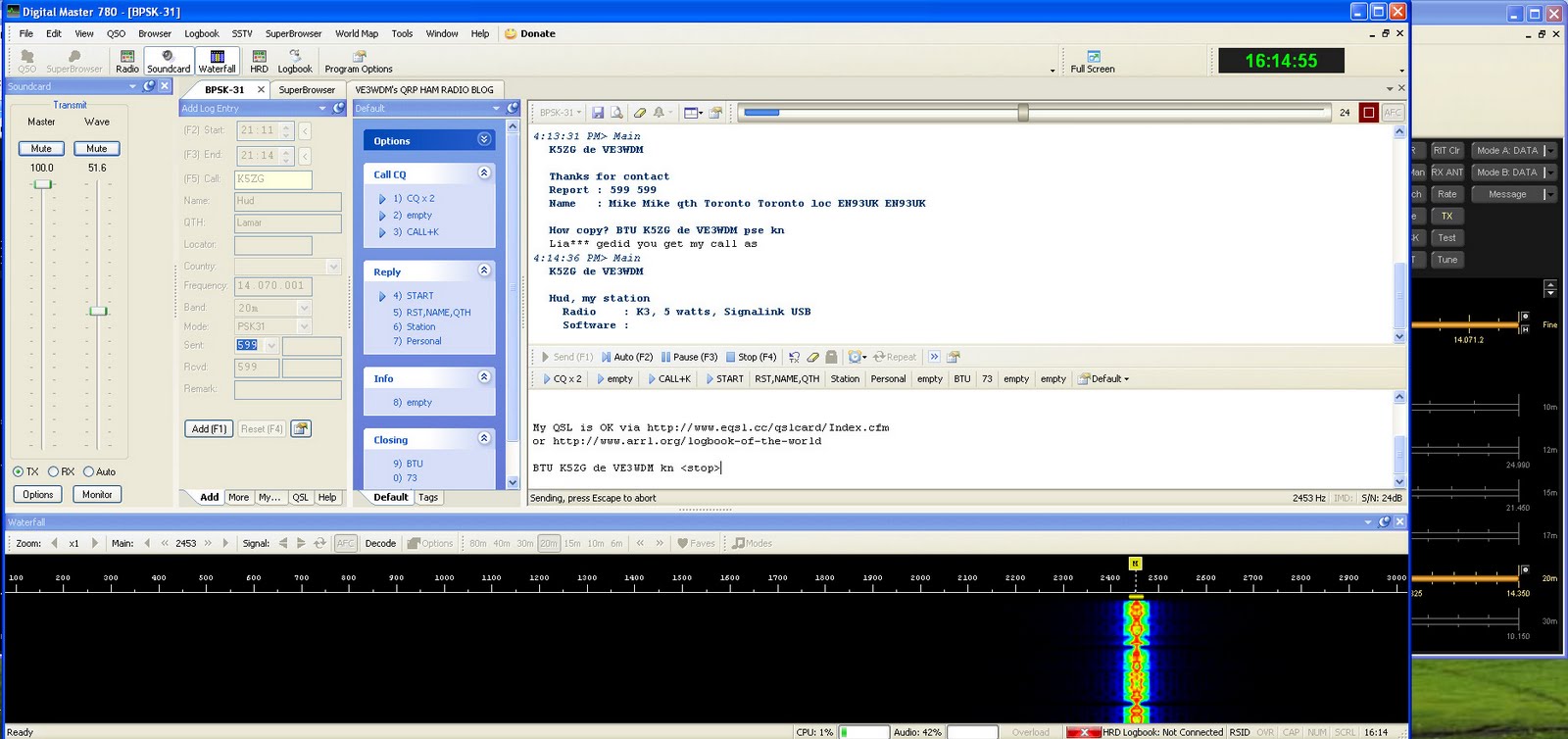 |
| 1st PSK QSO with K5ZG |
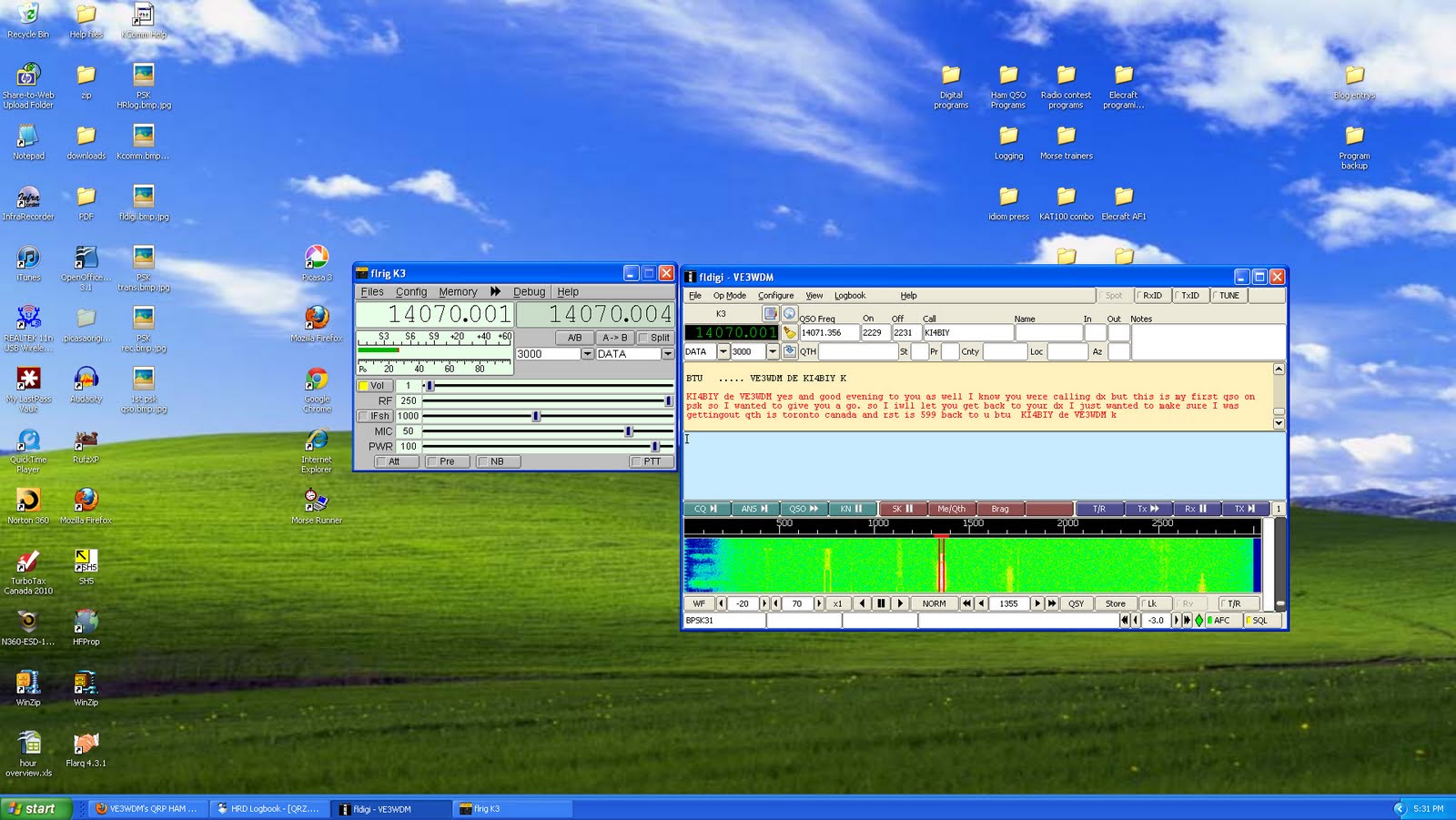 |
| fldigi and KI4BIY |
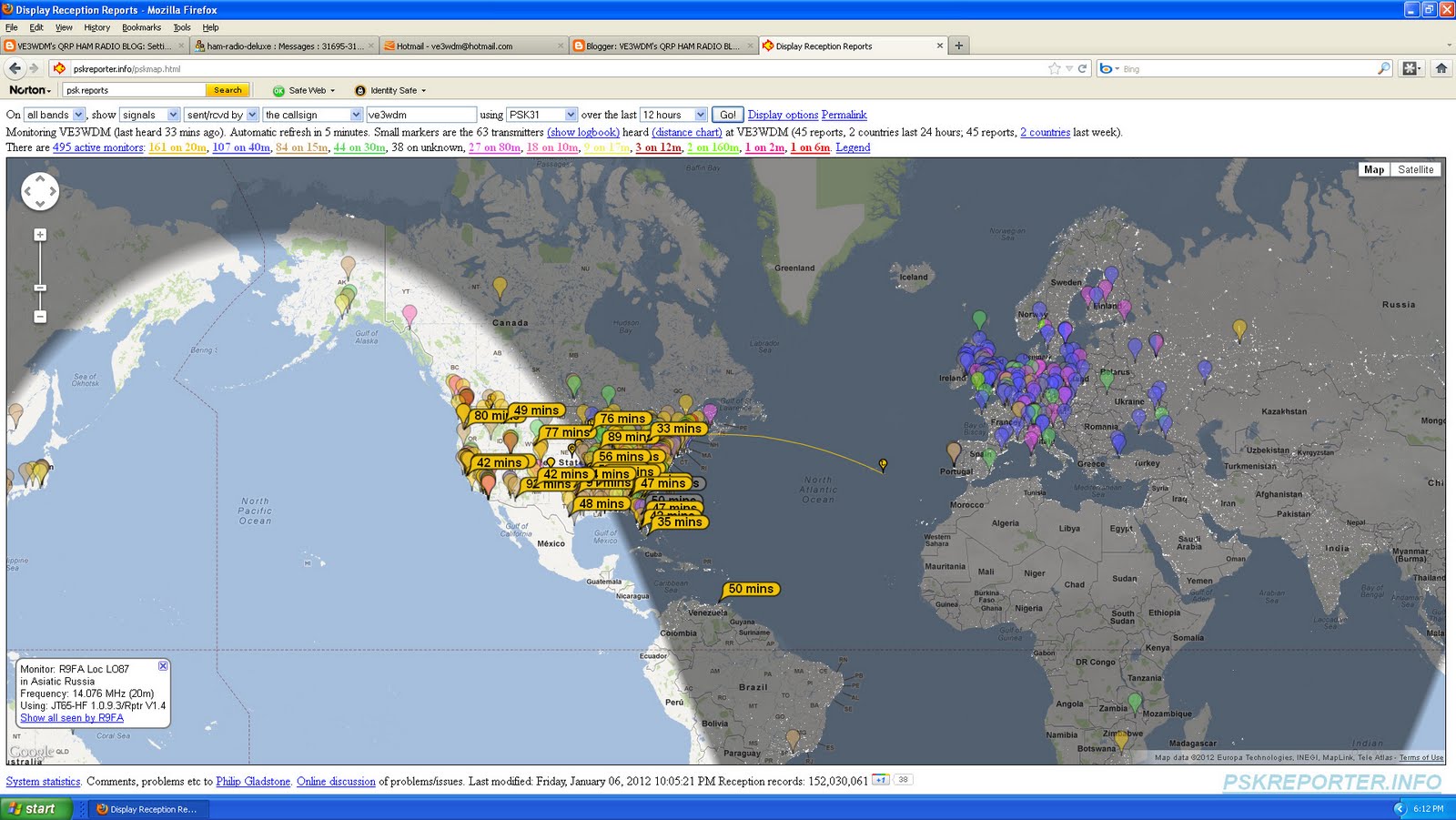 |
| My PSK reports with 5 watts |

Mike Weir, VE9KK, is a regular contributor to AmateurRadio.com and writes from New Brunswick, Canada. Contact him at [email protected].
Technician License Class – April 2012
 Monument, Colorado
Saturday April 21 and Saturday April 28 (8 AM to 5 PM) 2012
Location: Tri-Lakes Monument Fire Station 1
Sponsored by the Tri-Lakes Monument Fire Radio Association
The Technician license is your gateway to the world-wide excitement of Amateur Radio…
- Earn your ham radio Technician class radio privileges
- Pass your FCC amateur radio license exam right in class on the second day
- Multiple-choice exam, No Morse Code Required
- Live equipment demonstrations
- Learn to operate on the ham bands, 10 Meters and higher
- Learn to use the many VHF/UHF FM repeaters in Colorado
- Find out how to participate in emergency communications
There is no cost for the class (donations accepted)
However, students must have the required study guide:
Gordon West Technician Class guide, 7th Edition $20.95
And pay the FCC Exam Fee: $15.00
Advance registration is required (no later than April 15th, earlier is better!)
To register for the class, contact: Bob Witte KØNR
Email: [email protected] or Phone: 719 659-3727
For more information on amateur (ham) radio visit www.arrl.org or www.wedothat-radio.org
Bob Witte, KØNR, is a regular contributor to AmateurRadio.com and writes from Colorado, USA. Contact him at [email protected].
Propeller does WSPR
Through Eldon, WA0UWH I have discovered another blog to add to the blogroll: that of Jeff, KO7M. Jeff is interested in a lot of the same things I have been (including light aviation: an ambition of mine when I was in my 20s but which I could never afford to take up.) But what really piqued my interest was that he has just got a Parallax Propeller to generate a WSPR signal.
This is one of the things I was interested in trying. But I never got further than wondering how to implement the fractional frequency shifts of the WSPR signal, which uses 4 tones shifted by just under 1.5Hz from each other. Jeff has apparently found that a 2Hz shift is good enough to be decoded, allowing WSPR to be sent using the integer frequencies the Propeller chip can easily generate.
Once I have finished the Tiny Keyer project and can get back to the Propeller I will be trying this myself. My ambition at the moment is to make a multi-band multi-mode (OPERA, WSPR and perhaps QRSS as well) standalone beacon with an LCD panel to enable me to choose the band and mode. We’ll see how far I get, but having two other people working on the same ideas should certainly make the task easier!

Julian Moss, G4ILO, is a regular contributor to AmateurRadio.com and writes from Cumbria, England. Contact him at [email protected].
ICQ Podcast S05 E02 – Wolfgang Philipps – W8DA Android Apps (15 January 2012)
Series Five Episode Two of the ICQ Podcast has been released. News Stories include :-
- Yaesu supports 4-FSK digital radios
- Yaesu Musen
- Go back to school - DX University
- US feedback for 60m band plan
- GB80PW for the Practical Wireless 80th year
- New DV-RPTR modem board
- RSGB Commonwealth Century Club Jubilee Award 2012
- UK Propagation charts for January 2012
- New data mode crosses Atlantic on 136Khz at the first attempt
- USA HF Spread Spectrum Experiment
- 43 years of 73 Magazine online
Your feedback and Ed Durrant (VK2ARE) interviews android app author Wolfgang Philipps (W8DA).
Colin Butler, M6BOY, is the host of the ICQ Podcast, a weekly radio show about Amateur Radio. Contact him at [email protected].
 Ham Radio Deluxe |
 W5SWL Electronics |
 Ham Radio Prep |
 KB3IFH QSL Cards  Hip Ham Shirts  HamRadioAuctions HamRadioAuctions Reliance Antennas Reliance Antennas Enigma Shop Enigma Shop |  morseDX  Ni4L Antennas  R&L Electronics R&L Electronics antennas.us antennas.us QRV QRV |
- Matt W1MST, Managing Editor
