 |
 ICQ Podcast S05 E02 – Wolfgang Philipps – W8DA Android Apps (15 January 2012)
 15 January 2012 | by
 Series Five Episode Two of the ICQ Podcast has been released. News Stories include :-
- Yaesu supports 4-FSK digital radios
- Yaesu Musen
- Go back to school - DX University
- US feedback for 60m band plan
- GB80PW for the Practical Wireless 80th year
- New DV-RPTR modem board
- RSGB Commonwealth Century Club Jubilee Award 2012
- UK Propagation charts for January 2012
- New data mode crosses Atlantic on 136Khz at the first attempt
- USA HF Spread Spectrum Experiment
- 43 years of 73 Magazine online
Your feedback and Ed Durrant (VK2ARE) interviews android app author Wolfgang Philipps (W8DA).
Colin Butler, M6BOY, is the host of the ICQ Podcast, a weekly radio show about Amateur Radio. Contact him at [email protected].
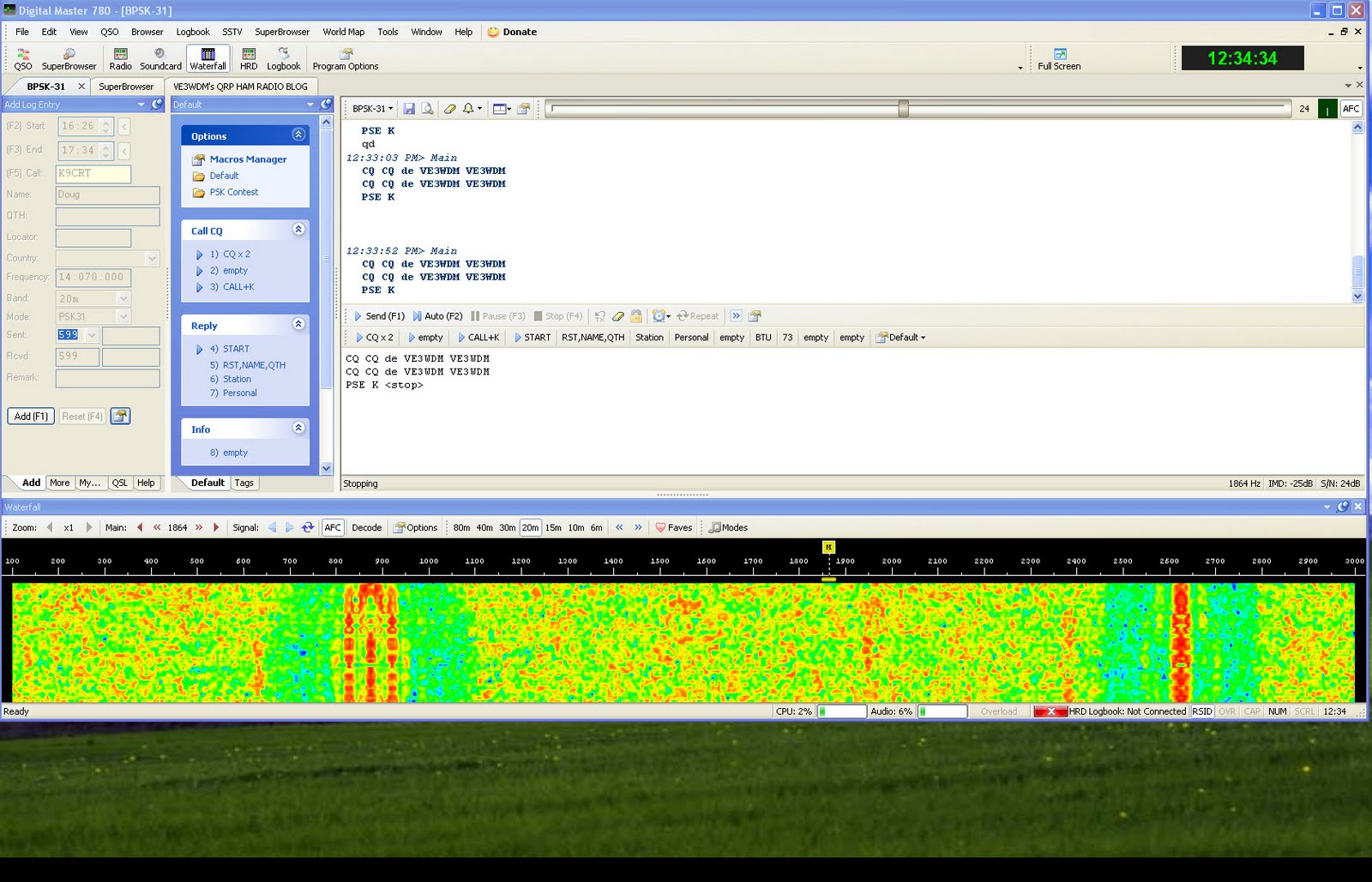
PSK31 up and running…….
 |
| Giving PSK a go |
 |
| Action on the band |
is not getting out. I do see on my LP-100 watt meter there is 5 watts getting to the antenna but whether it is readable or not I am not sure. Besides I am still getting the hang of PSKreporter as well so it could be operator error at this end. Also today I was involved in the NAQP CW contest but am now just taking a bit of a break. I was calling CQ on 40m CW a short time ago and KC9SNC came back to me. Our QSO was going well and the CW speed was very comfortable for me.......then came the contester's right over our QSO!!! Now they may not have heard us as I was QRP at 5 watts but that brought the QSO to an end. I did email Matt and gave him some more info about my station and that we may have better luck next time. So up to this point I have not been able to make a PSK contact maybe I will give Fldigi a go on Sunday and see if I can bag my first PSK QSO. It's now time to head back to the NAQP CW contest......and try not to QRM anyone who is not involved in the contest!!!

Mike Weir, VE9KK, is a regular contributor to AmateurRadio.com and writes from New Brunswick, Canada. Contact him at [email protected].
JT65HF problems
There re just a ton of data modes you can play with and this morning was the turn of JT65-HF to be on my screen. I’d installed it quite a while ago and not used it for some months but I thought I could do with giving it a quick run through to remind myself of the protocols in case we use it on the SOS radio week operations (as GB4LBC for St Bees lifeboat station).
Time is very important with JT65 and a few other modes and I’ve never been a big fan of windows time setting utility. It never seems to be right and there is always a problem with either this or that. I use Dimension 4 on XP machines and it works very well. Under Windows 7 you have to remember to run it as an administrator so I suspect the same will be true for Vista. there seemed to be a bit of a conflict going on on my puny little computer so I had to reinstall JT65-HF and only then did it start to decode the received signals.
I took the opportunity to use my stealth antenna (A Watson 80 plus 2 dipole – which is really only good for 20m here) and immediately got a contact with DG8RW & W3PV with 15 watts.  I had a bit of trouble with the first contact as he couldn’t copy my signal report for a while and I had to resend it quite a few times before he got it. Eventually we got a QSO together and that was pretty pleasing.
So I’ve got my hands dirty again with JT65 and whilst its not the most interactive of modes it reinforces the fact that SSB is inefficient in comparison as I doubt I’d have got where I did with 15 watts and a loft mounted antenna. Still, it was a nice distraction from what I should have been doing. That was to be revising for an exam on Tuesday. Nothing exciting, a professional exam and much less enjoyable that playing with radios.
Alex Hill, G7KSE, is a regular contributor to AmateurRadio.com and writes from Cumbria, UK. Contact him at [email protected].
The SOTA Activities of KD0BIK–Blog Site
 I’ve setup an independent blog site to somewhat showcase my past and future SOTA or Summits On The Air activities. In addition to posting alerts to future SOTA activations and detailed trip reports after, I also plan to post some “How To” or instructional related topics all about SOTA.
These special instructional SOTA topics can all be found under the category of “How To”. In addition, I’ve setup links to all the various SOTA related websites and even documented some of the gear I carry along with me. The gear page explains what I use and also details into why and how.
You can access The SOTA Activities of KD0BIK by clicking the SOTA Activities link at the top of the page.
Thank you to all who continue to read my blog sites and listen to the podcast.
Until next time…
73 de KD0BIK
Jerry Taylor, KD0BIK, is a regular contributor to AmateurRadio.com and writes from Colorado, USA. He is the host of the Practical Amateur Radio Podcast. Contact him at [email protected].
Trials and tribulations
I’m sorry if you are one of the many people who have sent me email expecting a reply, but unfortunately answering emails is one of the things I very often never get around to. Although it might seem from the blog that I am getting back to normal, everything I do still takes me a lot longer than it did when I was fit and well and I’m more prone to making stupid errors. I’m happy that I’m still able to do some of my ham radio activities but what I achieve is often accomplished only after a lot of frustration.
Today the Simple Keyer Chip from Steve Weber arrived in the post. I verified the behaviour of the chip I’d programmed, then replaced it with the new one. I was pleased to find that it now operated at the correct speed – the sidetone was now audible to humans rather than bats and the default speed was rather more sensible. Obviously I’d messed up some setting of the programmer – but the keyer still ignored the dot paddle. I began to suspect that this meant there was something wrong with my wiring, but between my limited field of focus and my shaky hands it took the entire morning – culminating in a lot of bad language – before it eventually dawned on me what was the trouble.
To cut a long story short, the cause of the problem was the 3.5mm socket I was using for a key jack. It had three terminals which I thought were for tip, ring and sleeve, dash, dot and ground. But it was a mono socket! There was no ring connection. One of the three terminals was linked to the other and disconnected when the plug was pushed in, intended to silence a speaker when phones were plugged in. It took me an entire morning including checking the wiring of two morse keys before I discovered my stupidity.
I hunted in my parts drawers and eventually discovered a proper 3.5mm stereo socket. After connecting that in place of the other one I confirmed that the keyer worked as expected. But the frustrating search for the solution had made me tired so I decided to leave the task of drilling the box and finishing the keyer for another day, thereby adding to the list of unfinished tasks alongside the unanswered emails.
Another thing that annoys me is my Rapid Electronics HY3003D bench power supply. It has a rather inconvenient fault for a power supply that is used in a radio shack. The voltage regulation circuit suffers from RFI. If any of my radios transmits, the voltage increases. In some cases it could increase to a level that could damage the circuit I am testing, though fortunately that hasn’t happened yet.
I don’t always remember to put my APRS gateway or the WSPR (or Opera, which I have been testing today) beacon into receive-only mode whenever I’m working on something. (I’ve tried clamp-on RFI suppression ferrites on the mains lead and they made no difference.)

Julian Moss, G4ILO, is a regular contributor to AmateurRadio.com and writes from Cumbria, England. Contact him at [email protected].
New 70MHz beacon from Skye (IO67)
Speaking to Ken, G3LVP he told me that GM8RBR is running a ‘personal’ 70MHz beacon from the Isle of Skye (IO67UF) on 70.100. The beacon was supplied by HG1YA and runs 10W to a 5element dual band 50/70MHz antenna beaming south.
The beacon has been heard by a number of 70MHz enthusiasts in the south by meteor reflections – Ken, G3LVP and John, G4ZTR both report hearing a number of meteor pings via the 70MHz website

Tim Kirby, G4VXE, is a regular contributor to AmateurRadio.com and writes from Oxfordshire, England. Contact him at [email protected].
The first scratch…
You know how it is when you buy that new pickup truck and you’re so careful with placing anything into the back for fear of getting that first scratch.
A few months ago I learned about Keith, G6NHU and his QSO365 project. I thought to myself what a marvel idea and what a great way to ensure you get on the air more. Keith’s plan was certainly more than just the hope of making a contact a day. It was very well organized and he blogged about his progress throughout the year. Keith successfully completed his goal and did in fact make a QSO each and every day in 2011. Please visit his blog site to read all about his 2011 QSO 365 project.
I think we all struggle from time to time with staying active on the bands. I once interviewed Duncan McLaughlin, KU0DM on the practical amateur radio podcast. You can listen to this two part episode in episode 28 and episode 29. During the interview, I asked Duncan how he managed to stay active on the air with all the other activities a high school aged young man has competing for his spare time. His comment was simple. His goal is to make 5 contacts or QSO’s per week. This might be completed with a single QSO each day for five days or he might complete 5 QSO’s all in one day. The point was to at the very least have a goal and stick to it.
Sadly, I have experienced months where I’ve only made a handful of QSO’s and some months where I’ve made none. I’ve even experienced consecutive months of no QSO’s. I should note, these consecutive months of no on-air QSO’s had nothing to do with HF band conditions. It was available time and motivation to create available time.
As an example, the month of January 2011 I failed to make a single QSO. While I made 157 in February 2011, I experienced zero QSO months in March and April. I really came out of my shell in August with 69, then 302 in September (Colorado and Texas QSO Parties) and I finished the year strong with over 100 QSO’s each month in October, November and December. The month of January 2012 is still young and I’ve logged over 100 Q’s. While it’s not about the quantity or number of QSO’s I make in a given month or year, it really is the quality.
Back to that first scratch. Just after I kissed my wife and wished her a Happy New Year (just after midnight), my wife said to me, “Don’t you want to go down to your ham shack and make a first contact of 2012?” My wife is VERY supportive of my amateur radio hobby and everything that goes along with it (this blog, podcast, SOTA adventures etc.) Of course I said yes, be right back. I quickly fired up JT65 and the first QSO was in the log for 2012. Really without trying I found myself making QSO’s on Jan. 2, 3, 4, 5 etc. I guess you could say I’m trying for a QSO a day in 2012.
But why do I keep talking about a scratch? On the evening of 10 January, I didn’t make it down to the shack until after 9 PM local time. The bands were in horrible shape and I didn’t hear anything on 40 or 80m SSB. I checked the data modes and still nothing. I decided my best chance for a QSO was JT65 and I began calling CQ at 5 watts. Every couple of CQ cycles I increased the power by another 5 watts. Calling CQ at 10, 15, 20 and even 25 watts….NOTHING heard. I began to have the feeling you feel just after you get that first scratch in the pickup bed.
See…when you buy that brand new pickup truck, you do everything in your power to prevent that first scratch. I mean….just about everything. Then one day you look and there it is. As big as Dallas….that first scratch. From that point on you just simply don’t care. You haul anything and everything and don’t care if something slides and bangs around.
I wasn’t ready for the first scratch or the first day with no logged QSO’s. I turned the power up to 30 watts and sent my JT65 CQ out one more time. Thank fully, K5DHY in Texas heard me and replied. A few minutes later the QSO for the day was in the logbook. Whew….I avoided that first scratch.
So I guess you could say that I’m trying for a QSO a day in 2012. My rules are simple…have fun. The day it becomes a chore, I’ll stop. But right now it is fun and yes I realize I’m not even half way through my first month. 
Rules??? I don’t have any rules set really. All contacts will be HF. Most will be made in my shack. But others will most certainly be from portable operations such as SOTA and other portable/mobile operations. My calendar day is based on UTC. Which means in the evenings I’m working towards the next calendar day. This also sort of provides a safety net in the sense if I hadn’t made that QSO on the evening of the 10th, I could have made attempts the next day as long as I got it in the log before 00:00 UTC.
We’ll see how things progress and see if I can avoid that first scratch.
Until next time….
73 de KD0BIK
Jerry Taylor, KD0BIK, is a regular contributor to AmateurRadio.com and writes from Colorado, USA. He is the host of the Practical Amateur Radio Podcast. Contact him at [email protected].
 Ham Radio Deluxe |
 W5SWL Electronics |
 Ham Radio Prep |
 KB3IFH QSL Cards  Hip Ham Shirts  HamRadioAuctions HamRadioAuctions Reliance Antennas Reliance Antennas Enigma Shop Enigma Shop |  morseDX  Ni4L Antennas  R&L Electronics R&L Electronics antennas.us antennas.us QRV QRV |
- Matt W1MST, Managing Editor
