 |
 ICQ Podcast S05 E03 – G-QRP Limerick Sudden 40m Receiver (29 January 2012)
 29 January 2012 | by
 Series Five Episode Two of the ICQ Podcast has been released. News Stories include :-
- Earth Station For Sale
- New 60m web site
- ARRL achieves fund raising goal
- KG4, Guantanamo Bay
- UK amateurs experience echo phenomenon
- Danish presidency of EU callsign
- Student D-STAR satellite to launch in 2012
- The new VHF-UHF band plan - 4m in Ireland
- QRP to the ISS
- Special callsigns for UK radio amateurs during 2012
- New Clubs and Training section for RSGB website
- Cuban Amateur Radio regulations modified
- Call of Titanic will go out again
Your feedback and Colin (M6BOY) reviews the G-QRP Limerick Sudden 40m Receiver.
Colin Butler, M6BOY, is the host of the ICQ Podcast, a weekly radio show about Amateur Radio. Contact him at [email protected].
Life’s Too Short
Harvey Adkins, K1ZWK, was found dead in his apartment in New Haven, CT this week of apparent natural causes. Adkins was first licensed in 2000, shortly after retiring from over 30 years of service at Lockheed Martin.
“He was an engineer’s engineer.” said Walter Roomberg, a former co-worker. ”Any challenge you placed in front of him he would attack with vigor. He was always trying to do “one better” than anyone else and would always succeed.”
“After he retired, Harvey was bored and needed something to do. He knew about amateur radio for years, but dismissed it as too simplistic.” said Roger Smith, a local ham friend. “At work he was on complex high tech multi-million dollar defense projects.”
We spoke with Adkins’ ex-wife, Mildred. ”We divorced in 2010. He had always been successful all his life but was failing at this new thing he was working on with his radios called QRP. It became an obsession and he was failing at it. It took such a toll on our marriage that I had to call it quits after forty years.” she said sadly.
Adkins excelled in amateur radio radio shortly after getting his ticket. He acquired Worked all States on four bands within his first three months. DXCC was achieved a few months later and within three years he was approaching the honor roll.
“Harvey operated all the modes at that time, except for CW and some of the slower digital modes.” stated Smith. ”He had to learn the code in order to get his license, which he did easily, but he had no interest in CW. He saw it as slow, simplistic, and too low tech, and enjoyed the ease with which he could conduct a conversation with other modes. In additional to phone ragchewing and DXing, he was doing all kinds of cool stuff like EME and writing his own DSP software, using the engineering capabilities he developed in his professional career. ’Life’s too short for CW!’ he would say. “
Another club member, Elmer Keglovits, gave a similar profile of Adkins. ”He was the Renaissance man of amateur radio. He did it all. Some modes he briefly did but found too mundane or just not that challenging. PSK31 was one of those modes. He tried it for a short time but found the nature of it, macros and all, to be a bit mindless and boring. But he would never put down the mode, and if you ever asked him about PSK at a meeting, he could immediately tell you exactly how it worked and even draw on the whiteboard the modulation technique. It was the same with CW. He learned it to get his license and felt he knew enough about it, and moved on to other more interesting things, for him. He wanted to try everything in amateur radio and learn the underlying technical details. He didn’t find it necessary or worthwhile to dwell on modes that got in the way of his ‘journey of discovery’ as he often called it.”
“One night he was talking about his achievements at our monthly club meeting and someone chuckled and said that anyone could do what he did on QRO and phone and that if he wanted to be a real ham he should do all CW. Something snapped in Harvey that night.” said Smith. ”Throughout his professional career he was accustomed to being recognized for everything. He had thought he had reached the pinnacle of amateur radio achievement and was insulted, but also challenged by this.”
Adkins became introverted and isolated after the encounter, Rogers explained. ”After that night he changed. He studied and practiced CW again and increased from a rusty 5 words per minute to 30 in a matter of two or three weeks. It was amazing. He made some contacts on the air, but he was frustrated as it seemed too easy to bang out quick QSOs, and he felt too encumbered to ragchew like he did on phone. On the other hand, once enjoyable phone operation didn’t interest him anymore with the mode considered tainted, in his mind. That’s when he vowed to go all CW and QRP. He sold all of his gear at Dayton later and proudly purchased and built an Elecraft K1 and began operating a relatively spartan station compared to his previous setup. But for some reason he just couldn’t make a contact, any contact, at all with the rig.”
Rogers had offered to help Adkins determine what was wrong with his new radio, but Adkins steadfastly refused, seeing it as a failure if he had to seek help. ”At that point our relationship deteriorated.” said Rogers. ”He had gone for about four months without being able to make a CW QRP contact. He bragged in an email to the QRP-L reflector about diving into the QRP CW lifestyle and how much he was enjoying it, but unfortunately was banned for life when he mentioned a Rockmite that he had acquired on eBay.”
The ban from QRP-L added to his angst and focused him even more, but his downfall was beginning. He began gaining weight, his marriage fell apart apart and after a messy divorce funds were limited so he had to move into an apartment where no outside antennas were allowed. This fueled the obsession, with the necessity of stealth antennas adding to the challenge. Two years later and fifty pounds heavier he still had not made a QRP CW contact.
“Local hams could hear his signal very weakly, but no one dared work him.” said Rogers. ”Knowing Harvey, we didn’t want to ruin his challenge. We weren’t rare DX so it probably would have made him go over the edge if someone a mile away worked him.”
But Harvey was already going over the edge. Analysis of files on his computer showed that he had created an anonymous email alias and fake callsign and was frantically emailing QRP-L.org, the other main QRP “watering hole”, for suggestions. Unfortunately his emails were HTML formatted which was forbidden by the reflector, and his emails were silently discarded without anyone seeing them or responding. The lack of response which mimicked his on air struggle was apparently more than Adkins could bare.
After nearly three years of no QSOs, Adkins was found dead in his apartment full of Elecraft rigs, Rockmites, straight keys, and various homebrew stealth antennas. Roger Smith acquired all of the rigs and coordinated an estate sale at the request of estranged relatives who declined to be involved. ”Each rig was modified. There was a resistor pad on the output of each one, reducing the power output. Apparently five watts was too much power for him, or he thought someone would up the ante on him again with an even lower power challenge. All of his rigs were putting out less than a milliwatt. It was very strange.”
No services are planned for Adkins, however local amateurs are planning to honor him by acquiring his ashes and compressing them into an Altoids tin and storing them at their clubhouse in New Haven. Harvey Adkins was 74 and is survived by two children and one grandchild.


Another nice day as GB5LBC
Well, that has to be the longest day I’ve ever spent at the mic. Both Norman, G7MRL and myself have been at the coalface from about 8am. The morning sun was just starting to peep through the fells and made for a lovely sight. The bonus was that the ground that had been boggy and muddy last week was stiff with the hard morning frost and it made setting up the mast much easier.

Lovely morning for radio
The St Bees lifeboat station manager has been so helpful and not at all concerned by our muddy footprints that have given away our movements on his clean floor. We’ll need to clean it up properly tomorrow afternoon.
Conditions weren’t as good as last weekend. The band seemed to have a lot of static in the morning and QRM at lunchtime followed by bedlam in the afternoon with stations on top of each other on 40m. 20m was contest town and we only managed 1 contact before be gave it up as a bad idea. 17m, 12m and 10m gave a few contacts including Greece on 10m FM, which was nice.
Both Norman and myself had a tiring day and at 3pm headed back to 40m for a few more QSO’s. We’re back on the air tomorrow although I’m on home duties in the morning but Noel and Norman will be on in the morning. Perhaps I’ll get a chance to use my 6m 5/8 vertical.
Anyway, although it was a tiring day we couldn’t have filled 5 pages in the log without everyone coming back to our CQ call. Without those patient people who helped us when the conditions were against us. The number of stations that wanted our little extra award certainly helped get the numbers up. I’ve a sneaking suspicion that GB1LBC will be in big demand tomorrow after Bill had to call it a day with feeder troubles today.
Alex Hill, G7KSE, is a regular contributor to AmateurRadio.com and writes from Cumbria, UK. Contact him at [email protected].
The One
Ham radio is an activity that’s been around for over a hundred years and boasts millions of adherents around the world. It should come as no surprise that an institution so ancient and so compelling would harbor a few mysteries.
During the early development of radio the activity was particularly attractive to a certain kind of fellow, one with a keen interest in science and industry and often a fellow whose station in life was a cut or two above that of the ordinary man. The formation of clubs and societies, recondite in nature and hidden within the rank and file of this adventurous lot of explorers led to more than a few secrets.
That much you might know. What you probably don’t know is that a few of these clandestine organizations remain active inside the hobby to this very day.
I’m not personally a member of any of these groups nor do I have first-hand knowledge of who they are or what they do on a daily basis. But from time to time I hear from some of these secret members who drop bombshells on me that strain credulity.
I think they’ve given me a few of these nuggets to distribute because I’m an oddball. Really, compared to other ham radio bloggers I rarely over-hype the hobby and pretend to be its personal spokesman as has become common among those intent on making “X” number of contacts a day and who extol only the virtues while never telling the whole story of what it’s like to be a radio amateur.
That’s what I like to think anyway.
More’s the likely they know I’m close friends with W6OBB and they’re looking for a higher profile outlet in exposing the reclusive activities of the Lodges and are using me to get that information to him. In any event, on occasion a package arrives at my shack, delivered by a personal courier as happened just a few days ago.
This time the package included a short tale of something that happened 35 years ago and it included instructions to share it with my readers, which I’m doing today…
It seems that back in the late 1970’s a distinguished scientist and radio amateur whose name must not be spoken had developed a rather amazing antenna that performed well at high frequencies. It’s precise construction remains a secret to this very day but imagine if you will a six-foot long tube whose diameter was about two-inches. A coil of wire was wrapped around almost the entire outer body and inside there were active components, including a small pump as most of the tube was filled with a Noble gas compound that periodically required refilling.
To simply say that this antenna worked well would be a serious understatement.
Reports indicated that the antenna was highly effective without a tuner across all of the HF amateur bands. Placed horizontally or vertically in the corner of a room or the attic it was an order of magnitude more effective than any directive array installed at 150-feet.
In a nutshell, it was The One, the killer antenna that the prophets had written about.
This would revolutionize the world of HF communications. No longer would the fellow with the 100-acre antenna farm and California Kilowatt rule the Honor Roll. Now even the lowliest QRPer with his milliwatt homebrew designed gear would be on equal footing with the millionaire.
In essence, the new antenna would instantly turn the 99 percent into the 1 percent and at least when it came to hardware, there would be no more elite amateur radio stations.
Plans were made to manufacture the small wonder. This scientist/inventor wanted to sell the antenna for US $1000 and he fully expected to eventually sell one million of them making him the first amateur radio manufacturer with $1 billion dollars of revenue.
He tried to keep these plans as secret as possible for obvious reasons so he never patented the antenna which would have announced it to the world. His belief was that the gas compound required was so exotic that even if someone managed to reverse engineer the design, the compound would remain the only edge he needed.
The first five-thousand units were assembled in a large, vacant building somewhere in New Mexico.
It was about that time that the inventor discovered that his secret had leaked when he got a call with an offer to purchase the design – which he refused – and he continued to build inventory. But the phone calls and strange contacts never ceased – all warning him to sell the design for the antenna or risk losing it all.
He underestimated the threat and continued in the pursuit undaunted. Until one night when he was visited by four members of one of these secret societies who explained to him that ham radio was bigger than he and his design. And that his antenna while extremely clever would ruin the hobby by allowing those with the most basic equipment to compete on equal footing with those who had invested hundreds of thousands of dollars in hardware and antenna farms.
Equal wasn’t good nor was it even “fair” he was told.
Unmoved by their threats, he stood to leave so they grabbed him, pulled a covering over his head and tossed him into the back of a dark colored sedan and drove off into the desert where he was never seen again.
The inventory of over five thousand antennas was moved by truck to a landfill outside of Alamogordo, New Mexico where they were first crushed and then buried. Three feet of concrete cover the burial site and while a few of the local hams had some knowledge of this activity, the years have created doubts as to its veracity and scope, leading some to conclude that this was just another urban legend.
But I know better and now so do you.
I can tell you this because the inventor had an assistant.
A fellow radio ham who hid in the shadows when the abduction took place and who watched this all unfold.
And at 85 years of age, he figures there’s no reason to take this story to his grave…
Jeff Davis, KE9V, is a regular contributor to AmateurRadio.com and writes from Indiana, USA.
A QSL card that was almost a quarter century in coming!!
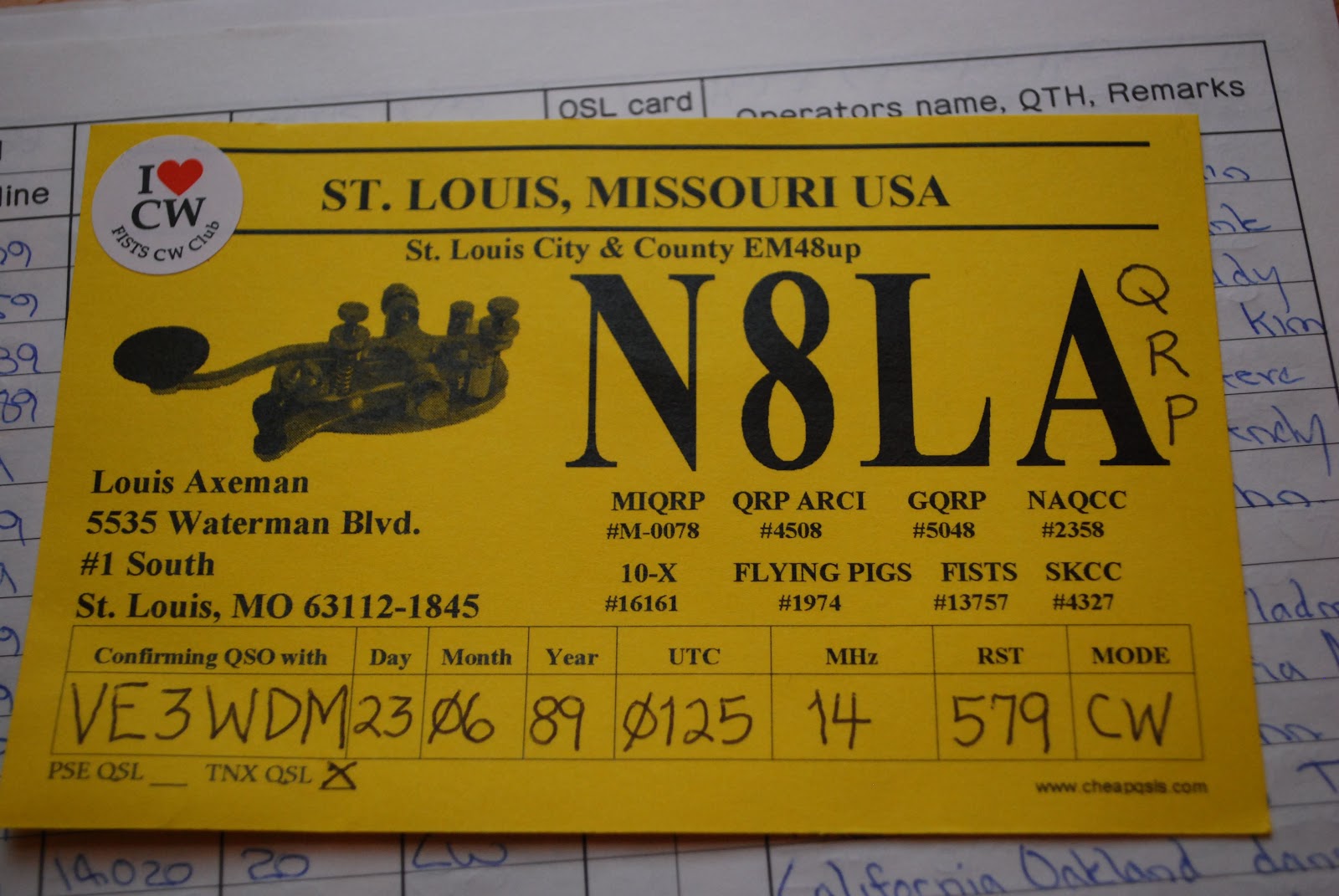 |
| A contact from 23 years ago |
have not sent out QSL cards (all electronic cards now) for over 10 years. Now I was just a bit confused...maybe this was a mistake....he must had copied a call wrong and sent me a card......Then I look a closer look at the front of the card..... this card was from 1989!!! To say the
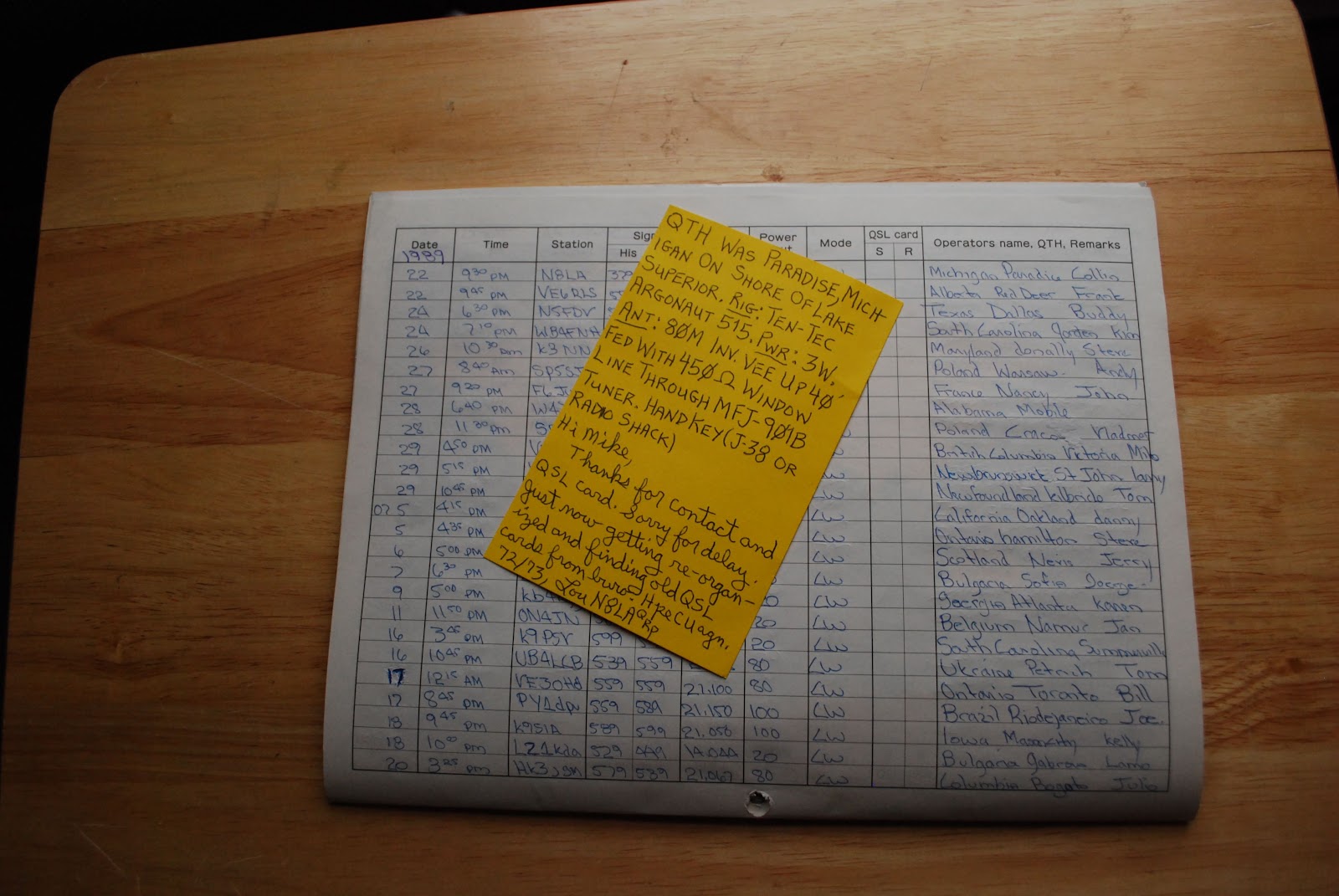 |
| The back of the card |
 |
| The station 23 years ago |
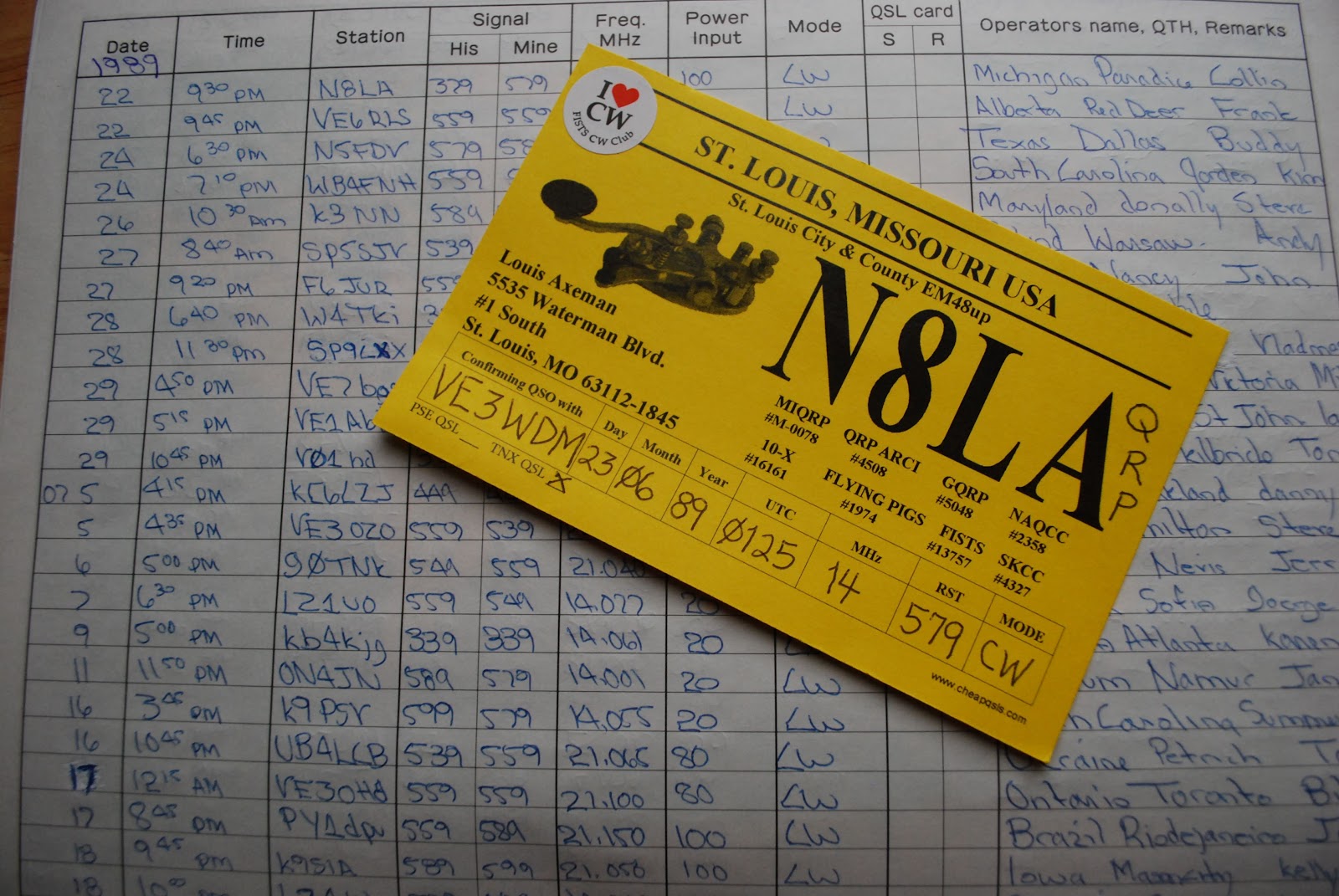 |
| The log (N8LA at top of log) and QSL |

Mike Weir, VE9KK, is a regular contributor to AmateurRadio.com and writes from New Brunswick, Canada. Contact him at [email protected].
Ham Nation 32

Hosts: Bob Heil (K9EID), Gordon West (WB6NOA), and George Thomas (W5JDX)
Tim Allen’s shack, more from Gordo at CES, iCOM 718 and 7200 reviews, and more.
Download or subscribe to this show at http://twit.tv/hn.
We invite you to read, add to, and amend our show notes at wiki.twit.tv.
Thanks to Joe Walsh who wrote and plays the Ham Nation theme.
Thanks to Cachefly for the bandwidth for this show.
Running time: 57:21
http://dts.podtrac.com/redirect.mp4/twit.cachefly.net/video/hn/hn0032/hn0032_h264b_864x480_500.mp4
http://dts.podtrac.com/redirect.mp4/twit.cachefly.net/video/hn/hn0032/hn0032_h264b_640x368_256.mp4
http://www.podtrac.com/pts/redirect.mp3/twit.cachefly.net/hn0032.mp3
Dr. Bob Heil, K9EID, is the founder of Heil Sound and host of TWiT.tv's Ham Nation which streams live each Tuesday at 6:00pm PT (9:00pm ET) at http://live.twit.tv. Contact him at [email protected].
Handiham World for 25 January 2012

The new handiham.org is up and running. I hope you like it, but I am sure open to suggestions if there is something you find that does not work. In the meantime, the old website is still alive, but it is at the URL handiham.net. The two sites are different, but many of our users have not yet registered with the new site, and will probably just find it easier to log in at handiham.net until they have time to get set up in the new handiham.org. So if you visit handiham.org and find that your log in credentials don’t work, the reason is that the new site uses an entirely new database and re-registration is necessary. I have done this in advance for some users, but have not had the time to devote to manually entering so much data. If you wish you can use the create an account link to enter your own data, but please remember that this is a Handiham member service, so I would appreciate it if you used the credentials you already registered with us for the old website. That way, I can check against our database and approve your account because I will know it is really you, not some spammer who wants access to the site. Most of our users registered with their callsigns, except for those studying for a first license. Please stick with your existing username from the old site and, unless you have a different email address, the same email you registered with us in the first place. Be sure you always keep your email address up to date. If you are not a Handiham member, you may still enjoy the public portion of our website without logging in. If you are a Handiham member and need access, please use the Create Account link and apply for access. I will review and approve as soon as possible.
Another change is that our QST audio digest for February 2012 is available to our blind members in DAISY format from the members section. DAISY is the same special format used by the Library of Congress and other organizations providing specialized adapted audio to blind users. It is a single zip file, the preferred method for download simplicity. It will play on DAISY players and the the new Library of Congress player. The complete issue of QST generally takes a month to a month and a half to be released from the Library of Congress, so our audio digest gives blind hams some of the time-sensitive information at around the same time print subscribers to QST are reading their copies.
VOLLI, our volunteer hours logging system, has stopped functioning. We ask that Handiham volunteers simply email Nancy their hours on a regular basis. The best way is to fire off an email as soon as you finish a project. For example, if you volunteer at a hamfest giving out our literature, when you get home just send Nancy a message letting her know the volunteer activity and the hours you spent at the fest. For recording a big project, such as an audio tutorial or a book for our blind members, you might want to keep a log of your hours and then inform Nancy of the total when you complete the recording project.
The Handiham Radio Club and Handiham Volunteer mailing lists have both gone into the bit bucket! I should have thought about that before changing the domain name, but I forgot that detail. We still have the ability to set up mailing lists, so I will see what we can do. That project will have to wait just a little while because I want the website project to be further along and secure before taking on another task.
So that’s my update for this week. I expect to release a new General Class audio lecture on Friday, but we will see what time is available. We are always looking for help from talented volunteers who can record audio, teaching into a microphone. Be on the lookout for an upcoming two part “With the Handihams” series in Worldradio online about how to record using the open-source software Audacity. It is cross-platform, running on Windows, Mac, or Linux!
Handiham Manager

Pat Tice, WA0TDA, is the manager of HANDI-HAM and a regular contributor to AmateurRadio.com. Contact him at [email protected].
 Ham Radio Deluxe |
 W5SWL Electronics |
 Ham Radio Prep |
 KB3IFH QSL Cards  Hip Ham Shirts  HamRadioAuctions HamRadioAuctions Reliance Antennas Reliance Antennas Enigma Shop Enigma Shop |  morseDX  Ni4L Antennas  R&L Electronics R&L Electronics antennas.us antennas.us QRV QRV |
- Matt W1MST, Managing Editor
