 |
 Transmission from space…
 18 January 2012 | by
 Andre Kuipers is a Dutch astronaut in space at the ISS at the moment. Since he’s Dutch he is the operator behind the HAM radio when skeds are made with Dutch and Belgian schools. His call is PI9ISS. Today he was answering some questions from Belgian students. I knew that the contact was actually made from Belgium this time so there was a chance to receive him. Since I was on the job I was not able to listen to the full session but managed to hear some of the overs. Of course my colleague had to listen to it as well, actually at first he didn’t even believe it was Andre from space till he listened a few overs. The signal was most of the time full scale, after 10 minutes it went down fast and I lost PI9ISS in the noise.
 |
| Radio Netherlands relaystation entrance |
Well I was home this afternoon cleaning the temporarely radioshack a bit. And had of course the radio on receive. I suddenly heard PJ4B from Bonaire Isl. on 12m SSB in a small pile-up. PJ4B was again transmitting from he Radio Netherlands Relay station site and used the commercial antennesystem. They told that it had a gain of 21dB over a normal dipole. Very nice steady signal peaking S7 here on the horizontal loop antenna. They were asking another Dutch station (PE2MC) what the difference was between signals of PJ4C and their signal. I couldn’t hear what Marco was telling but it must be a large difference as I couldn’t even hear PJ4C who was a few KHz down. Well, PJ4NX Peter was on the mike when he was calling for Dutch stations, so I had a easy chance to make the QSO.
Bas, PE4BAS, is a regular contributor to AmateurRadio.com and writes from Groningen, Netherlands. Contact him at [email protected].
I’m Shocked and Disappointed…
Let me first start off and say that I believe something should be done to protect against piracy and to protect intellectual property (IP). However, like many of you, I feel the current legislation of SOPA (Stop Online Piracy Act) and PIPA (Protect IP Act) are the wrong way to go about it. Actually, these are both very dangerous pieces of proposed legislation. I encourage everyone to take action.
Websites like Google decided to place a black box over their Google Logo to show support against the SOPA and PIPA legislation. Other sites like Wikipedia have decided to black out their entire site again as protest. In both of these examples, Google and Wiki have posted links where visitors can read more and do more to stop this legislation.
I announced yesterday on Twitter, Facebook and Google+ (the three social media platforms I use) that while I agree something should be done to protect IP, I felt SOPA and PIPA in their current form was not the answer. I then stated my three amateur radio websites, http://myamateurradio.com, http://kd0bik.com/blog and http://kd0bik.com/sota would remain open to share the free flow of information to the amateur radio community.
I began hearing last night of several popular amateur radio websites would follow the trend Wikipedia has done and black out their websites for 24 hours. This is what has shocked and disappointed me. Please allow me to explain why.
Amateur radio is both a hobby and it is a service. Actually in times of need, the service amateur radio can provide is very important. But amateur radio is also more. It’s a community of like-minded individuals who come together to share the magic of radio in all its forms. While not all amateur operators practice this, for the most part we don’t let social, political, religious type issues prevent the free flow of information and enjoyment for the hobby. We prove this each and every day.
What disappoints me is when I’ve learned of certain amateur radio related websites have shut down in protest of the SOPA and PIPA legislation. I’m not talking about just displaying a banner…I’m talking about a full blackout with no access to the information. Again, I understand this is what “could” happen. However, the important thing to remember is…IT HASN’T HAPPENED!!!
Now…let me state I fully understand these websites have the freedom of speech to stay open or to shut down. In addition, I’m really not addressing the individual amateur radio operator who has a personal blog site and blogs about his activities in the hobby. If he or she chooses to shut their site down for 24 hours, this is of course his or her right. What I’m talking about are those sites which are built around supporting the community of amateur radio.
But don’t they too have the right to do as they please? Yes…of course. However, while these sites may be owned by a single individual…their existence is to support the amateur radio community. In many cases, these sites accept donations to help offset their operational costs (yes it does cost real money to host websites). These donations come from the community which uses the sites. Finally, much of the content created on some of these websites has been done so by….YEP, THE COMMUNITY. Therefore the way I look at it is the site just doesn’t belong to a single individual. It belongs to the community. More specifically it belongs to the amateur radio community.
Now I have thought long and hard about if I would actually mention by name some of the amateur radio sites I’ve discovered who chose to shut down in protest to SOPA and PIPA. I’ve decided I would. After all, in both of these examples the site owners/admins made public announcements so they certainly aren’t trying to hide.
The first site might actually surprise you. It did me. APRS.fi, this is the popular Automatic Packet Reporting System map site which many APRS enthusiasts use to track their mobile position. This site is also used by those participating in SOTA or Summits on the Air. In the example of APRS.fi, I find their decision to shut down the most troubling. Simple because many EMCOMM (Emergency Communications) groups utilize this website system and back to SOTA (as this is near and dear to me), many who participate in SOTA do so alone. They are on the trail alone and use APRS to beacon their trail position. While alternative sites exist, APRS.fi has somewhat become the most popular.
The second site fits the “belonging to community” example. HFPack has also blacked out their website in protest of SOPA and PIPA. The somewhat ironic thing I find disturbing about HFPack and their decision to black out the site is unlike every other example I’ve seen, they failed to provide links for visitors to contact their local representatives and links to help a visitor understand why they are protesting.
A friend of mine said it best, “The Interwebz community pokes itself in the eye to protest SOPA…”
In closing, I’ve worked very hard to eliminate certain topics of discussion from my podcast and blogs…especially political commentary. Yes I have opinions. I have ideas. Yes I VOTE. But I keep these things to myself as they don’t directly relate to what amateur radio is about. I will continue to use both APRS.fi and HFPack when the sites return. I’m not boycotting them and I’m not asking you to boycott them. I’m simply stating my opinion and my opinion is these sites should be open to share their services and content with all of us, the amateur radio community.
That is all…Thank you for your time.
73 de KDØBIK
Jerry Taylor, KD0BIK, is a regular contributor to AmateurRadio.com and writes from Colorado, USA. He is the host of the Practical Amateur Radio Podcast. Contact him at [email protected].
Hellschreiber and microprocessors – Bridging more than 80 years
ZL1HIT (Bryan Rentoul) has bridged a gap of more than 80 years by combining the text transmission system developed by Rudolf Hell in the late 1920’s with current microprocessor technology.
 |
| A sample of received Hellschreiber test from Bryan’s beacon |
Hellschreiber sends a line of text as a series of vertical columns. Each column is broken down vertically into a series of pixels, normally using a 7 by 7 pixel grid to represent characters. The data for a line is then sent as a series of on-off signals to the receiver, using a variety of formats depending on the medium, but normally at a rate of 112.5 baud.
This process was historically accomplished with mechanical equipment but there are very few examples of this equipment still in operation and it is now sent and received by computer. Hellschreiber is very tolerant of noise and interference and requires only simple transmitters and receivers to work effectively.
 |
| German Hellschreiber unit in operation |
With a microprocessor generating the digital on-off signals a simple crystal oscillator transmitter can be used to form a beacon station, one that transmits a call sign and perhaps some other information over and over. Changing the transmitted message is as simple as reprogramming the microprocessor or having it respond to a connected input, for Eg. A thermometer, light sensor, switch, etc.
Receiving the signal and decoding requires a radio receiver capable of CW reception and a computer running any of several free software packages like FLdigi or Digital Master 780.
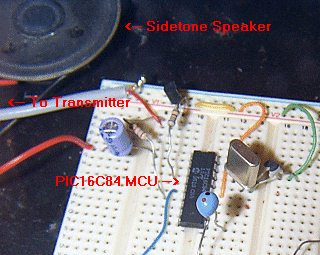 |
| The ZL1HIT beacon using a PIC microprocessor and a simple crystal oscillator transmitter. |
For more information and the PIC microprocessor source code please visit the web page of Bryan Rentoul here : ZL1HIT Hellschreiber / PIC Beacon
Owen Morgan, KF5CZO, is a regular contributor to AmateurRadio.com and writes from Texas, USA. Contact him at [email protected].
AmateurRadio.com joins opposition to SOPA/PIPA… and why you should join, too
Websites are going black on January 18th to save the Internet.
Join them by writing your senator and tell them you oppose PIPA.
Matt Thomas, W1MST, is the managing editor of AmateurRadio.com. Contact him at [email protected].
Simple keyer complete
At last, I finally got the QRP keyer using KD1JV’s Simple Keyer Chip boxed and working.
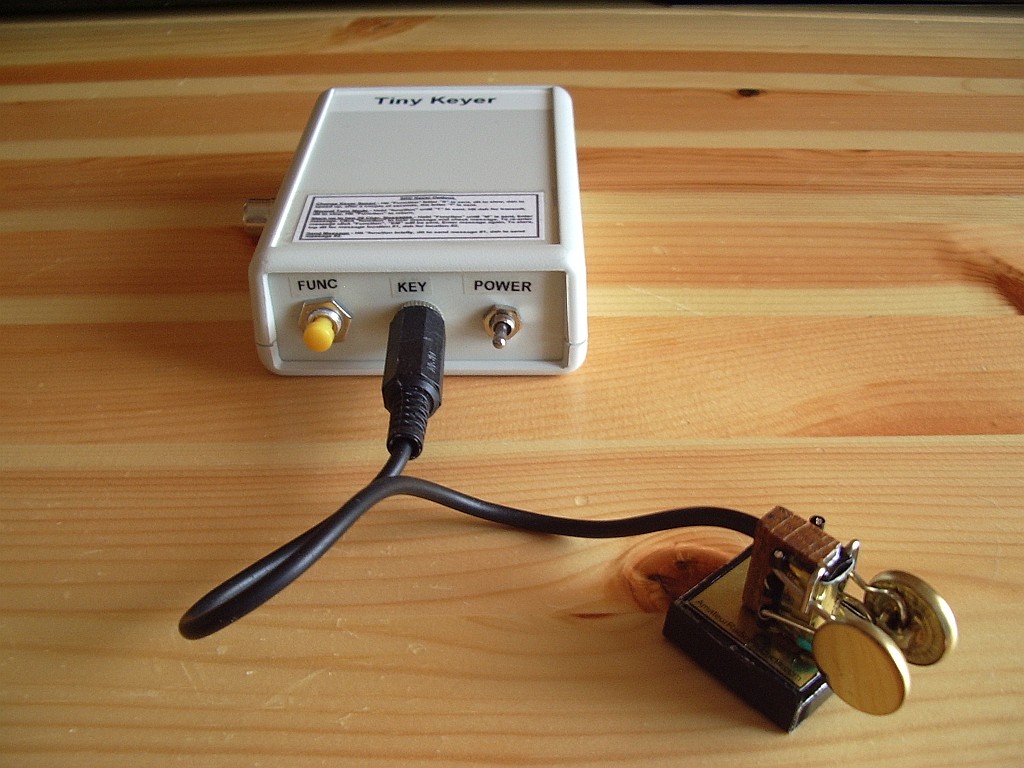 |
| The completed keyer |
As usual, nothing went according to plan. There must be some relative to Murphy’s Law that states for any homebrew project the case will be just too small for comfort. A related rule is the one which guarantees that after you have drilled the case, the position of one of the switches or sockets will be in just the place where it fouls one of the components.
After my first attempt at getting it into the box the keyer was dead as a dodo. This turned out to be because I had forgotten to break one of the tracks on the Veroboard.
After the second attempt the keyer responded to the function button but there was no keying. That turned out to be because one of the connecting wires had broken at just the point where it was soldered. With my eyes as they currently are that took a while to spot.
When I had resoldered the connection and put the board into the case for a third time I noticed that another connecting wire was hanging on by one strand of copper. Lesson: don’t use hookup wire from China, it is made from inferior grade copper.
 |
| View from the front |
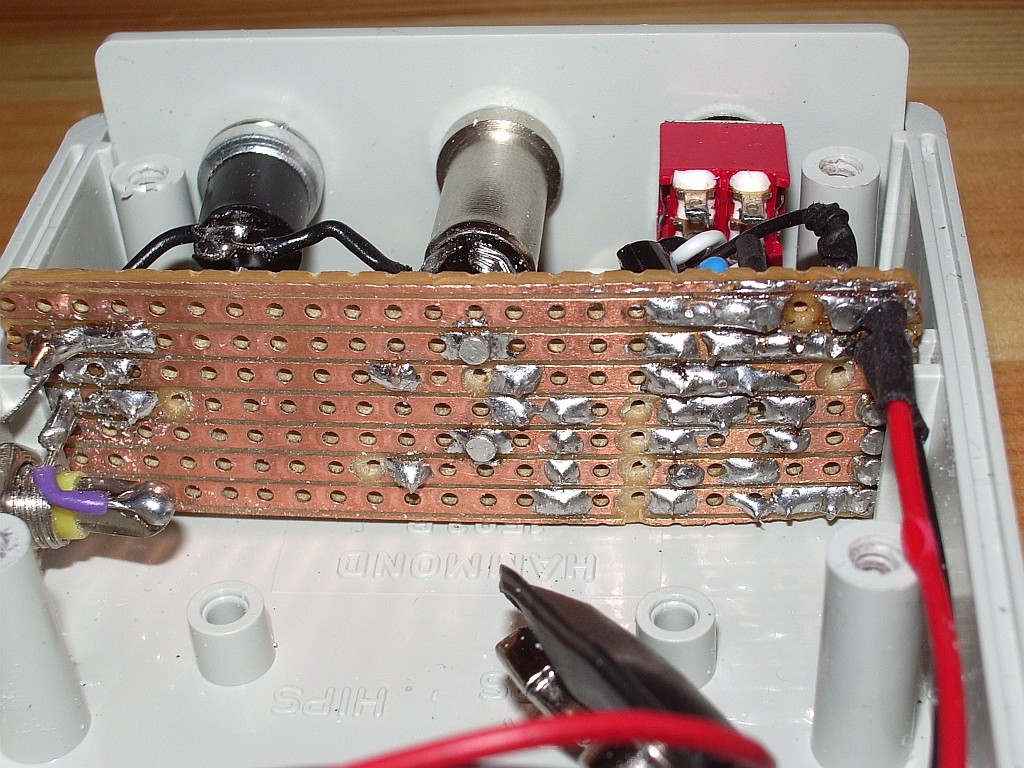 |
| View from the back |
This had taken me a day, so I decided to put the project aside until I felt calmer. The next day I re-made all the connections using new wire, put the board into the case one last time and it actually worked! But Murphy had one last laugh: Now I couldn’t find the four screws for the Hammond case I was using. We searched everywhere. Fortunately my parts box had another Hammond case which sacrificed its screws for the benefit of the keyer. Later, Olga and I managed to find suitable replacements in the local DIY emporium so the other case won’t be wasted.
This Simple Keyer is just what I need for the simple QRP rigs that only work with a straight key. The code speed is easily adjustable and there are two memories, one of which can be repeated as a beacon. I don’t need more sophistication than that for QRP work.

Julian Moss, G4ILO, is a regular contributor to AmateurRadio.com and writes from Cumbria, England. Contact him at [email protected].
SOS Radio Week
This year Workington and District are joining up with Barrow in Furness club to extend the amount of stations we activate. We are operating from Silloth GB1LBC, Workington GB2LBC, St Bess GB4LBC and Barrow GB5LBC lifeboat stations from the 21st to the 29th January in a relaxed style. hopefully making htis years SOS radio week a bigger event locally.
The purpose of our time on the air as special event stations is to promote the RNLI as a charity, something that costs £300,000 a day to run!
St Bees will only be running at the weekends and We are looking to be on mainly 40m and 80m but the Cobwebb is coming with me so there is a possibility of something on the higher bands but it really depends on the weather as high winds will certainly destroy it.
I hope to work as many as possible in between cups of tea and choccy biccies and if you would like to make a donation then it would be really appreciated. Keep an eye out on the status monitors to see when we’re up and running.
Alex Hill, G7KSE, is a regular contributor to AmateurRadio.com and writes from Cumbria, UK. Contact him at [email protected].
Raspberry Pi
The Raspberry Pi, which is a 700 Mhz ARM-based single board computer targeted at providing computing hardware to poor countries is going to be going into production soon. Two models called “A” and “B” are being offered, at approximately $25 and $35 (US). Options to purchase boards and donate money to provide units to needy folks around the world will be available. 
The concept of single board computers isn’t new, but the horsepower and price point of these units are. At this price range it puts the boards squarely in Arduino territory, but unlike the Arduino and other microcontrollers it will run a full blown OS. Several Linux distributions will be supported immediately and presumably BSD variants won’t be far behind. It will not run Windows or Windows emulation, like WINE. (Yes, I know WINE is not an emulator).
The board is equipped with a USB port that obviously can be used to interface with a multitude of devices, however it also includes a General Purpose I/O port or GPIO that supports, PWM, Serial UART and I2C capability. This will open the board up to hardware hackers like us. Sweet!
I’m pondering what amateur radio applications this could run. It has enough horsepower to do DSP. It would make a nice logging and contest appliance, with some well-designed software. How about an EchoLink or digimode appliance? Considering the low price it’s almost disposable and could make a powerful hot air balloon radio payload system controller. I may port my keyer code over to it for giggles. It will be interesting to see what uses radio artisans come up with.


 Ham Radio Deluxe |
 W5SWL Electronics |
 Ham Radio Prep |
 KB3IFH QSL Cards  Hip Ham Shirts  HamRadioAuctions HamRadioAuctions Reliance Antennas Reliance Antennas Enigma Shop Enigma Shop |  morseDX  Ni4L Antennas  R&L Electronics R&L Electronics antennas.us antennas.us QRV QRV |
- Matt W1MST, Managing Editor
