 |
 QRP Antennas
 7 February 2012 | by
 I guess in all reality, that’s a misnomer. There are antennas – period. I often get asked, “What’s the best antenna for a budding QRPer?” Without a doubt, this is:

But if you’re like the rest of us mere mortal human beings, you don’t have the real estate, money or insurance agent for one of these. But you do want to get involved in QRP on the HF bands. What should you use? Again, my friends – that’s the $64,000 dollar question; and there as many answers as there are Hams.
But the main thing to remember is this. In the end, you have to determine this for yourself, as everyone’s situation is different. Here are some questions that you can ask yourself:
1) Can you even put up an outdoor antenna?
2) How much do you want to spend?
3) How much room do you have?
4) Do heights scare the living heck out of you?
5) Are you handy?
6) What bands do you wish to operate on?
If you cannot put up an outdoor antenna, then you will have to end up with a real “compromise antenna”. That may sound really crummy, but don’t be discouraged! There are lots of folks out there who have earned Worked All States and DXCC using indoor or stealth antennas. Dipoles can be strung up in attics and be quite effective. Also, keep in mind that if your antenna is not going to be exposed to the elements, then you can lash up something quite often using lighter duty wire and components. Another antenna to investigate are the magnetic loop antennas. Use Google to invest yourself with the wealth of information on these babies. I have a friend AF2Q who lives in an apartment that is more like a Faraday Cage than anything else. He uses a magnetic loop from inside his apartment and works juicy DX all the time – even with 5 Watts. Other folks with antenna restrictions use the Buddipole and Buddistick for temporary installations and have great success. My friend Bob W3BBO just finished WAS for the umpteenth time – but this time using a Buddistick mounted to a mobile mount on his car – and he got HK0NA in his log before I got them in mine. So, there’s a lot to be said for his set up, even though it’s not considered to be “ideal”.
If you have access to the outdoors then your choices are greater; but they can still be dependent on the size of your lot. I would love to have a full sized 160 Meter loop antenna; but this postage sized New Jersey suburban lot just does not allow for it. In my case, I have two antennas – an 88′ Extended Double Zepp (EDZ) wire antenna and a Butternut HF9V antenna. With these two, I can operate anywhere from 80 to 6 Meters with no problems. The 88′ EDZ was homebrewed and the Butternut is a commercial antenna, of course. The EDZ fits nicely. I had a G5RV for 12 years and one leg had to be zigged and zagged to get it to fit within my property lines; but it worked well. The only reason I took it down was that it physically degraded between the harsh summer sun and the harsh New Jersey winters.
If you’re going to operate on just a few bands, individual resonant half wave dipoles might be your answer. If you want to operate on most, if not all the bands, then a non-resonant antenna like my EDZ and a tuner will allow you to do that. I can work all the bands on the Butternut, too. If space is at a super premium, keep in mind that a vertical will require ground radials. I have about 25 (25′) radials currently attached to the Butternut and I want to add more. It works very well; but I want to add even more.
If real estate is not a problem, the a 160 Meter full sized loop might be the way to go. Even if you’re not going to operate on 160 Meters, you can operate on all bands if you use a tuner. And loop antennas tend to be quiet and sensitive. The point is, if you have a very spacious backyard with plenty of trees, then there’s no reason to put up as much wire as you can, as high as you can. Individually tuned dipoles will eliminate the need for an antenna tuner, if that’s something you wish to avoid. The great thing about wire antennas is that they are fairly cheap, if you go the homebrew route. Again, there is a wealth of information about them on the Internet. Utilize Google to investigate dipoles, doublets, loops, long wires (Zepp antennas), W3EDP, bazookas, etc, etc, etc. While Amateur Radio gear is becoming increasingly more complex and expensive, wire antennas still provide an area for low cost experimentation.
If price is a MAJOR factor, please go to my links section and click on the link for the $4 “Special” antenna. I used one of these for years at my old East Brunswick QTH. It may not be pretty; and it may not be fancy; but it works and gets results. Ham friends would come over to my house and laugh at it, “How does THAT thing work?”- then they’d walk inside my shack and see a ton of QSL cards on the wall. Which would you rather look at – your antenna or a wall filled with QSL cards? I think you’re thinking that you’d rather look at the cards and of using the wire to get the cards. Pretty antennas are nice; but antennas were never meant to be aesthetic works of art.
If you’re deathly afraid of heights, then you’re either going to need some help getting wires up or you can use a ground mounted vertical – just keep in mind the radials deal. If you’re all thumbs, or building and experimenting is not your thing, then you’ll just have to resort to commercial antennas for all your needs. Hey, just about everything that you can possibly think of is offered commercially, it just depends on how much you’re willing to spend. If you have really deep pockets, you can always invest in a tower and a beam and have them commercially installed and maintained, but then you’re getting closer to the picture above. And if you have THAT much money, would you consider adopting me?
So in the end, after answering the necessary questions, and doing a lot of Web surfing, you’ll probably come up with a half dozen or so solutions that will work for you. Don’t be afraid to experiment, modify or change. Keep thinking outside the box!
72 de Larry W2LJ
QRP – When you care to send the very least!

Larry Makoski, W2LJ, is a regular contributor to AmateurRadio.com and writes from New Jersey, USA. Contact him at [email protected].
Things are a changing……….
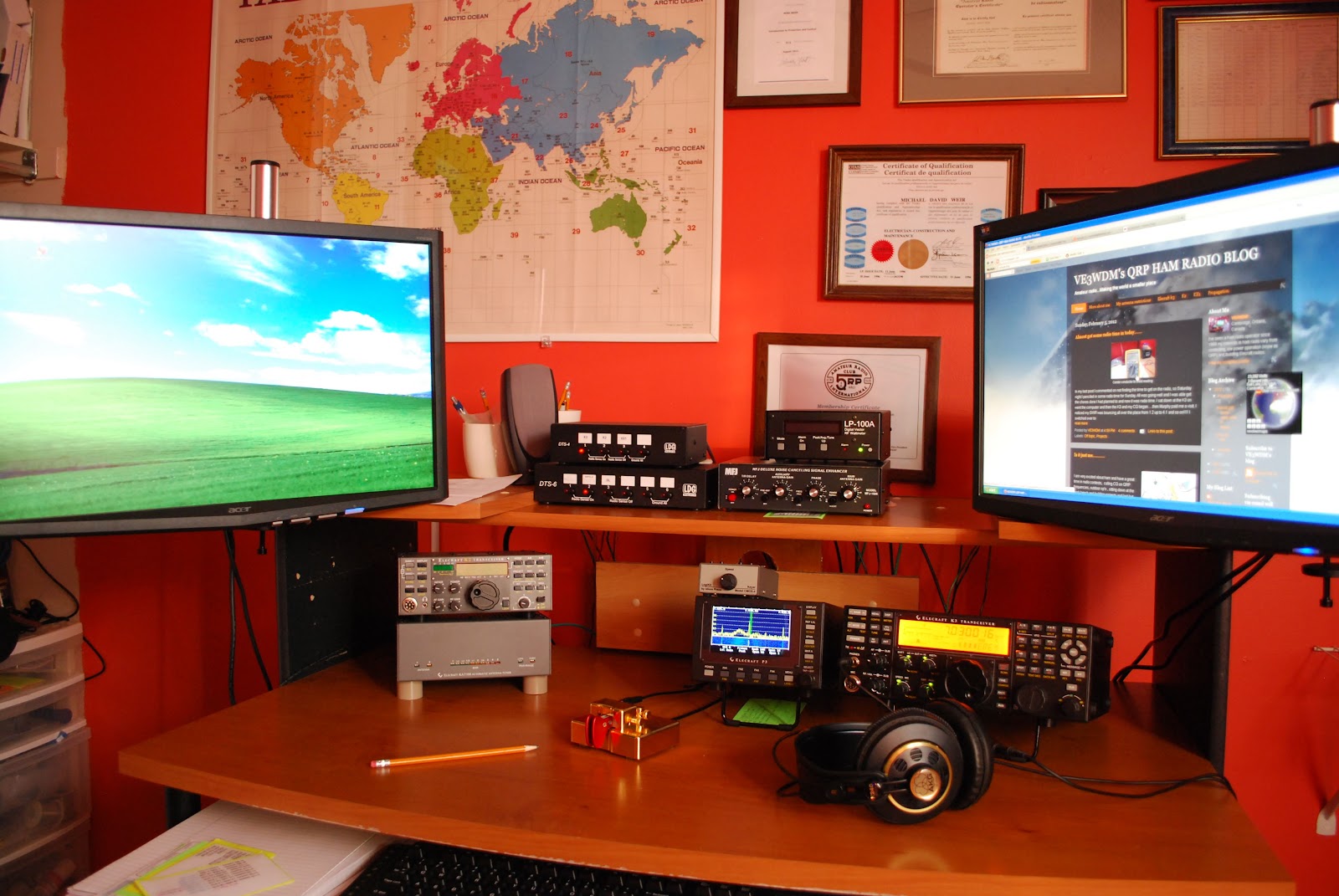 |
| Lots of changes |
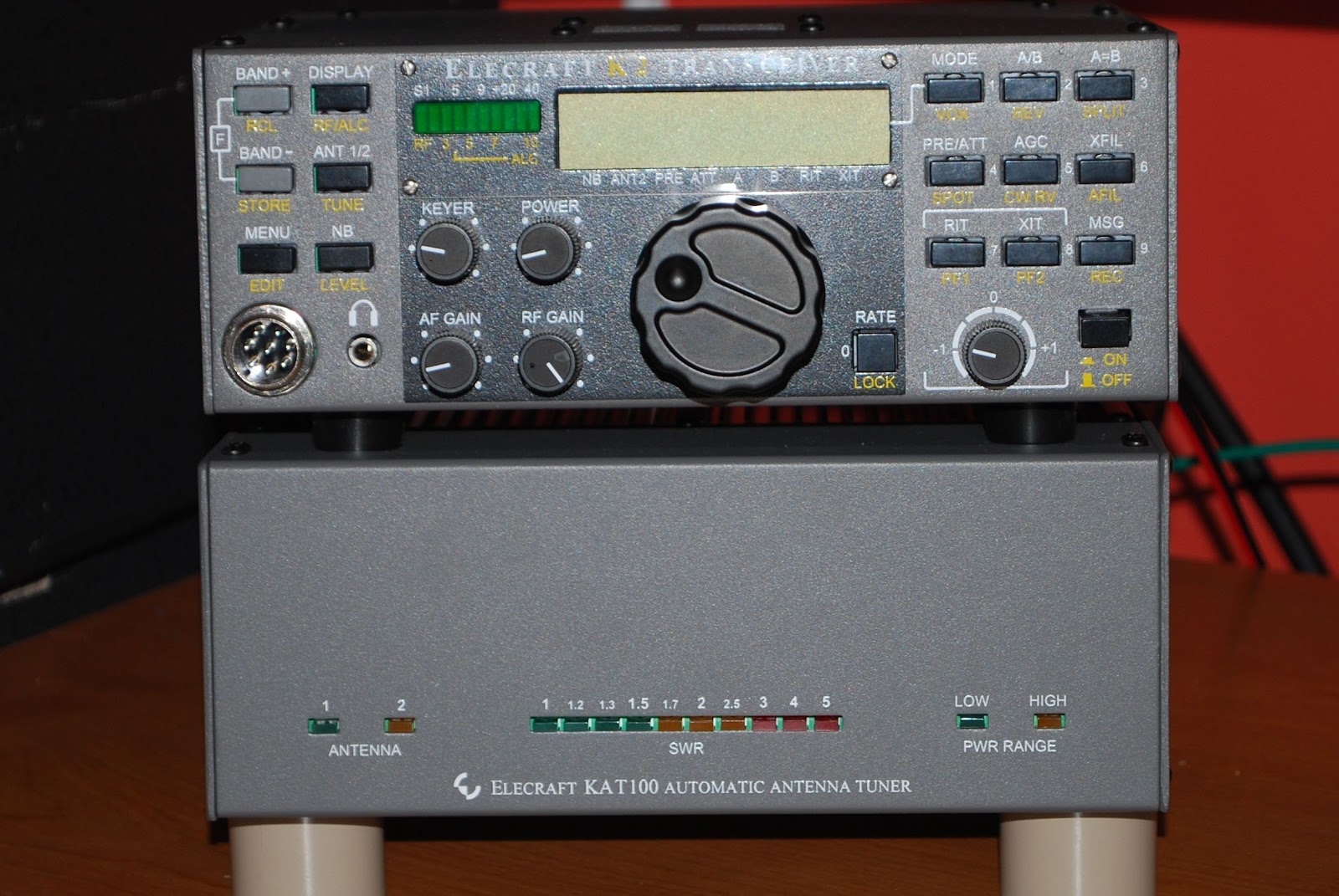 |
| The KAT100 and 100w amp enclosure |
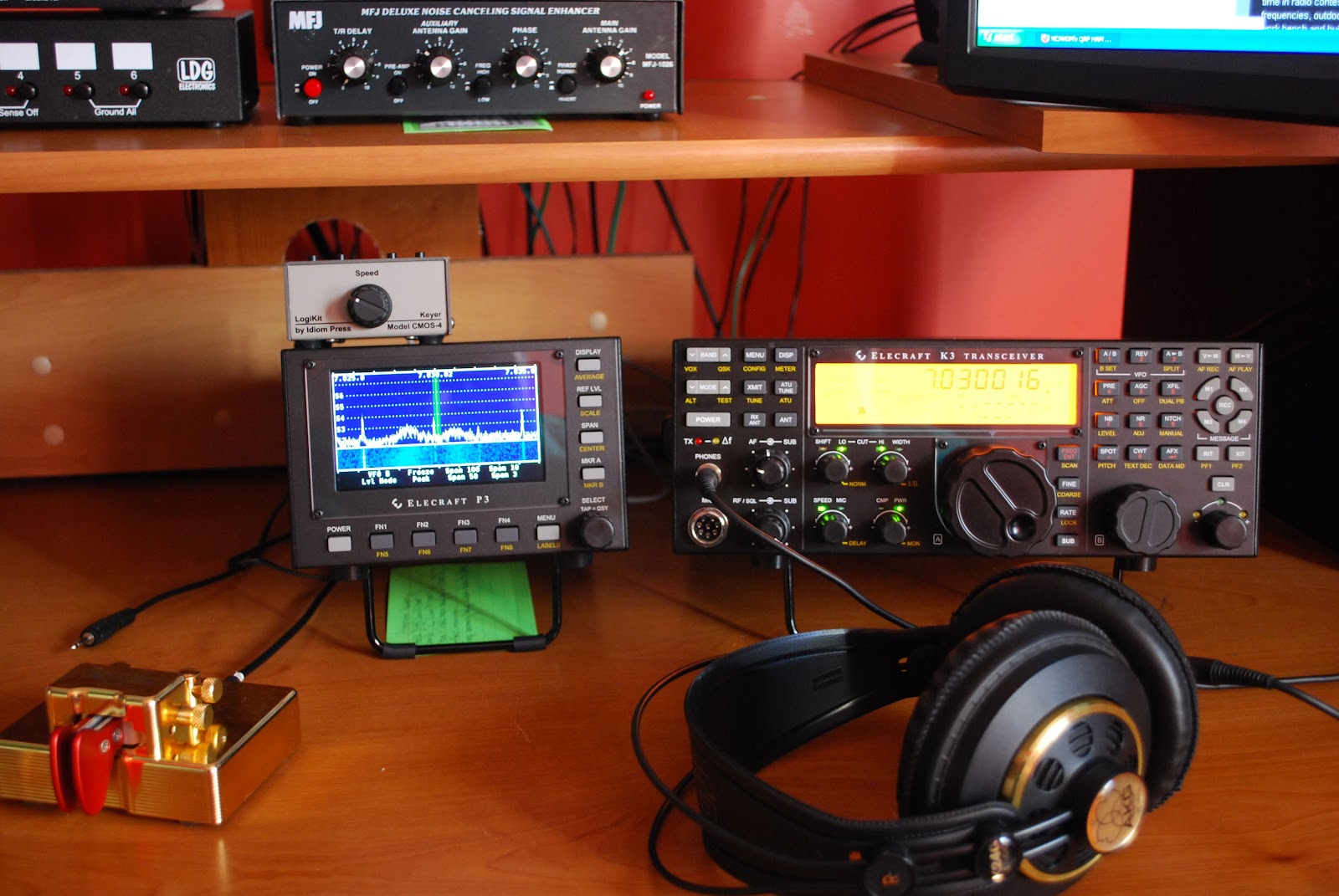 |
| P3 and AKG headphones |

Mike Weir, VE9KK, is a regular contributor to AmateurRadio.com and writes from New Brunswick, Canada. Contact him at [email protected].
Under the microscope
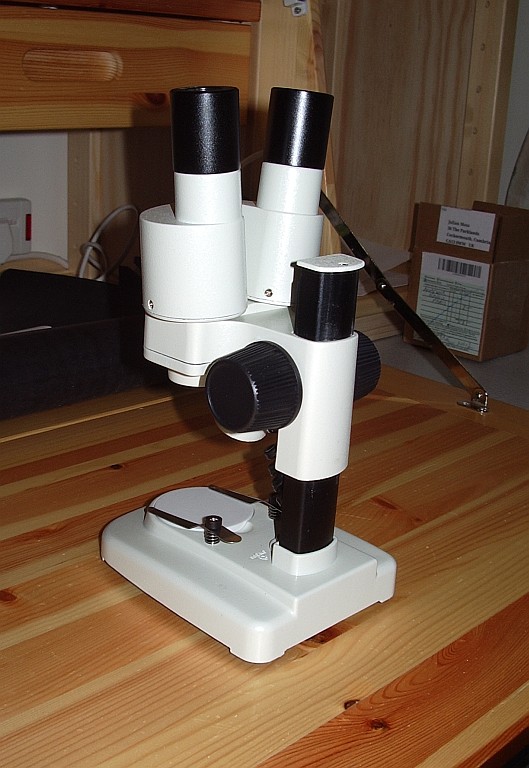 A couple of weeks ago Jeff KO7M wrote that he had acquired a binocular microscope for the workbench to enable him to work with SMT components. Although I have no particular desire to do SMT work at the moment I do have trouble with close-up work due to my eyes’ limited focal range and becoming very far-sighted. So I thought a binocular microscope would be a good addition to my workbench too.
Jeff wrote that his binocular microscope was not cheap and from the look of it I would imagine the cost ran well into three figures. The one I got was £30 from a firm that disposes of liquidated stock on eBay. I’m sure it isn’t as good as the one Jeff got but hopefully it will be useful. If not I can always start another hobby looking at plants and insects or growing bacteria!

Julian Moss, G4ILO, is a regular contributor to AmateurRadio.com and writes from Cumbria, England. Contact him at [email protected].
When in Rome…
Over the Chinese New Year’s holiday I managed to start and (almost) finish a project I have been brooding over for months: a Cobweb antenna. Lightweight, small, multi-band, no tuning needed, in one-word “ideal.” There was a very interesting thread over at QRZ.com about building one and I read all the other literature I could find on the subject. I finally settled for the alternative design by G3TXQ using single wire dipoles which would be easier to tune, but required a balun for impedance transformation.
I’m still on a very tight budget, so the antenna had to be build on the cheap. That means thinking outside the box and starting with taking a good look around you. Fishing rods are expensive here. The cheapest I could find were almost 400 NT dollars per piece. But hey, we’re in Asia: bamboo is cheap, but it is also strong and lightweight. So I spend 200 NT dollars (5 euro’s or 7.50 USD) on bamboo instead of 2000 NT on fishing rods. Aluminium is hard to get in Taiwan, because people find it too soft. Stainless steel is widely used, so the local iron monger cut me two pieces for a little less than 200 NT dollars. U-bolts were also cheap at the local hardware store. Twin lead costed me 400 NT dollars for 50 meters and after two days of work it all looked like this….

The G3TXQ version requires a 1:4 balun to bring up the impedance to 50 ohms, as square folded dipoles have an impedance of 12 ohms (which every one knows, right?). The ferrite of choice is the Amidon FT140-61, but ferrite is not easy to get in Taiwan. Over in Taipei there is a little shop called RF-Parts, run by Mr. Dong, so I went to see what he got. He only had the FT-114-61, so that would mean two stacked together and that twice. Suddenly the Cobweb started to get expensive, because when I left Mr. Dong my wallet was NT$720 lighter. Add another 160 NT dollars for two meters of RG316 coax and the cost of the balun gets close to NT$1000, That’s almost more than the rest of the materials for the antenna together! But the final result looks like this….

After Chinese New Year we had two days of mild weather. Great for pruning the antenna on the balcony. Centimeter by centimeter I started cutting the wires until I had the SWR 1:1 on the frequency I wanted. The five dipoles influence each other, so it was going back and forth from 20 to 10 meters, measuring and cutting. The balcony was full of little pieces of wire afterwards, which refused to be swept up, so they were picked up by hand. But after two days the job was finally done and I could start enjoying my new creation.

NOT! Where are those sun spots when you need them? The bands were pretty empty and my first QSO was with 4W0VB in East Timor on 30 meters, at night. I know, that is not one of the band the Cobweb covers, but the TS-440S build-in tuner did it’s job well. And then it started to rain and I started to cry. Because the rain caused my carefully tuned 1:1 SWR to wander off two to 300 kHz below the resonant frequency that I tuned it for. Again, the TS-440S tuner could manage that, but why? Why does a little bit of rain de-tune my new baby? I don’t want to use a tuner. That’s not why I build the Cobweb.
I did manage to work some nice stations during the last week though: C31HA twice, 4W0VB twice more, XW3DT, PY6HD, CX3TQ and N7DR who mailed me to say I need to be patient, because conditions are indeed pretty lousy. I put up the CB whip to compare signal quality and indeed the Cobweb is quieter than a vertical. Signals are also a bit weaker, but only by one or two S-points.
So, am I happy now? No, because after the rain the wind started to play games. Longtan is not Port Martin, but it comes close. Winds howling all day long and gusts that make you and the house shiver. Longtan is situated on a plateau about 300 meters ASL and the area is known for wind and moisture. The Cobweb is light and strong, but the wires on my version were sweeping and swaying so much that SWR was not stable for a second. And the sectioned fiber glass pole that the Cobweb is mounted on was turning too much and the coax curled around it.
I need to start thinking about a sturdier construction. I saw some springs in a hardware store and I’m thinking about using them to keep the dipoles tight. That is the easy part, but I also need to figure out why moisture is influencing the SWR so much. Could it be the bamboo? Or is it the heavy reinforcement in the house?
I’ll keep the antenna up for another couple of days and then put the 10 meter vertical back up again. I miss roaming the upper bands at night and I want to keep my CW streak going. But a fun project it was and I learned a lot from it. And that’s what it’s all about, not?
Hans "Fong" van den Boogert, BX2ABT, is a regular contributor to AmateurRadio.com and writes from Taiwan. Contact him at [email protected].
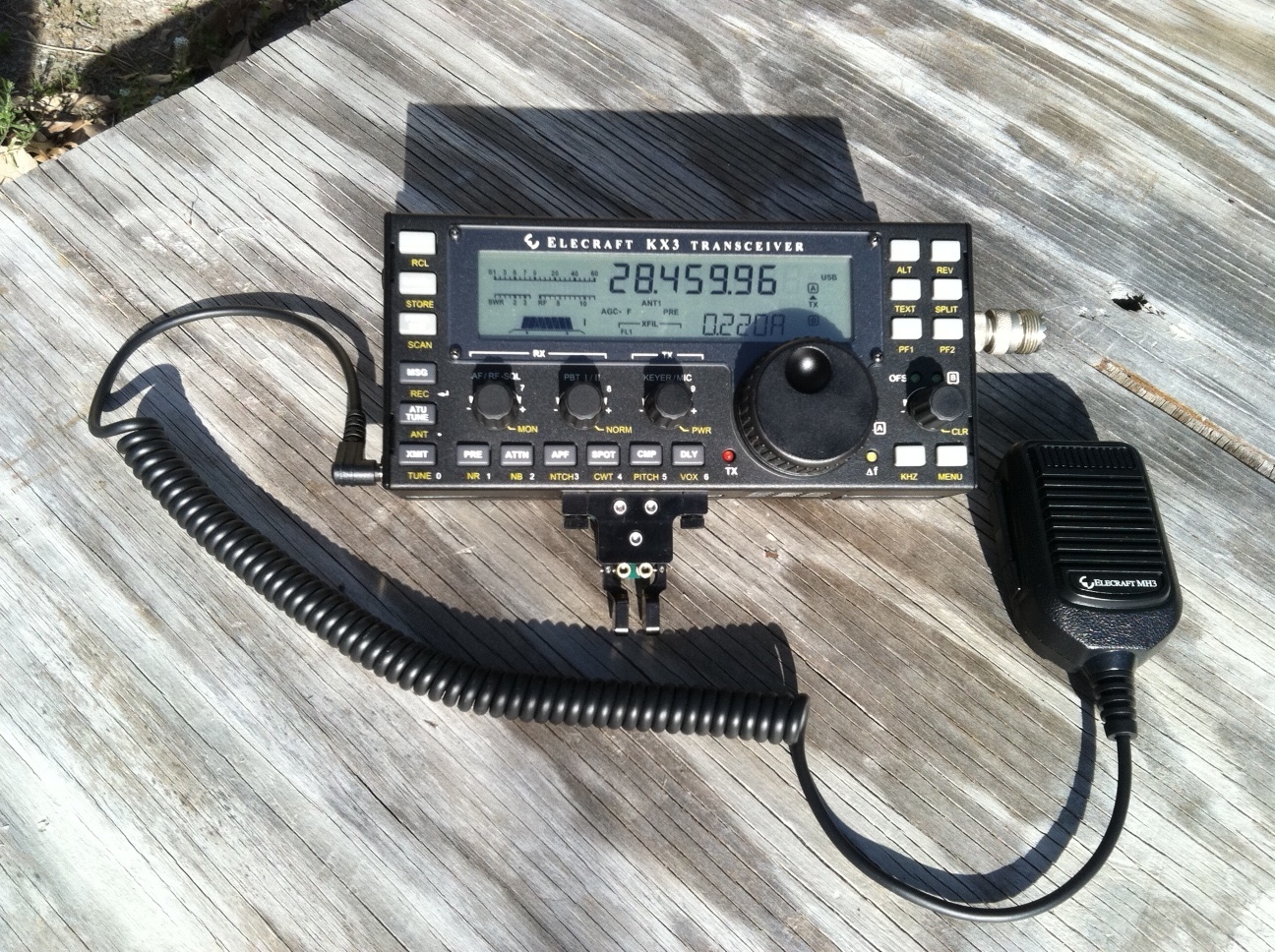
First KX3 Field Test
This appeared on the KX3 YahooGroup reflector today:
All-
Attached is a photo of KX3 #6. It’s an outdoor shot with the backlight off. This unit is in Field Test here, which is its own type of milestone for all those waiting patiently. I’ll be writing objective appraisals of this FT unit. That will be my intent, anyway (objectivity). This email is a first cut. Read on.
My personal opinion is that this is the coolest amateur transceiver ever designed, built, or dreamed of. Perfect size, perfect weight, VERY respectable performance. You can *really* take the KX3 with you, and you’ll really want to. Mine’s going everywhere with me, including the workplace! I know my engineering staff will demand to see how Wayne and crew fit it all in, and how well the KX3 works.
After one day using this unit, I’ve reached the conclusion that the KX3 is basically ready for initial production. As is usual for a ‘young’ rig from Elecraft, firmware is still a work in progress. This should be no surprise to anyone on this list. The hardware is at near-100% shape, IMHO. There are a few minor issues – mostly features not yet implemented. And I mean minor. If I weren’t an engineering manager in the consumer products industry I would not have noticed any of them. The electronics seems solid, and I’ve done a bit of lab testing for MDS and selectivity. Most of my testing has been on the air though. My lab testing shows MDS better than -136 dBm, but my signal generator can’t extend any lower. No problems with rejecting out of band signals (away from the roofing filter’s coverage).
On the air: I’ve had about fifteen CW QSOs, using between 1 and 12 Watts output power. The antenna is a homebrew multi-band vertical, ground mounted. Four of these Qs were on battery power. No differences were found between operating on external and internal power, except for the output power limitations due to batteries. One Q was with an extremely weak QRP station in New Mexico. The APF helped with this, to the point that I could not have pulled him out without the feature. With APF engaged, his signal was 539 with rapid fades to 319. He was running 0.5W and I was running 3 W. Great ragchew, with very few repeats.
Except for Navy-Marine Corps MARS, I’m mostly a CW op. Several SSB contacts went successfully after a false start: I had to finagle the MH3’s input connection a bit (a virgin socket seating issue). I set the MIC and CMP values by listening on a second receiver and built in MONitor, giving MIC=18 and CMP=10 as the best combination. Audio reports using the MH3 and this setting were excellent – “clear as a bell” and “good presence”. Output using the internal speaker is adequate, though not amazingly loud. Some of that is probably my 55 year old ears and too many rock concerts when I was younger. The frequency response seems relatively flat and lows are surprisingly well-represented. Distortion is low (< 2% THD the way I hear it).
The FOC and NA contests run this weekend were an interesting environment for first-time ops on the KX3. Lots of strong signals, many in excess of S9+25. A majority of the QSOs mentioned above were near strong signals and with the roofing filter in place I had pretty good luck ignoring the big guns while working weak signals. I have to admit this is completely subjective, however years of experience with the K3 also tells me that the KX3 has similar characteristics in this regard. The best example from on-air testing was the NM CW station I mentioned above. His signal was marginal, meaning the APF was essential for pulling him out of the band noise. At the same time, 3 to 4 KHz up was one of those big guns thumping away. I could even hear key clicks from the contester, but only a tiny amount of blocking from his signal on the KX3. That’s what I mean by “similar to the K3”. It’s not identical though. I found instances where a little bit of a strong station’s signal was near- or in-band, and as you would expect some pretty severe blocking occurred. I’d recommend everyone make sure they have the roofing filter on the “essentials” list for purchase. In many ways the roofer makes the KX3 what it was meant to be.
One thing that’s notable and exceptional: I haven’t seen any of the typical issues of a “zero IF” architecture. No image problems, no ripple in the passband (in either SSB or CW), no audio artifacts. The advantage to a zero IF architecture is that there’s no “donut hole” around the IF frequency; there are others too – one single conversion takes less space than multiple conversions, less power consumed, less heat generated.
As a Navy-Marine Corps MARS operator, I’m looking forward to using the KX3 in our ECOM exercises. Its size and power consumption are perfect for such types of portable operation. It’s the item that will take the least amount of space in your Go Kit.
Sorry so much of this is non-quantitative. I’ll try to get more out after another day or two.
Standard disclaimer: I am not employed by nor do I have a fiduciary interest in Elecraft.
73,
Matt Zilmer, W6NIA / NNN0UET / NNN0GAF THREE
NMCM RMS Winmor: NNU9ET-5: Upland, CA.
W2LJ is …..trying…….to……..remain calm ……….not get………too………..excited ……….
Not working – not working – not working !!!!
72 de Larry W2LJ
QRP – When you care to send the very least!

Larry Makoski, W2LJ, is a regular contributor to AmateurRadio.com and writes from New Jersey, USA. Contact him at [email protected].
Brave and Hearty Souls
Now this is REALLY Freeze Your Buns Off / Polar Bear Moonlight Madness !!!
QRP’ers – are we dedicated or just plain crazy?
Gatineau Park and the Wolf Trail sure look beautiful! Thanks Martin, for sharing, you have shown us the quintessential FYBO / PBMME effort.
FYI, the HK0NA DXpedition ended today. Thanks to the crew and its supporters for their efforts. I got them exactly once and that’s plenty for me. According to the Team, even after 190,000 +++ QSOs, the pileups were still very deep. Hope all of you were lucky enough to have worked them, if you were trying.
72 de Larry W2LJ
QRP – When you care to send the very least!

Larry Makoski, W2LJ, is a regular contributor to AmateurRadio.com and writes from New Jersey, USA. Contact him at [email protected].
Snap Circuits SC-300 on sale for $30

OK, I know…. This isn’t a steals and deals kind of blog, but I wanted to share with you a great promotion Amazon is running on the Elenco Snap Circuits SC-300.
I paid over $60 when I bought one for my kids a year ago and it’s on sale right now at Amazon for just over $30 with free shipping. If you have kids or grandkids who are interested in electronics and science experimentation, this kit can’t be beat. Do a little early Christmas or birthday present shopping and get them something they’ll really enjoy — and learn something from, too! You’ll be truly amazed at the projects they can create with this kit.

OK, here’s the best part! If you buy it through this link, you’ll be helping to support one of my favorite podcasts, Jerry Taylor’s Practical Amateur Radio Podcast. Jerry does a tremendous job and there are many costs associated with creating and distributing a podcast. Buy a fantastic product (the Snap Circuits SC-300) for a special youngster and support a great cause (KD0BIK’s Practical Amateur Radio Podcast). It doesn’t cost you anything to use the link, but he’ll make a dollar or so to help support his podcasting efforts. Win-win!
And lastly, being from New England… GO PATS!
Matt Thomas, W1MST, is the managing editor of AmateurRadio.com. Contact him at [email protected].
 Ham Radio Deluxe |
 W5SWL Electronics |
 Ham Radio Prep |
 KB3IFH QSL Cards  Hip Ham Shirts  HamRadioAuctions HamRadioAuctions Reliance Antennas Reliance Antennas Enigma Shop Enigma Shop |  morseDX  Ni4L Antennas  R&L Electronics R&L Electronics antennas.us antennas.us QRV QRV |
- Matt W1MST, Managing Editor
