 |
 Seventeen Prefixes
 20 February 2012 | by
 I didn’t make a single QSO on Saturday. We had to go to my principle’s wedding in Taizhong and when we came home the radio only made a lot of noise with very few signals around. The K-index was 4 if I remember correctly, so that explains it a bit. Instead I heated up the old Weller and I finished another part of my audio filter. A Saturday night well spent.
Sunday was a different story. I hadn’t planned on participating in the ARRL contest, but there were so many signals on 15 meters from the States that it was impossible not to log some new prefixes for the FISTS 25th Anniversary Prefixes award. I spent an hour in the morning and logged 13 stations.
There was no FEA net at 0800, so I logged E73W (new country for me) and then took down the Cobweb. It was making too much noise in the wind and I need to get the wire tension fixed anyway. I put up the 10 meter vertical again and what a difference that makes! The higher bands were suffering from local noise but 40 meters was brimming with stations and even with the attenuator switched on they were still booming in. Nothing like a good vertical for 40 meters. 80 meters and 160 meters only yielded Asian stations, so back to 40 and in the course of the evening I spent – altogether – an hour logging another 11 stations from North America. In the end I counted the following 16 new prefixes for my award:
K0, KV0 / N2 / K5 / AA6, K6, KA6, N6, W6 / K7, N7, NJ7, NK7, VE7, WA7 / N9. All of them from the Western part of NA.
Add to that the E73 prefix and I didn’t do so bad at all this weekend: my score went up almost 7%. More important: my CW skills improved again, especially the rapid taking of call signs. I know there are “apps” for practising Morse code, but the best practice is still on air. Only 152 prefixes to go.
Hans "Fong" van den Boogert, BX2ABT, is a regular contributor to AmateurRadio.com and writes from Taiwan. Contact him at [email protected].
ARRL DX Contest – 2012
Since 0000 UTC Saturday morning (Friday night here) the bands were absolutely humming. Hard to find spectrum that wasn’t occupied by someone calling ‘CQ TEST” or with two stations engaging in an exchange. It’s now 0000 UTC Monday morning here, and the bands are eerily quiet.
The weekend was like all the others around here – super busy. I did not get to spend nearly as much time on the air as I wanted to; but I did get a couple of hours last night and then a couple more this afternoon. I added quite a few new countries to my Diamond DXCC tally. Not as many as I would have liked; but I should be well on my way now.
The bands seemed to be in good shape and I even heard some activity on 10 Meters and joined in the fun there. My plan of action was to “cherry pick” and work the louder stations I was hearing, thinking that would give my QRP: signal the best chance of being heard. I didn’t stick with that strategy, however and ended up working quite a few weak ones, too. It pretty much turned out that I was able to work anyone that I called. I even got a new one that I have never worked before – QRP or QRO. I worked ZD8Z on Ascension Island for the first time ever. Unfortunately, the only station that wasn’t able to pick me out of the din was OA4SS down in Peru. I tried for quite a while, but in the end was not successful.
I have tomorrow off for the long President’s Day weekend. I am so tired right now that I am going to turn in early and I will get my QSO for the 20th, tomorrow.
72 de Larry W2LJ
QRP – When you care to send the very least!

Larry Makoski, W2LJ, is a regular contributor to AmateurRadio.com and writes from New Jersey, USA. Contact him at [email protected].
QRV on VHF digimodes using a ZLP interface
If you’ve been reading the blog for a while, you’ll know that I have been keen to get going on the VHF datamodes, particularly the WSJT modes. I’d been thwarted up until now by the lack of an interface and I’d been reluctant to part with money until I could verify that things ought to work ok! I’d had some bad experiences with the FT-847 and interfaces in the past.
The random trigger for getting this sorted out was seeing a tweet from Colin G6AVK on Twitter that he had ordered a ZLP interface for his laptop. I hastily Googled ZLP Electronics and discovered a range of interfaces very competively priced. I e-mailed Neil, G4ZLP to ask his advice about interfacing with the FT-847 and he recommended the Pro Plus interface. On the basis of his advice I placed an order.
Two days later it arrived, well packaged. Getting the FT-847 setup proved very simple indeed – although I’d had a bit of fun and games getting the levels right from the Pro Plus interface to my FT1000MP. However, it was the VHF/UHF rig that I really wanted to interface with.
Armed with the interface and the WSJT software, I popped onto the ON4KST chat server to see if anyone was around to try a JT6M test with. Although I only have the vertical up, I thought it would probably yield some results. And so it proved, as I was quickly able to exchange signals with Pat, EI8IQ on 50MHz although the reflections ran out before we could complete a ‘proper’ QSO.
Yesterday evening, I set the receiver running on 144.370 with the FSK441 decoder going and I was pleased to decode a meteor burst from Martin OK1UGA. I shall be keen to try and work him sometime soon.
.JPG)
Will 50W from the FT-847 be enough? I have a 4CX350A amplifier here, but I’m sort of trying to avoid using it! And I wonder if I can make some JT6M QSOs with the vertical, or will I have to try and erect a dipole or a low beam? It’ll be fun finding out!

Tim Kirby, G4VXE, is a regular contributor to AmateurRadio.com and writes from Oxfordshire, England. Contact him at [email protected].
A rig for £30 – the Baofeng UV-3R 144/433MHz dualbander
.JPG)

Tim Kirby, G4VXE, is a regular contributor to AmateurRadio.com and writes from Oxfordshire, England. Contact him at [email protected].
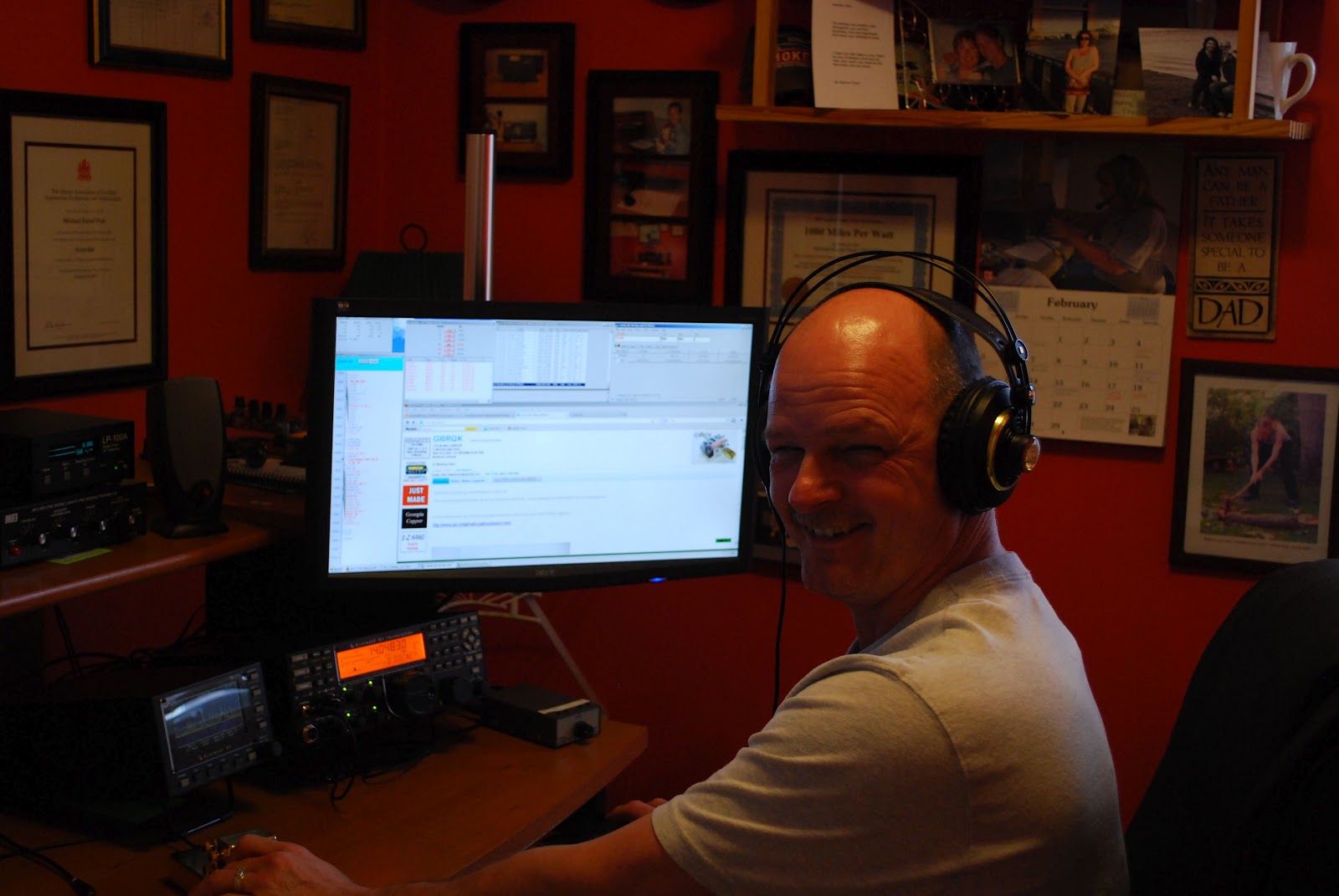
Day one (for me) of the ARRL CW DX contest
 |
| Relaxing and contesting |

Mike Weir, VE9KK, is a regular contributor to AmateurRadio.com and writes from New Brunswick, Canada. Contact him at [email protected].
New offering from Four State QRP Group
The following was announced today on the various QRP e-mail reflectors:
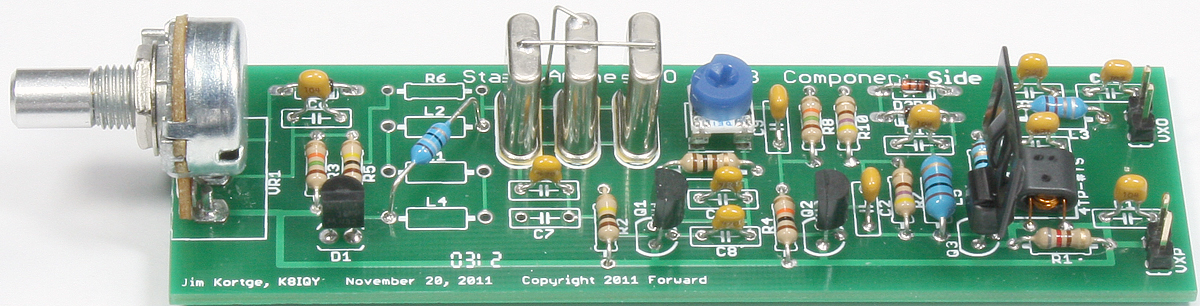
The Four State QRP Group is pleased to announce a new kit, the Stand Alone VXO (SAVXO) designed by Jim Kortge, K8IQY. The very complete manual, specifications, and ordering information can be found here http://www.wa0itp.com/savxo.html PayPal is accepted. It is shipped with 40M components but can easily be used on any HF band.
This is a Super VXO design which has it’s origins in the Super VXO of the SS-40 receiver. It is crystal controlled yet combines frequency agility with smooth stable tuning, and NO perceptible drift – even from a cold start. It is ideal for driving your NS-40 or other crystal controlled transmitter or receiver, and is also a great starting point for a transmitter strip of your own design. As kitted the SAVXO will put out over 250mW by itself, plenty of power to operate QRPp if desired.
All proceeds go to fund OzarkCon. As always thank you for supporting the Four State QRP Group. http://www.4sqrp.com/
I ordered mine! And once OzarkCon 2012 is over, I’ll be ordering a Magic Box kit, too.
72 de Larry W2LJ
QRP – When you care to send the very least!

Larry Makoski, W2LJ, is a regular contributor to AmateurRadio.com and writes from New Jersey, USA. Contact him at [email protected].
I need to follow my own advice
I went downstairs and flipped the K2 on and tuned around 40 Meters – WOW !!!!!!
After a long and full day of work, my brain is simply not ready to wrap around 40 WPM code. I worked HG3R who was cruising at about 35 WPM and called it a night. Tomorrow, after a good night’s sleep and after the opening hours pandemonium is over, I will be ready to jump into the fray. Also, during the daylight hours, stations will be spread out more as other bands open. Seems like right now, everyone is crammed into 40 and 80 Meters.
I’ve been at this Morse game for over 30 years now; and I really admire these guys who can while away at 40 – 50 WPM. I would love to be able to attain that kind of speed; but right now, it sounds more like a buzz saw than Morse Code. God bless them, you have to admire and respect that kind of ability.
72 de Larry W2LJ
QRP – When you care to send the very least!

Larry Makoski, W2LJ, is a regular contributor to AmateurRadio.com and writes from New Jersey, USA. Contact him at [email protected].
 Ham Radio Deluxe |
 W5SWL Electronics |
 Ham Radio Prep |
 KB3IFH QSL Cards  Hip Ham Shirts  HamRadioAuctions HamRadioAuctions Reliance Antennas Reliance Antennas Enigma Shop Enigma Shop |  morseDX  Ni4L Antennas  R&L Electronics R&L Electronics antennas.us antennas.us QRV QRV |
- Matt W1MST, Managing Editor
