 |
 903-MHz cavity filter tune-up
 29 February 2012 | by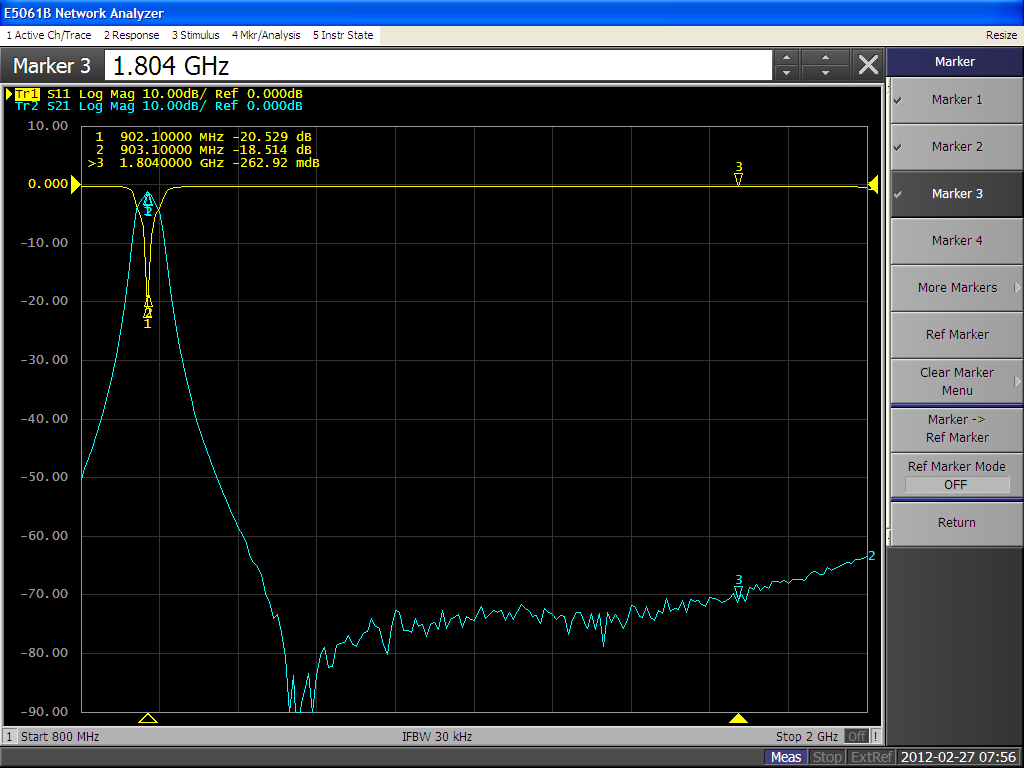
For reasons that will become clear in a future post or series of posts, we’ve been busy lately—don’t worry, it’s a good thing. I did manage to sneak away from my regular (usually desk-bound analysis) work into the lab and tune-up an eBay-special cavity filter for 903 MHz with our new network analyzer. It’s really amazing how you can dial these things in if you have the right tools. This one is a 3-cavity filter about 10x8x3 cm.
Passband insertion loss is about 1.2 dB. Harmonic rejection at 1.8 GHz is 70 dB down. I’ll take it.
I also have some eBay-special helical filters that were advertised to be for 432 MHz. So, I need to cobble up some carrier boards to try them out. Another day, another project.
Ethan Miller, K8GU, is a regular contributor to AmateurRadio.com and writes from Maryland, USA. Contact him at [email protected].
Mike Adams, WA2MWT, SK
A good friend of mine passed away last week after a short illness. Mike Adams, WA2MWT, was a good friend and mentor, but just saying that doesn’t do Mike justice. You can (and should) read his obituary, or this nice article about him from the local paper to get an idea of what kind of person Mike was, but I wanted to take a few minutes to share some of my personal memories of Mike.
I first met Mike about 12 years ago, right after I was first licensed as KC2FZT. I was encouraged by Joyce, KA2ANF, to attend a meeting of the local ham radio club, the 10-70 Repeater Association, but other than Joyce (who was one of the VEs who administered my exam), I really didn’t know anyone at the meeting. I wandered into the meeting and sat down, feeling a bit like a lost sheep, when Mike came up to me, introduced himself, and asked me to join him and a few others sitting together at a table near the back of the room. Mike helped “translate” some of what was going on and introduced me to others at the table, and generally made me feel welcome. Mike and I seemed to hit it off immediately. Actually, Mike seemed to hit it off with everyone immediately. To paraphrase my son Justin, KC2MCS, “Nobody ever had a bad thing to say about Mike. Everyone just liked him.”
As I found out, Mike was the Emergency Management Coordinator for the Borough of Ramsey, New Jersey, a town about 15 minutes away from where I lived. He was also a regular Net Control Station not only for the local NTS traffic net (NJVN/Late), but he also filled in on several other local area nets. I thought it might be interesting to get involved with NTS, but I didn’t really know how to get started and, like many other new hams, I was very “mic shy”. (As Mike explained to me, it’s “mic shy”, not “mike shy”.) Mike invited me to stop by the Ramsey Office of Emergency Management (OEM) headquarters (better known as the Emergency Operations Center, or EOC) and he’d show me how traffic handling was done. (Traffic, in this context, has nothing to do with cars and roads, but rather with handling radiogram messages. While for the most part what’s done is for practice, it is a function of the Amateur Radio Service that has proven to be invaluable when other forms of communications are not functioning.) Mike patiently coached a very nervous me through my first NJVN/L check-in at the EOC, and kept on helping me until I was comfortable enough to eventually act as Net Control myself. Mike had a great way to put me at ease when I was nervous. In what became a running joke between us, he’d say “Don’t worry, we’ve all been there.”
Mike also introduced me to other public service aspects of ham radio. He got me involved with supporting numerous public service events, including bike tours and foot races. His encouragement helped me to decide to volunteer one year to support the NY City Marathon as a radio operator, which was an amazing experience.
Mike got me involved with Skywarn and ARES ® and while I’m not as involved with either of those organizations as I was in the past, I glad that Mike gave me the push that I needed. He also encouraged me to become a member of the Ramsey OEM, which is a little unusual since I don’t live in Ramsey. Of course, I’m not the only one from out of town. Mike explained that one of the reasons why he recruited people from out of town was because that way there would always be someone unaffected by something that happened in the town available to provide assistance. Mike strongly believe that unless you were comfortable that you and your family were safe that you wouldn’t be able to effectively serve others. To that end, he made sure that we always remembered to “look out for number one”. It was that attitude that made me want to help, and I was honored a when I was made a Life Member of the Ramsey OEM a few years ago.
I will miss taking car trips with Mike out to Upton to attend the annual Skywarn coordinators meeting, the trip up to Newington to visit ARRL Headquarters, working with him during the Ramsey Run, the MS-100, and countless other public service events, and I will miss just sitting around the EOC talking with him. I will miss Mike’s sage advice, his wit, and his friendship.
Goodbye my friend.
What has been happening?
Anyone looking at my blog could be forgiven for thinking that I had dropped off the face of the earth for a while, has nothing been happening in my world?
Well, the answer is that a LOT has been happening and all at once. My daytime job has become busier and there have been several non-radio projects at home that needed to be completed. All this has kept me away from Amateur Radio blogging even though I have spent more time on the computer than usual.
In between projects I did manage to stumble across this video of Rear Admiral Grace Hopper explaining just how “long” a nano-second is and what it looks like. This has relevance to radio as we’re usually well aware of frequency and wavelength but don’t usually spend too long thinking about speed.
Owen Morgan, KF5CZO, is a regular contributor to AmateurRadio.com and writes from Texas, USA. Contact him at [email protected].
Use WPtouch to Create Mobile WordPress Site
 I’ve been using WordPress for my weblog for years now and just turned on a mobile version of the blog. The WordPress plugin WPtouch makes this very easy to do. It took about 5 minutes to get it up and running.
The WPtouch plugin automatically detects when the user is browsing with a smartphone and implements the mobile interface. The user has the option of turning the mobile presentation off.
Highly recommended!
73, Bob K0NR
Bob Witte, KØNR, is a regular contributor to AmateurRadio.com and writes from Colorado, USA. Contact him at [email protected].
Raspberry Pi announcement
For those who are following the progress of the ultra cheap pc proposed by Raspeberry Pi, I received this email this morning.
The Raspberry Pi Foundation will be making a big (and very positive) announcement that just might interest you at 0600h GMT on Wednesday 29 February 2012. Come to www.raspberrypi.org to find out what’s going on.
Eben Upton
Executive Director, Raspberry Pi Foundation
Perhaps they’ll be announcing pricing and delivery of what should be very useful lightweight PC’s (is that even the right way to describe them?)
Alex Hill, G7KSE, is a regular contributor to AmateurRadio.com and writes from Cumbria, UK. Contact him at [email protected].
Welcome to the new addition
When we lost Sadie, many of you out there suggested adopting another cat. We hesitated with that decision as there will never be another Sadie, but we did see the value of saving another kitty from a bad fate.
That Saturday, Joey and I stopped by the local PetCo to pick up some dog biscuits for Jesse. That was where we met Spongy.
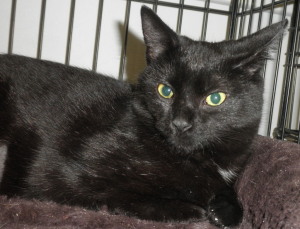
Spongy was born last June and got separated from her Mom as a consequence of Hurricane Irene. Spongy was found as a kitten, wandering around Long Beach Island, NJ by a man selling ice cream – Sponge Bob ice cream bars, hence her name.
The man who told us about Spongy was affiliated with Cattitude, NJ, a pet adoption organization that rescues cats and dogs. He said that Spongy was in a foster home longer than most kittens, as people seemed to be hesitant about giving a black cat a home. I guess there are a lot of superstitious folks out there. Well, that sealed the deal for me! Spongy, who is now seven months old, officially became a member of the W2LJ household this past Thursday. After a day of being scared and hiding behind furniture or down in the basement, Spongy found her courage and now walks around the house like she owns it. She’s not even scared of Jesse anymore. She is a sweetheart and is quite the purr machine who loves to be petted and scratched behind her ears. And does she love chasing the red dot from a laser pointer!
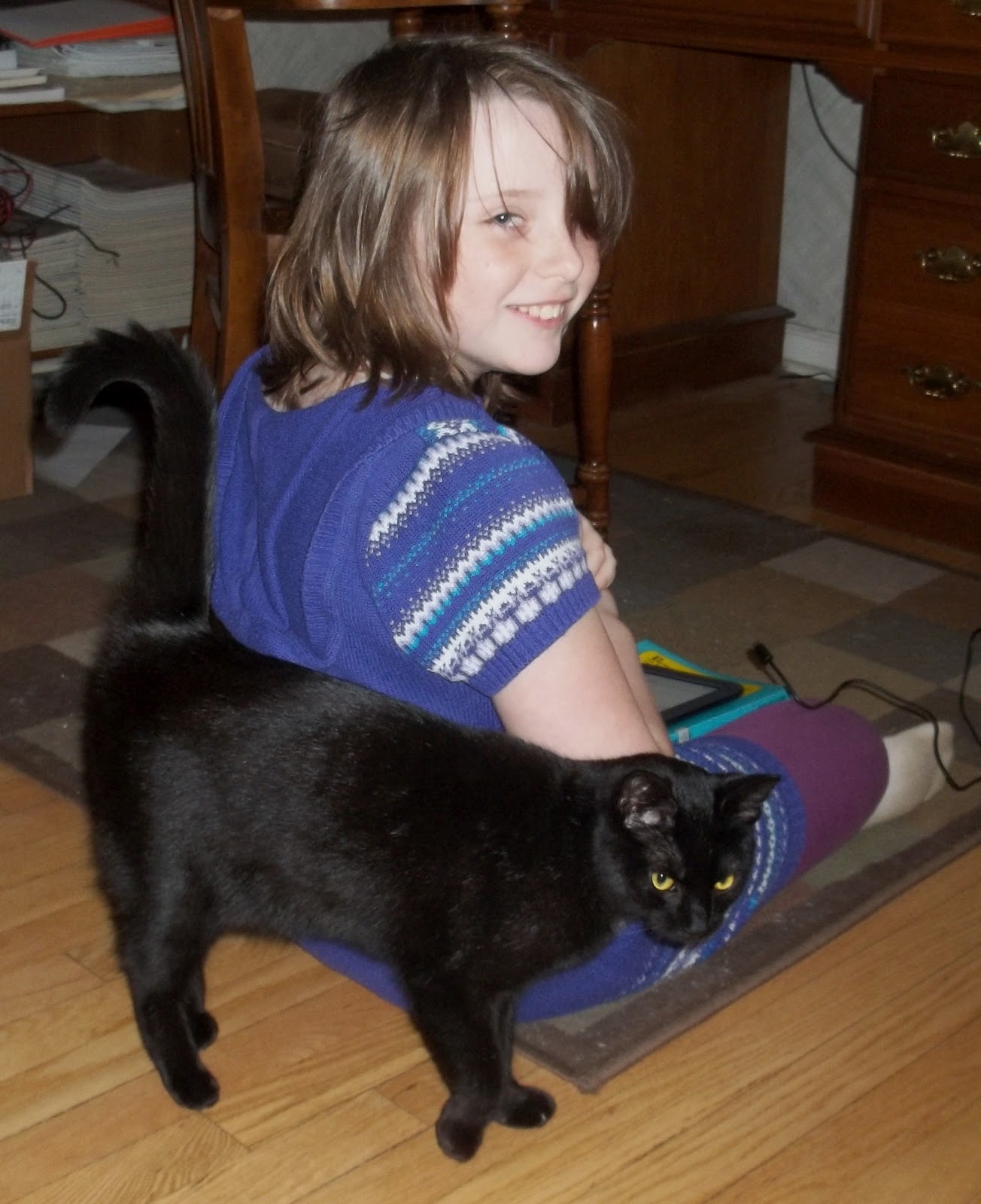
Thanks to all of you out there who sent notes and comments during a bad time – they are appreciated more than you will ever know. Our home feels just a little bit more “whole” now, and although it will never be the same without Sadie, I think she would have approved of us saving one of her feline sisters from being homeless or worse.
72 de Larry W2LJ
QRP – When you care to send the very least!

Larry Makoski, W2LJ, is a regular contributor to AmateurRadio.com and writes from New Jersey, USA. Contact him at [email protected].
A little bit of QRP history
is available in a new, free online e-book by Adrian Weiss, W0RSP.
It is entitled, The Five-Watt QRP Movement in the US, 1968-1981, and is available by clicking on the title. The hyperlink will take you right where you need to go.
I have already downloaded it and will send it to my Kindle, so that I can read it without being tied to the computer. The history of QRP and how 5 Watts came to be the “definition” of QRP is intriguing to me. My very first membership certificate explained that QRP was considered to be 100 Watts or less. As a Novice, pushing out 75 Watts max with my Drake 2-NT was a natural fit, so I joined QRP-ARCI way back when in 1979.
I never got involved in the 100 Watt vs. 5 Watt debate; but had no problem with the final decision. Operating with low power always fascinated me and I had lots of fun and good times with it, throughout my earlier Ham career. Going strictly QRP back in 2003 is something I have seldom regretted. I’d be lying if I told you there weren’t times that I wished I had 100 Watts in order to help bust through a pileup in order to snag a new DX entity. But limiting your self to lower power helps to reinforce discipline and knowing your limits and capabilities. Good life lessons.
72 de Larry W2LJ
QRP – When you care to send the very least!

Larry Makoski, W2LJ, is a regular contributor to AmateurRadio.com and writes from New Jersey, USA. Contact him at [email protected].
 Ham Radio Deluxe |
 W5SWL Electronics |
 Ham Radio Prep |
 KB3IFH QSL Cards  Hip Ham Shirts  HamRadioAuctions HamRadioAuctions Reliance Antennas Reliance Antennas Enigma Shop Enigma Shop |  morseDX  Ni4L Antennas  R&L Electronics R&L Electronics antennas.us antennas.us QRV QRV |
- Matt W1MST, Managing Editor
