 |
 Ham Nation 36
 23 February 2012 | by
Hosts: Bob Heil (K9EID), Gordon West (WB6NOA), George Thomas (W5JDX), and Leo Laporte (W6TWT)
Ham Tails, building a homopolar motor, white noise explained, and more.
Guests: Amanda Alden (K1DDN) and Cheryl Lasek (K9BIK)
Download or subscribe to this show at http://twit.tv/hn.
We invite you to read, add to, and amend our show notes at wiki.twit.tv.
Thanks to Joe Walsh who wrote and plays the Ham Nation theme.
Thanks to Cachefly for the bandwidth for this show.
http://dts.podtrac.com/redirect.mp4/twit.cachefly.net/video/hn/hn0036/hn0036_h264b_864x480_500.mp4
http://dts.podtrac.com/redirect.mp4/twit.cachefly.net/video/hn/hn0036/hn0036_h264b_640x368_256.mp4
http://www.podtrac.com/pts/redirect.mp3/twit.cachefly.net/hn0036.mp3
Dr. Bob Heil, K9EID, is the founder of Heil Sound and host of TWiT.tv's Ham Nation which streams live each Tuesday at 6:00pm PT (9:00pm ET) at http://live.twit.tv. Contact him at [email protected].
The opposite of the other night
It’s like going from the ridiculous to the sublime.
Tonight a real treat was in store. My CQ on 40 Meters (yes, 40 Meters was quiet tonight, yay!) was answered by K4BXN, Crit who hails from Hendersonville, NC . Crit and I have QSO’ed a few times before; and as always, listening to his fist is pure pleasure. Crit was using an old bug with his K3, and if he hadn’t mentioned it, you would have thought for sure that he was using an electronic keyer and paddles.
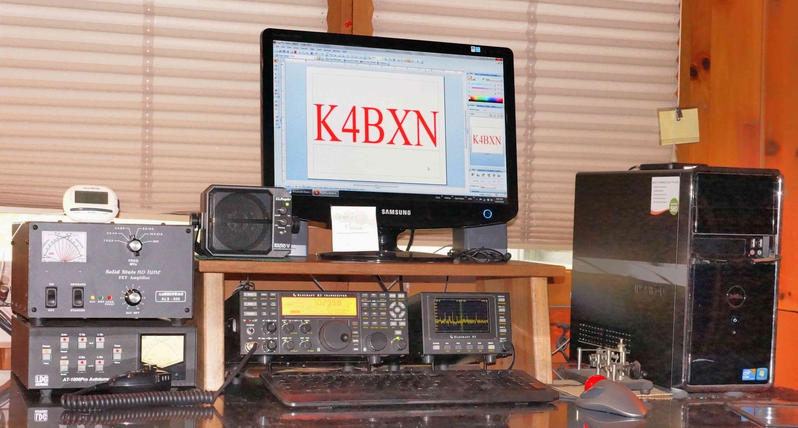
Perfect spacing and perfect sending – period. Music to my ears. And sending Morse like that with a bug is no mean feat. From my own experience, I know it’s so easy to develop a swing. Not that a swing is necessarily a bad thing – but it can be if you’re not careful. It takes a lot of practice and a lot of skill to be as good as K4BXN. But boy, is it a treat to listen to!
72 de Larry W2LJ
QRP – When you care to send the very least!

Larry Makoski, W2LJ, is a regular contributor to AmateurRadio.com and writes from New Jersey, USA. Contact him at [email protected].
nanoKeyer
I’m pleased to report that Oscar, DJ0MY, has created an open source hardware initiative and kit offering called nanoKeyer. This project utilizes my Arduino keyer code and the Arduino Nano, a smaller cousin of the Arduino Uno, but fully software compatible.

Oscar is offering the kit at a reasonable price, but also provides Gerber files on his site for those wishing to reproduce the hardware design. The hardware kit features three memory buttons, a speed potentiometer, a PS2 Keyboard connector, and optically-isolated keying and PTT lines. The Arduino Nano module that mates with the nanoKeyer supports the K3NG keyer code command line interface and K1EL Winkey emulation via the built-in USB port. The Arduino Nano is programmed via a typical Windows, Mac, or Linux machine with free software.

This kit offers commercial / contest quality performance and features in an open source package that can easily be assembled by beginners or customized by advanced experimenters.


Handiham World for 22 February 2012
Welcome to Handiham World.
Have you ever belonged to a book club or discussion group? Sometimes public libraries or local bookstores sponsor such activities. The idea is for everyone in the group to read a book and then come together to discuss it in a relaxed and cordial atmosphere.
I started thinking about this idea of having a discussion group while I was listening to one of our Handiham nets. As luck would have it, I was also browsing through the e-mail from my local radio club and one of the messages in my inbox had a list of potential radio club program topics. The idea of the book club discussion group and the message about radio club program topics started to mix and merge in my brain. Perhaps it would be a good idea to have a discussion topic on a regular basis during one of our nets, but make it related to a particular article about ham radio, much the same as a book club would discuss a particular novel. This would be different than the trivia net in that a roundtable discussion would be essential to make it work. The norm in many amateur radio nets is for the net control station to run the net in what I will call a “linear” format. In other words, the net control station opens the net with a preamble and then follows a pattern of calling for stations to check in with traffic or announcements or just to get on the station list for that day. Once checked into the net, a station operator need not feel obligated to check in a second or third time. In fact, if the net is run in this kind of linear format, the expectation is that permission will be requested from the net control station to “re-check” because it is assumed that once a station has checked in the net will move on to each new check-in in succession.
Of course this kind of linear format will not work in a discussion net. By its very nature, a discussion requires back-and-forth dialogue as ideas and concepts are presented and then commented on by the group. If you were sitting in a room at the library or bookstore with other book club members who have read the book of the month that has been assigned for discussion, how would you prefer that the chairs be arranged? My preference would be to put them in a circle rather than in a long line along one wall of the room. Having chairs in a circle promotes discussion, and what we want in a discussion group is the interchange of ideas. It is not an accident that this kind of ham radio net is called a “roundtable”. Sitting around the table encourages discussion.
So a linear format net is different in that very fundamental way from a roundtable discussion net. If you tune across the amateur radio bands and really get familiar with what is going on, you will soon learn that groups of friends meet at various places on the bands around the same time every day or evening. Most of these groups are really just informal roundtable sessions and did not have a specific net mission or formal structure. There are, however, some discussion nets that are more formal in that the discussion topic may be limited by the group to a particular interest area such as religion or aviation. What I would propose is something just a little bit different in that the discussion topic would change depending on which article is the assigned reading of the week. The net would discuss that particular article and then participants would be able to weigh in with their opinions and suggestions as well as comment on the opinions and suggestions of the other net participants.
One consideration with this kind of a targeted roundtable discussion group is that it tends to work best when there are not too many people trying to participate. If the group gets too large, this will hamper discussion because by the time everybody gets a chance to say their piece the allotted time for the net may be nearly over. As with any kind of a net, everything will run more smoothly when all of the participants know and follow the rules. Some of the basics are:
1. Always yield to the net control station.
2. Stick to the topic.
3. Be sure you have read the article before joining the net as a participant. If you have not read the article, don’t bother checking in but feel free to listen.
4. Try to be as brief and concise with your thoughts as possible so that everyone will have a chance to talk.
5. Play nice! Be respectful of everyone’s opinions.
6. Take notes during the discussion so that you can comment on what has been said while you are waiting for your turn.
7. Maintain good engineering standards for your station and computer system so that your audio is clean and easy to understand.
8. Be on time for the net. Remember, the discussion will begin right away so the expectation is that only the stations who are on time will participate in the discussion. Latecomers are welcome to listen to the discussion.
9. As the discussion comes to a close, be ready with ideas for the next week’s topic. At that point, the net control station can ask for other ideas and see if there is any consensus about the next article to be discussed. Sometimes this will not be possible to nail down, given the limited time available on the air. In that case, an e-mail message with a topic can be sent to the discussion group participants.
10. If the net decides that the topic will be carried over into the next week or that some other follow-up needs to be done, put that in your notes to make sure that you don’t forget to do whatever “homework” needs to be done before the next net session.
You can see that this is a whole different ballgame than the nets that we are used to. Most typical linear format nets require virtually no preparation and ask very little of participants. A discussion roundtable net requires a different level of commitment but at the same time can be a more rewarding experience because of the depth of your participation. Roundtable discussion nets are not for everyone, and no one need apologize if they are just not willing to commit the time and effort that this kind of net requires. I have often found myself tuning around the bands and listening to different roundtable conversations without actually participating. There is nothing wrong with doing a lot of listening – after all, you can learn a lot by listening. If a topic area seems beyond your understanding, listening is probably your best choice until you learn enough to join in. On the other hand, some people are adventuresome and jump off the highest diving board as soon as they get to the pool. “Learn by doing”, they will say, and they might just be right!
This morning I enjoyed listening on 3.930 MHz. “The Morning Group” is up here in Minnesota, but I’m sure you have similar groups located near you. Round table discussions need not be formalized with a net control station, nor do they have to have a scheduled topic. You may find this kind of informal net to be an interesting way to stay in touch with a small group of friends who share some of your interests. On the other hand, a directed net with a net control station can give a formal roundtable with a designated topic for the day just enough direction to make for a lively and fun conversation.
For Handiham World, I’m…
Patrick Tice, [email protected]
Handiham Manager

Pat Tice, WA0TDA, is the manager of HANDI-HAM and a regular contributor to AmateurRadio.com. Contact him at [email protected].
PARP 52–QSL Bureau and more
 The Practical Amateur Radio Podcast episode 52 is now available for download or stream. You can subscribe via iTunes, Zune or stream directly from MyAmateurRadio.com Want to stream on the go from your favorite smart phone device? You can do that as well via our mobile site.
In this new episode, I discuss the QSL Bureau Service as it relates to US Amateur’s. The bureau service is a great, inexpensive method of QSL’ing those DX contacts. Our featured website segment discusses the Ham Nation podcast/netcast as well as Mike Baxter, WA0XTT.
Please visit MyAmateurRadio.com to listen or download this new episode.
Thank you for listening and thank you for sharing your knowledge with others. The Practical Amateur Radio Podcast, creating Elmers one podcast at a time.
Until next time…
73 de KD0BIK
Jerry Taylor, KD0BIK, is a regular contributor to AmateurRadio.com and writes from Colorado, USA. He is the host of the Practical Amateur Radio Podcast. Contact him at [email protected].
Android Apps
I’ve long been a user of smartphone’s and always felt that in the past they were able to offer a lot in terms of being able to make and receive calls then the applications or apps that run on them we additional bonuses. Nowadays the primary selling point of a smartphone is not to do the basics like calls and text (SMS) messaging are the apps. My HTC desire S is like many other that run the Android OS in that it has access to the Android Market and its ever growing list of extras. A little run down on the ham radio one I have is as below. There’s no great explanation as to their functionality as its all on the Android Marketplace
APRSdroid – APRS on your phone. Well worth the money especially now that it supports messaging.
Echolink – Ro real need to introduce this application. Just does what you need to make use of the Echolink network
Electrodroid – A collection of electrical references
Hamsatdroid – Satellite prediction for your phone. Very effective with a simple interface.
Morse code reader – Like all readers its not as good as your ear and as such is limited but a simple application
Morse CT – The trainer that if it was a person would have given up on me learning the code a long time ago. A very patient trainer.
Repeater – Repeaters in you local area. Shows you the distance to your nearest repeater.
Satellite AR – A mixture of Google sky maps and hamsatdroid with a nice ‘point at the sky and see where the satellite is in real time’ interface. Does more than amateur radio satellites.
This is by no means an exhaustive list but these are the ones that have been installed and used. I’ve tinkered with the idea of a log book for when I’m portable but nothing so far has stood up to the old pencil and paper. If a developer makes one that can pick out call signs then that would be smart but I can imagine that’s not going to happen in the near future.
I know there are apps for digimodes like PSK-31 but nothing for things like WSPR or any of the exotic ones. As the next generation of phones come out and these become functional but obsolete the ability to repurpose them must be on someone else’s mind and not just mine.
Alex Hill, G7KSE, is a regular contributor to AmateurRadio.com and writes from Cumbria, UK. Contact him at [email protected].
DIY Magnetic Loop Antenna – Part 2
Part 1 of the DIY Magnetic Loop Antenna covered mostly theory and materials so now its time to move on to designing the magnetic loop antenna (MLA).
If you have priced a commercially made MLA you’ll see prices start at $400 and keep going up, and up. If they cost so much you would think they must be difficult to build or use expensive parts, right? Well, it is certainly possible to spend more and get a higher quality MLA but a low cost MLA will still work very well.
For the purposes of this article we’ll assume that you want to build a loop to cover the 20-10M bands. I’ll run through the calculations required to build the MLA.
The required information for the MLA calculator is:
- Length of the loop
- The conductor diameter
- Frequency/s of operation
- Input power to the antenna
- We don’t really know the best length of the loop at the moment so I’ll pick 9 feet circumference as a starting point (It’ll still fit in the trunk of my car)
- Since we seem to be having better luck with sunspots now I’d like to try 10M so we’ll start with 29 Mhz as the highest frequency we’ll use.
- I have some copper pipe left over from an ice-maker install, it is 1/4 (0.25) inch in diameter.
- Input power to the loop will be 100W.
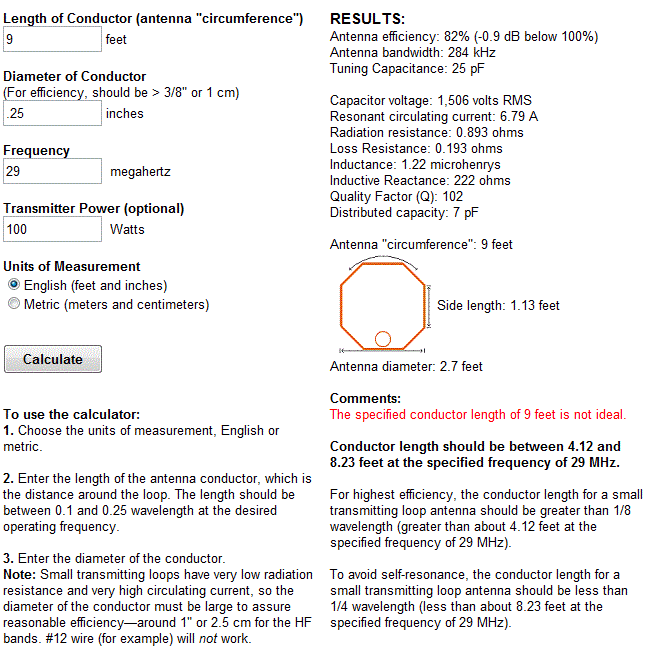
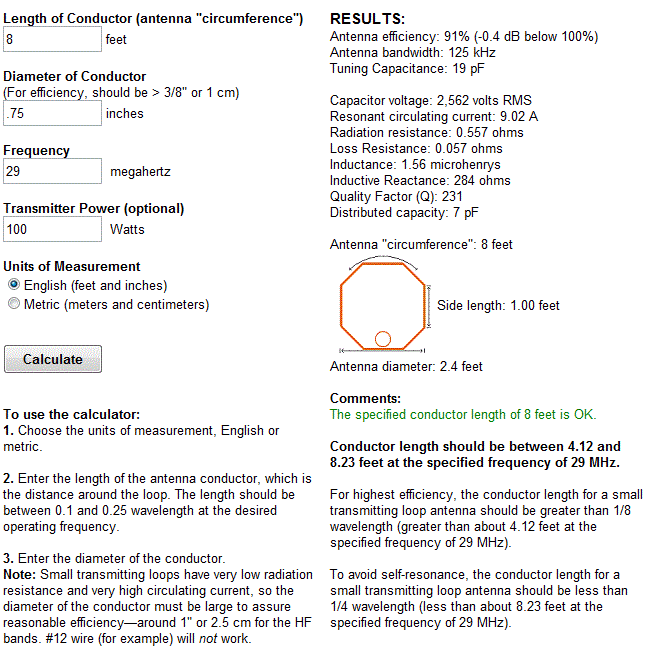
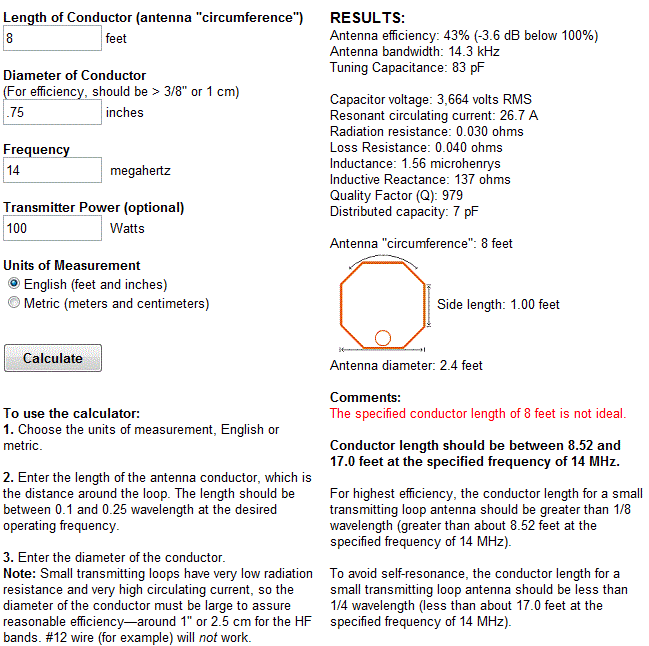
 A peak voltage of 5181V will require a minimum spacing of 1.7 mm (peak voltage / breakdown voltage per mm) between the closest conductors in the capacitor. That would rule out an old air spaced variable capacitor from a vacuum tube radio but you could still use a wide spaced variable capacitor from an antenna matching unit or transmitter. A vacuum variable capacitor would be great (watch the minimum capacitance) or a home-made capacitor would also be fine provided you checked the breakdown voltage of the insulating material.
Owen Morgan, KF5CZO, is a regular contributor to AmateurRadio.com and writes from Texas, USA. Contact him at [email protected].
 Ham Radio Deluxe |
 W5SWL Electronics |
 Ham Radio Prep |
 KB3IFH QSL Cards  Hip Ham Shirts  HamRadioAuctions HamRadioAuctions Reliance Antennas Reliance Antennas Enigma Shop Enigma Shop |  morseDX  Ni4L Antennas  R&L Electronics R&L Electronics antennas.us antennas.us QRV QRV |
- Matt W1MST, Managing Editor
