 |
 Ham Radio and Mesh Networks
 21 March 2012 | by
 Lately I’ve been fascinated by the capabilities of mesh networks. The ability to quickly create ad-hock computer networks could be an invaluable resource for amateur radio operators in general and particularly for emergency communications (EMCOM)
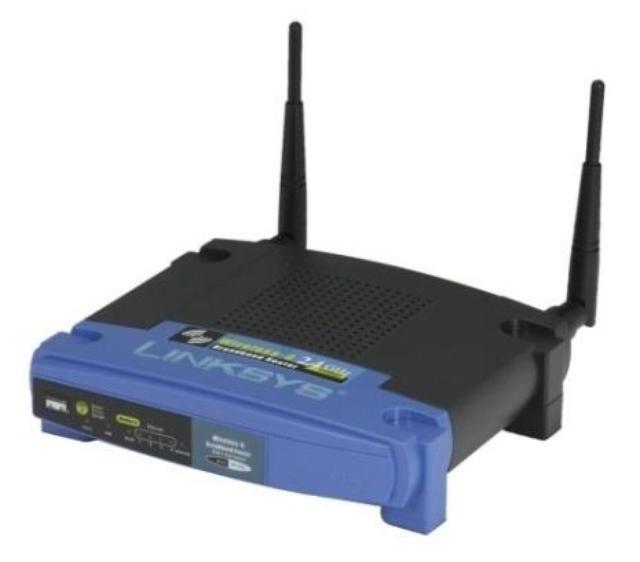
The particular device and software I have been experimenting with is the Linksys WRT54G router and HSMM-MESH firmware from http://hsmm-mesh.org/.
Installing the HSMM-MESH firmware changes the way the Linksys router functions and allows it to automatically connect to other HSMM routers in a mesh network. No special configuration is required after setting your callsign. All TCP/IP configuration is pre-configured, even down to automatically assigning addresses to connecting clients.

Mesh networks are highly fault tolerant. Every router in the network is aware of every other router and has the ability to move network packets through from one unit to another provided there is a link, or chain of linked routers, between them.
In the diagram to the right each router is represented by a numbered circle. If router number 6 were to fail then network packets that needed to move between router 1 and 7 would travel through routers 2 & 3 or 5 & 10 until 6 was repaired. All this happens automatically and quickly enough so that there is no disruption to the traffic.
Anything you can access on a normal computer network can be made to work on a mesh network. Some of the services that have been demonstrated include email, voice over IP (VOIP), video conferencing, file sharing, web servers & groupware applications.
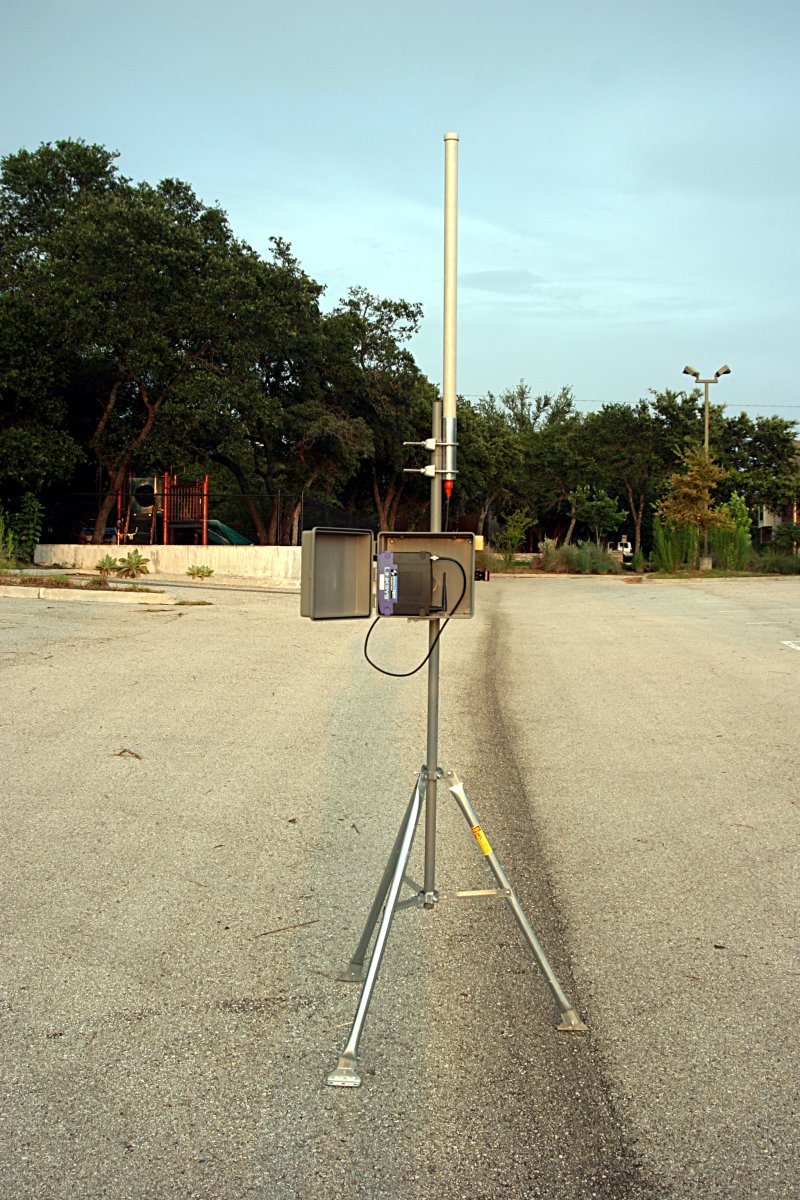 With simple modified antennas the modest output power from the WRT54G (100 to 200mW) can be used to reach distances of many miles or tens of miles with directional antennas. Mounting the router on a mast in a sealed enclosure can reduce losses from long cable runs while running off 12V power makes them compatible with ham radio power sources including solar and wind power.
The example to the left is from NG5V located on hsmm-mesh.org and consists of an omni-directional external antenna and a lawn sprinkler controller box from a popular home improvement store.
Did you know that … Frequencies used by channels one through six of 802.11b and 802.11g fall within the 2.4 GHz amateur radio band. Licensed amateur radio operators may operate 802.11b/g devices under Part 97 of the FCC Rules and Regulations, allowing increased power output but not commercial content or encryption.
I hope to acquire a few more WRT54G routers and put together a mesh network in the Katy TX area as a resource for experimentation and education in an area not normally touched upon by regular amateur radio operators. Who knows what the future holds & it behooves us to investigate this technology and bend it to our own needs.
The Amateur is Progressive … He keeps his station abreast of science. It is well built and efficient. His operating practice is above reproach.
Owen Morgan, KF5CZO, is a regular contributor to AmateurRadio.com and writes from Texas, USA. Contact him at [email protected].
Handiham World for 21 March 2012 Repost
Welcome to Handiham World.
Digital Bling and a Cautionary Tale
The news this week about QST going digital is exciting stuff. (See the next story for an explanation and link.) If our own Handiham World had not gone digital, we would still be publishing only four issues a year, one for each season. Yes, back in the bad old days a couple of decades ago the Handiham World was mailed out each Spring, Summer, Autumn, and Winter in a print format. Volunteers would read the print version onto cassette tapes that were mailed to our blind members. Any news that arrived via that system was bound to be pretty old. Then, when printing and mailing costs began to climb we had to cut down to three issues, then two. Using the Internet to deliver the Handiham World was faster, cheaper, and better. Not only could it be read directly with screenreading software by our blind members, but it could be in audio as well, also delivered via streaming or download. Members could even call a phone number to hear the same Internet audio, even if they only had a telephone. The Handiham World could be enjoyed by anyone as a podcast from iTunes. Better yet, it could be published weekly instead of quarterly.
Even though these advantages seem obvious, there were – and still are – some who feel that our service has left them behind. These are the members who don’t have computers and who don’t plan to get them. And this, my friends, is the problem every publisher faces. That is why I’m going to share with you my experience with a newspaper.
It is certainly not news that newspapers want to print: Newspapers are struggling to find their new business model in the 21st century. Who reads them anymore?
Probably people like me, that’s who! I’m old enough to remember having a paper route as a kid. Delivering the daily paper was one of those rite of passage jobs a kid could have back in the middle of the 20th century. The news business was less competitive back then, and there was little urgency to have up to the second updates. The newspaper business held its own until cable news began nipping at its heels, but it wasn’t until news sites began appearing on the Internet that the real problems with printing paper copies and physically dumping them on doorsteps became too big to ignore.
These days we would get our newspaper delivered by some guy driving his personal vehicle around town and pitching the paper out onto the driveway or sidewalk. He would back over the lawn and sometimes his truck would have a loud muffler in the wee hours of the morning. Often as not the morning dew or the lawn sprinklers would soak the paper before we could retrieve it. On rainy mornings the paper arrived in a plastic bag that managed to protect about 3/4 of the paper from getting soaked. The newspaper company also published an on line edition once the power of the web was obvious, and like many other readers I took to it instantly and never looked back. Unfortunately for the newspaper, they lost money giving the news away for free on the web (duh), and they finally had to come up with a pay-for alternative. It involved a special digital edition that looked just like the printed version. In a scattergun approach to pleasing every customer from the grumpiest computer-hating Luddite to the early-adopter geek, they offered a plan to give you a print paper AND a digital edition.
We signed up. I like trying new stuff but I still like a print edition. This would be a chance to compare the technologies.
It’s been a couple of months now, so I feel as if I know where things are going. Both my wife and I read the print paper to some extent, and both of us use the newspaper’s website. The website is actually easy to use, but it is not the new so-called “digital edition” that looks exactly like the printed paper. For that, you have to log on to a special website. The newspaper sends a helpful link by email each day as a reminder. The digital look alike loads a web application in your browser window, after which you see the copy of the printed version in what amounts to a browser frame. Try as I might, I just cannot warm to the idea of trying to read a newspaper that way. The page does not all fit in the browser window, which means that you are constantly scrolling one way of another to read articles. Worse yet, because the digital look alike is supposed to be like the printed copy, you have to follow the story onto other pages buried deep in that day’s edition. The pages of the digital edition have a feature that prompts you with a cute little animation to turn them. Page turns themselves are also animated. Ooooo! This is digital bling! It looks so cool, but let’s face it – I think having to scroll left and right and up and down, then fiddle with the mouse to get the cursor exactly in the right spot to connect me to the remainder of a front-page article that ends up buried on page 10 is just not my cup of tea. What I want is content. I would like it to be easy to find, easy to read, and – after being in the business of helping people with disabilities for so many years – accessible to people who use screenreaders. I have to say that some of these new digital publishing efforts fall flat on all those counts.
What I don’t really understand is the need to make a digital edition look like a printed page. The printed page is fine when it is a printed page. When it is a digital copy on a small screen, it is like putting Victorian furniture in a Frank Lloyd Wright house. It is a bad fit. If you are going to use the web to publish your newspaper, publish it using the easily understood, common, and highly accessible web page formats that are already available. That is why for Handiham World we provide accessible HTML in our web pages. If we put something up in a format like PDF, it contains embedded text and an audio alternative, plus an HTML version. But really, the PDF version is not meant so much to be read on line as to be printed and read as a print publication.
The bottom line with digital publishing is that it needs to be recognized for what it really is – a new and better way to deliver content that is more up to date, cheaper to deliver, and takes advantage of the technology to allow users to search thousands of pages quickly, have access to past issues without collecting an attic full of paper copies, and enjoy it all with accessible technology. It is not a new way to deliver the same old paper dressed up with page turn animations. In other words, forget the bling and give me the content.
Oh, well. At least the digital version does not drive over my lawn at 4:00 A.M. in a noisy truck. On the down side, I miss the plastic bag that is so handy for “dog duty” when I take Jasper out for a walk.
For Handiham World, I’m…
Patrick Tice, [email protected]
Handiham Manager

Pat Tice, WA0TDA, is the manager of HANDI-HAM and a regular contributor to AmateurRadio.com. Contact him at [email protected].
Handiham World for 21 March 2012
Welcome to Handiham World.
Digital Bling and a Cautionary Tale
The news this week about QST going digital is exciting stuff. (See the next story for an explanation and link.) If our own Handiham World had not gone digital, we would still be publishing only four issues a year, one for each season. Yes, back in the bad old days a couple of decades ago the Handiham World was mailed out each Spring, Summer, Autumn, and Winter in a print format. Volunteers would read the print version onto cassette tapes that were mailed to our blind members. Any news that arrived via that system was bound to be pretty old. Then, when printing and mailing costs began to climb we had to cut down to three issues, then two. Using the Internet to deliver the Handiham World was faster, cheaper, and better. Not only could it be read directly with screenreading software by our blind members, but it could be in audio as well, also delivered via streaming or download. Members could even call a phone number to hear the same Internet audio, even if they only had a telephone. The Handiham World could be enjoyed by anyone as a podcast from iTunes. Better yet, it could be published weekly instead of quarterly.
Even though these advantages seem obvious, there were – and still are – some who feel that our service has left them behind. These are the members who don’t have computers and who don’t plan to get them. And this, my friends, is the problem every publisher faces. That is why I’m going to share with you my experience with a newspaper.
It is certainly not news that newspapers want to print: Newspapers are struggling to find their new business model in the 21st century. Who reads them anymore?
Probably people like me, that’s who! I’m old enough to remember having a paper route as a kid. Delivering the daily paper was one of those rite of passage jobs a kid could have back in the middle of the 20th century. The news business was less competitive back then, and there was little urgency to have up to the second updates. The newspaper business held its own until cable news began nipping at its heels, but it wasn’t until news sites began appearing on the Internet that the real problems with printing paper copies and physically dumping them on doorsteps became too big to ignore.
These days we would get our newspaper delivered by some guy driving his personal vehicle around town and pitching the paper out onto the driveway or sidewalk. He would back over the lawn and sometimes his truck would have a loud muffler in the wee hours of the morning. Often as not the morning dew or the lawn sprinklers would soak the paper before we could retrieve it. On rainy mornings the paper arrived in a plastic bag that managed to protect about 3/4 of the paper from getting soaked. The newspaper company also published an on line edition once the power of the web was obvious, and like many other readers I took to it instantly and never looked back. Unfortunately for the newspaper, they lost money giving the news away for free on the web (duh), and they finally had to come up with a pay-for alternative. It involved a special digital edition that looked just like the printed version. In a scattergun approach to pleasing every customer from the grumpiest computer-hating Luddite to the early-adopter geek, they offered a plan to give you a print paper AND a digital edition.
We signed up. I like trying new stuff but I still like a print edition. This would be a chance to compare the technologies.
It’s been a couple of months now, so I feel as if I know where things are going. Both my wife and I read the print paper to some extent, and both of us use the newspaper’s website. The website is actually easy to use, but it is not the new so-called “digital edition” that looks exactly like the printed paper. For that, you have to log on to a special website. The newspaper sends a helpful link by email each day as a reminder. The digital look alike loads a web application in your browser window, after which you see the copy of the printed version in what amounts to a browser frame. Try as I might, I just cannot warm to the idea of trying to read a newspaper that way. The page does not all fit in the browser window, which means that you are constantly scrolling one way of another to read articles. Worse yet, because the digital look alike is supposed to be like the printed copy, you have to follow the story onto other pages buried deep in that day’s edition. The pages of the digital edition have a feature that prompts you with a cute little animation to turn them. Page turns themselves are also animated. Ooooo! This is digital bling! It looks so cool, but let’s face it – I think having to scroll left and right and up and down, then fiddle with the mouse to get the cursor exactly in the right spot to connect me to the remainder of a front-page article that ends up buried on page 10 is just not my cup of tea. What I want is content. I would like it to be easy to find, easy to read, and – after being in the business of helping people with disabilities for so many years – accessible to people who use screenreaders. I have to say that some of these new digital publishing efforts fall flat on all those counts.
What I don’t really understand is the need to make a digital edition look like a printed page. The printed page is fine when it is a printed page. When it is a digital copy on a small screen, it is like putting Victorian furniture in a Frank Lloyd Wright house. It is a bad fit. If you are going to use the web to publish your newspaper, publish it using the easily understood, common, and highly accessible web page formats that are already available. That is why for Handiham World we provide accessible HTML in our web pages. If we put something up in a format like PDF, it contains embedded text and an audio alternative, plus an HTML version. But really, the PDF version is not meant so much to be read on line as to be printed and read as a print publication.
The bottom line with digital publishing is that it needs to be recognized for what it really is – a new and better way to deliver content that is more up to date, cheaper to deliver, and takes advantage of the technology to allow users to search thousands of pages quickly, have access to past issues without collecting an attic full of paper copies, and enjoy it all with accessible technology. It is not a new way to deliver the same old paper dressed up with page turn animations. In other words, forget the bling and give me the content.
Oh, well. At least the digital version does not drive over my lawn at 4:00 A.M. in a noisy truck. On the down side, I miss the plastic bag that is so handy for “dog duty” when I take Jasper out for a walk.
For Handiham World, I’m…
Patrick Tice, [email protected]
Handiham Manager

Pat Tice, WA0TDA, is the manager of HANDI-HAM and a regular contributor to AmateurRadio.com. Contact him at [email protected].
PARP 53–RST Signal Reports

The Practical Amateur Radio Podcast episode 53 is now available for download or stream. I’ve also updated the audio player used on MyAmateurRadio.com to work across multiple platforms including portable devices such as iPhone and iPad.
In this episode I discuss RST Signal Reports. I provide details into what each of the numerical values mean and my own thoughts about their use. In the featured website segment I introduce the new amateur radio podcast from Gary Pearce, KN4AQ titled Ham Radio Now.
Please visit MyAmateurRadio.com to listen or download this new episode.
Thank you for listening and thank you for sharing your knowledge with others. The Practical Amateur Radio Podcast, creating Elmers one podcast at a time.
Until next time…
73 de KD0BIK
Jerry Taylor, KD0BIK, is a regular contributor to AmateurRadio.com and writes from Colorado, USA. He is the host of the Practical Amateur Radio Podcast. Contact him at [email protected].
Happy Birthday WOTA
Happy Birthday WOTA. What do you get a portable operators scheme for its birthday? I simply have no idea.

For those who aren’t too sure what it is. WOTA is a bit like SOTA but for the Wainwright Fells in the Lake District. If you don’t know what SOTA is then one explanation is portable operations from summits (or fells if you live here in the lakes). Or as I like to describe it to non hams, working you way up a fell till you get to the top, looking at the view for a bit then getting out a radio (generally in the fog or rain, in the lake district) and saying ‘hello its me, can you hear me?’ ‘yes, it’s me, can you hear me?’ ‘yes, good stuff, who’s next’. I don’t think I’ve had too many positive looks giving that explanation but its better than trying to explain what that pole sticking out of your rucksack is in a howling gale.
Anyway,m back to the point. WOTA was devised by Julian, G4ILO and the first activations have been tabled as the 21st March 2009. So all I can say is happy birthday and my XYL wants a word with you because I’ve not managed to fix the downstairs toilet whilst I’m out operating from a fell top.
Alex Hill, G7KSE, is a regular contributor to AmateurRadio.com and writes from Cumbria, UK. Contact him at [email protected].
The K0NR History of Electronic Communications
Humans have always had a desire to communicate. They started out just talking to each other but then found that it was really handy to be able to write things down. This caused the invention of the alphabet and the training of English teachers to explain overly-convoluted rules of grammar.
In 1831, Joseph Henry was playing around with electric circuits and came up with the idea of a telegraph. We can imagine a simple system where ON means “time for dinner” and OFF means “not yet”. This wasn’t good enough for Samuel Morse, who invented the Morse Code which could use ON and OFF to represent the entire alphabet. This was the first digital code and was used for important messages such as “Laughing Out Loud”, later abbreviated to LOL. This was basically the same as modern text messaging but you needed a trained telegrapher to do it.
In 1875, an inventor named Bell decided that it would be better if you could just talk over the wires instead of messing around with Morse Code. This will be a recurring theme — whether to talk to other people or just send digital codes. Bell invented this thing called the telephone, which is still used today. Basically, a person could talk into one end of a wire and have his voice pop out of the other end.
Later a guy named Marconi came along with the idea that communication should not depend on wires. For example, it was quite inconvenient to drag a telephone wire behind a ship as it moved across the sea. Unfortunately, Marconi didn’t know how to do voice over the wireless, so he dropped back to using Morse Code. ON and OFF is a much easier way to go. Although there is a persistent rumor that Marconi intentionally used Morse Code to torment future generations of FCC Licensed Amateur Radio Operators, I can find no evidence of this. Some people argue that Nikola Tesla invented wireless but I think he had to be disqualified for overloading and shutting down the Colorado Springs power grid on numerous occasions.
Again, not wanting to be limited by trained telegraphers, voice communication (originally called Amplitude Modulation, but now known as Ancient Modulation) was invented. We are not sure who first came up with Ancient Modulation, but there are a bunch of radio hams on 75 Meters still trying to perfect it.
Somewhere around 1973, Motorola figured out that what the world really wanted was a portable phone that everyone could carry around in their pocket. The first attempt at this was the Motorola DynaTAC, which required an enormous pocket to carry it in. Knowing that customers were not going to enlarge their pockets, various mobile phone manufacturers worked feverishly to reduce the size of these phones.
Unfortunately, the mobile phone manufacturers terribly miscalculated, thinking that people would want to actually talk on these phones. As text messaging was added to these phones, it was discovered that most people, especially those under the age of 30, preferred to send cryptic text messages rather than actually talk to anyone. It was also discovered that all forms of human thought can be captured as 140 character messages. Although it was tempting to apply Morse Code to digital text messaging, it was rejected in favor of the ASCII 8-bit code. Instead of using ON/OFF keying, text messages are normally sent with a tiny keyboard patterned after a full-size typewriter (now obsolete).
73, Bob K0NR
P.S. I made up some of this stuff.
Bob Witte, KØNR, is a regular contributor to AmateurRadio.com and writes from Colorado, USA. Contact him at [email protected].
Fishing
It’s been said that the universe could be described entirely with car analogies. Analogies don’t really prove anything, but they’re great for clarifying an opinion or illustrating a complex concept in a more simplified, understandable fashion. Often it’s difficult to describe amateur radio to non-technical family, friends, and co-workers.
I can’t think of a better analogy for explaining amateur radio than fishing.
Why do you call CQ and try to talk to just anyone?
We’re not out to catch one particular fish. We cast our line where we think there might be fish and when we catch one, it’s a surprise. This is part of the joy. You never quite know what you’re going to reel in.
Why do you do Morse code? Isn’t it easier to just talk to someone? Or perhaps type on your computer?
Some fisherman like to fly fish. It’s not for everyone, but it’s an art that takes a bit of practice and skill. You don’t catch bigger fish fly fishing, and many times it’s a lot more work. But some people find it more fun than regular fishing. Some do both regular fishing and fly fishing. Some fisherman ice fish.

Some hams use power amplifiers to make big signals while others use low power, this thing called QRP. Why wouldn’t everyone want to use more power?
I know guys who go deep sea fishing and catch big tuna or swordfish on big expensive boats. Some of us like to use ultralight rods and fish streams for trout or small ponds for panfish.
In this age of the Internet where you can chat with anyone around the world on your computer, why even bother with amateur radio?
Why bother buying a fishing license and all that equipment when you can much more easily go to a supermarket and buy a fish? It’s because it’s not about just eating a fish. It’s the experience of fishing.
Amateur radio seems inherently non-competitive, but you have contests?
On the surface fishing is a non-competitive hobby. But there are fishing tournaments in which fisherman compete. Like other types of fishing it’s not for everyone, but some love it, and for some fisherman that’s all they do.
What do you talk about?
We often talk about fishing techniques or what else we caught that day, but more often we talk about whatever comes to mind. Sometime we don’t talk about much at all.
Is amateur radio all old guys?
There are a lot of old guys who fish probably because they have a lot more free time, but everyone fishes. It’s nice to get the whole family fishing.
Are you always going to be a radio amateur?
You’re always a fisherman, even if you haven’t gone out fishing for awhile. I hope to fish until the day I die….


 Ham Radio Deluxe |
 W5SWL Electronics |
 Ham Radio Prep |
 KB3IFH QSL Cards  Hip Ham Shirts  HamRadioAuctions HamRadioAuctions Reliance Antennas Reliance Antennas Enigma Shop Enigma Shop |  morseDX  Ni4L Antennas  R&L Electronics R&L Electronics antennas.us antennas.us QRV QRV |
- Matt W1MST, Managing Editor
