 |
 Lightweight 50Mhz Yagi
 9 March 2012 | by
 Building antennas seems to be getting to be a bit of a habit for me. This time I’ve bought a kit, for evaluation purposes. No really it is.
I was trying to think of a project that I could use at MX0WRC (Workington and district amateur radio club) to help give some direction to some of the members who may never have built anything other than the kit they built for their intermediate licence. So, as I’ve been roped in to give a talk on my portable set up, which consists of what I thought were low cost antennas I thought I’d found the right direction.
Low cost is not what I came across when researching simple antennas. It seemed that I was way off the mark for commercial offerings until I found a company in Germany called Nuxcom.  They supply what look like simple yagi kits at realistic prices. By which I mean the cost of the materials isn’t prohibitive (For example from a raw material supplier 25mm box section can be bought for as little as £6-8 for a 1m length, enough for a 3 element 2m yagi and round tube for similar cost – and this isn’t cheap Chinese metal this is western European fully traceable materials! Don’t even get me started on the price of pipe clamps)
So, to placate my ever growing concern that prices are rising higher than a bankers bonuses, without any real justification I ordered one of the larger kits from Nuxcom, a 2 element lightweight 6m yagi. Purchasing was a bit drawn out as I placed an order and the ‘quote’ was returned with shipping costs added in a few hours later. But at £35 I was prepared to take a gamble, even is a third of the cost was shipping.
I’m expecting the kit before the weekend and I’ll do a little write up when it arrives. On the face of it the kit looks fairly simple in design without any bells and whistles, just what we need to add to the J pole, vertical and dipole designs that I plan on demonstrating.
What I’m really hoping for is a good value, simple lightweight antenna than doesn’t cost the earth so that the club members can learn and experiment without breaking the bank. More later.
Alex Hill, G7KSE, is a regular contributor to AmateurRadio.com and writes from Cumbria, UK. Contact him at [email protected].
This came today
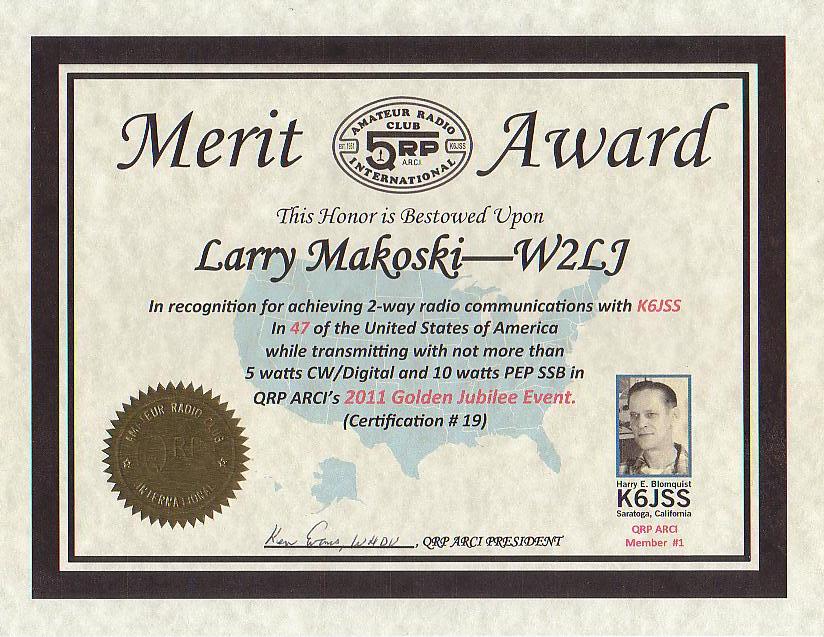

Larry Makoski, W2LJ, is a regular contributor to AmateurRadio.com and writes from New Jersey, USA. Contact him at [email protected].
Spring time in New Hampshire.
Jim W1PID was at it again today:
Prepare yourself for some beautiful photos as well as a good story.
http://www.w1pid.com/spring/spring.html
On a side note, some of you may have noticed that I removed the “Capcha Code” from the blog comments area. I did that in response to a couple of you out there that were having difficulties posting comments. It’s a good thing that comments are on moderation and that Blogger has a good spam detection process. Since removing the Code, I have been averaging about 15 – 20 spam comments a day! Don’t people have better things to do?
Today was more like the end of April than the beginning of March. Around lunchtime, the high was 68F (20C). We really shouldn’t be seeing temps like this for another 4 to 6 weeks; but you know what? I’ll take it any day. Unfortunately, tomorrow is supposed to be more seasonable with highs only in the upper 40s (8C or so).
Tonight is the 40 Meters QRP Foxhunt. I managed to get both Foxes Tuesday night in the 80 Meter hunt. I worked Lee AA4GA quite easily; but was having a devil of a time with Ray KX9E in Illinois. Turns out I had the K2 set to 1 Watt. When I bumped it up to 5, Ray was able to hear me a bit more easily. I had forgotten that I had set it to 1 Watt over last weekend, and forgot to reset it. That means I worked AA4GA in Georgia with only 1 Watt as it turns out. Cool!
72 de Larry W2LJ
QRP – When you care to send the very least!

Larry Makoski, W2LJ, is a regular contributor to AmateurRadio.com and writes from New Jersey, USA. Contact him at [email protected].
Propellor on Packet
My Gadget Gangster Parallax Propellor board has just modulated its first APRS packets. This is not down to any clever programming by me. I simply used the Spin APRS Object published by Richard, G3CWI based on code by Alex Erlank.
Richard had to make some changes to get Alex’s code to work and I had to change a few things as well. Mostly they involved replacing Richard’s callsign and position with my own! The AFSK output was connected to the mic input of my old TH-205E using a 0.1uF DC blocking capacitor. There is enough idle time at the start of the packet for VOX to be used if the transceiver supports it. Mine doesn’t, so for test purposes I manually keyed the radio’s PTT.

I found that my packets were not decoded by the Kenwood TM-D710 TNC when I used the option to include a path such as WIDE1-1,WIDE2-1. I’m not up to debugging the code. However, Richard had mentioned that calls less than 6 characters long needed to be padded with spaces so thanks to an inspired guess I found that that this applies to paths like WIDE1 as well.
There is a GPS object included with the code. I haven’t tried the Propellor with my GPS module yet, mainly because the GPS doesn’t pick up any satellites from inside the shack so I’d need to rig up a battery supply and take all the kit out to the garden to test it, where it’s damp and cold. (Yes I know, I’m a wimp.)
The AX25 object contains a section intriguingly called “demodulator” which has been removed. So it seems that there may be some Spin code that would enable the Propeller to be used as a TNC to decode and display APRS packets. That isn’t something I had particularly planned to do, but it would be interesting to see if it works better than the WB8WGA PIC based TNC that I built a year ago which is a bit fussy about the level of the input audio.
One of the options with the Propeller is a touch screen colour TFT display panel. With one of those a suitably clever person could make a very nice standalone APRS terminal. I think there’s an Ethernet module as well, so it could even be an IGate…

Julian Moss, G4ILO, is a regular contributor to AmateurRadio.com and writes from Cumbria, England. Contact him at [email protected].
Baofeng UV-5R spotted on Ed Griffin’s website

Some exciting news! It looks like the new Baofeng UV-5R has arrived stateside. Browsing Ed Griffin’s Wouxun.us, I’ve found a page indicating that it’s coming soon and the scrolling banner lists the price at $65 shipped (USA). Brick O’Lore has a great post showing some of the exciting new features:
BAOFENG UV-5R 4W
136-174/400-480MhzBAOFENG UV-5R The transcevier is a micro-miniature multiband FM transceiver with extensive receive frequency coverage,providing local-area two-way amateur communications along with unmatched monitoring capability
VHF/ UHF DUAL-BAND TWO WAY RADIO
Frequency Range: 136-174 / 400-480MHz
Dual-Band Display, Dual Freq. Display, Dual-Standby
Output Power: 4 /1Watts
128 Channels
50 CTCSS and 104 CDCSS
Built-in VOX Function
1750Hz Brust Tone
FM Radio (65.0MHz-108.0MHz)
LED Flashlight
Large LCD Display
Hight /Low RF Power Switchable
25KHz/12.5KHz Switchable
Emergency Alert
Low Battery Alert
Battery Saver
Time-out Timer
Keypad Lock
Monitor Channel
Channel Step: 2.5/5/6.25/10/12.5/25KHz
Roger Set
Matt Thomas, W1MST, is the managing editor of AmateurRadio.com. Contact him at [email protected].
World Kidney Day
With all the news about giant solar flares that could black out communications I was surprised to hear activity on 10 metres. I made a few contacts on SSB with my attic dipole, including A65EE in Dubai and TC2012WKD from Turkey: a special event station for World Kidney Day to raise awareness of the importance of kidneys to our health.

I like to operate on the highest frequencies I can. On the shortest wavelengths small antennas are at the least disadvantage.

Julian Moss, G4ILO, is a regular contributor to AmateurRadio.com and writes from Cumbria, England. Contact him at [email protected].
Ham Nation 38

http://dts.podtrac.com/redirect.mp4/twit.cachefly.net/video/hn/hn0038/hn0038_h264b_864x480_500.mp4
http://dts.podtrac.com/redirect.mp4/twit.cachefly.net/video/hn/hn0038/hn0038_h264b_640x368_256.mp4
http://www.podtrac.com/pts/redirect.mp3/twit.cachefly.net/hn0038.mp3
Hosts: Bob Heil (K9EID), Gordon West (WB6NOA), and George Thomas (W5JDX)
Dayton Hamvention 2012 plans, the history of qrz.com, building a Dremel table saw, and more.
Guests: Michael Kalter (W8CI), Fred Lloyd (AA7BQ), Amanda Alden (K1DDN), and Cheryl Lasek (K9BIK)
Download or subscribe to this show at http://twit.tv/hn.
We invite you to read, add to, and amend our show notes at wiki.twit.tv.
Thanks to Joe Walsh who wrote and plays the Ham Nation theme.
Thanks to Cachefly for the bandwidth for this show.
Dr. Bob Heil, K9EID, is the founder of Heil Sound and host of TWiT.tv's Ham Nation which streams live each Tuesday at 6:00pm PT (9:00pm ET) at http://live.twit.tv. Contact him at [email protected].
 Ham Radio Deluxe |
 W5SWL Electronics |
 Ham Radio Prep |
 KB3IFH QSL Cards  Hip Ham Shirts  HamRadioAuctions HamRadioAuctions Reliance Antennas Reliance Antennas Enigma Shop Enigma Shop |  morseDX  Ni4L Antennas  R&L Electronics R&L Electronics antennas.us antennas.us QRV QRV |
- Matt W1MST, Managing Editor
