 |
 And now for something completely different
 20 April 2012 | by
 But in the same vein as the last post, sort of, as we’ve recently passed another anniversary (April 14th) ………
I am currently finishing reading Bill O’Reilly’s “Killing Lincoln: The Shocking Assassination that Changed America Forever”.

It is an extremely fast reading book. I started it Monday, while visiting my Mom, who has been in the hospital this week (hence the pandemonium). I should be finishing it very soon. I wouldn’t consider it to be the definitive book on the subject, but it is definitely interesting. I would heartily recommend it.
Having it on the Kindle makes it that much easier to carry along.
I know this topic isn’t radio related in any way; but the authors do mention that Mr. Lincoln was addicted to the Internet of his day – the telegraph. He spent much time bothering the Signal Corp for as much “from the front’ war news as he was able to get. I’m willing to bet that were he alive today, President Lincoln would have been an Internet and cable news junkie – and who knows, maybe a Ham, too?
72 de Larry W2LJ
QRP – When you care to send the very least!

Larry Makoski, W2LJ, is a regular contributor to AmateurRadio.com and writes from New Jersey, USA. Contact him at [email protected].
Titanic error on my part
I don’t like to “steal” from my fellow bloggers; but I caught this on John N8ZYA’s blog. It is worth sharing with those of you who might not read his blog (You’re cheating yourself if you don’t! Just saying!) This “independent movie” is about 45 minutes long. It’s worth viewing to get an idea on how wireless was situated on seafaring vessels.
Now for the error as described in the post title. I didn’t work any of the Titanic Special Event stations due to some pandemonium that has been enveloping me over the past few days. With this Saturday being a full week past the anniversary day, I doubt any of them remain on the air. Oh well, centennial observances, like the tides, wait for no man.
Oh – before I close. This rule change to QRPTTF appeared on QRP-L today:
~~~~~~~~~~~~~~~~~~~~~~~~~~~~~~~~~~~~~~~~~~~~~~~~~~~~~~~
Gang,
While QRPTTF is open to all QRPers, I have always seen it as a “QRP-L” function. This is where it is administered and the QRPers on this list are those I attempt to satisfy and respond to.
Response to having additional SOTA stations on the air for QRPTTF has generally been positive. However, I underestimated the desire of QRPers to go climb their nearby mountain or feature, whether a SOTA summit or not. A few want to make a camping trip out of it. SOTA began and is headquartered in the UK. There are numerous US chapters. Not all states/call districts have a SOTA chapter, mostly due to no or few summits to survey or activate over 500 feet high. SOTA guidelines state that the minimum “prominence” for a summit is 100M or 300 feet. Sounds good enough for me. Therefore, we will also use this definition.
RULE CHANGE
QRPTTF has been expanded from three to four categories and multipliers
STATION CLASS AND MULTIPLIERS:
X1 HOME station
X2 FIELD HILL station – operating on a hill from 3-300 feet above
average terrain
X3 SUMMIT station – operating from a “hill” or geological feature
300 feet or higher from the average terrain
X4 SOTA Summit – operating from a designated SOTA summit
I have received several emails from those wanting to operate from the largest darn “mountain” in their corner of the state, though not a SOTA summit, which in most cases will require a substantial effort. This rule change will allow you to do this and receive a X3 multiplier for the additional effort. In turn, operating from a designated SOTA summit is now X4.
This rule change has been updated on the website, rules and summary sheet
http://www.zianet.com/qrp/ or direct: http://www.zianet.com/qrp/QRPTTF/ttf.html
So for those of you who want to be a QRP “Mountain man” for the weekend, go
for it!
72, Paul NA5N
PS – Driving out to the VLA site today (54 miles from Socorro), it made me appreciate how we have to drive through or around three different mountain ranges, with numerous peaks from 9,000-12,000 feet. I always took them for granted. Not anymore. Average terrain here is about 4,700 feet, the VLA is at 7,000 feet.
~~~~~~~~~~~~~~~~~~~~~~~~~~~~~~~~~~~~~~~~~~~~~~~~~~~~~~~~~
72 de Larry W2LJ
QRP – When you care to send the very least!

Larry Makoski, W2LJ, is a regular contributor to AmateurRadio.com and writes from New Jersey, USA. Contact him at [email protected].
KX3 Delivery Day
On Tuesday afternoon, I received the email notification that many of my fellow amateurs are waiting for. That email of course was from Elecraft and the subject line read “Package Shipped to You”.
I ordered my Elecraft KX3 within 30 minutes of the email notification which was sent out on 27 December (or 28 December UTC time). I can’t remember ever ordering anything in “pre-order” fashion prior to the KX3. Although within a few weeks of ordering the KX3, I did submit another pre-order for the Raspberry Pi.
Anyway, if you are familiar with the KX3 order and wait process, then you know initially it was expected to begin shipping in late February or early March. This date slipped and slipped another time or two. However, about three weeks ago, we began seeing the first of the factory build units shipping out.
I have worked in the IT industry for over 20 years. I’ve worked for both hardware and software vendors and I’ve personally seen products rushed out of the door and felt the impact as a result. I’ve also been on the other side and purchased products which were not ready for prime time.
While no one wants to wait, I’m extremely impressed with what I have seen from the Elecraft company regarding the release of the KX3. Certainly in the amateur radio transceiver category, you won’t see the kind of interaction between company and customer like we are experiencing with Elecraft. The other element I’m impressed with is the way Elecraft listens to their Customers and as a result, we’ve seen many changes go into the KX3 and some have even been in the last 7-10 days. WOW!
So as I write this, I just checked USPS tracking and my KX3 left San Jose on Tuesday evening and arrived and was processed through the Denver USPS sorting facility. This should mean, Bob (my mailman) will have a box to deliver to my QTH on Thursday. Again WOW!
I will take pictures and perhaps video. I may not be as lucky as one ham yesterday who actually photographed his KX3 box while still in the hands of his mailman. In any event, there has already been a few videos showing the unboxing and operation of the KX3. I may not be able to do anything “original” but will at the very least try to get a little footage.
Finally, I’m sure everyone wants to know the burning question of when will my KX3 make her maiden SOTA voyage? I would truly love to say it will be this weekend. Perhaps it will be. Also, next weekend is the QRPTTF Contest. I blogged about the QRP To The Field contest earlier in the week and mentioned it was joining forces with SOTA. While QRPTTF is a CW contest (I’m still struggling to gain altitude with this endeavor) I did feel it would still be worthwhile to activate a SOTA summit on SSB.
Of course, some might say….Why not do both weekends? I’d love that! If you’ve been following my blog you also know I’m working most every weekend on the new ham shack. With drywall now covering the walls and ceiling, we have reached the tape, mud and sanding phase. As someone who suffers from dust allergies, I think I’d rather just push through this phase as quickly as possible. This will also make the XYL happy as dust from the construction zone has reached just about every point in the house. It will continue to get worse until this is completed.
Well that is about all the news I have for now. Expect another blog posting in the next few days once I have my KX3 in hand.
Until next time…
73 de KD0BIK
Jerry Taylor, KD0BIK, is a regular contributor to AmateurRadio.com and writes from Colorado, USA. He is the host of the Practical Amateur Radio Podcast. Contact him at [email protected].
LHS Episode #080: Fitch Best
 Ever had something you wanted to get off your chest? Richard did on this episode of Linux in the Ham Shack. Somewhere along the line, Russ got sucked in as well and suddenly it was all about stuff the hosts didn’t like. There’s plenty of comic relief in the middle, though, and there is a happy ending when one of the show’s ambassadors calls in to talk about his adventure at a recent hamfest. All in all, a fun ride down Birch Street–uh, you know what we mean.
73 de The LHS Guys
Russ Woodman, K5TUX, co-hosts the Linux in the Ham Shack podcast which is available for download in both MP3 and OGG audio format. Contact him at [email protected].
QRPTTF Rules for 2012
Hot off QRP-L:
~~~~~~~~~~~~~~~~~~~~~~~~~~~~~~~~~~~~~~~~~~~~~~~
Gang,
The rules for this year’s QRP TO THE FIELD (QRPTTF) and Summary Sheet are posted at: http://www.zianet.com/qrp/
This year, we are teaming up with the Summits on the Air stations – or SOTA. SOTA stations will be operating from designated summits to participate in QRPTTF. SOTA stations are QRP – some QRPp, and operate on the usual QRP watering holes. This joint effort was designed to give us all more stations to work (since the sun isn’t helping us out much … solar flux for QRPTTF predicted to be 100).
Since we’re talking mountains and summits, this year’s theme is “Get high with QRP” … basically, operate from any old nearby hill or as high as you want to go.
SOTA stations will send the exchange, plus a SOTA designator they use for identifying the summit (this gives them credit for their awards as well). Many hike to the summits with a minimalist station, often QRPp, so may be a bit weak. Whether you work TTF or SOTA stations, they all go in the log for credit. However, you also get an extra multiplier for each SOTA station worked to reward you for your effort to boost your score.
Complete details and scoring on the website http://www.zianet.com/qrp/
There are also several SOTA members on QRP-L that will be participating in QRPTTF. If you have any questions regarding SOTA, or if you feel so inclined to operate a SOTA location, ask here and they will answer your questions.
None of us want to haul our gear to the field then struggle to find stations to work. Past few years, we have plenty of experience with that! This will give us more stations to work for more QSOs, higher scores, and of course, more fun.
72, Paul NA5N
~~~~~~~~~~~~~~~~~~~~~~~~~~~~~~~~~~~~~~~~~~~~~~~
Thanks, Paul – remember folks, QRPTTF is Saturday, April 28th.
72 de Larry W2LJ
QRP – When you care to send the very least!

Larry Makoski, W2LJ, is a regular contributor to AmateurRadio.com and writes from New Jersey, USA. Contact him at [email protected].
The Baofeng UV-5R has arrived
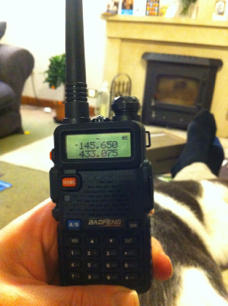
Haven’t had a QSO with it yet, but the UV-5R has arrived. Nicely built and looks promising.
Programming the memories manually is, um, interesting. I can program most things but I’ve ordered a programming cable.
The VHF side seems to work better than the UV-3R. I’ve successfully blipped up GB3WH on 2m and GB3TD, GB3DI, GB3UK on 70cms.
Charger looks ok, though I preferred the USB capability on the UV-3R plus. No sign of an earpiece/mike as supplied with the UV-3R which I found useful. I will try the UV-3R earpiece/mike – I’m guessing that will work fine.
More soon as I have time to play.

Tim Kirby, G4VXE, is a regular contributor to AmateurRadio.com and writes from Oxfordshire, England. Contact him at [email protected].
Handiham World for 18 April 2012
Welcome to Handiham World.
You can do it!
Today, just as we did last week, we are going to begin with Troubleshooting 101 as part of our initiative to help new ham radio operators (and even some of us older ones) learn how to do some basic troubleshooting for ourselves. Yes, it can be tempting to ask someone else to do things for us. This can become a bad habit when it keeps us from learning new things, especially things that we could – with a bit of practice – learn to do for ourselves. Knowing these basic things can serve us well in the future when no help is available. This next simple exercise is one that we will be practicing at this summer’s Radio Camp. You can do it yourself once you learn a few basics.
Troubleshooting 101
Help! My HF radio is dead!
One of the things we grow used to is turning on the radio and hearing stations, even if they happen to be weak or off frequency. We quickly learn, as new operators, how to tune around and adjust the VFO to hear stations clearly. Sometimes we turn the radio on first thing in the morning and hear nothing but static from far-off thunderstorms, but that is nothing new. We know that we can tune across the band and find some really strong stations.
But this morning is different. You turn the transceiver on, but there is nothing – no sound at all, at least any that is loud enough to detect without headphones. What could be wrong?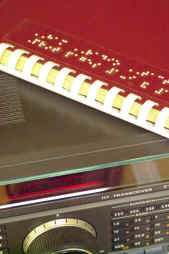
Well, the best thing to do is to follow the advice in “The Hitchhiker’s Guide to the Galaxy” and don’t panic. Many of our Handiham members are blind, so we will include some troubleshooting steps for them. We are going to check off everything without making assumptions. Some of our readers will think that this stuff is obvious, but in the grand scheme of things we must allow for a wide range in the knowledge and experience of amateur radio operators. Some will be familiar with the “dead radio” problem and others will be experiencing it for the first time. Let’s cover all the bases.
- Yes, I know this is obvious, but did the radio really turn on when you flipped the switch? Did the radio make a telltale sound when switched on? Even if I could not see the lighted display of my IC-7200, when it is powered up I hear a click as a relay energizes in the connected autotuner and my computer makes a connected sound to tell me that a USB device is now on line. Keying the PTT in SSB mode and not talking should trip the transmit relay without sending any RF, so you can hear the click of the relay. Have you checked the power supply switch?
- Make sure that you have not left headphones plugged into the PHONES jack. Doing so on most radios will mute the speaker.
- Check the AF gain (volume) control. Maybe you turned it all the way down the last time you used the radio. Don’t laugh – I often do this if I am in the radio room and get a phone call or start listening to something else. Turn up the volume and if you can hear stations, you have solved the problem.
- Check the RF gain control. Sometimes this gets turned down by accident, or perhaps you turned it down in a previous session because you were dealing with a very strong signal. Turn it back up and try tuning around again. Incidentally, I often find that users of the Handiham remote base stations leave the RF gain turned down on the TS-480 radios. No wonder the bands seem dead!
- Okay, so now we have power to the radio, the RF and AF gains are adjusted, and there is still no sound. Many radios have squelch controls, and this little feature can cause all but the very strongest signals to be completely muted. Perversely, this control is sometimes a concentric one that shares the same spot as the volume control. It is easy to misadjust, by which I mean setting it to anything but completely off! With the volume turned up to mid-range turn the squelch all the way down. Note that you don’t want the volume cranked up to max when you do this, as the sound may be startlingly loud!
- Don’t forget the other adjustments your radio may have to tailor the sound. Filter settings and pass band tuning might be set incorrectly. If they have detents, return them to “normal”.
- Still nothing at all? Retrace your steps to make sure there is power to the radio. Check the power supply and connection to the radio. Check the fuses and breakers at the station equipment and at your home’s breaker box. Make sure everything is connected as usual.
- Assuming that you do actually have power and that the radio is powered on, you could have a problem with the radio itself. Sometimes oxidation occurs on the mechanical connection in the headphone jack. Push a headphone plug in and out to clear it. Don’t forget to listen via the headphones to eliminate the unlikely possibility that the speaker coil has opened. If any of this resolves the condition, you are good to go. If not, take further steps to have the radio checked. Ask for help from your local radio club before assuming that the radio has failed. There are probably club members who are experienced with that radio and who can help you determine what is wrong and whether it needs service.
- Let’s say that you do actually hear a gentle hiss from the radio but that you can’t tune in any stations. Check to see if you have locked the main tuning dial by mistake. If the tuning is locked, you can twirl the dial all day long and the frequency will not change!
- Now you have tuned across the band and there are no signals. Try another band and check again. Still nothing? Check to make sure that the antenna’s feedline is connected. If you have an antenna switch, make sure that it is in the correct position. Don’t forget the radio’s antenna selector if your transceiver has one!
- Try WWV on 5 and 10 MHz. Both put out awesomely strong signals. If you hear a weak or warbling signal, conditions may be poor.
- Next, tune your radio to a local commercial AM radio frequency. You may not be used to doing this, so be aware that to direct enter such a frequency you may need to key in something like
zero dot eight three via the direct entry on your keypad to get “830” on the AM radio dial as I do here for local station WCCO. Of course you will choose your own local station if you don’t live here in the Twin Cities. If you can hear a local AM station it is likely that the radio is fine and that HF sky wave band conditions are just extremely poor. By tuning the local commercial AM station, you can hear a ground wave signal that does not depend on sky wave propagation. - If the local commercial station comes in fine, try checking the SWR on your antenna system. If that passes muster, it is likely that your station is intact and functioning normally and that HF band conditions are just really, really poor following a solar event. If the SWR is terrible, perhaps the feedline or antenna have failed. That is a separate troubleshooting issue.
- If the HF conditions are indeed so bad that you cannot hear sky wave stations, you can confirm this by checking various solar weather and propagation websites. It is generally a matter of waiting a few days for conditions to return to normal. When I was a young lad and had only recently gotten my General license, I ran into just this situation. I even went out side to check to see if my antenna was still up in the air! It was the first time I had experienced what amounted to a radio blackout of sky wave propagation caused by a solar event. Today we can confirm our suspicions about solar weather via the Internet, but back then it was a very puzzling thing. Eventually I did learn more about solar weather and HF propagation so that the next solar storm did not catch me by surprise and make me think my antenna had fallen down!
Email me at [email protected] with your questions & comments.
Patrick Tice
Handiham Manager

Pat Tice, WA0TDA, is the manager of HANDI-HAM and a regular contributor to AmateurRadio.com. Contact him at [email protected].
 Ham Radio Deluxe |
 W5SWL Electronics |
 Ham Radio Prep |
 KB3IFH QSL Cards  Hip Ham Shirts  HamRadioAuctions HamRadioAuctions Reliance Antennas Reliance Antennas Enigma Shop Enigma Shop |  morseDX  Ni4L Antennas  R&L Electronics R&L Electronics antennas.us antennas.us QRV QRV |
- Matt W1MST, Managing Editor
