 |
 Done!
Done!
 26 May 2012 | by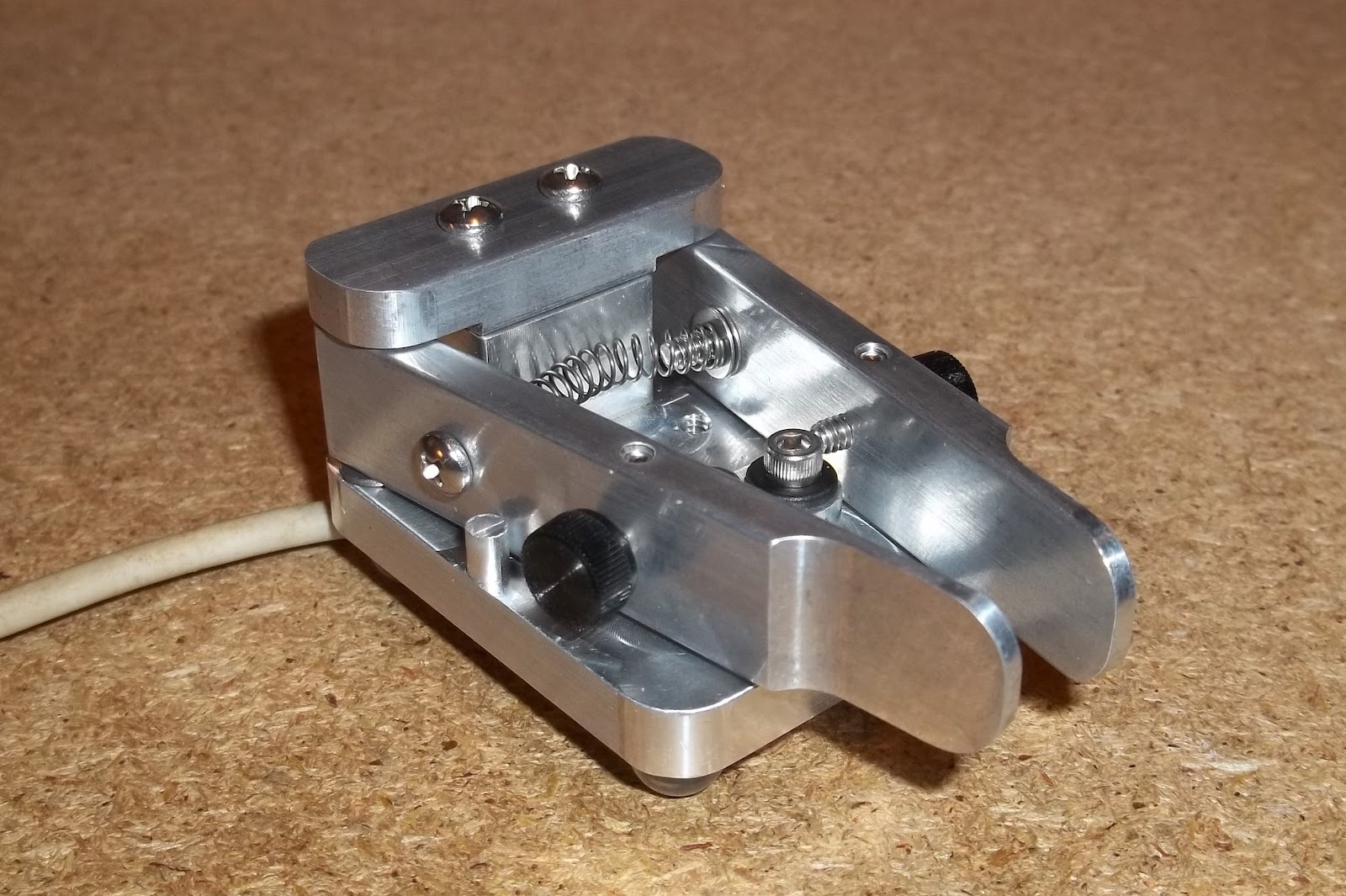
The paddles are done. The assembly was in the class of “Easy-peasy-lemon-squeezy” territory. And assembly time was all of about a 1/2 hour or so.
The instructions provided by Doug Hauff were superb and easy to follow. The hardest part, installing the compression spring was no big deal at all. Slipped one end of the spring over one of the spring retainer screws and used a tweezer to finagle the other end over the other screw. No launching into orbit or getting lost. Viola!
What I like most about these are:
1) Materials – nice grade of aluminum.
2) Weight – minscule.
3) Size – Super small; but yet not to the point where these are difficult to use. And I can be ham fisted, at times.
4) Ease of adjustment – Here’s the best part. I like my paddles to have MINIMUM arm movement. There should be no “clacking” and the closer I can get the feel to compare to a touch keyer the better. I succeeded here with the DCP. The adjustment screws have a fine enough thread pitch where this was easy to attain.
The only thing that I have to say that is negative, is that when you have the paddles attached to your radio (and it is on), you have to be careful about how you pick these up if you want to move them. Your first inclination will be to reach down (or over) and just grab the key with your hand. If you do it that way, you will most likely start inadvertently sending dits and dahs. Like I did – several times. Oops!
That minor inconvenience being noted, I would give these paddles a 5 out of 5 star rating. For their intended use, these paddles will more than fit the bill. Now all I have to do is figure out some kind of leg mounting scheme.
72 de Larry W2LJ
QRP – When you care to send the very least!

Larry Makoski, W2LJ, is a regular contributor to AmateurRadio.com and writes from New Jersey, USA. Contact him at [email protected].
Congratulations to Dustin, KC5FML!

Dustin, KC5FML from McKinney, Texas is the winner
of our TYT TH-UV3R giveaway from Import Communications!
Congratulations, Dustin!
Matt Thomas, W1MST, is the managing editor of AmateurRadio.com. Contact him at [email protected].
Have Handheld, Will Travel — Third Stop: VE3OSC!
This morning I once again brought my HT outside with me while I sipped my morning coffee. Don, VA3XFT, was my first contact. Don is a friendly, helpful fellow. The first time I met him was yesterday evening, when he heard me calling for Wade, VE3WGK — when Wade didn’t answer, Don called me and offered to call Wade on the telephone for me.  I didn’t take him up on it then, but this morning I did take him up on his offer to call and find out more about the amateur radio station at the Ontario Science Centre. When he came back on the air he said that the station is manned every day from 1000-1400 hrs. Thanks, Don!
After another contact with Steve, VA3SF (who, like Don, operated the repeater we were using), I prepared to go to the Ontario Science Centre.  My wife decided to come along, making it a grand adventure. We walked to the nearby subway terminal and soon were rumbling along. After transferring to a bus, we arrived at the Ontario Science Centre and made our way to amateur radio station VE3OSC on the fourth level.

Bill, VA3WTT, volunteering at VE3OSC
Bill, VA3WTT, was manning the station. This Scottish gentleman showed us the warmest hospitality, inviting me to come into the booth, sign the guestbook, and check in to a 2m ARES net that was in progress.

NØIP checking in to the Toronto ARES 11:00 daily 2m net
Ken, VA3KRS, was net control and gave me a warm welcome.
Bill also helped me get on 40m, where I tapped out a CQ with some Bencher paddles. For some reason the HF radio seemed deaf, so I’m not sure all was in order at the moment. But no matter! I thoroughly enjoyed seeing the station of the Ontario Science Centre Amateur Radio Club. It’s a great idea. I applaud the Ontario Science Centre for including this permanent display, and I applaud all the hams who man it every day.
Bill gave me a very nice QSL card, pictured above, and shook my hand. After saying farewell, my wife and I made our way to the OMNIMAX theater where we watched a documentary on the building of the Canadian Railroad through the Rocky Mountains. It was informative and full of amazing footage of a restored steam engine puffing through some sublimely scenic parts of Canada.
None of this would have happened had I not brought along my HT on this trip. Only because I happened to contact Wade, VE3WGK, did I learn about the station at the Ontario Science Centre. I’m glad I brought the HT, and I’m glad I met Wade and all these other fellows on the air. Maybe when I get back home I’ll even EchoLink back to Toronto and chat with them again on 2m and 70cm.
Here you can see some more photos of our trip to VE3OSC, the amateur radio station at the Ontario Science Centre.


Todd Mitchell, NØIP, is a regular contributor to AmateurRadio.com and writes from Minnesota, USA. He can be contacted at [email protected].
Deployable Aerial Communications Architecture

Today the FCC release a Notice of Inquiry (NOI) regarding Deployable Aerial Communications Architecture (DACA). In a nutshell, this technology involves deploying a light aircraft containing communications equipment over a disaster area to provide emergency communications. Those familiar with mobile wireless will recognize this as somewhat analogous to a COW (cellsite on wheels), and the military has been using similar technology for years.
A whitepaper on DACA describes the potential for this technology:
The DACA vision for disasters involves an aerial capability that is deployable within the first 12-18 hours after a catastrophic event to temporarily restore critical communications, including broadband, for a period of 72-96 hours. This capability would be useful in situations where the power grid may be inoperable for 5-7 days, depleting back-up power supplies and resulting in an almost complete failure of landline, cellular, land mobile radio, broadcast, and cable transmissions, as well as Wi-Fi and Internet services. In such circumstances, access roads and bridges may be impassable, preventing communications repair crews and fuel suppliers for generators from entering the area. If DACA systems were available, users on the ground could continue to rely on their day-to-day communications devices in a transparent manner.
While DACA technology does not involve amateur radio, nor does amateur radio have a horse in this race, amateurs may find DACA technology interesting, as the recent interest in unmanned balloon experiments with amateur radio payloads would suggest. The FCC in the NOI is seeking comment from industry on logistical, regulatory, and technological questions. I imagine it will be several years before we see DACA technology ready for prime time and probably only in major metropolitan areas.

Have Handheld, Will Travel — Second Stop: Toronto!

The view from Chinatown, Toronto.
You’ll have to imagine the siren.
One hour after finally rolling to a stop in Toronto yesterday, I felt like I had come home. Don’t get me wrong — there are all sorts of reasons I like living in the (relatively) small town of Granite Falls, MN. The congregation I pastor loves the Lord and loves one another, and the area is a beautiful part of the country. But I grew up in the big(ger) city, and I’ve come to appreciate things that for many years I took for granted (and that most of my country friends despise).
Mountain ranges of brick, concrete, steel and glass towering over concrete valleys. Endless streams of people flowing with a rush of different accents, different languages, different colors. Magical groves of old ivy-covered buildings. Flowery fields of shops, inns, and restaurants, some native grown, but even more transplanted from the four corners of the world. Toronto is all of these and more. It’s an unusually clean city, and friendly, too.
Not that it’s a perfect place. I have no doubt that there is a seamy side to Toronto like everywhere else. And let me tell you, the traffic is the worst I’ve seen anywhere. But as horrible as the traffic is, it brings out something great in this city: pedestrians, and a spectacular profusion of small shops that cater to pedestrians.

My daughter in Chinatown.
Cities like this are the last bastion of the small businessman, because the countryside is being has been taken over by big box stores. I shop at Walmart; these people shop at mom and pop stores. The industrial revolution may have begun in the big city, but it manifested itself most fully when it ravaged the countryside. The rural area I know is infinitely more industrialized than anything I’ve seen here.
Anyhow, yesterday evening after a cookout put on by the bride’s family I programmed my HT with a bunch of repeaters in the area. This morning I enjoyed my coffee outdoors, HT in hand. “NØIP portable VE3 listening,” I called. My first contact was on the VA3SF 70cm repeater with Jay, VE3EMP, a nice fellow who welcomed me to Toronto. Then I chatted at length with Wade, VE3WGK, on the 70cm VA3XPR repeater. Wade is the CANWARN coordinator here in central Ontario, and he is also a volunteer for the Ontario Science Centre where there is an operational Amateur Radio Station on display. He encouraged me to email him about visiting this station, and so I did. I’m hoping to visit the station tomorrow, but time will tell.

Here comes the bride!
Afterward we went to Chinatown, where the bride introduced us all to a delightful Chinese bakery. Even more exotic was the taro bubble tea she introduced me to a block down the street. Amazing!
Eventually the bride and her family departed, leaving my wife, daughter and I to stroll around Chinatown.

Who knew the Great White North could be so hot?!
Whew, was it hot! I bought some painted fans for the bride, for the bridesmaids and for my wife, and my wife also got a fancy hat to keep the sun off her fair red-headed skin. My daughter picked up a silk robe and a casual dress, and I bought myself a much-needed new watchband.

Strolling through Chinatown. That guy looks like he has spent too much time at the radio!
This evening, my wife and I went for another long walk. (Did I mention all the long walks I’ve been taking here in Toronto?) We had a late supper at a magnificent little Mediterranean restaurant. I haven’t had a felafel that good since I was in Israel! I was smiling so much and complimenting the fellow behind the counter so much that he gave us some baklava, refusing to let me pay him.
Ah, Toronto!
Photographs taken by my XYL. Thanks, Monica!


Todd Mitchell, NØIP, is a regular contributor to AmateurRadio.com and writes from Minnesota, USA. He can be contacted at [email protected].
Commencement
Not graduation – began working on my American Morse DCP paddles tonight, just as I thought I would.
I spent some time polishing up the aluminum. First, I gave the metal pieces a light scrubbing with one of those copper Chore Boy scrubby pads. Then I used some Noxon metal polish (that I forgot I had!) that I found on a shelf. Lastly, a going over with a polishing wheel on my Dremel.

Not a mirror finish, but a lot shinier than they were originally. All I did was remove the top layer of oxidation. I am sure that with time, the metal will get dull again, but for now, it looks pretty darn nice!
Tomorrow night I will assemble everything – shouldn’t take long at all.
72 de Larry W2LJ
QRP – When you care to send the very least!

Larry Makoski, W2LJ, is a regular contributor to AmateurRadio.com and writes from New Jersey, USA. Contact him at [email protected].
One of the uber QRP operators
If you’re really into QRP portable operations, you know, QRP from the great outdoors, then you may have heard about Steve Galchutt WG0AT.
If you haven’t ever heard of Steve, then you owe it to yourself to find out more. Steve and his two pack goats, Rooster and Peanut are a QRP portable operating team, extraordinaire. Seems like Steve and the boys are always out somewhere, inducing RF into the ionosphere to somewhere.
Besides being a superb QRP op, Steve is also a gifted videographer when it comes to his adventures. He has an entire YouTube channel devoted to them:
http://www.youtube.com/user/goathiker?feature=results_main
I have had the honor and privilege to work Steve when he’s been out and about as well as from home. Check out his YouTube videos. You will be entertained, educated and inspired all at the same time!
72 de Larry W2LJ
QRP – When you care to send the very least!
BTW – got an e-mail from Elecraft – a certain small 5 lb box will be here next Wednesday. WooHoo!

Larry Makoski, W2LJ, is a regular contributor to AmateurRadio.com and writes from New Jersey, USA. Contact him at [email protected].
 Ham Radio Deluxe |
 W5SWL Electronics |
 Ham Radio Prep |
 KB3IFH QSL Cards  Hip Ham Shirts  HamRadioAuctions HamRadioAuctions Reliance Antennas Reliance Antennas Enigma Shop Enigma Shop |  morseDX  Ni4L Antennas  R&L Electronics R&L Electronics antennas.us antennas.us QRV QRV |
- Matt W1MST, Managing Editor
