 |
 Backpacking Power
 20 May 2012 | by
 I’ve often wondered if I were to go on a long distance Appalachian Trail hike, where would I get the power to charge some lightweight batteries so I could operate a QRP rig and a cell phone each night. Of course, I’ve wondered more where I would get the vacation time or money to do such a long trip, but that’s another story. A company called BioLite is offering CampStove, a lightweight hiking stove that burns twigs and anything else you can gather and turns them into heat and electrical energy. The stove has a USB port for plugging in devices. 
BioLite manufactures a larger model called the HomeStove that is intended for third world countries and purchases of the smaller CampStove help fund providing HomeStove to needy families. The stove is more efficient at burning wood due to a built in fan which feeds more oxygen to the fire, and the stove produces less pollution than convention wood fires.
The USB port on the CampStove delivers 5 volts at a nominal 2 watts of power, with up to 4 watts power peak. That’s not a whole lot of power especially when talking about 12 volt powered QRP rigs, but it’s definitely up to the task of topping off your phone battery each meal. Undoubtedly for a long hike one would want a small solar panel to charge rig batteries. Perhaps a high efficiency 5 volt to 12 volt converter would allow charging of rig batteries with CampStove during meals or long periods of overcast, solar panel unfriendly skies.
The CampStove is $129 US and can be purchased on the website, though new orders currently aren’t shipping until July. I may get one just to try it out and have another hiking stove option and support BioLite’s efforts in poor countries.


ICQ Podcast S05 E11- Homebrew D-Star (20 May 2012)
Series Five Episode Eleven of the ICQ Podcast has been released. News Stories include :-
- New frequencies for AMSAT-UK FUNcube-1
- 2E0BTR Mountain Goat
- New regulations for the Olympic Games
- Special UK callsigns for Queen's Diamond Jubilee
- D-Star for London 2012 Olympics
- GB3LV repeater back on the air
- UK Propagation charts for May 2012
- US Emergency Services move to Digital
- Glasgow school wins 70cm CanSat launch competition
- RAYNET Isle of Man
- 60 metres 'Gazetted' in Canada
- European Football Championship 2012 on the Air
Martin M1MRB discusses Homebrew D-STAR.
Colin Butler, M6BOY, is the host of the ICQ Podcast, a weekly radio show about Amateur Radio. Contact him at [email protected].
A New Digital VHF/UHF Radio from Yaesu
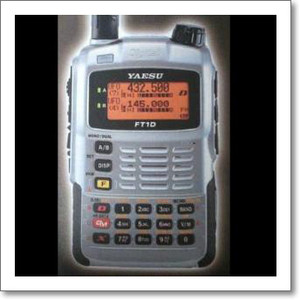 A while back, Yaesu published a white paper/brochure on VHF/UHF digital technology that slammed D-STAR for using GMSK modulation and stated that C4FM (4-Level FSK) is the way to go. See my previous posting on that topic. The paper also talked about DMR and APCO 25 as standards that use C4FM.
At this point in time Vertex Standard believes the C4FM (4-level FSK) FDMA or TDMA are the most suitable selections for Amateur radio applications. In early 2012, we will release a C4FM (4-level FSK) FDMA Handy-Talky and a Mobile transceiver into the Amateur radio market. After our initial introduction, we plan to introduce a C4FM (4-level FSK) TDMA (2 slots) or TDMA Handy and Mobile transceiver into the Amateur market.
Bob Witte, KØNR, is a regular contributor to AmateurRadio.com and writes from Colorado, USA. Contact him at [email protected].
More fun with the 28MHz mobile
This morning we headed over to the village of Coleshill, where Julie wanted to take a look at a clothes sale. Having had a look around, I left Julie to it and popped back to the car.
Being the middle of the day, I thought I would check 28MHz SSB. First I heard a ZS6 who wasn’t too loud. Although he could just hear me, my 10W to the whip wasn’t enough for a contact. ZS3Y was a bit louder but he couldn’t hear me. HZ1HN was contesting but I couldn’t get him to hear me.
I was starting to think it was a receive only day, when I heard a loud station just finishing a CQ. I called and was pleased and surprised to get a report of 5/5. Even more pleased when I discovered the station was in Israel, 4X4FR. We had a really nice QSO. Just as I signed with Rafi and we were preparing to drive off, with Julie back from the sale, Phil G7GVV from Oxford called in – so we quickly exchanged reports.
Slightly oddly, I noticed that on two channels only, there is a small difference between the Anytone’s TX and RX frequencies. And the clarifier seems to be set correctly. Odd! Happily it doesn’t seem to matter. Maybe a reset will help!
Fun contacts from the mobile!

Tim Kirby, G4VXE, is a regular contributor to AmateurRadio.com and writes from Oxfordshire, England. Contact him at [email protected].
A wonderful surprise
A couple of weeks ago I received an email to inform me that a 5lb package was on its way to me by UPS from Elecraft. As I had not ordered a KX3 or indeed anything else from Elecraft recently I wondered if I was the winner of a competition I had forgotten about or whether it was just my lucky day. I accepted the explanation from Elecraft Sales that it was just finger trouble at their end – those drop-down auto-complete lists can sometimes be a bit too helpful – and thought no more about it.
This morning the postman knocked on the door and handed over a package that looked as if it weighed about 5 pounds…
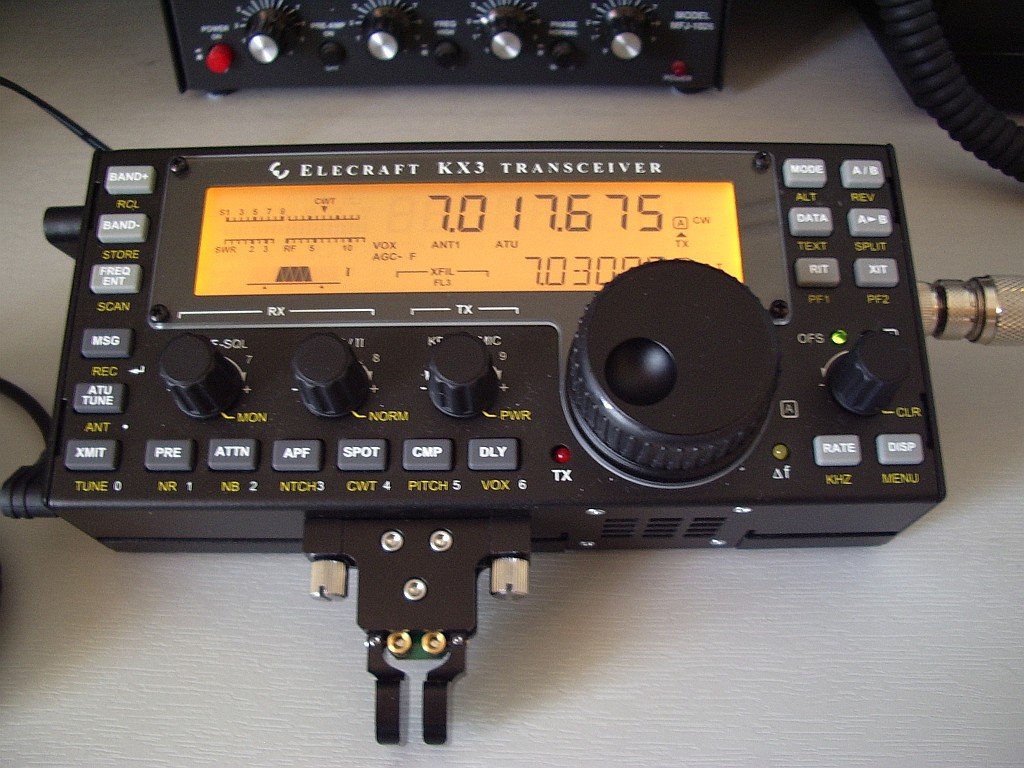 |
| KX3 S/N 110 |
Actually it was not a complete surprise as by then I had been let into the secret. A fellow Elecraft reflector subscriber, blog follower and someone with whom I have often corresponded about Elecraft and other matters (who wishes to remain anonymous) suggested to Elecraft that, in his words, “in appreciation for all of your constructive criticisms and suggestions over the years of how to improve Elecraft (and other) ham radio products that a fully accessorized KX-3 arriving on your doorstep would be a pleasant surprise.” It was, you better believe it!
Wayne and Eric were in on the conspiracy, as was a friend of my benefactor who was passing through the UK on his way home from the US and carried the radio across the Atlantic in his hand luggage before consigning it to the Royal Mail for the final leg of its journey.
I can hardly find the words to describe how delighted I am at this wonderful surprise. As I have written before, I didn’t want to even think about ordering a KX3 until orders were being fulfilled off-the-shelf because my health situation makes it impossible to plan very far ahead. My wish is to “beat the bugger” and survive as long as possible, but having a brain tumour is like having a time-bomb in your head with no idea what the fuse is set to.
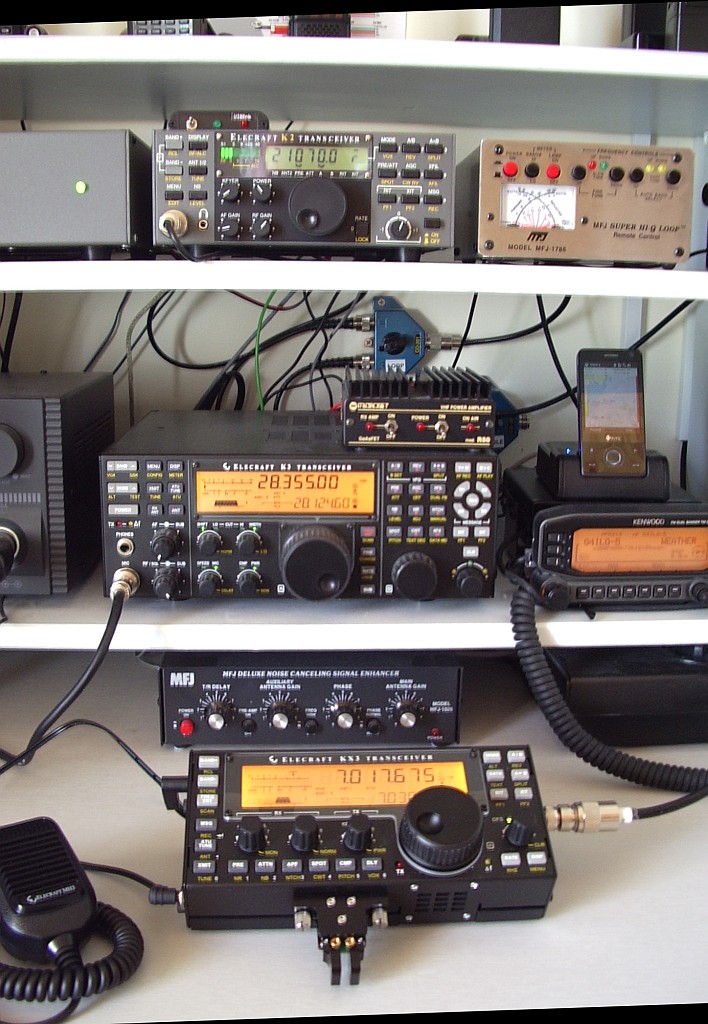 |
| A trio of Elecrafts |
For the time being, Elecraft KX3 serial number 110 joins its two older siblings: K3 s/n 222 and K2 s/n 392 in my shack. But it will be a constant reminder and incentive to get fit and well enough for some QRPTTF operation. Thanks to everyone involved in sending me this wonderful little radio.

Julian Moss, G4ILO, is a regular contributor to AmateurRadio.com and writes from Cumbria, England. Contact him at [email protected].
Hamvention from afar…

I was unable to make it out to Dayton but am enjoying seeing the onsite action through various mediums:
(1) w5kub.com – live streaming. It has been a bit hit and miss on the quality and coverage, but the feed is quite popular and it is a lot of fun seeing all the hams walking around the outdoor market. Lots of hams in front of the live feed cam seem to stand there, stare at the camera, and call home (or a buddy) to have them get on the website to see them on the live feed. At certain times the live feed appears to be an actual video version of hamsexy.com. The best part about amateur radio is the people and it is always great to see what an amazing variety of folks who share a common interest.
(2) Jeff, KE9V, is on the grounds of the Hara Arena and is frequently Tweeting and posting pictures. Jeff had an interesting picture of a vendor called Horse Fence Antennas. The product appears to be a dipole antenna that is built into what we in the Army call a cargo strap. The antenna looks a bit bizzare, but the eHam reviews are 5.0.
(3) D-STARS! I have not hooked up my DVAP and IC-92AD since I returned for Korea, but did so yesterday so I could monitor REF038C. Lots of great hamvention chatter on the reflector.
(4) I am going to look for any HF stations operating from the Hamvention. Often W1AW will setup up a special event station – those are always fun to work.
Hopefully I will be able to go next year…. 2013, Dayton or bust!
Scott Hedberg, NØZB, is a regular contributor to AmateurRadio.com and writes from Kansas, USA. Contact him at [email protected].
Thoughts on Digital
I have opined in the past (although perhaps not on the blog directly) that CW is the reason I am still an active ham after almost 19 years…actually, I think a week from today marks the 19-year anniversary of passing elements 2 and 3A in the basement of the Stark County Sheriff’s office. CW permitted me to make interesting, intriguing, compelling QSOs that I simply could not complete on SSB with my meager station as a beginner.
Over the years, I have used this as the argument for retaining the Morse code testing requirement: Morse code proficiency gave newcomers the opportunity to make exciting DX contacts under all solar conditions (except disturbed, of course) and hook them on the hobby.
PSK31 was the first mode that challenged CW in that arena. I made a couple of PSK contacts almost 10 years ago now and decided it was harder than CW. So, I did not pursue it. Aside from making a half-hearted effort to get ARRL’s Triple Play Worked All States using only unassisted (no cluster, no RBN, no skeds) contest contacts, I haven’t really operated digital modes much and didn’t really understand why anyone would want to because CW is so much easier. I’ve seen dozens of JT65 posts by fellow AmateurRadio.com bloggers. And, about a year ago, I met Paul, N8HM, who lives in an apartment in DC. He’s very active on HF digital modes with a shoestring setup…and he’s very passionate about it. That’s when it clicked.
Digital modes are the new CW: the DX mode for the average ham. I must be slow!
I still think CW is way easier than digital QSOs, especially in contests and pileups: there is a certain amount of critical humanity (varying timing, sending speed, spacing, or calling frequency) that you can’t apply to cracking a digital pileup…or maybe I just haven’t figured it out yet. I guess I have years of Morse practice and shouldn’t expect digital to be easy just because the computer is doing the sending and decoding. But, I think I understand digital operators a little better after this revelation.
You guys are alright.
Ethan Miller, K8GU, is a regular contributor to AmateurRadio.com and writes from Maryland, USA. Contact him at [email protected].
 Ham Radio Deluxe |
 W5SWL Electronics |
 Ham Radio Prep |
 KB3IFH QSL Cards  Hip Ham Shirts  HamRadioAuctions HamRadioAuctions Reliance Antennas Reliance Antennas Enigma Shop Enigma Shop |  morseDX  Ni4L Antennas  R&L Electronics R&L Electronics antennas.us antennas.us QRV QRV |
- Matt W1MST, Managing Editor
