 |
 A Ham’s Birthday
 31 May 2012 | by
 Yesterday it was my birthday
I hung one more year on the line
I should be depressed
My life’s a mess
But I’m having a good time.Paul Simon – Have a Good Time
It’s become a tradition that I play this song on May 31st. I did so every year, since I discovered the great Paul Simon. Just a reflection on my own life and every year the song seems to describe exactly how my life is going: it’s a mess, but I’m having a good time.
I make my own good time and so I was good to myself this year. I ordered an Argents Data Systems APRS kit, because I’ve been longing to do something with APRS for a long time now. I’ve already had some success with Xastir and SoundModem decoding APRS signals on my laptop, so I’m good to go now.
My wife was good to me, too, because she brought a Baofeng UV-5R back from China. Even cheaper than the export model, with a cute Chinese lady inside and a lousy Chinese manual. In China they use simplified characters, but also the use and translation of foreign phrases and words is different than in Taiwan. So over here in Taiwan we translate “menu” as 功能表 or “Function List”. Makes sense, right? In China they translate it literally: 菜單 or “Dish/Vegetable List”, like in the different dishes listed on the menu of a restaurant.
Enough has already been written on the Baofeng UV-5R. I can only add the following: “What an ugly looking thing!” The designer should be subjected to some serious Chinese torture. Not that we Westerners don’t mess up every now and then. When having the HT in my hand I constantly had to think of this beauty made by the French truck maker Renault. Maybe theses things are for “manly men” and I’m not man enough to appreciate this kind of design.
Anyway, I am also going to make my foray into the SDR world, because my lovely wife also brought back an DVB-T USB Television stick with a RealTek RTL2832U inside. There has been a lot of talk about these sticks lately and for only US$11 is it worth a try. I’ll keep you posted, but for now I only tried the TV reception (great) and DAB radio stations (non what-so-ever in Taiwan! It seems FM radio is here to stay for a long time).
Together with the other projects that are under way I will have a busy summer holiday.
Hans "Fong" van den Boogert, BX2ABT, is a regular contributor to AmateurRadio.com and writes from Taiwan. Contact him at [email protected].
LHS Episode #083: Smokey & The First Lady
 Welcome to the 83rdest episode of Linux in the Ham Shack. Freshly back from the Dayton Hamvention, Russ jumps in by telling everyone his experience at the show this year. The short version: It was great! From there, things move on to a question of FCC rules, at least in the mind of one ham.
One of the topics that kept repeating at Hamvention was: What is a good contest logger for Linux? Up until recently, it was hard to think of one. The ncurses-based application yfktest is out there, but thanks to IZ3NVR, our hosts discuss a new option. Tune in to find out what. There’s also some feedback, occasional rambling and hardcore lunacy. Everything you’ve come to expect from an episode of LHS.
73 de The LHS Guys
Russ Woodman, K5TUX, co-hosts the Linux in the Ham Shack podcast which is available for download in both MP3 and OGG audio format. Contact him at [email protected].
Rats!
I did a complete inventory of my KX3 hardware and am sad to report that I am missing some screws and lock washers.
I sent off an e-mail to Elecraft letting them know what was missing. Normally, I wouldn’t even bother, I’d just go off to Home Depot or Lowes to pick up equivalents, but these screws are black. That means they are going to show from the outside, and I don’t think either store will have black hardware.
I might have to stop off at Greenbrook Electronics on the way home from work tomorrow, in the off chance they might carry black hardware.
I know what you might be thinking, but no …….. I made sure to do the inventory in a box top, so that nothing could roll off the table and on to the floor – or worse.
To their credit, Elecraft sends a small bag of “spare” hardware. Unfortunately, nothing that I need is in there. I will try to start the build tomorrow night, but I think right from the get go, I am going to need some of these missing screws.
Heavy sigh.
Hmmmmm ….. the good news is that I may only be one screw short. In a burst of inspiration, I went down to the basement to the parts drawer where I kept screws that were left over from my K1 and K2 builds. I think I can make do until the missing parts arrive. Moral of the story? Don’t throw stuff like that out! But don’t become a hoarder, either – yes, I know it’s a fine line!
72 de Larry W2LJ
QRP – When you care to send the very least.

Larry Makoski, W2LJ, is a regular contributor to AmateurRadio.com and writes from New Jersey, USA. Contact him at [email protected].
QSL cards for TI7/K2DBK
When I returned from my operation as TI7/K2DBK in Costa Rica last summer, I didn’t receive any QSL cards immediately. I wasn’t very surprised by that, as I hadn’t worked all that many stations, Costa Rica isn’t a particularly rare entity, and I assumed that for the stations outside the US (where it’s a little less common), they’d be QSLing via the bureau or Logbook of The World. Since I had no cards that I needed to respond to, I focused my efforts on getting my operation approved for DXCC credit and getting a certificate so that I could upload the contacts to the Logbook of The World. As I wrote (here and here), that turned out to be an interesting challenge, but I was able to get that approval.
I didn’t really think about QSL cards after that until a few months ago, when I started receiving QSL requests via the ARRL DX bureau service. As I’ve written in the past, the bureau is a way to exchange QSL cards which, while inexpensive, can be quite slow, so lag of 6 or 8 months between the operation and the time to receive a card via the bureau isn’t terribly unusual. (Sometimes it can be much, much longer. I’m still receiving QSL cards via the bureau for my operation from Grand Cayman in 2007, and others for operations from home back to 2001. The bureau service itself isn’t quite that slow, but often folks like myself will discover after a few years that a particular card is needed.) When I first received those bureau cards, I realized that I had to create a QSL card but it wasn’t a high priority, as I wasn’t planning to send cards out via the bureau for at least a few months.
Things changed about a week ago when I received the first of several directly mailed QSL requests. Although it’s common to send a QSL card relatively soon after a contact, particularly if it’s sent “direct” (meaning mailed directly to the station, not via the bureau), sometimes stations will not realize until much later that they “need” the confirmation, or, as I’ve done, sometimes they simply forget at the time of the contact. Regardless of the delay, I have always made it a point to respond to direct QSL cards as soon as possible (normally I’ll send out a return card the day after I receive one). Unfortunately, I couldn’t do that because I still had the creation of the QSL card for my TI7/K2DBK on the “to do” list. The receipt of the handful of direct requests (all of which were from non-US stations) was the kick that I needed to get going designing my card.

I’ve always designed and printed my “special” cards myself, because the number of cards that I typically need is usually so small that it’s not worth it to have them professionally printed. There are a number of tools that can be used for the actual design, but for me, the hardest part is always coming up with an attractive layout. However, I’ve come up with sort of a standard that I’ve used on multiple cards, and I try to follow that now for each new one I create. I’ve followed that “standard” for the latest card, which is to use a background image shot with one or sometimes two “inserts”, along with a QSO information block. I’ve always used my own photos, not a “stock” photo, as I think it makes the card more personal. I usually include a picture of myself on the cards because I think that makes it even more personal.
When I first started printing the cards, I though that I’d use a gloss “postcard” printer stock (like this from Staples), separate the postcards (they are set up for 4 on a page that have perforations to make separation easy) and just mail them. However, I realized that the size of each card was bigger than the standard QSL card size and I had trouble fitting them in some envelopes. As a result, I wind up using a paper cutter to trim the cards down to about 5.3″ x 3.5″. Most likely the next time I buy paper stock for my printer I’ll just use plain “everyday” inkjet photo paper since it should be a bit less expensive.
With a card designed, I printed off enough copies on my inkjet printer to respond to the direct requests, and I’ll be working on responding to the bureau cards next. I think that this particular design worked out really well, and the color of the sand on the beach is light enough so that I can just use a regular pen to fill in the QSO information in the information box and it’s quite readable.
First 6m Sporadic-E
On Sunday afternoon, while the WPX contest was still on, DX Sherlock sent me an email to say that there was a possibility of Sporadic-E propagation on 4m from my location. Getting equipped for 4m is something I’m going to have to leave for another year – right now I’m not steady enough on my feet to go clambering about in the attic making additions to my antenna farm. But I do have a 6m antenna, though it’s only a dipole. The KX3 was plugged into it, so I had a tune around 6m, heard a few stations and managed to work OK2OV with 59 reports both ways. Not bad for 10W to an attic dipole.
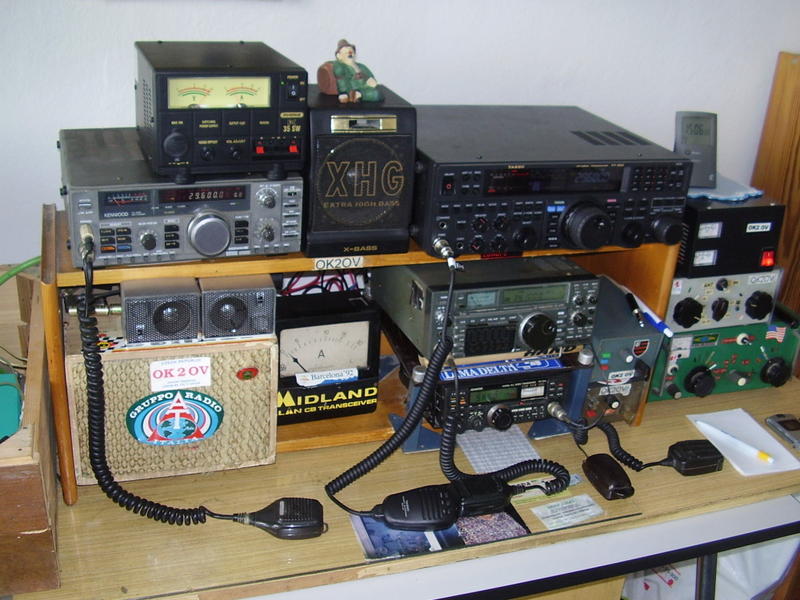 |
| Station of OK2OV, Czech Republic (from qrz.com) |
I was quite tired after my session in the CQ WW WPX contest so I called it a day. The following morning DX Sherlock sent another email alert to say there was possible Sporadic-E on 6m. I quickly switched the KX3 on and sure enough, there was a big Sporadic-E opening in progress. I made 18 contacts in all into France, Spain, Italy and Slovenia and heard OK2OV for a second time. Some of the signals were absolutely enormous and I received 59+ signal reports. This was with 10W of SSB to a dipole, remember.
Hopefully there will be more Sporadic-E fun before the end of summer.

Julian Moss, G4ILO, is a regular contributor to AmateurRadio.com and writes from Cumbria, England. Contact him at [email protected].
CQ WW WPX CW 2012
Last weekend was the weekend of the CW version of the CQ WW WPX contest. I am not a serious competitor as it isn’t really practical with attic antennas but I like to come on for the big contests to give away a few points and see what I can work. (Perhaps they should create a special category for stations with indoor antennas. 🙂 )

I only managed about an hour on Saturday and a couple of hours on Sunday as I easily get tired out. But I thought it would be an opportunity to put the KX3 through its paces. Although I don’t plan on sending in any more than a check log, when operating QRP I like to adhere to QRP power levels, so I limited the KX3’s output to 5 watts.
Other bloggers have written that conditions were good for the contest, but I thought they were poorer than in previous years. True, there was some activity on 10m this year. But on 20m it seemed I spent more time searching and less time pouncing than on previous occasions. And I didn’t hear any US stations at all. Perhaps I was just operating at the wrong time.
The KX3 performed superbly hooked up to KComm, my simple logging program for Elecraft transceivers. I logged 30 QSOs with 29 prefixes and 13 countries: Bulgaria, Croatia, Czech Republic, France, Germany, Italy, Latvia, Lithuania, Poland, Serbia, Slovakia, Slovenia and Ukraine. My short term memory is abominable – I forget a serial number the moment I stop to send my serial number to the other station, so I really appreciated KComm’s ability to read the text output by the KX3’s built-in Morse decoder and print it up on the screen.
So that was the CQ WW WPX CW 2012 for me. Hopefully next year I’ll be able to make a more respectable show.

Julian Moss, G4ILO, is a regular contributor to AmateurRadio.com and writes from Cumbria, England. Contact him at [email protected].
W&S to sell Elecraft
UK ham radio dealer Waters and Stanton plc has announced that they will be exclusive resellers of Elecraft products in the UK. This will be a great benefit to those who like to try before they buy or are just nervous about buying from abroad via the internet.
I have been buying direct from Elecraft for 12 years and have never had a problem apart from the high cost of shipping and the courier’s tax collection fee, both of which make buying some of the smaller Elecraft kits and modules rather expensive. But then, I have been lucky so far never to have had a faulty radio that had to be shipped back to California. Touch wood.
Elecraft has said that UK hams will still be able to buy direct if they want to.

Julian Moss, G4ILO, is a regular contributor to AmateurRadio.com and writes from Cumbria, England. Contact him at [email protected].
 Ham Radio Deluxe |
 W5SWL Electronics |
 Ham Radio Prep |
 KB3IFH QSL Cards  Hip Ham Shirts  HamRadioAuctions HamRadioAuctions Reliance Antennas Reliance Antennas Enigma Shop Enigma Shop |  morseDX  Ni4L Antennas  R&L Electronics R&L Electronics antennas.us antennas.us QRV QRV |
- Matt W1MST, Managing Editor
