 |
 And the heat goes on ……
 30 June 2012 | by
 but definitely not quite as bad as yesterday. The high for today was only around 94F – about 5 degrees cooler than yesterday.
Looks like we might get some thunderstorms tonight – I’ve got some chicken, potatoes and corn-on-th-cob on the grill. Hope it waits until AFTER dinner is cooked!
Tonight’s plan is to start working on the K3. I’m really torn between using the KX3 and having some operating fun and the build of the new radio. Another determining factor is that I am beginning to pack away the KX3 in preparation for vacation soon. I need to finalize the logistics of my new Lowepro “portable ops” pack. I’ll try and shoot some photos or perhaps a video once I get the final configuration down.
Radio, key, battery and accessories aren’t the problem. The problem is figuring out which antennas to bring along. This year the Buddistick and the magmount will ride along in the Jeep. But for hiking purposes, I think I will end up taking only the EFHW wires that I have pre-cut. They take the least amount of space and are quick to set up – AND, they are proven, I have gotten decent results with them before, including some European DX last year.
72 de Larry W2LJ
QRP – When you care to send the very least!

Larry Makoski, W2LJ, is a regular contributor to AmateurRadio.com and writes from New Jersey, USA. Contact him at [email protected].
Jumping Heliophysics Batman……..
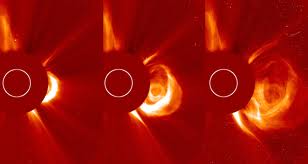 |
| M class solar flare letting go |
Bz was way in the negative which is not good. The rise in solar wind and K index numbers pointed to a solar flare. The sun sure has been very busy on June 28th M2.4 class flare, June 29th M2.2 flare and now today two flares M1.0 and M1.6 class.
So in a nut shell things are very busy in space in such a way that radio is affected here on earth!! I have been using a less power as possible mind set here at VE3WDM to see how many miles per watt I can get. It seems I may have to chance the game up a little....see how many contacts I can make compared to the size of solar storm that is affecting us.
In closing let me know how this conditions are affecting you in your ham location. Oh and a side note to all those who live in the high latitude parts of the world.....enjoy the Auroras this evening.

Mike Weir, VE9KK, is a regular contributor to AmateurRadio.com and writes from New Brunswick, Canada. Contact him at [email protected].
Wouxun Dual-Band Mobile Update

Just received this from Ed at Import Communications:
fyi… KG-UV920R
Wouxun has released a limited number of the mobile radio to dealers. These samples are not FCC Certified yet and do not have the required 2.5 kHz tuning step required for 2013 regulations. SO THE RADIO DOES EXIST.
If no major problems are found when testing these samples, hopefully full production will begin in July.
The costs of these samples are higher than I expected but hopefully the costs will come down when the radio goes into full production.
If you have your name on the reserve list at www.wouxun.us, you will be notified by email when the radio is available to order.
Matt Thomas, W1MST, is the managing editor of AmateurRadio.com. Contact him at [email protected].
I Posted This Using 40 Meters!
Wow! Would you believe I’m posting this by email using WINMORE and Winlink 2000? That’s right, the words you’re reading were transmitted over HF.
My laptop is hooked up to my Kenwood TS-440S with a DigiMaster Pro+, and as soon as I finish this email I’m going to send it over 40 meters. RMS Express will send it off to a Radio Mail Server (RMS) station, which will then send it over the Internet.
For all you CW lovers, I’m still with you. This technology doesn’t hold a candle to the feel of a key in my hand! But it is tremendously valuable for ARES work, no doubt about it. If you lose cell phone, long distance service and Internet in your area during a disaster (as happened just a few days ago up on the North Shore of Lake Superior during the catastrophic flooding in Duluth), this is the only way to get an email out — and email is perhaps the single best way to convey detailed information to the outside in a situation like that. The software is free, and it’s easy to use. What a great way to cover that “extra mile!”
That’s all I have time for right now because I have a bunch of things waiting for me that are more important than ham radio. But I wanted to take a few minutes to give this a whirl since I just got my WL2K account last night before hitting the sack. Have you used Winlink 2000 to some good purpose, perhaps in an emergency? If so, please share your story.


Todd Mitchell, NØIP, is a regular contributor to AmateurRadio.com and writes from Minnesota, USA. He can be contacted at [email protected].
Baofeng in space!
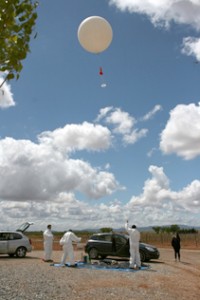
If you like APRS and cheap Chinese radios you might be interested in this Spanish balloon project which will launch tomorrow (Sunday) from Madrid. The helium balloon will carry aloft two Baofeng UV-3R transceivers connected as a transponder with a 435.450MHz downlink and a 145.840MHz uplink, an APRS module on 144.800MHz beaconing the SSID EA1RCS-11, three cameras, a radio ionosonde and a parachute. The team anticipates that the balloon could go as high as 30km, making operation or reception possible over a large area of Spain and neighbouring countries.
For more information see the project website http://cienciactiva.com/.

Julian Moss, G4ILO, is a regular contributor to AmateurRadio.com and writes from Cumbria, England. Contact him at [email protected].
Hot, hot, hot!
Years ago, that was the title of a song by Buster Poindexter. That title is very apropos for this coming weekend. Just to give you a little of our flavor – here it is 10:20 PM and it’s still 82F (28C) outside. When I got to my car to come home from work, the Jeep’s thermometer read 101F (38C). I thought to myself, “Yeah, that’s because the car was sitting in the sun, it will cool down as I move and I’ll get the real reading in a few minutes”. Ten minutes later, the temperature did indeed drop, all the way down to 100F. One degree!
This weekend is going to be brutal as this is supposed to last right through Monday. It’s a good thing we had the air conditioning fixed last week. At least we’ll be able to sleep in relative comfort. No matter how bad it gets, though, in my mind this is better than 6 inches of snow and 22F outside. I’ll deal with this any day of the week!
Two cool (pardon the pun) events took place tonight. First, yours truly, one of the most inept people on the face of the Earth when it comes to figuring out COM ports and such stuff, managed to download the KX3 utility from Elecraft. Not only that; but I got it to work! I downloaded from the Elecraft server and then uploaded into my KX3, the latest version of firmware. And I discovered that using the KX3 utility, that you can enter a start up banner. So now, when I turn the rig on, where the secondary VFO display normally is, you see “W2LJ’s KX3” for a few seconds before that changes over to the normal VFO display.
Second cool event:
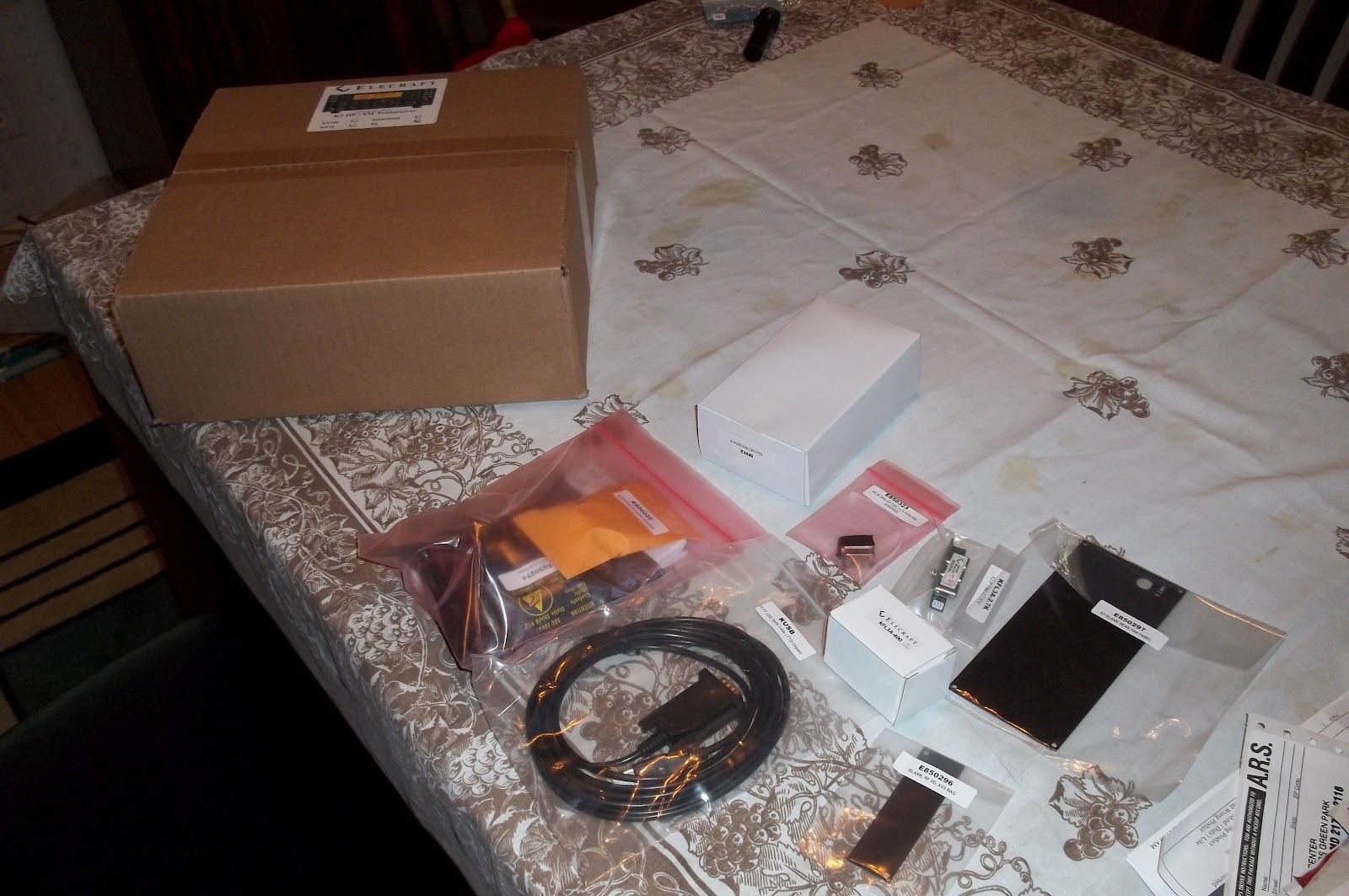
I completed the K3 inventory. Everything was there! Well, just about everything – I am missing three #6 split ring washers. But I can pick those up (or an equivalent) at a local hardware store. None of the screws were missing. In fact, there was OVER the amount needed and that does NOT include the extras that can be found in the Elecraft spare hardware bag. The picture above does not do the situation any justice. When I opened up that big cardboard box, it was jam packed with bags, envelopes, static bags and other things. By the time I was done, the entire table was covered with Elecraft goodies – you couldn’t even see the table cloth.
I am hoping to start the build tomorrow night after all Saturday’s chores are done. I am also hoping for a chance to run over to the park on Sunday with the KX3 a battery and some wire, If I get the opportunity, I will post myself on QRPSPOTS and maybe we’ll run into each other on the air!
By the way, we’re up to 75 Skeeter numbers given out for the NJQRP Skeeter Hunt to be held on Sunday, August 12th, I’ll be handing out numbers right up to the day before; but don’t be part of the last minute rush! Get yours today by sending an email to [email protected]
And no, to answer all of you out there who are concerned about FOBB – I have not heard anything new. I have no inside information; and in fact, there may be more of you out there who have better info than I do!
72 de Larry W2J
QRP – When you care to send the very least!

Larry Makoski, W2LJ, is a regular contributor to AmateurRadio.com and writes from New Jersey, USA. Contact him at [email protected].
Arduinos in Space and On The Air
Recently the Arduino has been making its way into the skies. ArduSat is a project to build and launch an Arduino-powered satellite into space. Here’s a video describing the project:
 A little closer to Earth, Michael Doornbos, N4LNX and founder of Evadot, is working on an Arduino-based board for using in balloon payloads. The unit is called FireFly and features wireless capabilities, a data acquisition and storage subsystem, and is solar power ready. It’s intended to pack a lot of functionality in one easy-to-use unit and save time and effort for those building payload computers for high altitude balloon experiments.
Here’s a short video showing reception of data bursts from a FireFly on a Yaesu FT-857:
This project is really timely considering the recent increase in interest in balloon experiments in amateur radio.

 Ham Radio Deluxe |
 W5SWL Electronics |
 Ham Radio Prep |
 KB3IFH QSL Cards  Hip Ham Shirts  HamRadioAuctions HamRadioAuctions Reliance Antennas Reliance Antennas Enigma Shop Enigma Shop |  morseDX  Ni4L Antennas  R&L Electronics R&L Electronics antennas.us antennas.us QRV QRV |
- Matt W1MST, Managing Editor
