 |
 Ask The Audience: Mobile Antenna Mount?
 10 July 2012 | by
A longtime reader, Chris K9ROC (Blog | Twitter), wrote me looking for some advice. Please take a moment to leave your great ideas, friendly suggestions, or dire warnings in the post comments. I know Chris will appreciate them!
2M/ 440 antenna mounts for a 2009 Dodge Grand Caravan? …
For many months I had a 1/4 wave 2m mag-mount antenna on the roof of the minivan and it worked very well with respect to both transmitting and receiving.
But I took it off for a couple reasons. First, a whip on the roof of the minivan hit everything in the parking garage at work. Second, the coax went through the rear of the van, the large door. Every time my wife opened the rear door it was grinding at the coax. And of course the mag-mount itself wasn’t great for the roof. 😉
I’ve been told to install an NMO mount on the roof with a hole (I have a great elmer experienced with this). But when I mentioned the idea to my wife I realized that discussion was a non-starter. 😉
Soooo … what other options do I have? Through-the-glass on a side window? I’ve read that that’s not a good idea with modern auto glass.
What about something that would clip-on to the front fender? At the last couple RARA events I saw a lot of cars that appeared to have some kind of fender mount.
Or should I really let myself get talked into the NMO?
Thanks very much in advance,
Chris K9ROC
Matt Thomas, W1MST, is the managing editor of AmateurRadio.com. Contact him at [email protected].
Just like fishing
This QRP thing is just like fishing. Yesterday, it was like I had magic bait. Every time I cast my call out upon the waters, I had a hit. Every time I called a station, I had a hit.
Today was the antithesis of yesterday. No one answered my CQs and also wasn’t able to raise anyone that I called. Reverse Beacon Network said I was getting out just fine …. no strikes, though. The difference between yesterday on today? Nothing except that yesterday was Sunday and today is Monday.
As much as we would like it to be, this Amateur Radio thing is not an exact science. I think tomorrow I will head out somewhere nature like and will try the EFHW. I had good luck with that “fishing pole” last year.
72 de Larry W2LJ
QRP – When you care to send the very least!

Larry Makoski, W2LJ, is a regular contributor to AmateurRadio.com and writes from New Jersey, USA. Contact him at [email protected].
KX3 – SOTA Style
Posted by Todd., W7TAO on the KX3 e-mail reflector. Todd, like Steve WG0AT is also quite the portable ops devotee. He also has pack goats that he brings along on his adventures; but not this time.
The sheer beauty of this SOTA site is magnificent. I think you will agree
72 de Larry W2LJ
QRP – When you care to send the very least!

Larry Makoski, W2LJ, is a regular contributor to AmateurRadio.com and writes from New Jersey, USA. Contact him at [email protected].
Tripod for a WalkHam
Having got an AlexLoop WalkHam antenna I needed some way of holding it up whilst it was in use. After considering ideas like a guyed mast made from plastic pipe I decided the best solution would be a photographic tripod, if only I could devise a way of mounting the antenna on it.
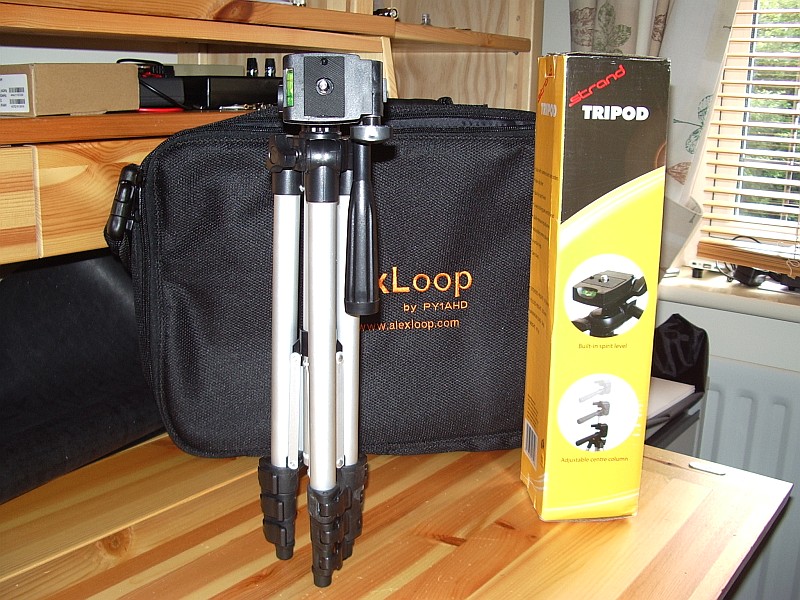
After scouring eBay for a suitable tripod I came across this one from British firm Strand Europe. Unfortunately this won’t be much help if you’re not in Britain as the seller will only post to the United Kingdom.
The tripod is short enough when collapsed to fit inside the WalkHam carrying case – the stumbling block for most of the ones I looked at which were just a bit too long. What’s more, the panning handle can be secured in the vertical position and fits inside the WalkHam’s mounting pole like it was made for it! So no modifications are needed and you can still use the tripod for photography if you want.
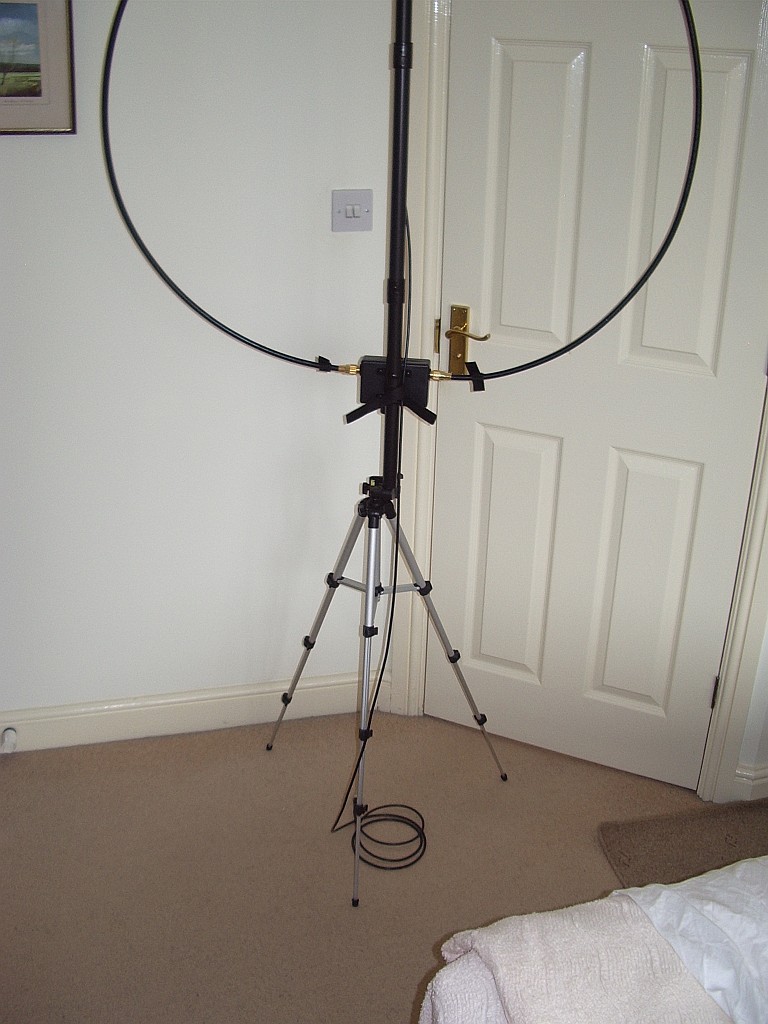
The same day that the tripod arrived I received an email from Alex giving details of his own tripod recommendation. He wrote:
“The perfect tripod is the VIVITAR VIV-VPT-1250. It is a 50” unit and the lightest and most inexpensive VIVITAR unit that can be found for less than U$ 10.00. The secret is take off the camera head with a Phillips screwdriver and leave the aluminum tube on the top. It must be marked with a pencil at 4 inches (12 cms): that is the maximum extension that can be used to introduce something to avoid any pressure on the antenna elements. Without the camera head the tripod can be collapsed and carried inside the antenna bag.”
I couldn’t find the Vivitar for as little as $10 in the UK so I’m content with my purchase. My only reservation is that the tripod is much lighter than the antenna (a good point for the person carrying it of course) and might be inclined to blow over if used in much of a breeze. I’ll find out when I manage to try it! I can’t say whether Alex’s recommended model would be any better in that respect.

Julian Moss, G4ILO, is a regular contributor to AmateurRadio.com and writes from Cumbria, England. Contact him at [email protected].
The $20 Software Defined Radio
Despite my interest in boat-anchors I do find myself peeking ‘over the wall’ from time to time and taking a look at new and emerging technologies. After several demonstrations from friends I had become convinced of the incredible potential of software defined radios and even found thinking about owning one … one day.

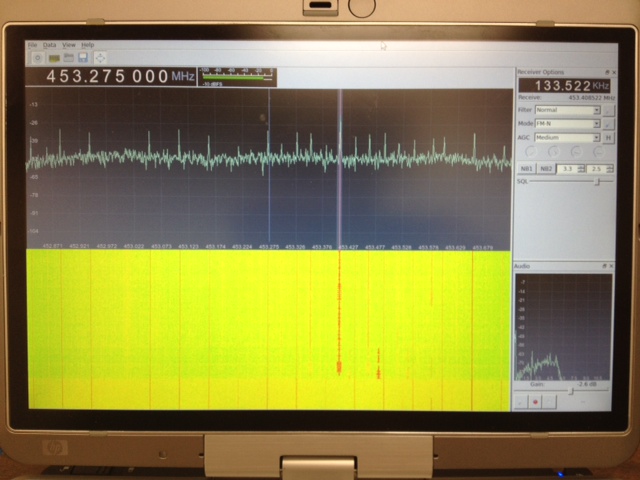
Software (Linux) : After poor results with the software running on MS Windows I moved across to Linux and got it working well there. I can’t point you to a single howto for this because I used several different guides and tried a few things before it started working. The most helpful, and probably all you really need, are the build-gnuradio script which gets hardware support and gnu-radio running and the “Getting Started With RTL-SDR” page by Tom Nardi which covers installing Gqrx. All the software used is in development and requires familiarity with the command line to install and use at the moment.
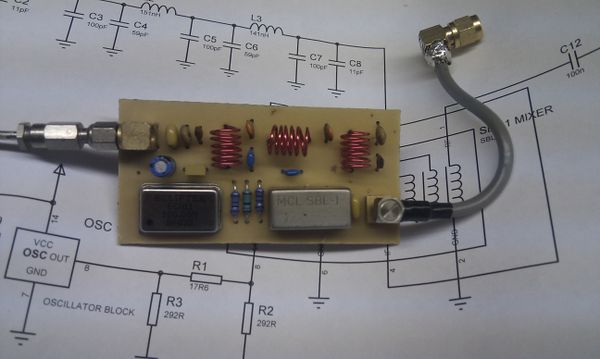
Update : Thanks to a link from Neil W2NDG to an EBay sale I’ve been able to track down a pre-assembled HF up-converter on this page : New HF Converter Kit for the SDR Fun Cube Dongle The price seems to be 45 euros, or about $55 US.
Owen Morgan, KF5CZO, is a regular contributor to AmateurRadio.com and writes from Texas, USA. Contact him at [email protected].
Now THAT was fun!
I participated in the QRP-ARCI Summer Homebrew Sprint for only a very little this afternoon. But thankfully, quality is not defined by quantity, so the QSOs, while few in number were great in fun.
I began by operating on 20 Meters. The Buddistick was set up with two 11 inch arms, the coil and the super long whip atop the Jeep on the magmount. With my coil tapped in the normal 20 Meter spot that I am accustomed to, the Autek analyser displayed an SWR of 1.4:1. I hit the ATU button anyway, for a very short “Brrrrp” and got a 1:1 match.

While on 20 Meters, as I was calling “CQ QRP” for a bit, and much to my surprise I was answered by Fred G4HOM out of Birmingham, England. He was much louder than the stateside stations that I was working; so I immediately thought “tower and beam”. Nope! Fred was using his K2 at 10 Watts to a simple wire – propagation, being what it was, favored a QSO between Lake George and Birmingham. Signal reports were good both ways.
Shortly thereafter, I switched to 40 Meters by undoing the tap from the coil to take advantage of the entire Buddistick coil, and I added two more 11 inch arms. After a bit of a scare that I won’t go into here (due to my own stupidity), the KX3 had matched the Buddistick to 1.4:1 on 40 Meters. I had several QSOs down around 7.030 MHz, including one with my very good friend Bob, W3BBO. This was our first QSO while I have been at Lake George. He had a good 579 signal and gave me a good report as well.
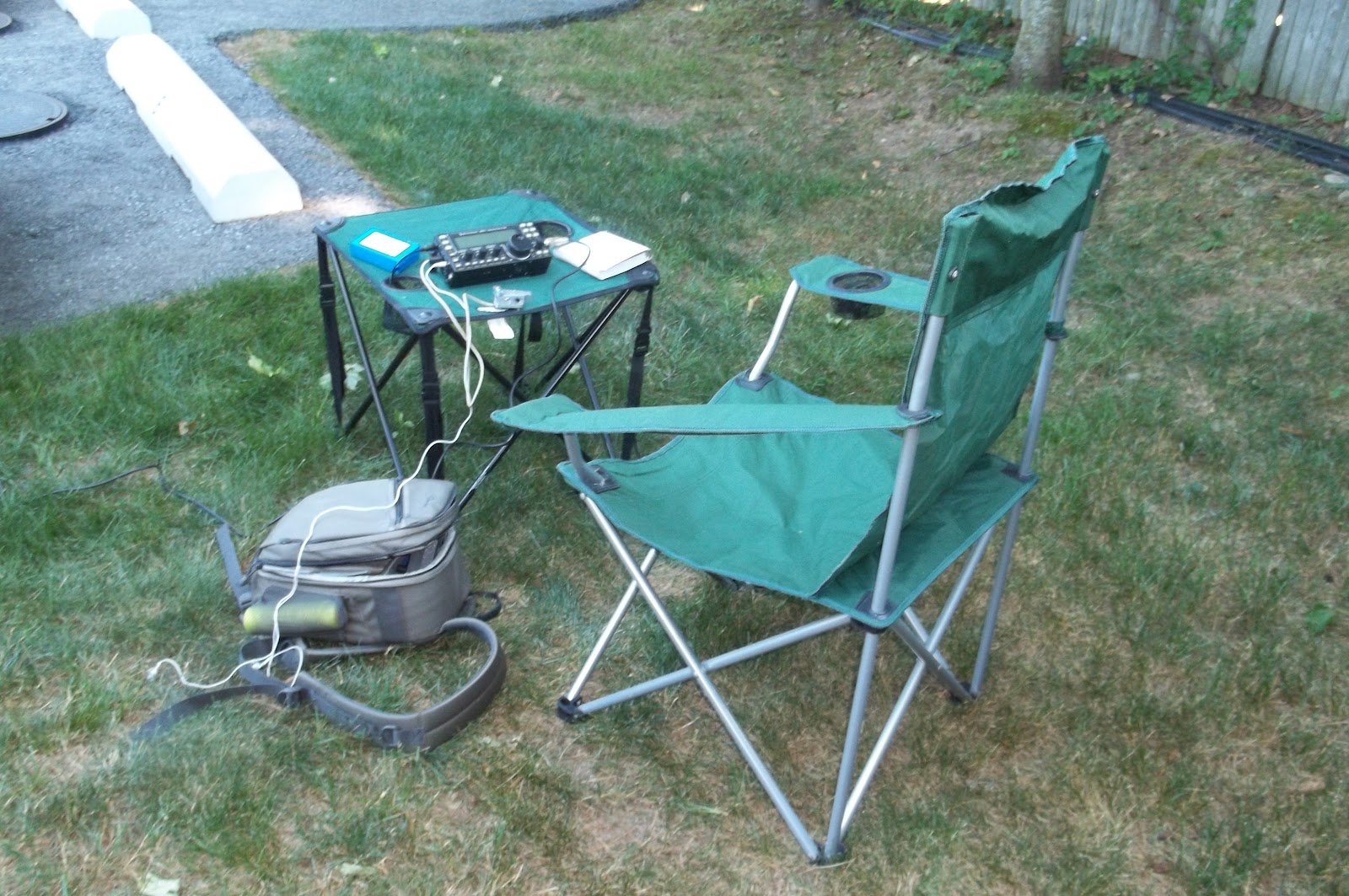
The Buddistick on the magmount, using the vehicle as a ground plane is great combination. Thanks to W3BBO for getting me to try that. It works so well that I may just forego using the EFHW wires unless I am on the hiking trail later this week.
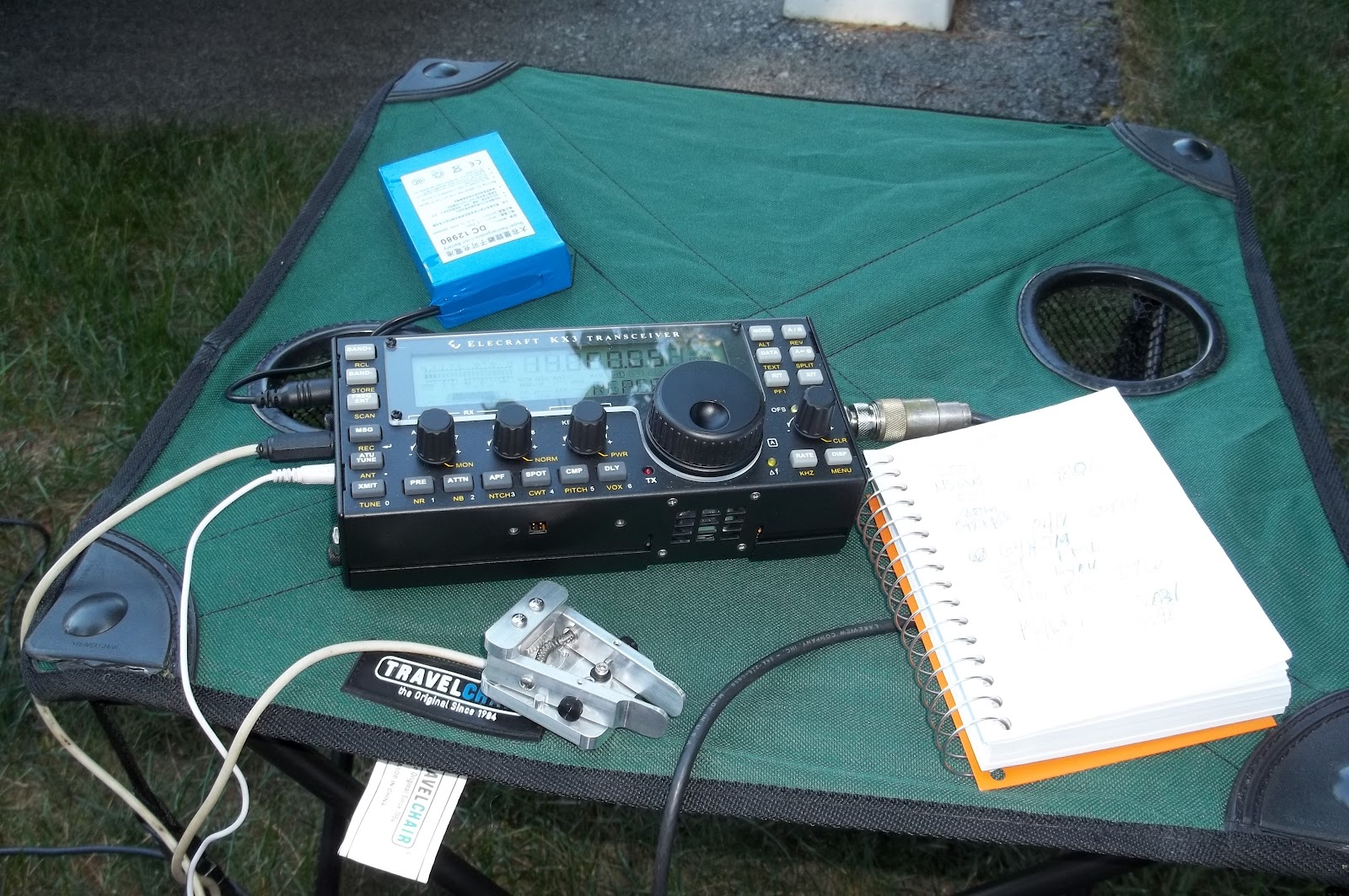
Oh, I don’t remember if I mentioned this; but I decided to leave the Lead Acid battery home. I am going strictly with the Lithium Ion this week. It held up very well this afternoon. I never dropped from 5 Watts output throughout the couple of hours of operating time this afternoon, including a few prolonged “CQ QRP” sessions. I think “The Little Blue Guy” will be quite adequate for my needs.
72 de Larry W2LJ
QRP – When you care to send the very least!

Larry Makoski, W2LJ, is a regular contributor to AmateurRadio.com and writes from New Jersey, USA. Contact him at [email protected].
The KARS 2012 Summer Field Day Video
It took a little while but I finally got the video for the Katy Amateur Radio Society summer field day together. I didn’t shoot as much video or as many photographs this year as I actually spent time a fair amount of time operating for a change!
Hopefully it will still be an entertaining, if short, reminder of those two days in June.
Katy Amateur Radio Society – Summer Field Day 2012 from Owen Morgan on Vimeo.
 Posted with Blogsy
Owen Morgan, KF5CZO, is a regular contributor to AmateurRadio.com and writes from Texas, USA. Contact him at [email protected].
 Ham Radio Deluxe |
 W5SWL Electronics |
 Ham Radio Prep |
 KB3IFH QSL Cards  Hip Ham Shirts  HamRadioAuctions HamRadioAuctions Reliance Antennas Reliance Antennas Enigma Shop Enigma Shop |  morseDX  Ni4L Antennas  R&L Electronics R&L Electronics antennas.us antennas.us QRV QRV |
- Matt W1MST, Managing Editor
