 |
 A Great Day of Mountaintop Radio
 6 August 2012 | by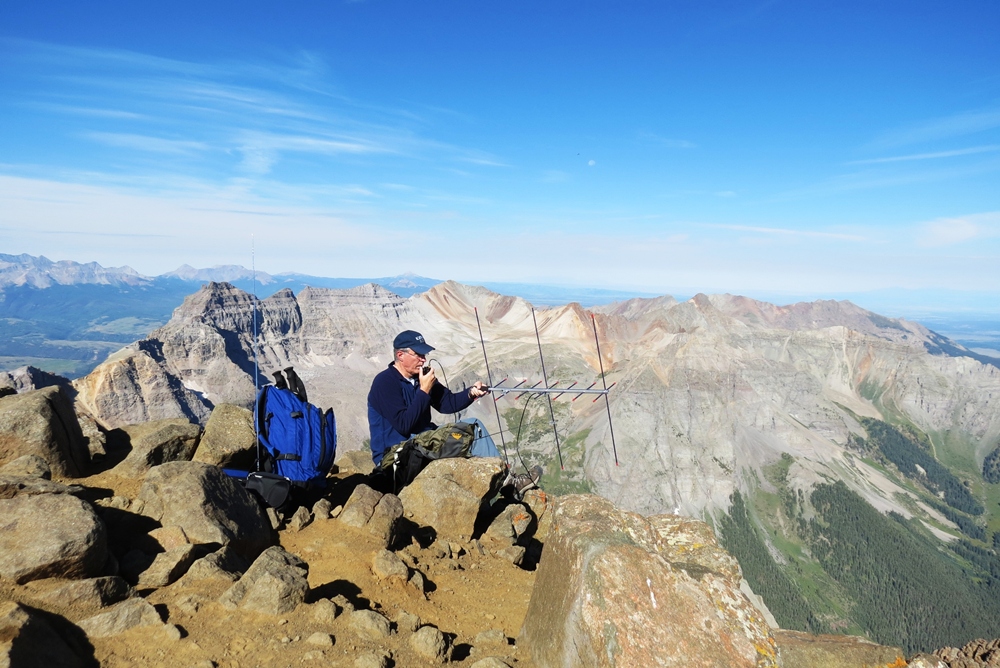
Here is the report on the Colorado 14er Event operation from Mount Sneffels. Joyce K0JJW and I drove our Jeep up to the “upper trailhead” for Sneffels, arriving at 6 AM. The 14ers.com web site describes the trailhead and route.
On paper, the climb is not that difficult but there is quite a bit of loose rock that you have to navigate…annoying on the ascent and very tiring on the descent. We reached the summit at 9AM and fired up the radio gear.
Mt Sneffels (and the other peaks in the San Juans) is a long distance from many of the fourteeners. Take a look at the fourteener map on 14ers.com. Previously, I had operated from Pikes Peak where you hear tons of stations calling and Mount Antero which is centrally located so you can easily work all of the 14ers. Operating from Mt Sneffels is different — kind of like you have fallen off the edge of the earth.
We soon found that the omnidirectional antennas were not that effective at pulling out the other 14er stations and that the Arrow II yagi antenna was the way to go. I’ll so some more analysis on this later.
Most of the contacts were made with the Yaesu FT-817 but we also used a pair of HTs. Note that we used both FM and SSB.
I had my Yaesu VX-8GR burping out APRS packets for the upper half of the hike but it appears they only made it to an IGate when we were on the summit.
The weather was awesome so we stayed on the summit until 11:40 AM. After we finally worked Pikes, we decided to head down. The clouds were building but we did not expect it to amount to much. But the storm moved in quickly and we did get snowed on while hiking down.
Radio Log
Local
Time  Freq        Callsign  Location    Comments
 0934 144.200 USB   N0KE    near Silt   Phil, 100 miles away
 0949 432.100 USB   N0KE    near Silt
 0954 147.420 FM    W0NX    Quandary    Keith, strong signal
 1006 147.420 FM    WE7C    near Cortez Glen, 70 miles away
 1018 147.510 FM    WO9S    Mt Evans    Jon
 1049 147.450 FM    KM5TY   Huron       Strong signal
 1058 147.435 FM    KD0EGE  Lincoln
 1100 147.420 FM    KC0VFO  aeronautical mobile
 1110 147.420 FM    KT0AM   Shavano     Mark, strong signal
 1115 147.420 FM    KI6ASW  Blanca      Strong signal
 1130 144.200 USB   KB0SA   Pikes Peak  Eric
 1132 144.200 USB   W0STU   Pikes Peak  Stu
 1135 147.480 FM    W0STU   Pikes Peak  Stu
Joyce ended up logging for me and pointing the antenna, so she only worked Glen WE7C on 147.42 MHz. She also got to explain to the other hikers what the heck we were doing. People seemed genuinely interested and when we told them we just talked to Quandary or Evans, they’d say “that’s cool.”
This was a Summits On the Air activation, the first ever for Mount Sneffels (W0/UR-001). All in all, a good day playing ham radio in the mountains.
Thanks to everyone that came out to play.
73, Bob K0NR
Bob Witte, KØNR, is a regular contributor to AmateurRadio.com and writes from Colorado, USA. Contact him at [email protected].
Weekend happenings……..
 |
| During the NAQP CW contest |
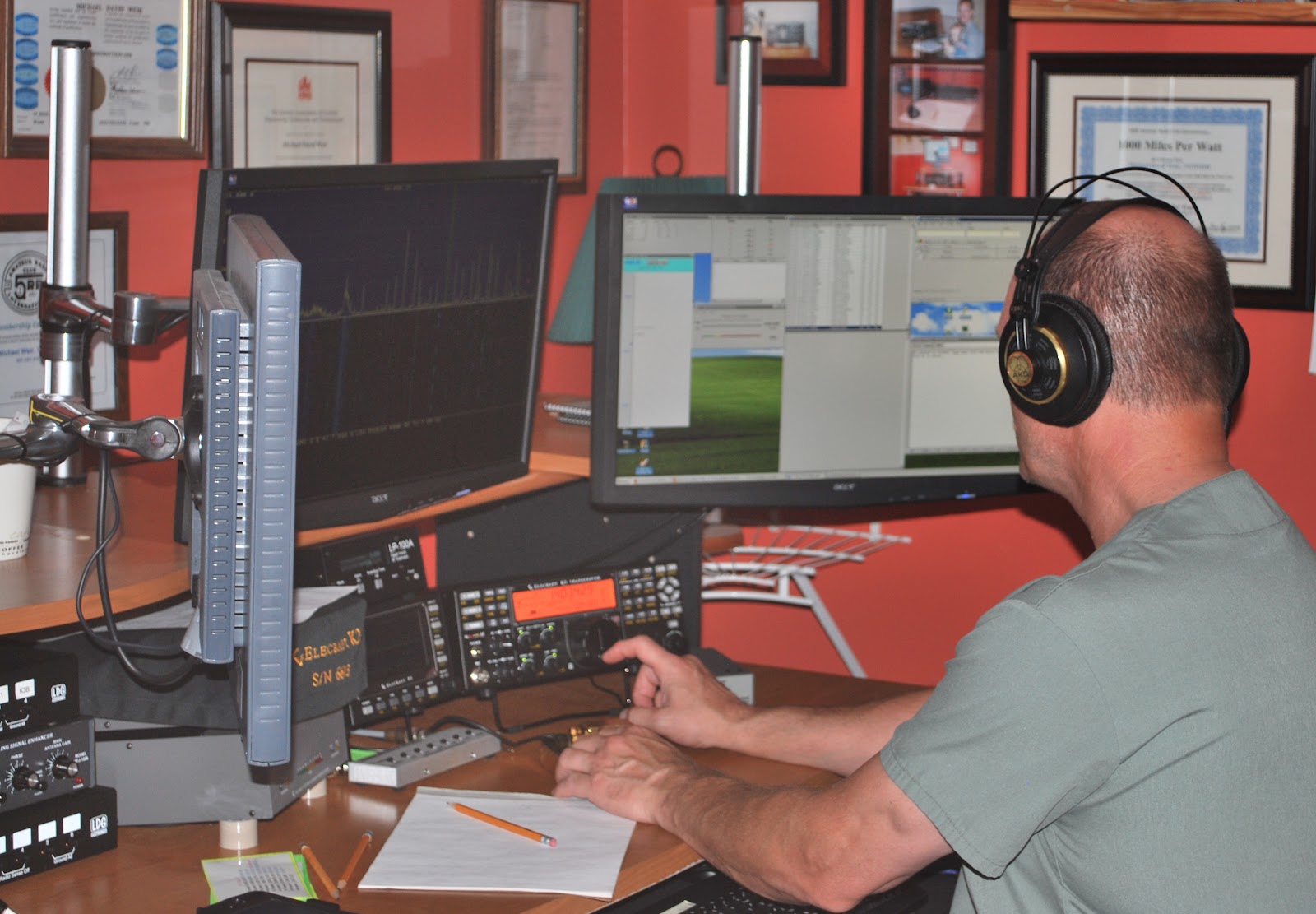
On Saturday I took part in the NAQP CW contest. It was this day and mostly early evening and evening that the thunder and lightening storms came my way. This limited my on air time in the contest. I entered as QRP at 5 watts and was going to lower the power into the mW range but the conditions would not allow it. I was having a hard enough time making contacts with 5 watts.
 |
| First time it has been blank |
So that is how the weekend more or less went here at VE3WDM!!

Mike Weir, VE9KK, is a regular contributor to AmateurRadio.com and writes from New Brunswick, Canada. Contact him at [email protected].
Lank Rigg
For the first time in many months the weather and workload was just about right to get out on one of the local fells for a ‘quick’ activation. I say quick because that was the plan but it didn’t really pan out that way.
Lank Rigg is a fairly unassuming fell not too far fro the cold fell road near to Ennerdale Bridge. I cycle past it very often but so far it hadn’t shown itself as somewhere to go for a summit activation. I only had the morning to play with as I had committed to going to the club to help sort out our shack which is creaking under the weight of under use. I managed to get this rare shot of some sun shining somewhere where I wasn’t – the sun does exist after all!

Approaching the fell from the fell road is easy enough and I only had the company of a few sheep and slugs on the way to the summit. A bit of mist on the summit cleared then re-appeared with vengeance so after some longer QSO’s I headed off down the direct route rather than following the valley between Lank Rigg and Whoap which forms the easy route. This was supposed to be quicker but turned out to be significantly longer due to the amount of water in the beck at the bottom. Heavy rains hadn’t fully cleared and I chickened out of the crossing as I was fairly sure that the volume of water could have knocked me over if I wasn’t careful. So having made my bed I had the follow the route all the way to a footbridge and walk back up the road. Several miles of detour.
So, today’s summit activation lesson is, watch out for becks that need bridges or pack some waders if you’re feeling brave. Otherwise enjoy the longer walk back to the car and see parts of the valley you wouldn’t ever expect to see.
Alex Hill, G7KSE, is a regular contributor to AmateurRadio.com and writes from Cumbria, UK. Contact him at [email protected].
St. Joseph, Missouri – The Patee House
This past Sunday, we decided to take a small trip north to St. Joseph, Missouri. St. Joe is full of history and one of my favorite places to go there is the Patee House Museum. Two parts of the museum I enjoy the most:
(1) A railroad telegraph office with a nice collection of telegraph keys


(2) An amazing display of vintage radios as well as an old amateur radio station


Julius B. Abercrombie, W0NH (ex 9NH) was a member of the Old Old Timers Club and first got on the air back in 1906! It looks like Julius was one of the original Midwestern Big Guns.
I really enjoyed his collection of convention pins (…open the image below to see the details of the pins)

Scott Hedberg, NØZB, is a regular contributor to AmateurRadio.com and writes from Kansas, USA. Contact him at [email protected].
Change of address
DX Sherlock, the website that has the very useful real-time propagation maps derived from DX Cluster and WSPR spots, has moved to a new site.

The addresses vhfdx.net, vhfdx.info and dxsherlock.com will now redirect to dxmaps.com. If you have bookmarked the site you will need to update your bookmarks.

Julian Moss, G4ILO, is a regular contributor to AmateurRadio.com and writes from Cumbria, England. Contact him at [email protected].
Fake or genuine?
Buying radio gear on eBay is like gambling. It’s addictive, but often you lose. You win often enough to keep you coming back in the hope of finding that absolute bargain.
 |
| Is the antenna on the right a fake? |
I thought that I would buy a dual-band handheld antenna that was long enough to have a bit of gain but not too long to use in the shack. (I have several gain antennas but at over a metre in length they are not suitable for indoor use.) I have a Nagoya NA-701 which works very well for its length (22cm) so I thought I would get a NA-771 which is 40cm in length and ought to perform a couple of dBs better. I know only too well that there are a lot of fake antennas on eBay so I bought this one from 409shop, or rather from radiobanker which is one of the eBay IDs used by 409shop. The general consensus is that 409shop is a trustworthy trader and doesn’t sell fake stuff.
When the antenna arrived I was concerned to see that instead of the silver-on-black label showing the make and model number the details were printed on in blue. I have had other fake antennas with printed-on labels, even ones with the same shade of blue so it was not a good omen. When I tried the antenna on one of my handies I found that it performed no better than the much shorter NA-701.
 |
| SWR of the alleged NA-771 |
I put it on my AA-200 antenna analyzer and found that the SWR at 145.000MHz was about 4:1. There were two dips to the HF of the 2m band, the best of which was at 195.000MHz with 2.7:1. This is not the worst I have found but it explains why the antenna did not perform optimally.
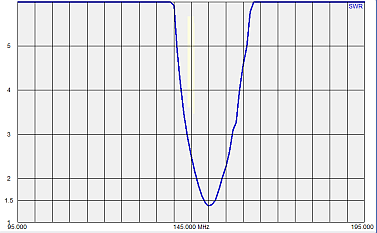 |
| SWR of Nagoya NA-701 |
For comparison I looked at the SWR of the NA-701 with the silver-on-black label. This was a really good match – better than 1.5:1 at 150.000MHz though closer to 2:1 at 145.000MHz. Given that the resonance at any given time will be affected by conditions surrounding the hand-held antenna that’s close enough.
So is the NA-771 from radiobanker a fake or not? The plastic sleeve the antenna came in bears a silver hologram label that says “Nagoya”, and the name “Reuex Industrial Co. Ltd.” That is the name of the company that manufactures Nagoya antennas and apparently they do use blue lettering.
So I conclude that this antenna is probably genuine and performs as well as it was meant to, which unfortunately happens to be not as well as I hoped. The Nagoya NA-771 is not worth its extra length.
FYI using an SWR/power meter I measured the SWR of the two antennas at 433.000MHz to be: NA-701 3.4:1, NA-771 4:1.

Julian Moss, G4ILO, is a regular contributor to AmateurRadio.com and writes from Cumbria, England. Contact him at [email protected].
Happy Dance Time!
Turned on the radio to around 14.060 MHz, hoping to hear some QRPers, only to hear “CQ NA”. I didn’t remember that the North American QSO Party was this weekend. Regular readers of this blog know that except for short QRP Sprints, W2LJ is not big into contests. I have nothing against them; just can’t force my butt into a chair for a long enough period of time to make it interesting for myself.
So instead of kvetching, I pushed the band button on the K3 and took ‘er up the road to 17 Meters. I love 17 Meters! When the band is open there is usually all kinds of good DX. Tonight was no different – and since 17 Meters is a WARC band – no contesting!
So, as is my usual routine, I started at the bottom of the band at 18.068 MHz and slowly twiddled the VFO dial upward. I came to a stop at around 18.074 MHz. D3AA calling “CQ UP” – not too many takers, a small pile up building, but still not bad yet.
Where the heck is D3AA? I quickly plop D3AA in to AC Log. Angola. Hot dog – Angola is a new one! Never worked Angola – QRP or QRO (100 Watts) before.

I throw my call out a couple of times; but no dice. D3AA is up and down. One time he calls, he’s 599 – next time, 569. So I’m thinking to myself that he’s going to fade and that I missed the best propagation (as usual). But no! As time goes along, he’s actually getting louder; but the pile up is also growing, commensurately. The K3 makes it pretty easy to figure out where he’s listening as he stated he was listening up. So I go to where I heard the last few stations he worked and figured out that for the time being, he was staying put and not drifting up after each contact.
Patience and persistence are a big part of QRP and this time was no different. I stayed at it for about 15 minutes and finally, I interjected “W2LJ” at just the right moment and was rewarded with “W2LJ 599 TU”, to which I responded in return, of course.
Coolest of the cool beans! A new African country – a new country via QRP (or ANY power level for that matter). I opened up Chrome on my netbook and figured I would post this to QRPSPOTS. Most of the time I figure that if I was able to work a station with my simple antennas, then a lot of other QRPers should be able to, also. I posted anyway, but saw that I was beat to the punch by my good bud, John AE5X – Amateur Radio op, DXer and QRPer and photographer extraordinaire
Anyway, that’s the reason for “The Happy Dance” tonight.
72 de Larry W2LJ
QRP – When you care to send the very least!

Larry Makoski, W2LJ, is a regular contributor to AmateurRadio.com and writes from New Jersey, USA. Contact him at [email protected].
 Ham Radio Deluxe |
 W5SWL Electronics |
 Ham Radio Prep |
 KB3IFH QSL Cards  Hip Ham Shirts  HamRadioAuctions HamRadioAuctions Reliance Antennas Reliance Antennas Enigma Shop Enigma Shop |  morseDX  Ni4L Antennas  R&L Electronics R&L Electronics antennas.us antennas.us QRV QRV |
- Matt W1MST, Managing Editor
