 |
 I’m fixed!
 22 August 2012 | by
 I finally have an official fixed amateur radio station! Isn’t it great! I’m tickled pink. (Calm down Hans, don’t get too excited here).
Yesterday two people from the NCC (our local version of the FCC) came to inspect my station for the official fixed station licence. An hour late, but we’re in Taiwan, so get used to it. There were two guys and one started off with a strange question: if I had any questions about the radio regulations? Ehh…no! I passed the exam, so I know what they are. And then again, I ignore them when I feel like it, because that is what we do in Taiwan, right? But the guy asking the question was Mr. Liu and he wasn’t so bad at all. In fact, he was interested in the examination procedure in the Netherlands and he wanted my e-mail address so he could consult me on changes in the examination question pool, which is going to be changed in November. He is also the man who put together the statistics I mentioned in my last post here on AmateurRadio.com.

In the mean time the other guy tested my TS-440S. He hooked it up to a Bird clone and a spectrum analyser, fed into a dummy load. On 80 and 40 meters my harmonics suppression was only just 40 dB, but on the other bands around 50 dB: good enough. The power output was measured at around 80 Watts, but I saw that the SWR of the whole set up was 1:1.5, so then it’s no surprise that the rig didn’t show its full potential. They looked at my antenna, which is on the balcony, but other than that they weren’t interested in anything. After an hour they left and the licence will be coming in the mail.

You would have thought that inspecting a radio station would be more thorough: electrical safety, structural safety of antenna’s, equipment that can only transmit on designated frequencies, etc. My TS-440S can transmit on any HF frequency, but they didn’t even check or notice. So what is this farce about? Unfortunately us hams in Taiwan know more about amateur radio than anyone working for the NCC. But there need to be rules and regulations, thought up by people high up in the chain of command, who want to be listened to (just like the Emperor, a hundred years ago. Really, little has changed). It doesn’t matter if they are right or wrong, propose something realistic or not, you just have to obey them. But once you have shown that you have played by the rules then there is a solution: ignore them. You know that you will never be bothered by them again, so you make your own rules.
Example: the Ministry of Transportation and Communication devises a national frequency allocation table. The NCC (which is a subdivision of the MOTC) extracts the amateur radio frequencies, allocates them according to type of licence and puts it in the official rules and regulations which we are to obey. Now the MOTC frequency allocation table is already inaccurate due to contradictions within the MOTC. The NCC uses an old version of the FOT and the MOTC doesn’t bother to let the NCC know of the updates. The result: most hams in Taiwan use the IARU region 3 frequency allocation table for HF. The NCC knows that Class 2 and 1 amateurs are serious people and we are never checked apart from the time you set up a station, so live and let live. On VHF and UHF there is a little tighter control because of the great number of sausages and inexperienced Class 3 amateurs. So, do what you want on HF and be a bit careful on V/UHF. That’s the way we do it in Taiwan.
I am careful by nature and I want to enjoy the hobby for as long as I can, so no worries about me. Besides, amateur radio is more about listening than transmitting, not? So after the NCC folk were gone the TS-440S was still on 10 meters and I tuned that band for a bit. Heard beacons from DU1EV/B on @28195 (very weak) and HS0BBD/B on 28205.9 (in OK03, strong at times). The DU1EV beacon is in testing phase, running 1 Watt into a Yagi pointed to Japan. Eddie hopes to relocate it to a better spot, with a GP antenna instead of a Yagi. Stay tuned.
Hans "Fong" van den Boogert, BX2ABT, is a regular contributor to AmateurRadio.com and writes from Taiwan. Contact him at [email protected].
Fixing my Lithuanian oscilloscope

I visited Riga, Latvia with a youth group which we as a family were involved with in 1992, and there I stumbled upon a Soviet oscilloscope in a department store. It was from the neighboring country, Lithuania, and was manufactured in Vilnius, the capital. The markings say what I guess means “Made in the Soviet Union”. At least it says CCCP in the upper right-hand corner. I remember these letters very well as all Soviet athletes used to have them on their backs.
The oscilloscope came with full documentation, even with a bilingual manual. I had grown fond of this oscilloscope as it was lightweight and simple to use once I had learned what the Russian markings meant. It is a typical instrument for TV-repair with a 7 MHz bandwidth.
Now after 20 years, I was therefore very sad when it malfunctioned. This was the time to test if the manual was helpful or not. The symptom was that the beam no longer could span the whole screen in the X-direction. Even with the Horizontal positioning all the way to the left one could barely see the beam.
I opened the bilingual manual only to discover that the two languages were Russian and Lithuanian!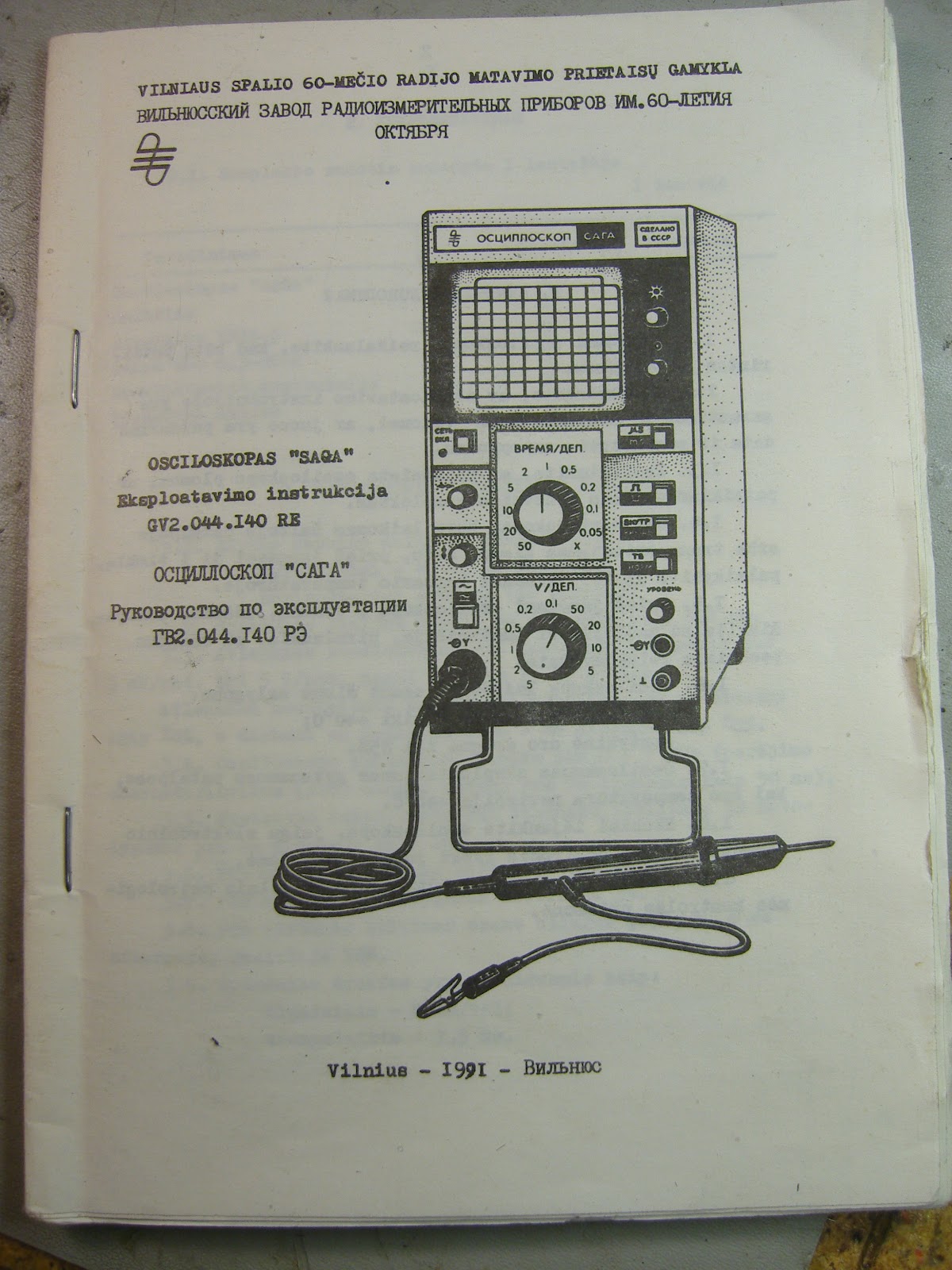 But lucky for me, the schematic was similar to what I am used to and quite readable. It even contained PCB-layouts.
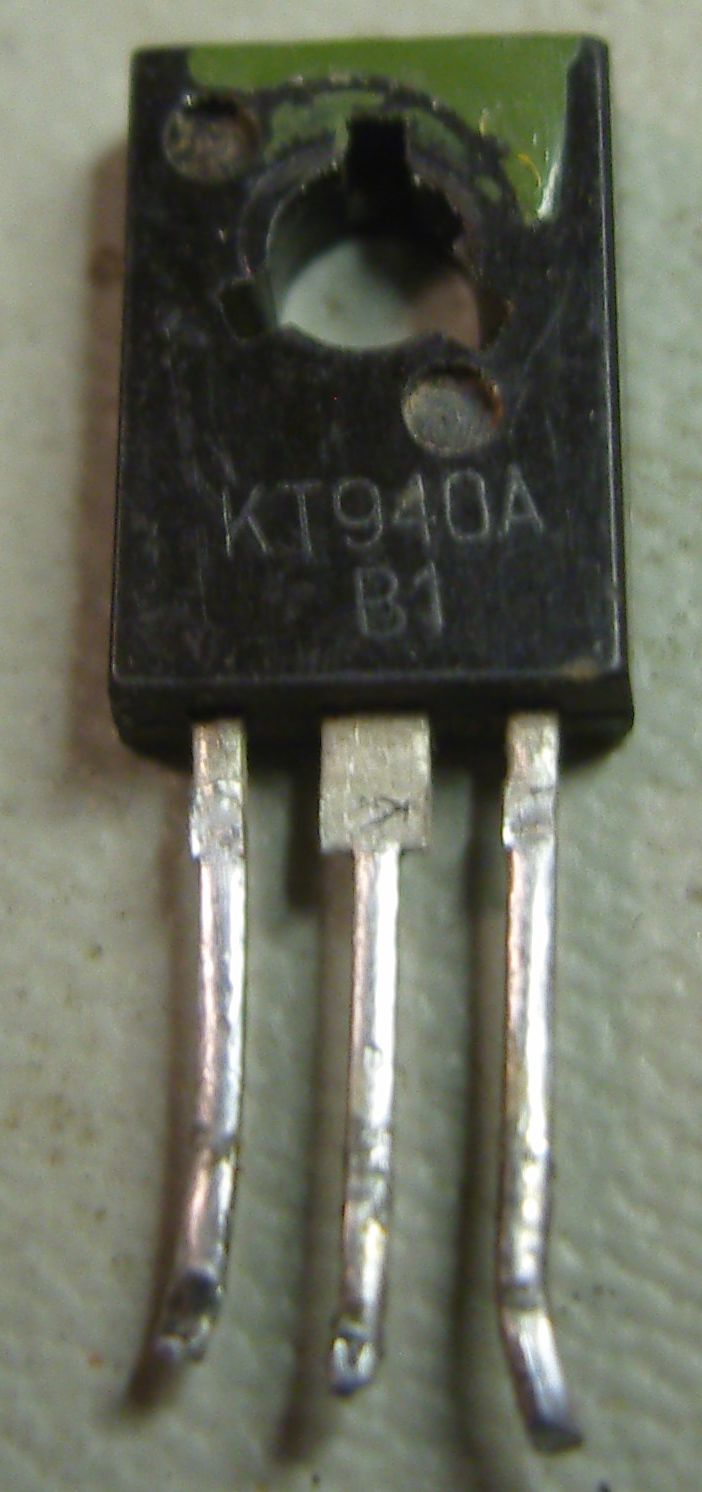 It showed two high-voltage transistors, KT940A, in the last stage of the horizontal amplifier. One of them turned out to have an open emitter-base junction. Specs that I could decipher from Russian data sheets on the web showed that KT940A is NPN, 300 V, 90 MHz. I found that I had a 2SC2611 lying around with similar specs. It even fitted the same footprint. So now the oscilloscope is back in business again.
The oscilloscope is called Saga – осциллоскоп “Сага” – osciloskopas “Saga”. It would be interesting to learn if this factory is still in business. Were they able to diversify into other areas in these very interesting last 20 years of independence for Lithuania, and indeed all three Baltic states, or have they vanished?
Sverre Holm, LA3ZA, is a regular contributor to AmateurRadio.com and writes from Norway. Contact him at [email protected].
KX3 distorted audio problem
KX3 #110 has had a problem ever since I received it. The audio through the speaker has always sounded badly distorted and buzzed at anything above a very low volume. Judging by comments in the KX3 Yahoo group this was not an uncommon problem. A couple of solutions were proposed, including removing the cloth between the speaker and its grille. As I could get perfect audio on headphones I decided to wait until the definitive solution was published and until I plucked up sufficient courage to take a screwdriver to the radio.
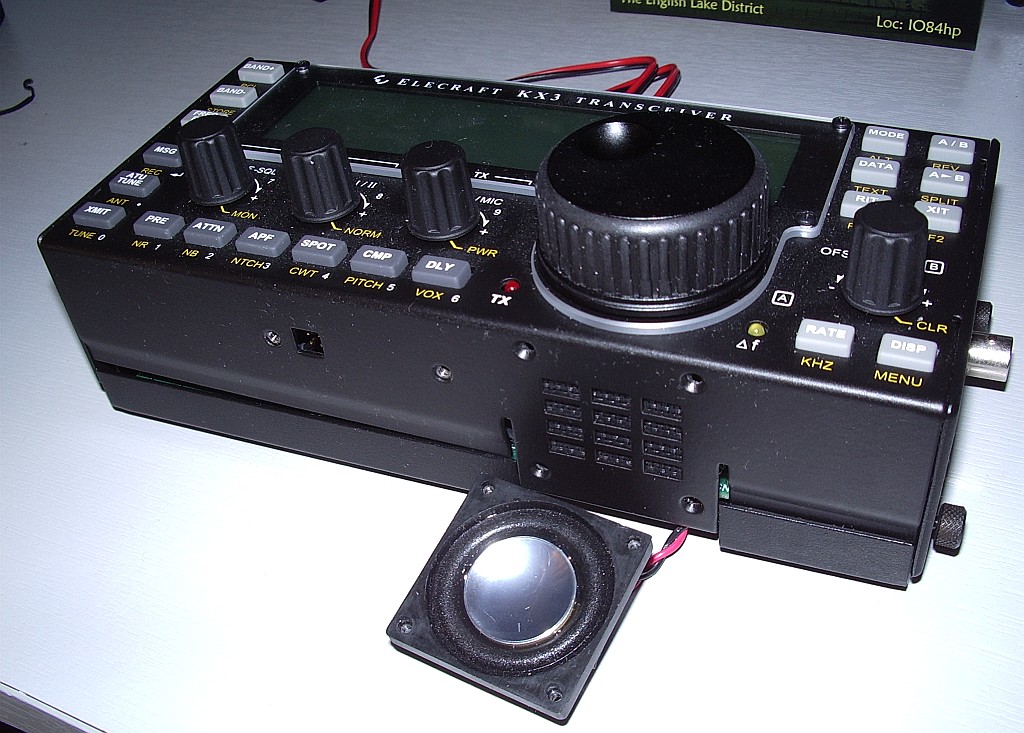 |
| KX3 #110 awaits a replacement speaker |
I opened the case and poked around with a finger to see if I could find what was vibrating. The buzzing was definitely coming from the speaker area so I concluded that the problem was the speaker cone vibrating against the grille cloth. I posted a message on the KX3 Yahoo group to see if I could determine the chances of a successful cure if I removed it. The replies suggested that the prospects were good. I also received an email from KX3 Support offering me a replacement speaker. Excellent customer service!
This morning I was feeling brave so I opened up the case and tried to remove the speaker. I took out the 4 screws but the clearances around the speaker are so tight it looked as if I might have to take the KX3 to pieces to remove it. With a bit more jiggling it came free (phew!) so I partially reassembled the two halves with the speaker poking out the front of the radio. I applied power and attached an antenna and various howling and squawking noises emerged from the speaker.
So the culprit really was the speaker! Perhaps it had been damaged during assembly (not by me, as this was an assembled radio.) I told KX3 Support that I would have to take up their offer of a replacement speaker. The KX3 will remain in two halves until I receive and install it.

Julian Moss, G4ILO, is a regular contributor to AmateurRadio.com and writes from Cumbria, England. Contact him at [email protected].
LHS Episode #088: Total Breakdown
 Hello, esteemed listeners. Welcome to the latest installment of Linux in the Ham Shack. Tonight, Richard and Russ take the first third of the podcast to get a few topics off their minds that they’ve been thinking about over the past several weeks, whether or not those topics have anything to do with amateur radio or Linux. Wedged in the middle, discussion of wireless networking comes up, using HSMM and inexpensive Linksys hardware to provide Part 15 and Part 97 based communications for local, regional and EMCOMM use. Then our cagey hosts finish up with a mad dash through feedback, giving useful advice to those listeners with enough mettle to write in. Thanks as always to our loyal followers. We appreciate each and every one of you, each and every fortnight.
73 de The LHS Guys
Russ Woodman, K5TUX, co-hosts the Linux in the Ham Shack podcast which is available for download in both MP3 and OGG audio format. Contact him at [email protected].
Wouxun KG-UV920R gets out into the wild
After speaking with Ian G4WUH on his new Wouxun mobile 144/433MHz dual bander at the weekend, some more reports are starting to come in.
A very useful resource is VA3ISP’s blog which details some of the findings so far.
A friend in Hungary has also received a rig and I am looking forward to hearing how it works out on the air.
Reading through some posts today, I realised that the reason for the long period of time between my original blog post about this rig and the eventual release date was that some redesign work had to be done. Wouxun have made a good impression with their handhelds, let’s keep our fingers crossed this continues with the mobile.

Tim Kirby, G4VXE, is a regular contributor to AmateurRadio.com and writes from Oxfordshire, England. Contact him at [email protected].
Eye-ball QSO
If you haven’t noticed it yet then I will confess myself: I am a little bit of an oddball! I don’t like ham fests, field days, working mobile, going QRP in the park, ARES or hanging out at other people’s shack. My own shack is where I feel the best. My soldering iron to the left, my radios to the right, the key in front of it. Nobody who can bother me, but the world is coming to me via my set.
Unfortunately this has its limitations, because everybody needs help at some point. And as I am not a recluse I do enjoy some company, every now and then, with people who are like minded. So when I learned about the weekly meeting at the shack of BX3AA I decided to check it out. The Taiwanese hams I had met up till now were okay, but not really like minded. Well, that has changed. Sam (BX3AA) has a little ham shop in down-town Taoyuan. When you go in you are being welcomed by a very friendly 45 year old guy, some jazz music in the background and a cup of Taiwanese tea. And on Saturday afternoon hams from around Taoyuan join him for a cuppa. There is some talk, but you don’t have to say much. Sometimes every one is quiet so to better enjoy the tea and the music. Talking about like-mindedness! I think I finally found my posse!
 Unfortunately Taoyuan is a very busy city and my car was parked in a wrong spot and thus towed away. A bummer after such an enjoyable afternoon, but BV3FQ (not in the photo, he had already gone home) made me forget it all a couple of days later. I had asked him where I could buy aluminium tubes and rods (trust me, not easy to find in Taiwan) and phoned me up and said he had already bought what I needed. Well, isn’t that a great way to get help!
Hans "Fong" van den Boogert, BX2ABT, is a regular contributor to AmateurRadio.com and writes from Taiwan. Contact him at [email protected].
An interesting weekend’s VHF
Having written last week about the shifting conditions on VHF, it was fun to notice and enjoy both sides of the coin this weekend; summer conditions in the shape of some Es and autumn conditions in the shape of some tropo.
Saturday started off with an interesting QSO with Ian G4WUH on the GB3UK repeater – interesting because Ian was using one of the new Wouxun 144/433MHz dual band mobiles. Very nice it sounded too and Ian spoke highly of the sensitivity of the receiver.
Just as I was about to head back out to the garden I noticed some signals on 50MHz and discovered that there was some Es around up in the direction of Scandinavia. The best distances were SM2SUM (KP03) and YL2LW (KO26) but there were a couple of new squares closer to home in Norway. Signals got very loud at one stage and I thought I should check 70MHz. I was glad I did, as the first thing I heard was ES1AEW/2 on 70.200. Didn’t work him, but had a nice QSO with ES1CW on the key. Not so far away, but just as interesting was a QSO on 50MHz with the Grantham club, operating GB0BL from the Bressay light near Lerwick, Shetland – I was delighted as the GB3LER beacon was coming in and very often there are no stations to be heard.
Sunday morning saw 145MHz FM lively with lots of French stations. In particular, the repeater on 145.725 was strong, way over the top of GB3SN in Hampshire. A bit of research showed that it was the FZ2VHC repeater near Le Havre. I listened to a QSO finish and then cautiously dropped my call in. To my delight, Jean F6CRB replied, in English and was delighted to have a QSO with a UK station – we chatted for a few minutes. Some other repeaters and simplex stations were heard although the good conditions were over, probably by around 1030 local time as the day warmed up.
It was enjoyable to once again, get the 145/433 MHz scanning going again and see what could be worked.

Tim Kirby, G4VXE, is a regular contributor to AmateurRadio.com and writes from Oxfordshire, England. Contact him at [email protected].
 Ham Radio Deluxe |
 W5SWL Electronics |
 Ham Radio Prep |
 KB3IFH QSL Cards  Hip Ham Shirts  HamRadioAuctions HamRadioAuctions Reliance Antennas Reliance Antennas Enigma Shop Enigma Shop |  morseDX  Ni4L Antennas  R&L Electronics R&L Electronics antennas.us antennas.us QRV QRV |
- Matt W1MST, Managing Editor
