 |
 My first 24 hours on WSPR
 20 September 2012 | by
My first beacon on 30 m, a free-running Ultimate QRSS kit (no GPS) has now been running for a full 24 hours using the Weak Signal Propagation Reporter (WSPR) mode. The figure comes from the WSPRnet page.
With an output power of about 150 mW to an 80 m horizontal loop it has not been possible to reach beyond Europe so far. Perhaps this will happen in the future with better conditions and/or with some more output power.
Added 26.9.2012: I made it for the first time across the Atlantic!
Timestamp Call MHz SNR Drift Grid Pwr Reporter RGrid km az
2012-09-26 00:50, LA3ZA, 10.140262, -26, -2, JO59fu, 0.2, WB2EEE, FN21xh, 5852, 290
Sverre Holm, LA3ZA, is a regular contributor to AmateurRadio.com and writes from Norway. Contact him at [email protected].
A couple of 6 and 10 reports
Martin Harrison, G3USF has collated a couple more 6 and 10 reports which he’s passed on to me. They are available at the usual place (here). Any feedback is always welcome so please don’t hesitate in getting in contact if you would like to add anything.
Alex Hill, G7KSE, is a regular contributor to AmateurRadio.com and writes from Cumbria, UK. Contact him at [email protected].
Along the Pemigewasset River
Today I road my bicycle along the Pemigewasset River. It was sparkling. I worked a mobile station in Montana and two QRP stations… one in North Carolina and the other in Ontario.

The old road runs along the river in the Army Corps of Engineers flood control property in Sanbornton. Today I rode about a mile north and stopped at a sunny spot right along the river. It was dazzling.

I threw a line over the branch of a tall pine tree and sat down along the bank. I ran 4 watts with the little HB-1B on 20 meters. To my west was the river, and to the east, a steep hillside that rises nearly 700 feet toward Knox Mountain. I was pretty sure any QSOs would not be coming from Europe and I was right. I heard NT7R mobile in Montana calling on the county hunters frequency and I made a quick contact. Then I went up to the QRP calling frequency and heard Steve W5QC calling CQ from North Carolina. We gave each other 559s. Steve was running an 817 at 2 watts with a telescoping antenna right on the back of the rig! Fantastic. He was camping in North Carolina. As soon as we finished, Gary VE3MPQ called me from Windsor, Ontario. He was very strong at 579 and he gave me a 579 too. Gary was also running an HB-1B at 4 watts. We chatted for more than five minutes with perfect copy both ways.

When I told Gary I was sitting by the edge of the river, he sent, “I’m jealous of your QTH.”

After operating for a bit more than 20 minutes, I headed south back down the road. It’s nice to have the camera to record these wonderful afternoons. But it doesn’t record the sound of crickets, or the touch of a cool breeze on my face as I peddle along the river. It doesn’t catch the smell of early fall or the nostalgia of the first fallen leaves along the trail.
Jim Cluett, W1PID, is a regular contributor to AmateurRadio.com and writes from New Hampshire, USA. Contact him at [email protected].
Handiham World for 19 September 2012
Pat Tice, WA0TDA, is the manager of HANDI-HAM and a regular contributor to AmateurRadio.com. Contact him at [email protected].
How Much Does That Second Band Cost?
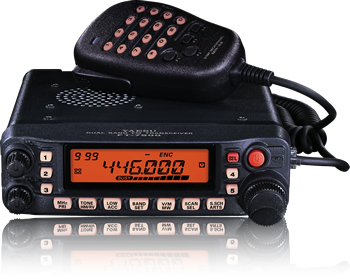 I encourage newly licensed radio amateurs to go ahead and get a dual-band FM rig…handheld, mobile or both. I think the additional cost of the dualbander with both 2 Meters (146 MHz) and 70 cm (440 MHz) is justified by having the ability to operate on the additional ham band. I have noticed that the price of the single-band 2 Meter mobiles are pretty low, less than $200… a real bargain in terms of technology. This made me wonder what the price premium for the second band (70 cm) really is.
I pulled all of these prices from the same major ham radio web site, trying to keep some consistency among the price of the various models. (I ignored specials and coupon pricing.) I looked at a basic 2 Meter FM rig and any comparable dual band models from the same manufacturer. I tried to stick to the basic transceivers and not include models that had advanced features such as D-STAR and APRS in them.
The data is captured in the table below. Note that I differentiated between a single receiver (one frequency at a time) dual-band radio and a two receiver dual-band radio, since the latter variety is much more expensive. I calculated a percent premium for each of the dual-band transceivers, calculated as the percent increase in price over the single-band radio from the same manufacturer. I think this is the most objective way to describe the extra cost of a dual-band radio.
| Transceiver | Price | Bands | Percent Premium |
| Yaesu FT-2900R | $185 | 2M | |
| Yaesu FT-7900R | $330 | 2M/70cm | 78% |
| Yaesu FT-8800R | $460 | 2M/70cm Dual Receiver | 149% |
| ICOM IC-2300H | $260 | 2M | |
| ICOM IC-2820H | $670 | 2M/70cm Dual Receiver | 158% |
| Alinco DR-135T | $170 | 2M | |
| Alinco DR-635T | $320 | 2M/70cm Dual Receiver | 88% |
| Kenwood TM-281A | $145 | 2M | |
| Kenwood TM-V71A | $395 | 2M/70cm Dual Receiver | 172% |
It is worth noting that only Yaesu and Alinco offer a single-receiver dual-band rig. These two radios are 78% and 88% more expensive than their single band counterparts (less than twice the cost). The two-receiver dual-band radios are consistently more expensive, with a price premium ranging from 149% to 172%. While these rigs are often described as having two radios in one, they are more than twice as expensive as a single-band radio.
Although I appreciate the extra utility of the two-receiver radios, it looks to me like the best value is with the single-receiver dual-band rigs.
What do you think?
73, Bob K0NR
Bob Witte, KØNR, is a regular contributor to AmateurRadio.com and writes from Colorado, USA. Contact him at [email protected].
Skeeter Hunt results delay
I had intended to post the 2012 Skeeter Hunt results last weekend; but alas, some family stuff has come up which has taken away my discretionary free time.
Results will be posted this coming weekend on the Skeeter Hunt page of my blog and at http://www.qsl.net/w2lj/
72 de Larry W2LJ
QRP – When you care to send the very least!

Larry Makoski, W2LJ, is a regular contributor to AmateurRadio.com and writes from New Jersey, USA. Contact him at [email protected].
Antarctica!
Interesting conditions on 15m this afternoon.

Amazing where 2 watts of WSPR can end up!

Julian Moss, G4ILO, is a regular contributor to AmateurRadio.com and writes from Cumbria, England. Contact him at [email protected].
 Ham Radio Deluxe |
 W5SWL Electronics |
 Ham Radio Prep |
 KB3IFH QSL Cards  Hip Ham Shirts  HamRadioAuctions HamRadioAuctions Reliance Antennas Reliance Antennas Enigma Shop Enigma Shop |  morseDX  Ni4L Antennas  R&L Electronics R&L Electronics antennas.us antennas.us QRV QRV |
- Matt W1MST, Managing Editor
