 |
 Helicopter in Hill and QSO with Russia
 12 September 2012 | by
 This afternoon I rode my bicycle to Old Hill Village on the
Pemigewasset River. Just as I was about to call an Italian station,
a Black Hawk Helicopter landed in the field in front of me.

I wasn’t really surprised… the National Guard from Concord flies training missions along the river. It’s a wonderful, isolated place… not just for nature-loving radio ops, but for helicopter training maneuvers as well.
So I put down the key, and walked out into the field as the helicopter was about to take off again. They had left an airman on the ground.

I walked over to see what was going on. “You want me out of here?” I asked the airman. “No, you’re fine,” he replied. He explained that the helicopter was going to circle the area, drop a rescue litter and then circle again and haul the litter aboard. They were practicing rescue operations. The airman is a medic, and his team is leaving for Afghanistan at the end of the month. I thanked him, wished him godspeed in Afghanistan, and walked off the field to watch the practice session.

Soon the helicopter returned and dropped a line to the airman who guided the litter to the ground. Afterwards, they hauled both the litter and airman back aboard. Soon I could hear them repeating the drill in a field on the other side of the river.

I returned to my setup at the edge of the field. I was running the little Chinese HB-1B on 20 meters with a half-wave vertical wire. As soon as I sat back down, I heard R1NA calling CQ. Alex was pretty strong and answered my call. He gave me a 449 and copied all of my information. He was north of St. Petersburg, not far from the Finnish border… about 4,000 miles from Old Hill Village.
After the QSO, I packed up and started back to the car. It was a glorious afternoon in Hill. The day was balmy, early fall flowers were in bloom, and I was exhilarated to be in the outdoors once again.
Jim Cluett, W1PID, is a regular contributor to AmateurRadio.com and writes from New Hampshire, USA. Contact him at [email protected].
Handiham World for 12 September 2012
Pat Tice, WA0TDA, is the manager of HANDI-HAM and a regular contributor to AmateurRadio.com. Contact him at [email protected].
Pounding Brass
Like everything else in Amateur Radio, CW has its supporters and its detractors. Me, I am neutral. I encourage those with the dedication to pursue proficiency with this mode and to be able to copy code at blinding speeds. I think it is great that this part of our radio heritage is preserved and that there is even growing interest today. Just like Boy Scouts who use two sticks to start a fire. Do they still do that or do they prefer the magic of a butane lighter today?
There was a time when I could copy code at 20 WPM with my trusty No. 2 Dixon Ticonderoga pencil. And after I got my general in 1955, I pinky-swore that I would always use CW as my primary mode. And you know that among kids a pinky swear is the most powerful swear you can make.
NOT! After a few months, I fell under the spell of AM and spent more and more time on the phone bands. I was running phone patches and participating in the AREC (the predecessor to ARES) emergency nets. Night after night was spent roaming the 20 meter phone band, searching for a new country. Pushing the envelope to see how close I could get to the edge of the band without a pink ticket; speaking in tongues and only to fellow addicts I met on the air. It was not a pretty sight.
There is something about CW that is the essence of ham radio. Like the “purity of essence” mentioned by General Jack D. Ripper, just before he blew his brains out in the movie, Dr. Strangelove. So when I came back to the hobby in 2009 after a hiatus of forty plus years, I promised myself that I would get back to the purity of CW someday. I am afraid that I haven’t made it back there yet.
In spite of the best efforts of my friends to coax me, support me, lend me a key and a keyer, challenge me with a bet and regale me with stories of DX contacts on the low end of the bands and listening to W1AW code practice sessions. I have to confess, the magic isn’t there. Somewhere along my path, I lost the purity of essence that CW represents. I surrendered to the Dark Side of the Force (SSB).
Its pretty good over here on the Dark Side you know. I have plenty of projects that need to get done and that challenge my skill set. Improving antennas, camouflage techniques, installing mobile HF, eliminating RFI, better grounds, more automation and improving my audio. All those are wicked diversions from the purity of essence.
There are plenty of pileups for rare DX or special events and contests, on sideband and CW. Though CW purists believe they can get through when SSB can’t, that is in a perfect world. A CW operator has to deal with bad manners, QRM, splatter and guys running 2 KW against their 100 watts too.
On the other hand, SSB can be a more personal mode. While in a CW QSO, you get to know the operator by their fist, its more like texting; only faster. On SSB you actually hear the other guy’s voice, their tone and timbre. The little nuances of speech that make them human. You are face to face, mano a mano. SSB contests take on the character of an old fashioned bar fight and some rag chew nets go on and on like old radio soap operas.
But, I promise that I will get back to CW someday.
Ron Litt, K5HM, is a special contributor to AmateurRadio.com and writes from Texas, USA. Contact him at [email protected].
AnyTone AT-588UV Dual Band Mobile Radio
Is this the Chinese mobile radio at a good price point ($275) people have been waiting for? The specs list a detachable head, cross-band repeat, 50/40 watts, 758 memories, AM aircraft receive, wide-band FM receive, and 2013 FCC compliant. Ed’s site even mentions that it’s Part 90 certified.
Here is the text of Ed’s e-mail:
 After the dismal performance and high price of Wouxun’s dual band mobile radio, I’m excited to share information about the AnyTone AT-588UV. I have been testing this radio for a couple of weeks and I’m impressed. I think this will be the Chinese dual bander that takes the market.
It’s computer programmable and the control head separates from the radio via a CAT5 cable. This radio is easy to manually operate because there are no sub-menus and there are matching controls for the left and right sides. Either side can be set for VHF or UHF or both the same. It has dual receive (two signals at once) and when transmitting, you can set the off side to be muted if desired. Unlike the Wouxun, with the AnyTone, you can scan one side while monitoring the other side. It only takes a couple button pushes to set up cross band repeat. And unlike the other brand, this cross band repeat actually works! It has AM Aircraft receive plus 220-260 MHz receive (sorry NO 220 transmit).
The company has given me this timeline for availability. They plan to produce a small run at the end of September and hopefully full production by the end of October. I suggested they make a larger test run because I’ve found nothing major that needs improving. I’ve made a few suggestions for firmware changes which they quickly approved. This company is interested in producing a good product. When the AT-588UV is available to purchase, I will send an announcement to this mailing list.
The owners manual is not yet available but I have a list of the various functions. I will post this information and the programming software on my web site as soon as I can. This will take you to that location.
http://6FJ.r.mailjet.com/
Best Regards,
Ed Griffin
—-
So, what do you think? Will you be in for one of these?
Which would you choose, this radio or a Yaesu FT-7900R ($350) or Icom IC-208H ($345)?
Matt Thomas, W1MST, is the managing editor of AmateurRadio.com. Contact him at [email protected].
Programming again
Recently I downloaded the latest version of Lazarus, the rapid application development tool that uses Free Pascal. It’s a clone of Delphi but open source and cross platform. I’ve used it for hobby program development for the last few years, when I was no longer able to get free copies of Delphi. But now I actually prefer Lazarus to Delphi. It’s like how Delphi used to be.
 |
| The Lazarus IDE |
In Lazarus I have been making a few changes to my logging program for Elecraft transceivers, KComm. Programming again marks another milestone in my return to normality, though in all honesty the time it takes and the number of stupid mistakes I make show that my brain still isn’t firing on all cylinders.
Why write my own logging program when there are so many good alternatives available? For one thing it is the same motivation that makes people build their own gear. For another, it allows me to use a program that works the way I want. If I want a certain feature then I get on and implement it. By limiting its use to the Elecraft community I avoid the troubles encountered by, say, the developers of Ham Radio Deluxe: the problem of dealing with thousands of users. There are probably only a handful of users of KComm, but that’s all right because I’m mainly developing it for my own use.
 |
| KComm can speak Russian |
An example of what writing my own software allows me to do can be seen in the screenshot above. KComm supports user choice of character set for digital modes. So that if someone sends me a message in Russian (for instance) I can see what they sent (and copy and paste it into Google Translate, since I don’t speak Russian.)
This should not be taken as a sign that I will start writing new programs again. I’m just making a few changes to programs I use myself. I have downloaded the source code to the last released version of JT65-HF (which happens to have been developed in Lazarus too.) Perhaps one day I’ll see if I can make a few tweaks to that!

Julian Moss, G4ILO, is a regular contributor to AmateurRadio.com and writes from Cumbria, England. Contact him at [email protected].
Solar Powered Ham Shack
Adding the panels
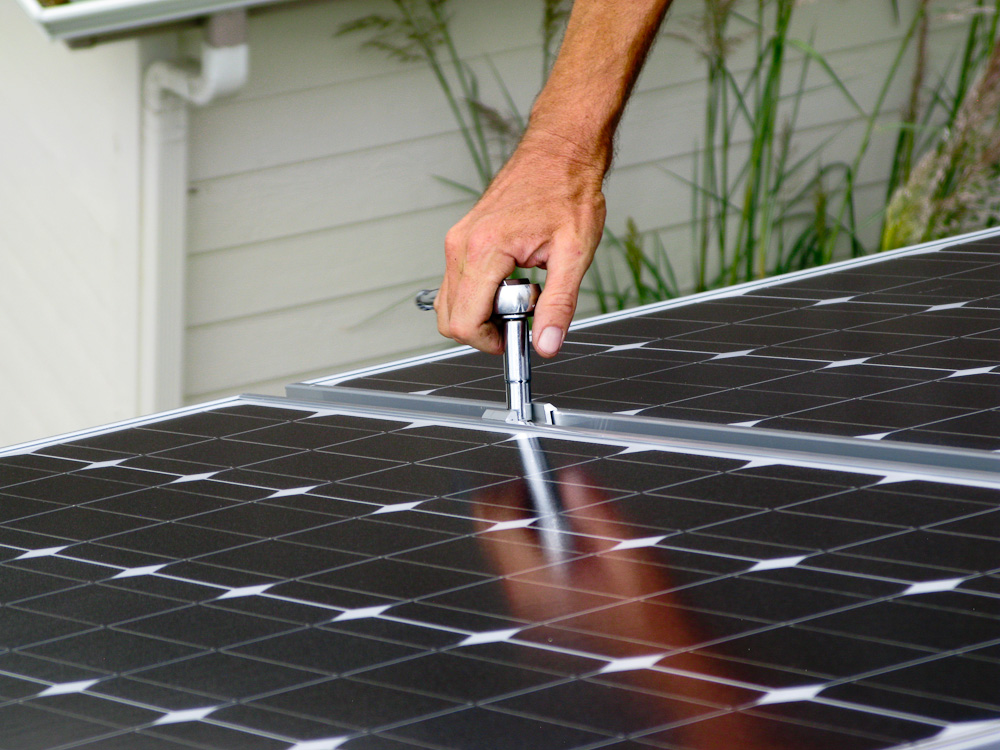
Finally everything fell in place… my shack is running on solar power only. An idea/project I have been pursuing for years but the circumstances were never perfect… until this July. Last fall, a hailstorm took care of the roof and I had to replace it. In July I was able to secure a large chunk of money from our City which is offering a (very) limited number of rebates for Photovoltaic (PV) installations. Together with the federal tax credits it will put the ROI within my life expectancy. Good enough for me.
PV: Panel Monitor
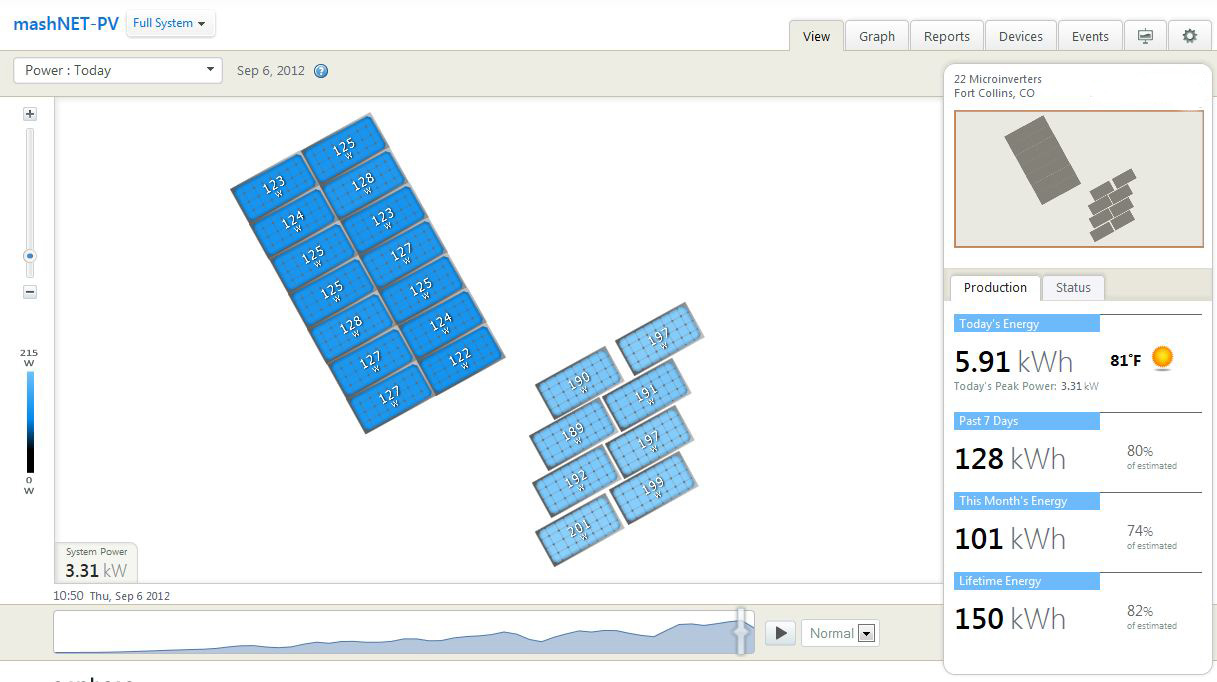
The complete system is a grid tied, 5.5 kW system – 22 panels organized in two arrays (one south and one west facing). Each panel has a microinverter to optimize production and to add some ‘intelligence’ to the system. Monitoring and trouble shooting is a breeze. I can literally see when a bird poops on a panel and degrades my production 🙂
Since my shack consists only of a Yaesu FT-817, I am using the excess energy in the rest of the house. It should produce over 100% of our typical electricity usage per year if everything goes according to plan – I guess time will tell.
Here a short clip of the installation:
Please add your questions and comments through Youtube.
Matt Schnizer, KØMOS, is a special contributor to AmateurRadio.com and writes from Colorado, USA. Contact him at k0mos at schnizer.com.
Remember
W2LJ

Larry Makoski, W2LJ, is a regular contributor to AmateurRadio.com and writes from New Jersey, USA. Contact him at [email protected].
 Ham Radio Deluxe |
 W5SWL Electronics |
 Ham Radio Prep |
 KB3IFH QSL Cards  Hip Ham Shirts  HamRadioAuctions HamRadioAuctions Reliance Antennas Reliance Antennas Enigma Shop Enigma Shop |  morseDX  Ni4L Antennas  R&L Electronics R&L Electronics antennas.us antennas.us QRV QRV |
- Matt W1MST, Managing Editor
