 |
 Ten watts on ten metres
 29 September 2012 | by
 The trouble with having 100 watts at your disposal is that the temptation is there to use it if the going gets tough. So I thought I would avoid temptation and give the KX3 an airing using my attic antennas.
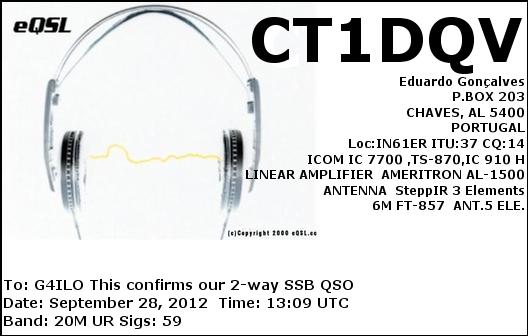
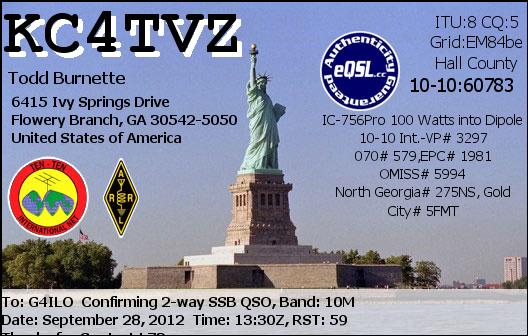
My first contact was on 20m SSB with CT1DQV near the Spanish border. I then popped up to 10 metres. The first contact on Ten was with a mobile station, Steve K0STP/M. Next was Todd KC4TVZ in the prettily named Flowery Branch in the state of Georgia.
After that I called another Steve, K3PIN in Philadelphia. Steve was using a K3 with an amp. On hearing I was using a KX3 he reduced power and was still 5 and 9. Steve complimented me on the audio of the KX3 and played some back. I thought it sounded great, with the KX3’s compressor doing a great job of turning my rather soft voice into a punchy signal.
The final contact of the session was with Joe N2CEP in New Jersey. QSB caused part of my over to fade out but it was still a solid contact. It’s good now and again to remind yourself what can be achieved with low power!

Julian Moss, G4ILO, is a regular contributor to AmateurRadio.com and writes from Cumbria, England. Contact him at [email protected].
Some new wall paper arrived this week….
 |
| Paper work for the "I love me" wall...:) |
My antenna here at VE3WDM is an attic dipole and it's not the best of setups for sure but it gets me on the air. But then there is John N8ZYA , I thought my antenna situation was a challenge. John's QTH is very close to very large buildings and the types of antennas he can use are limited. He uses indoor antennas, he has two Isotron antennas.....these things look like they are from outer space. Then he has just started using a long wire antenna and I believe that is indoors as well. BUT he has been knocking off 1000 mile per watts contacts one after the other. These are just three hams who have encouraged my QRP adventure there are many more out there. So this new 1000 miles per watt certificate is a result from the encouragement and challenge of other QRP and QRPp hams out there!!
Mike Weir, VE9KK, is a regular contributor to AmateurRadio.com and writes from New Brunswick, Canada. Contact him at [email protected].
70MHz TEP from SV2DCD to ZS6BTE
It’s the right time of the year to be looking south on 50MHz and 70MHz for TransEquatorial propagation.
Great to see a report from Leo SV2DCD on his blog about a QSO this week with ZS6BTE.

Tim Kirby, G4VXE, is a regular contributor to AmateurRadio.com and writes from Oxfordshire, England. Contact him at [email protected].
Double-hop Es?
Thursday brought more great 10m propagation. Take a look at the screen-grab below.
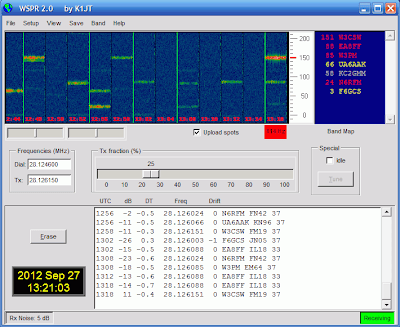 |
| 10m WSPR signals received on G4ILO’s attic dipole |
The bright trace at the top right is the 10 watt signal of W3CSW at 11dB over noise. That is one of the strongest WSPR traces I’ve ever seen, and definitely the strongest signal from a station outside Europe. I think it has to be double-hop Sporadic-E propagation. It is interesting that my previous spot of the same station was 11dB below the noise. My 2 watts produced a positive result from his side as well.
Tuning around the 10m band and there was not the wall of loud signals that such good propagation would suggest. A couple of good old boys from Mississippi and Tennessee were chewing the rag, oblivious to the fact that their signals were bending S meter needles thousands of miles away. But apart from those few stations there was an absence of signals. A station I worked called CQ with no takers for some time afterwards. I tried CQing myself, with no result. To me this also shows that the enhanced propagation was very selective, supporting the theory that it was Sporadic-E propagation.
 |
| 10m signals spotted by G4ILO, 27/9/2012 |
I did make a couple more SSB contacts but once again the digital sector provided the best returns for my efforts.
There is yet more interesting 10m propagation today. I have already spotted stations from VK2 and from Thailand. It’s a shame you can’t WSPR and operate on the same band at the same time. Or rather, it’s a shame that I can’t. So I’ll switch between modes, running WSPR when I’m not actually in the shack and able to use the keyboard or mic.

Julian Moss, G4ILO, is a regular contributor to AmateurRadio.com and writes from Cumbria, England. Contact him at [email protected].
All it needs is a title
I found this on a scrap piece of paper at the club last night. Being a bit thick and not knowing what it was for certain I asked a few people and the response was fairly consistent.
‘Its a…errr…y’know…..that you know used to do as kits for err’
Obviously I wasn’t the only one who was a little stuck. Well I don’t know what it is exactly, but I can have a few guesses – I’ll nail my colours to the mast and suggest it is a current meter of sorts. Anyone else care to join in the guesswork with more confidence? It took me long enough to find out what brass treblet tube is!

Alex Hill, G7KSE, is a regular contributor to AmateurRadio.com and writes from Cumbria, UK. Contact him at [email protected].
USS Slater
At the beginning of the month, I posted about a Special Event Station – K2N, that was going to be operating from NY State aboard the USS Slater.
As luck would have it, my schedule did not permit me to get on the air that day “to give a shot” at working them. This was a disappointment as I love working Special Event Stations, especially those that in anyway commemorate our Military or our Veterans.
Fortunately, Stan WB2LQF announced on the e-mail reflectors about a video posted to YouTube showing the day’s activities. Here it is:
On a different note, I spent the evening printing out certificates for the 2012 NJQRP Skeeter Hunt. The top five finishers, as well as the high scorers from each state or province that entered should be seeing something in their mailboxes within the next week or two.
Again – thanks to all for making this inaugural 2012 event a big success!
Lastly – ATTENTION KIT BUILDERS !!!!!!
The ARRL wants your input, as they are looking for recommendations for “easy to build” kits for first time or Newbie kit builders. The link to the page is: http://www.arrl.org/news/attention-kit-builders-the-arrl-wants-to-hear-from-you.
I recommended the ACME QRP GC100 Gel Cell Charger Kit. It was easy to build and is highly functional and usable. What more could you ask for?
72 de Larry W2LJ
QRP – When you care to send the very least!

Larry Makoski, W2LJ, is a regular contributor to AmateurRadio.com and writes from New Jersey, USA. Contact him at [email protected].
The postman came by today……….
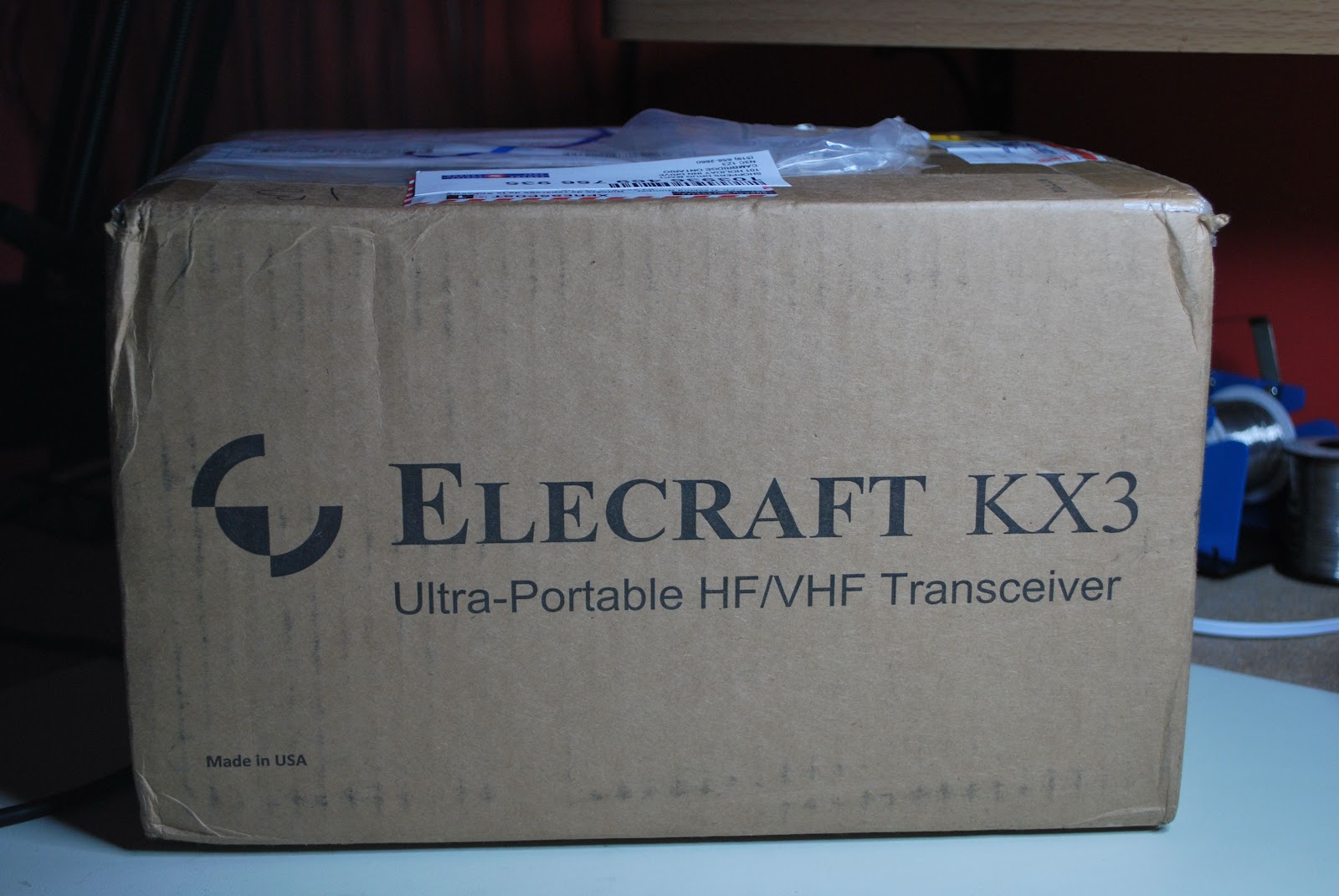 |
| Someone is going to be busy this weekend with a kit!! |
Mike Weir, VE9KK, is a regular contributor to AmateurRadio.com and writes from New Brunswick, Canada. Contact him at [email protected].
 Ham Radio Deluxe |
 W5SWL Electronics |
 Ham Radio Prep |
 KB3IFH QSL Cards  Hip Ham Shirts  HamRadioAuctions HamRadioAuctions Reliance Antennas Reliance Antennas Enigma Shop Enigma Shop |  morseDX  Ni4L Antennas  R&L Electronics R&L Electronics antennas.us antennas.us QRV QRV |
- Matt W1MST, Managing Editor
