 |
 LHS Episode #092: Yardfuls of Cooked Squab
 11 October 2012 | by
  Welcome, everyone to Episode #092 of Linux in the Ham Shack. In order to bring some more Linux users into the fold, we spend some time addressing issues pertinent to them. The first segment discusses some useful video and photo editing software that might be of interest to anyone, ham radio operator or not. The second segment discusses the ease of getting into the amateur radio hobby and how computer enthusiasts can use that shiny new license to expand their computing horizons. Third and finally, we respond to listener feedback. Catch you in a couple of weeks for the next go-around.
73 de The LHS Guys
Russ Woodman, K5TUX, co-hosts the Linux in the Ham Shack podcast which is available for download in both MP3 and OGG audio format. Contact him at [email protected].
Enough with the nitrates, already !!!!
There’s a couple of threads going on the KX3 e-mail reflector today. One is titled “QRP Baloney” and the other “QRP Sausage”. Both threads are a “discussion” trying to determine what QRP “really is”.
I, for one, originally thought that QRP was making sure your transmitter put out 100 Watts or less. Well, that was back in the “Ancient Times”, in the Mesozoic Era when I originally joined QRP ARCI.

Somewhere along the line, that changed and the definition of QRP became a power output of no more than 5 Watts for CW and 10 Watts for SSB.
I am fine with that definition. Period.
Now we have some purveyors of bologna that are insisting that QRP means “5 Watts with ONLY simple, non-gain type antennas”. Wow!
Somehow it’s not in the “Spirit of QRP” to do as much as you possibly can with that 5 or 10 Watts.
Really?
For the record, my antennas (currently – might add a W3EDP soon) are simple, and non-gain – a Butternut HF9V ground mounted vertical and an 88′ Extended Double Zepp wire . But while I am sleeping tonight, if the Angel of the Lord appears in a dream and says, “Lawrence, the Father has decided that you have truly been a good and faithful servant lately. In appreciation, when you wake up tomorrow morning, in your backyard He will provide a 40 foot tower with a multi-band Yagi mounted at the top”.
What? Am I supposed to say, “Dear St. Michael (or Gabriel or Raphael – whatever), I am a QRP Purist – could you tell the Lord to make that a Buddipole instead”?
No …. I don’t think so.
The concept of QRP is to limit your power output. If you take that 5 or 10 Watts and pump them into an antenna “fire hose” so that you SOUND like you’re pumping out a kW, then I say “Bravo for you”. The true “Spirit of QRP” is “doing more with less” – taking those Watts that you’re using, and with a combination of good operating skill and the best antenna you can muster, putting out the best signal that you possibly can. That’s it – no more, no less.
If you listen to the purveyors of bologna, I guess they would also tell you that a guy pumping 500 Watts into a 6 inch piece of copper at ground level is actually QRP.
No …… that would just be stupid.
72 de Larry W2LJ
QRP – When you care to send the very least! (But take the pains to make it sound like the very most!)

Larry Makoski, W2LJ, is a regular contributor to AmateurRadio.com and writes from New Jersey, USA. Contact him at [email protected].
Handiham World for 10 October 2012
Pat Tice, WA0TDA, is the manager of HANDI-HAM and a regular contributor to AmateurRadio.com. Contact him at [email protected].
Pacificon 2012 – Night of New Media Elmers
This coming weekend, October 12, 13 and 14 the ARRL National Convention at Pacificon will take place in Santa Clara, California. The organizers of the 2012 Pacificon event have worked hard to make this years event the best ever.

You’ll find all the usual activities you expect to see and hear at these types of events including top-notch forums, events, vendors and even an astronaut. How cool is that?
I’m especially excited and honored to be a part of a special Friday evening event titled “Pacificon Night of New Media Elmers”. This event brings together some of the most beloved podcasters in the world of amateur radio in what I believe is the first event of its kind.
I will join Randy Hall K7AGE, Chris Matthieu N7ICE and Gordon “Gordo” West WB6NOA through a Skype connection from Colorado for this very special night.
New Media is sort of the all encompassing term to describe podcasting (both audio and video) and blogging. I’m truly honored to share the ranks with dozens of audio and video podcasters and hundreds of bloggers who frequently write and record audio and video all in an effort to help Elmer and promote the hobby and service of amateur radio.
I’m sure Randy, Chris, Gordo and myself are not strangers to you. But perhaps if you are new to the hobby, a very brief introduction might be in order.
Randy Hall K7AGE resides in Grass Valley, CA and has been creating videos for YouTube since 2006. His most popular video content has been his complete instructional videos on the digital mode PSK-31 and how to work the amateur radio satellites. It was Randy’s YouTube video series on PSK-31 which inspired me to upgrade from technician to general so that I could use this wonderful digital mode.
Chris Matthieu N7ICE resides in Phoenix, AZ and is the founder of the first amateur radio social network and very popular 73s.com. Chris also creates instructional videos on his HamBrief.tv website. Chris has a level of enthusiasm and excitement in everything he does which is extremely contagious.
Gordon “Gordo” West WB6NOA resides in Costa Mesa, CA and has helped many get their start in amateur radio through his license study materials. Gordo also appears each week as co-host in the popular Ham Nation video podcast.
Jerry Taylor KD0BIK – Yep…that’s me! Realizing I had a face for radio, I have mostly stuck to an audio only format for my Practical Amateur Radio Podcast which I launched in 2008. I do from time to time post supplemental video material on my YouTube channel. Between the audio podcast and video content, I’ve created over 100 audio and video episodes in the past 4 years all in an effort to help entertain, encourage, educate and inspire others.
I’m told the “Pacificon Night of New Media Elmers” event will be recorded and just as soon as all the post production work can be completed and the finished product uploaded, I’ll be certain to pass along how you can watch this special presentation.
For now, please watch the promotional video below.
Until next time…
73 de KD0BIK
Jerry Taylor, KD0BIK, is a regular contributor to AmateurRadio.com and writes from Colorado, USA. He is the host of the Practical Amateur Radio Podcast. Contact him at [email protected].
10m WSPR spots 10 Oct 2012
 |
| 10m WSPR spots @ G4ILO 10 October 2012 |
A lot more short-skip propagation today, but not much DX.

Julian Moss, G4ILO, is a regular contributor to AmateurRadio.com and writes from Cumbria, England. Contact him at [email protected].
MSc re-start
Last year my employer gave me one of those opportunities that are hard to turn down. After completing 9 years of distance learning to get my degree and masters they offered me the chance to do another masters. Oh dear. Nice but not more study. Trouble is, this kind of thing takes up a lot of your time.
So it’s going to be another 8 or 9 months of intense study and assignments interspersed with family, cycle training, work and ham radio. I still plan on optimising my Cobwebb antenna, setting up the QRP QRSS/WSPR beacon and attempting to get on air. By the end of this I should either have a degree in time management or failed in everything.
On the bright side I should be out of the books in time for next years Es season at the very least.
Alex Hill, G7KSE, is a regular contributor to AmateurRadio.com and writes from Cumbria, UK. Contact him at [email protected].
Antenna contemplations
The wire from my Inverted L End Fed Zepp met its doom this past August.. I went outside after a particularly bad evening of thunderstorms to find wire hanging down on the back porch and the other end hanging down the mast that was supporting the far end. The gusty winds caused it to fall apart somewhere in the middle.
I didn’t use it much as I could never get a decent match on the antenna tuner. For whatever reason, perhaps the truly random length of it and the lack of a decent counterpoise, it always gave my auto tuner fits and starts.
This evening (and for the past few evenings) I was following a discussion on W3EDP antennas on the Polar Bear QRP Ops mailing list. I did a lil’ Googlin’ and came up with this:
http://www.qsl.net/w5rin/Projects/Antennas/ae5vv/W3EDPAntenna.pdf
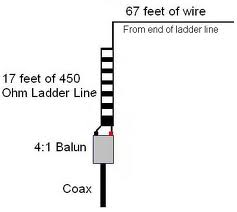
I can (I think) definitely fit a 67″ hunk of wire along the run that was occupied by my ill fated EFZ. According to the .pdf, that should make operations on 80 Meters and up possible. However, I would really like to find a way to squeeze an 85″ piece of wire, in order to make operations possible on 160 Meters, too. I know, not nearly an ideal antler for 160 – but something is better than nothing (which is what I have right now).
I have the ladder line and I have a heavy duty 4:1 balun that my friend Bob W3BBO was not using and sent me. I have the wire and the coax is still there. I just need to cobble one of these together and get it up before the weather really turns nasty for the winter.
72 de Larry W2LJ
QRP – When you care to send the very least!

Larry Makoski, W2LJ, is a regular contributor to AmateurRadio.com and writes from New Jersey, USA. Contact him at [email protected].
 Ham Radio Deluxe |
 W5SWL Electronics |
 Ham Radio Prep |
 KB3IFH QSL Cards  Hip Ham Shirts  HamRadioAuctions HamRadioAuctions Reliance Antennas Reliance Antennas Enigma Shop Enigma Shop |  morseDX  Ni4L Antennas  R&L Electronics R&L Electronics antennas.us antennas.us QRV QRV |
- Matt W1MST, Managing Editor
