 |
 Cracking the Whip…
 13 October 2012 | by
 The Miracle Whip, that is.
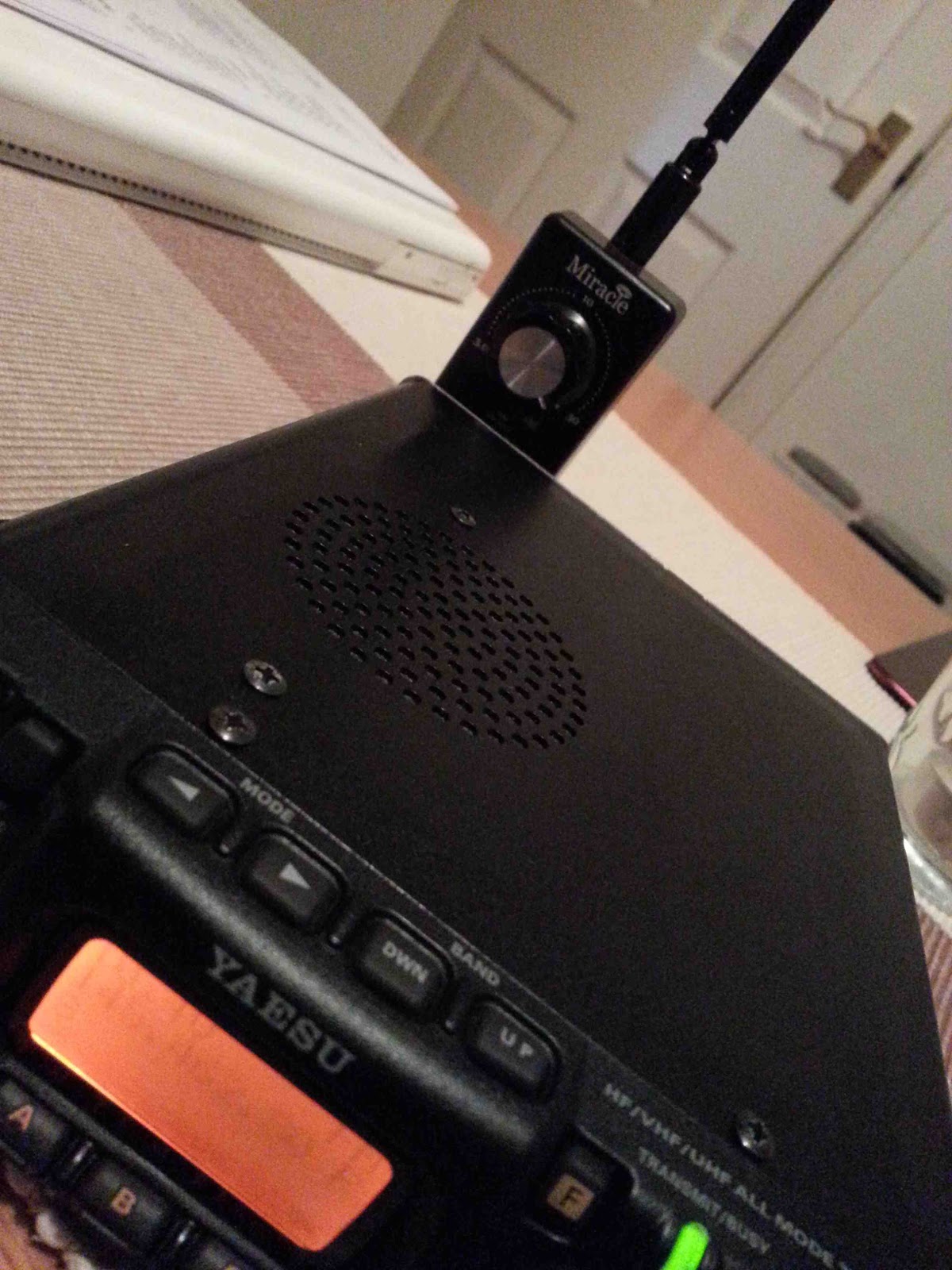
I only acquired my fantastic Yaesu FT-817 to give me 5W of SSB on V/UHF from windswept Welsh hilltops. I couldn’t resist a second-hand bargain of a Miracle Whip to see what I could achieve with QRP on the HF bands.

The ‘817 and Miracle Whip
It’s a classic Fred-and-Ginger combination that has been blogged, reviewed and You-Tubed extensively along with other rig/telescopic antenna double-acts. Yes, it’s only 57” of radiating metal with a rather good tuner at the base, but thanks to the current propagation conditions it at least enables you to experience the miraculous. Its advantage lies also in its simplicity. It means you’ll use it because it connects, extends and tunes in seconds. I like that! Connect. Extend. Tune.
I’ve been having fun with the ‘817 on my lap, indoors, running off its own batteries (=2.5W max) and chatting to stations on the higher bands in places such as St. Petersburg and the Ukraine with 5/9 reports. You simply can’t get this thrill with a big station. It’s reconnecting to the magic of radio – which is a real miracle every time a contact comes out of the ether. I’m even moved to ‘Tweet’ a new QSO with excitement! (@MW0DNK).
I’ve started at 10m, sliding my way down the bands as the challenge rises. Using 5W (external battery) I managed a QSO with Algeria yesterday on 15m, 4/3. I finally cracked 20m with a shorter, brief contact to Spain. I had a 5m counterpoise wire connected this time.
On 40m I’m simply not heard, at least not yet. This is where I need to start learning some CW skills. This will open up the lower bands for me. Until then, living on the Isle of Anglesey, I might head to a beach and try getting some salt water under my portable station to see if I can crack the ‘40m SSB phono challenge.’ Listen out for me.

Connect. Extend. Tune.
On 2m the antenna is a ¾ wave. I’ve no idea what the radiation pattern is for this length, but it seems to work very well. Unfortunately the antenna is just short of a ¼ wavelength at 6m, so perhaps a wire clip-on extension is the answer.
Rob Law, MW0DNK, is a regular contributor to AmateurRadio.com and writes from Anglesey, Wales. Contact him at [email protected].
Cracking the Whip….
 |
| The '817 and Miracle Whip |
 |
| Connect. Extend. Tune. |

Rob Law, MW0DNK, is a regular contributor to AmateurRadio.com and writes from Anglesey, Wales. Contact him at [email protected].
10m WSPR spots 13 Oct 2012
 |
| 10m WSPR spots @ G4ILO 13 October 2012 |
A day of poor propagation, enlivened in early afternoon by an opening to Argentina (LU8ENU). I was taking a walk at the time so could not take advantage of it.

Julian Moss, G4ILO, is a regular contributor to AmateurRadio.com and writes from Cumbria, England. Contact him at [email protected].
Digital Dinner
I see that Pacificon has organized a Digital Dinner this evening.
I suppose it will be a bit of this and a byte of that.
I’ll get my coat…

Julian Moss, G4ILO, is a regular contributor to AmateurRadio.com and writes from Cumbria, England. Contact him at [email protected].
10m WSPR spots 12 Oct 2012
 |
| 10m WSPR spots @ G4ILO 12 October 2012 |
Not a very lively day’s catch but some good propagation in evidence. Two-way spots with EA8FF and 4X1RF seem to be a regular occurrence. More noteworthy are two-way spots with PY2SDR and K1UTI.
Just a reminder that G4ILO is using 2W to an attic dipole.

Julian Moss, G4ILO, is a regular contributor to AmateurRadio.com and writes from Cumbria, England. Contact him at [email protected].
10m WSPR spots 11 Oct 2012
 |
| 10m WSPR spots @ G4ILO 11 October 2012 |

Julian Moss, G4ILO, is a regular contributor to AmateurRadio.com and writes from Cumbria, England. Contact him at [email protected].
What is QRP?
Over on the Elecraft KX3 Yahoo group an argument has been raging as to whether running low power into a tower-mounted beam is QRP. Some folk feel that QRP also means using simple no-gain wire antennas. Others argue strongly that using an antenna with gain is a perfectly valid way to do more with less, that “less” relates to power and nothing else.
On his QRP – Do more with less blog, Larry W2LJ nails his colours (colors?) firmly to the mast. Saying those who use towers and beams aren’t QRP is baloney, claims Larry.
Personally, I think QRP is whatever the ARRL, G-QRP Club, QRPARCI or CQ Contest committee says it is. If you are competing in one of their contests or applying for one of their awards you must follow their rules. And the only limitation they specify for the QRP category is power level. So I don’t think it is possible to win an argument that QRP includes any other restriction besides low power. But I can understand why some people feel that those who have a lot of aluminium in the air have an advantage over those who only use a piece of wire and that lumping them into the same category is unfair.
To really put the cat among the pigeons does the spirit of QRP include the use of store-bought or kit-built equipment too? I certainly feel that the art of QRP is strongly allied to the practise of home-brew, but I still claim to be QRP when operating my FT-817, KX3 or K2. Should the ham who operates an Elecraft KX3 belong in the same class as one who uses a two-transistor Pixie?
Perhaps we need a new term to define this kind of minimalist operation?

Julian Moss, G4ILO, is a regular contributor to AmateurRadio.com and writes from Cumbria, England. Contact him at [email protected].
 Ham Radio Deluxe |
 W5SWL Electronics |
 Ham Radio Prep |
 KB3IFH QSL Cards  Hip Ham Shirts  HamRadioAuctions HamRadioAuctions Reliance Antennas Reliance Antennas Enigma Shop Enigma Shop |  morseDX  Ni4L Antennas  R&L Electronics R&L Electronics antennas.us antennas.us QRV QRV |
- Matt W1MST, Managing Editor
