 |
 2012 CQ World Wide DX CW | The First List
 1 December 2012 | by
  |
| The First List |
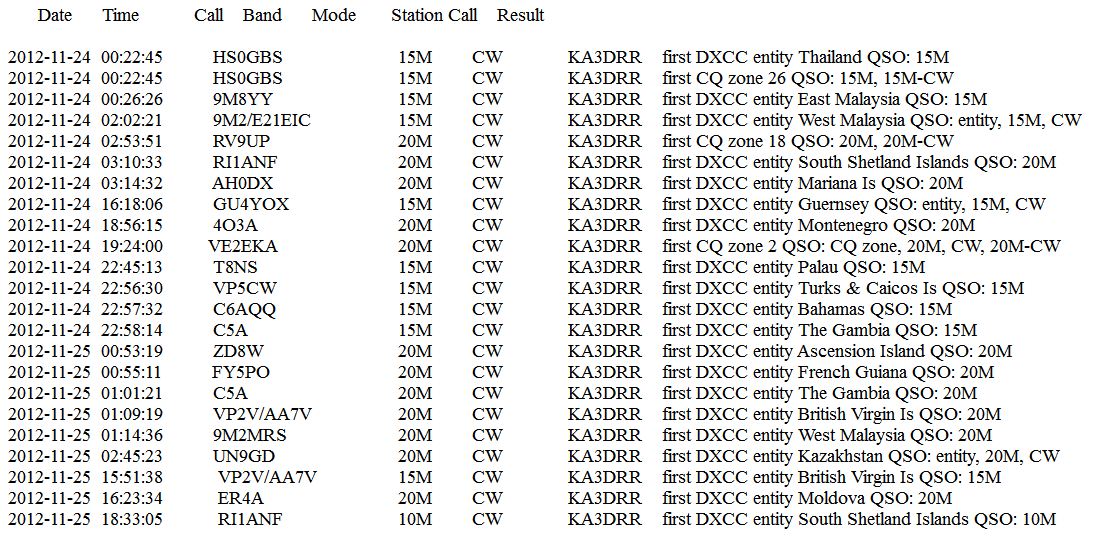
DXLab Suite generates a summary report after an event and this is my first list after last weekend. I really never know what the list may look like while in the game. As you can see, it is difficult to accomplish something like this over the course of a generic ham radio weekend, instead; my first list was accomplished across 21 hours during the ‘big event’.
You can have a lot of fun no matter what your shack hardware might be or what type of antenna system.
Chase DX with patience and respect.
W3EDP success – part 2
At the urging of my friend Bob W3BBO during our weekly Saturday Echolink BS session, after we were done, I went down the basement shack and removed the Butternut from my K3. In “Antenna 1”, I hooked up the 88′ EDZ and in “Antenna 2” I hooked up the W3EDP.
I then proceeded to go to 160 Meters to go listen to the contest traffic there.
Switching between “Antenna 1” and “Antenna 2”, I was able to make some comparisons between the two. First off, there was virtually no noticeable difference in the receive quality of any of the signals I heard. Both antennas gave me loud, strong signals to listen to. Neither was noticeably weaker or quieter than the other, and switching back and forth was instantaneous. The comparison in reception was easy to make.
On transmit, it was a different story. The best match I was able to get with the EDZ on 160 Meters was between 2:1 to about 1.6:1. And to get that match, the K3’s autotuner took it’s good sweet time – I’d say about 5 seconds or longer to achieve that match (seems like much longer while those relays are chattering away!). The W3EDP? A quick little “brrp” lasting about a second or two at the most, and a match that was 1.0:1.
In the space of a matter of a few minutes, I made contest QSOs with K8NVL in Ohio, WA1BXY in Rhode Island and NX2X in New York. All of them with the W3EDP.
Is this the solution I am looking for for 160 Meters? No, I’m not that stupid. But it will allow me to have some 160 Meter fun this winter until I get something dedicated built. Of course, that project has been on my radio project horizon for two years now. Next spring/summer I am really going to have to follow through. But for now, this will do.
72 de Larry W2LJ
QRP – When you care to send the very least!
Larry Makoski, W2LJ, is a regular contributor to AmateurRadio.com and writes from New Jersey, USA. Contact him at [email protected].
My 10,000 Hour RadioSport Challenge | 9,436 – 21 = 9,415 To Go
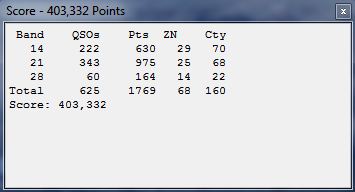 |
| 2012 CQ World Wide DX CW Results |
Good afternoon from the #hamr zone where a winter storm is raising a little havoc outside the shackadelic sliding doors. On the other hand, the stoke rages on after a sensational last weekend logging DX in the pilot’s seat at my mentor’s shack. I want to thank John, W6SL for the time on the high bands because several new entities and one additional zone went into my computer logger.
Changing The Game
N1MM contest logger function keys were fixed and what a difference maker versus sending callsign from the paddles then pressing an Icom 756Pro function key to send my exchange. Instead, with a fully operational keyboard, I sent our exchange with enter send message (ESM) or using F5 key for partial callsign with question mark.
The F5 key made a difference when a cluster swarm simultaneously pounced on my transmit frequency.
I’m not a qualified electrical engineer but I don’t think a receiver filter is designed for or capable of handling signals driven by cluster technology that is simultaneous ‘clicking’ of tens, hundreds, or thousands of band maps pointed in the direction of one multiplier.
Cluster Pounce
I’d like to cite an example of cluster pounce gone out of control. It was mid-Sunday morning and I was spinning the dial when a swarm of signals exploded on a Zulu Sierra One in South Africa. Perhaps, for many of us, this station was a double-double that is new zone, new multiplier. Africa is difficult enough from zone three and, a double-double, was seriously significant.
I felt for the operator thousands of miles from the Five Cities of California. The swarm was out of rhythm with the Zulu Sierra One therefore throwing out the rhythm for all of us. The moment was cataclysmic because the operator simply could not manage the cluster pounce — too many signals arrived at once with their callsigns sent immediately toward South Africa.
He tried. I was frustrated. And the double-double multiplier in South Africa vanished from the listening frequency.
Stormy Paths
On the other hand, propagation paths into Asia and Europe seemed short lived for this season whereas Saturday was better than Sunday. I enjoyed stable 15m conditions into Asia on Friday night with two hours of 60 plus Qs going into the log. However, 20m was search and log, with 10 minute bursts of rate toward Asia as well.
Twenty meter antenna is 6 elements at 50 plus feet and 15m system is 6 elements at sixty five feet on the left hand tower. Each antenna was manufactured by KLM of late 70s and early 80s fame. Additionally, ten meter antenna is 5 elements, at 60 feet on the right hand tower.
Saturday is everything in RadioSport with the polar path into Europe reasonably stable between 25 and 30 degrees on 15m and twenty meters. I established a decent rate frequency on 15m into EU while mostly searching and logging on twenty meters.
In the meantime, Central, South America, and Caribbean multipliers and zones pumped 10m numbers however; I missed additional multipliers on the same band as Saturday conditions were locally notable.
Conclusion
Overall, RadioSport’s ‘big event’ delivered serious ham radio fun through last week despite stormy conditions and short lived paths toward major continents. I spent more time searching and logging even though my band map was populating with multipliers. Instead, I watched one cluster for band openings and put that information to use, as spotting efficacy is oftentimes sketchy at best.
I recommend spinning the dial starting at the high end of the band and work’em as you descend to the lowest end of the band. Additionally, if using assistance, think about using that information to spot when a band is opening toward a specific continent. I’m sharpening my search and log technique as band maps tend to draw my attention away from the frequency dial.
Contest on!
I should practice what I preach…………
 |
| All is going well.....for now |
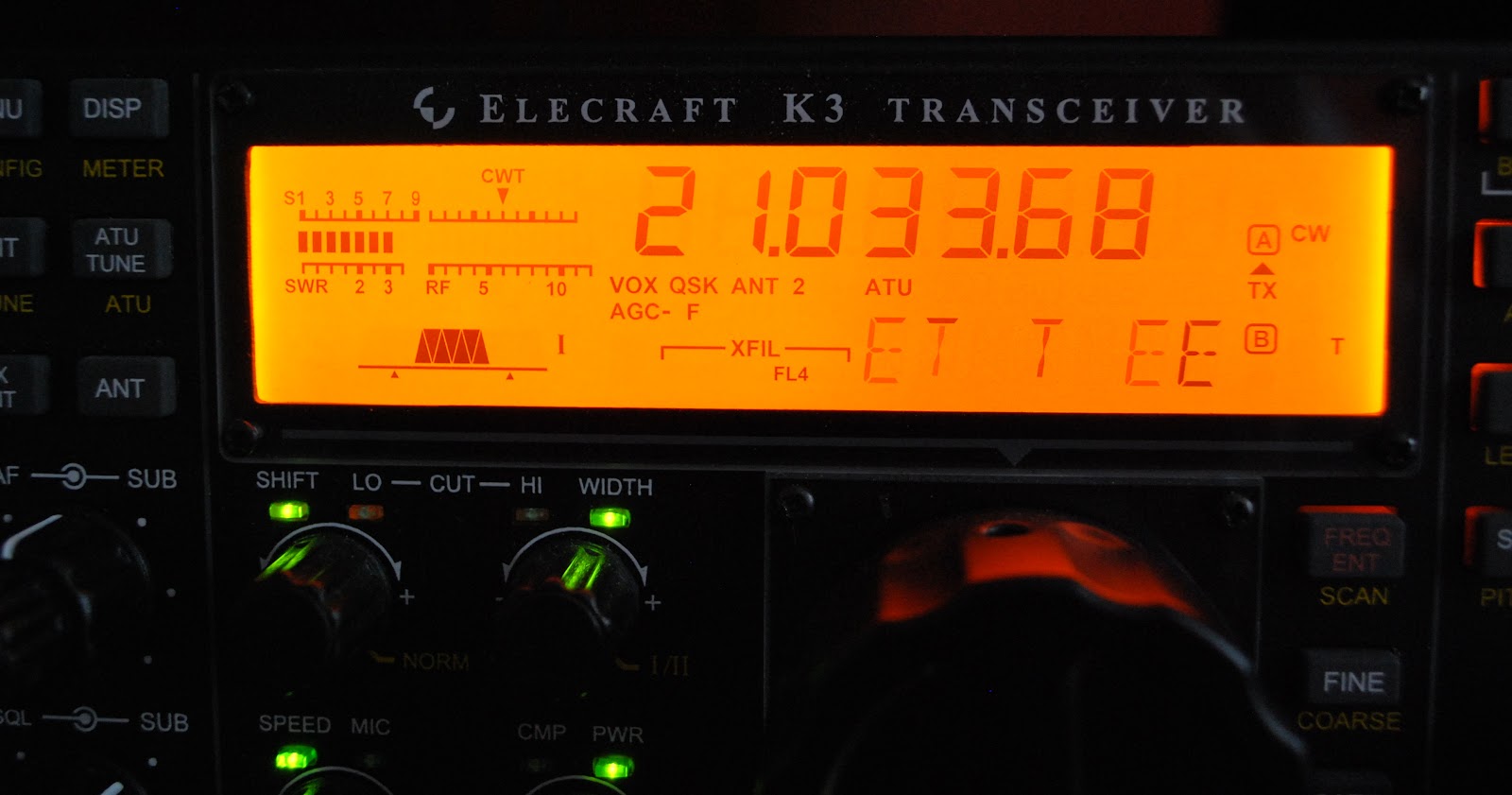
Last weekend I participated in the CQ WW CW contest and in a post just before the contest I shared some things I included and avoided regarding contests. One would think that because it's my list and I was "preaching" about it on my blog that I for sure would be one to follow it.........WRONG and boy did I pay for it!! The contest was going along just fine the propagation was great, 10m was wide open and my QRP signal seemed to be getting out just fine. Now this being a CW contest and a world wide one at that I found the CW was being sent as fast as a bullet. To copy these fast calls was taking more time than I wanted to
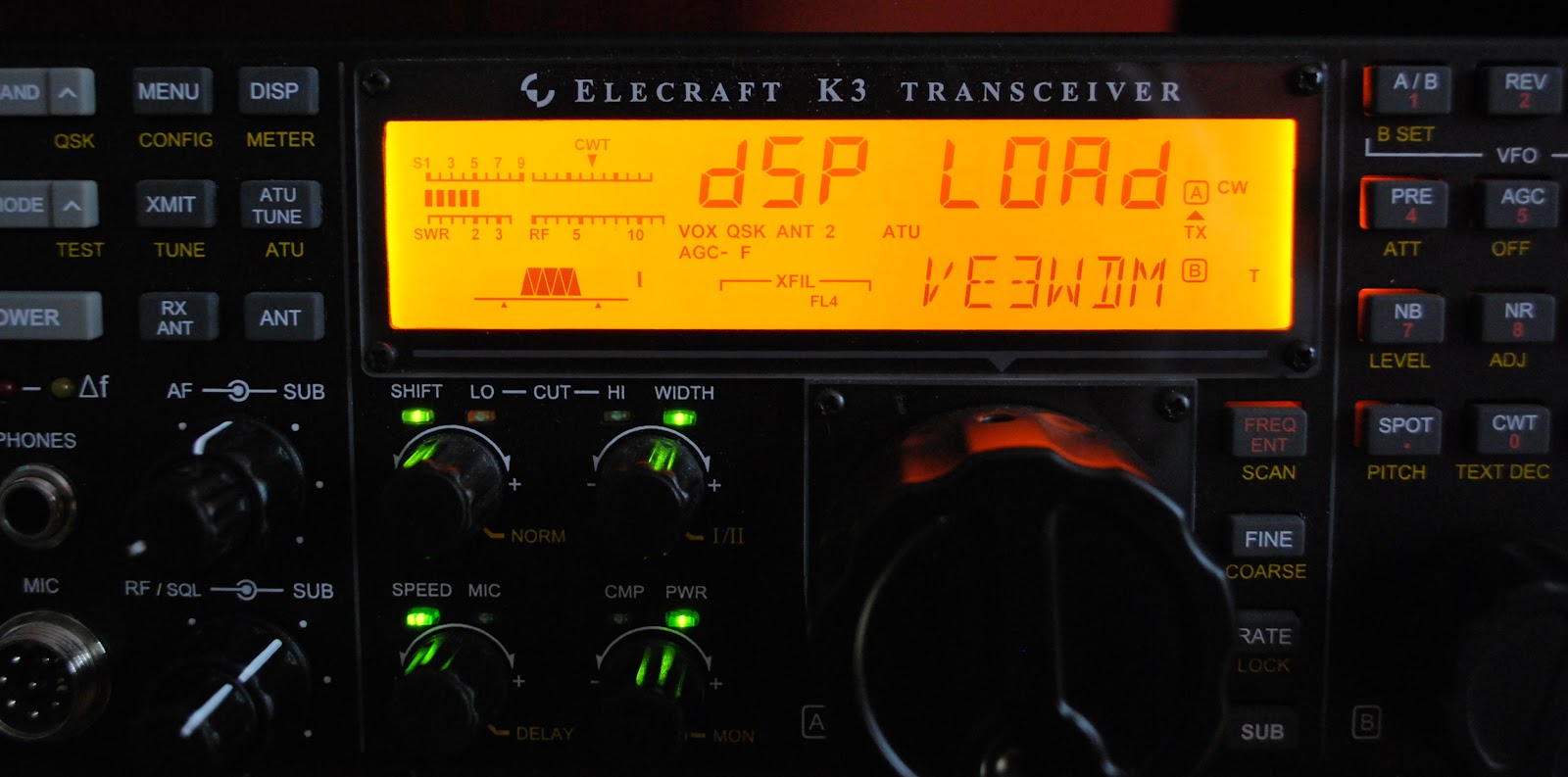
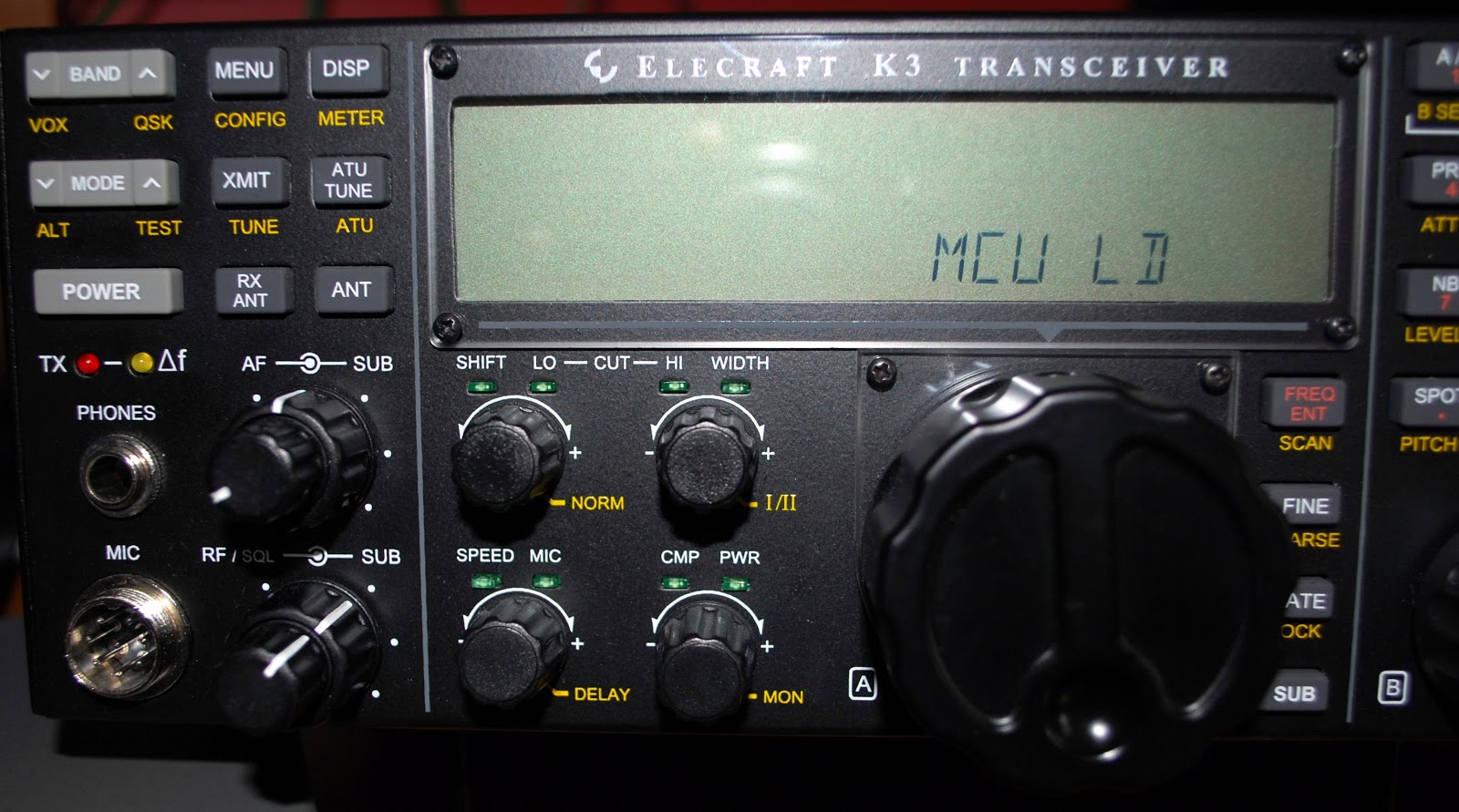
spend, but the stations were much needed multi's or possible DXCC's. In the past this is were my trusty Elecraft K3 has helped me out. The K3 has the ability to copy code and scroll it at the bottom of my Elecraft P3.......but it was not happening and no matter what I adjusted I could not get the rig to read the code.
 |
| Firmware download going well |
Mike Weir, VE9KK, is a regular contributor to AmateurRadio.com and writes from New Brunswick, Canada. Contact him at [email protected].
More on the Palstar KH-6 50MHz handheld
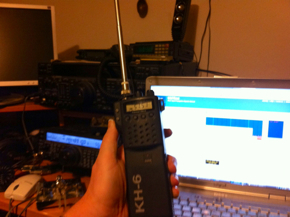
Perhaps you remember a few months ago, I picked up the KH-6 50MHz handheld from eBay. To be truthful I hadn’t done a lot with it.
I was a bit disheartened when I took it up White Horse Hill and failed to hear either the GB3RAL beacon at Harwell or the GB3ZY repeater at Dundry, both of which I thought should have been audible. So, I had a feeling the rig was perhaps a bit deaf.
A few days ago I was moved to investigate a bit more and the results were interesting. I examined the ‘rubber duck’ which had come with the rig. It turned out to be an AOR scanner antenna – probably not very efficient at all on 50MHz. Connecting the rig up to the 50MHz antenna on the roof, the GB3RAL beacon was end stop!
On my desk was another scanner antenna from my Dad’s old scanner which was a telescopic rod antenna. Although still rather less than a quarter wave on 50MHz it stood a better chance. Promising too was the fact that I could weakly hear the GB3RAL beacon keying.
So, I think the receiver’s just fine. I’ll take the rig up the hill next time and see what I can hear. Incidentally, the battery pack has great life – it’s held its’ charge over an extended period. Impressive!
Tim Kirby, G4VXE, is a regular contributor to AmateurRadio.com and writes from Oxfordshire, England. Contact him at [email protected].
QRP Fox Hunting thoughts
I haven’t been a Fox in a couple of years now. But in going through the logs that our current crew of Foxes have been posting after the hunts, I am seeing a lot of new calls compared to the logs that I had posted in the past.
Now this could mean one of two things:
1) Guys are changing their calls through the Vanity system, or:
2) We’re attracting a nice group of newer hounds.
I think it’s the latter and that’s a really good thing to see. The news of how fun this is, is getting out to people just getting into QRP. And as a bonus, I am still seeing a lot of the familiar calls that you would expect to see, so obviously retention is high. Just goes to show how addictive that QRP Fox hunting can be.
If you’re a QRPer and you’ve never tried this before, you are in for a world of fun. The entire concept and the rules can be found here: http://www.qrpfoxhunt.org/
It’s not hard and there’s nothing to be afraid of – it’s all about a bunch of wacky QRPers getting onto the air and causing our own, friendly melee’. Nobody bites and nobody gets hurt – even the Foxes. (For the PETA crowd – NO actual Foxes were hurt or killed in the process of the QRP Fox Hunts!) About the only bad thing that can happen is getting your ears blown out by a strong signal; but if you keep your AGC on …
then nobody gets hurt.
So ….. what are the benefits of participating in “The Hunts”?
A) You get to know your equipment better. The ins and out of it – what works and what doesn’t. Pardon the over done cliche’, but you really do “become one with your rig”.
B) You get schooled in several virtues – patience, humility, persistence being among them.
C) You have fun
D) You learn the proper way to operate in a pileup (as well as the NOT proper ways) – and if you choose to volunteer to be a Fox, you learn this from BOTH sides, in a microcosm sort of way. I really have to attribute the experience I gained through the Fox hunts as a major help in allowing me to successfully navigate several DXpedition pileups with only QRP power.
E) You have fun.
F) You learn about propagation and your antennas and what works compared to what you THOUGHT would work. You learn that conventional wisdom isn’t always so …… conventional.
G) You have fun.
H) You can make some really great, long lasting friendships with some outstanding folks – who you might never meet face to face. But these friendships can end up becoming your most valued ones.
Did I mention that you have fun?
Now a thought had come to me – a question really …….
I know the QRP Fox Hunts were the brainchild of Chuck Adams K7QO – I was actually there, in the beginning, participating as N2ELW. But has this caught on in other countries besides here? I don’t see it mentioned on any of the major QRP e-mail lists and I know there are a ton of you dedicated QRPers out there that read this blog that are not from this side of The Pond. Is there a European or UK or other (Russian, VU ……. ) version of this going on? If there’s not, there should be! It’s so much fun and in addition to that, the friendships that are forged because of the hunts are just priceless. Heck, the friendships made are more valuable than the hunts themselves!
Just sayin’
All that said – the QRP Fox Hunt Committee, the Foxes, and yes, even the Hounds do such a great job, keeping this fun (there’s THAT word again) and exciting. A big tip o’ the hat and a hearty “Thank You” to all of them.
72 de Larry W2LJ
QRP – When you care to send the very least!
Larry Makoski, W2LJ, is a regular contributor to AmateurRadio.com and writes from New Jersey, USA. Contact him at [email protected].
Skeeter Hunt Update
After some delays and setbacks, certificates for the 2012 NJQRP Skeeter Hunt have gone out this week.
The top five finishers; as well as the high scorer for each state and province that participated will be seeing something in their mailbox within the next few days to a week, hopefully.
Also, those of you who home brewed a key for the event will be receiving a special certificate of appreciation. Those of you who home brewed, but qualified for a high score certificate, will receive the score certificate instead.
Thanks again for your participation and please be on the lookout for the announcement for the 2013 NJQRP Skeeter Hunt somewhere around the beginning of May 2013.
72 de Larry W2LJ
QRP – When you care to send the very least!
Larry Makoski, W2LJ, is a regular contributor to AmateurRadio.com and writes from New Jersey, USA. Contact him at [email protected].
 Ham Radio Deluxe |
 W5SWL Electronics |
 Ham Radio Prep |
 KB3IFH QSL Cards  Hip Ham Shirts  HamRadioAuctions HamRadioAuctions Reliance Antennas Reliance Antennas Enigma Shop Enigma Shop |  morseDX  Ni4L Antennas  R&L Electronics R&L Electronics antennas.us antennas.us QRV QRV |
- Matt W1MST, Managing Editor
