 |
 CW Academy FB
 27 February 2013 | by
 Yesterday I had my final CW Academy session. As an indication of how good it was and how much we valued it, not one of the five of us ever missed a single session! There were sixteen hour-long sessions over two months. And it was all free!
Late last year I noticed a couple of messages from Jack W0UCE inviting hams keen to improve their CW skills to join in and pointing them to this page detailing the thinking behind CW Academy’s approach.
What was on offer was a series of online sessions in a small online group re-learning the code. The hour-long sessions are designed to get you to read in your head and to break or avoid habits (like writing everything down) that will prevent you from increasing speed later.

The target for our beginner group was around 20wpm. The sessions took place using Oovoo which is like Skype for groups. (Apparently it’s important that the instructor can see who is having difficulties.) We logged on twice a week. In between times we were expected to practice daily using a nifty online tool, Morse Translator. This neat web app lets you practice listening to code and adjust both character speed and Farnsworth spacing. Our default setting from day one was 20wpm character speed with gaps to yield an effective speed of 10wpm. Morse translator is a great model to help practice sending as well. I found including sending practice helped lock in recognition of words.
Our teacher or Elmer was Rob K6RB. He shared his intense enthusiasm for CW with us as well as his experience on air. After a few weeks of walking us through the alphabet, numbers and prosigns and practising new letters and words, Rob gradually upped the speed. Then the rubber hit the road about week five when we were QSOing back and forth. Rob patiently introduced us to the format of the typical QSO, contesting and even handling a DXpedition. His aim was to prepare us for these so that we’d know what to expect and what was expected of us when we joined in. We got the benefits of decades of operating experience in these sessions.

The CW Academy is an initiative of the CW Operators Club. CWops is international in focus and it was great to be accommodated as the token DX in the group. As they say on the webpage “available to anyone, anywhere”.
The training has got me confident to get back on the air with a practical code speed and as a bonus, interested for the first time in having a go at contesting, initially the CWops fortnightly Mini-CWT contest which we spent a couple of sessions rehearsing.
A big TU to CWops and Rob K6RB for all their efforts running the CW Academy.
Stephen Rapley, VK2RH, is a regular contributor to AmateurRadio.com and writes from New South Wales, Australia. Contact him at [email protected].
Monitor RFI issue…..
 |
| RFI from new monitor |
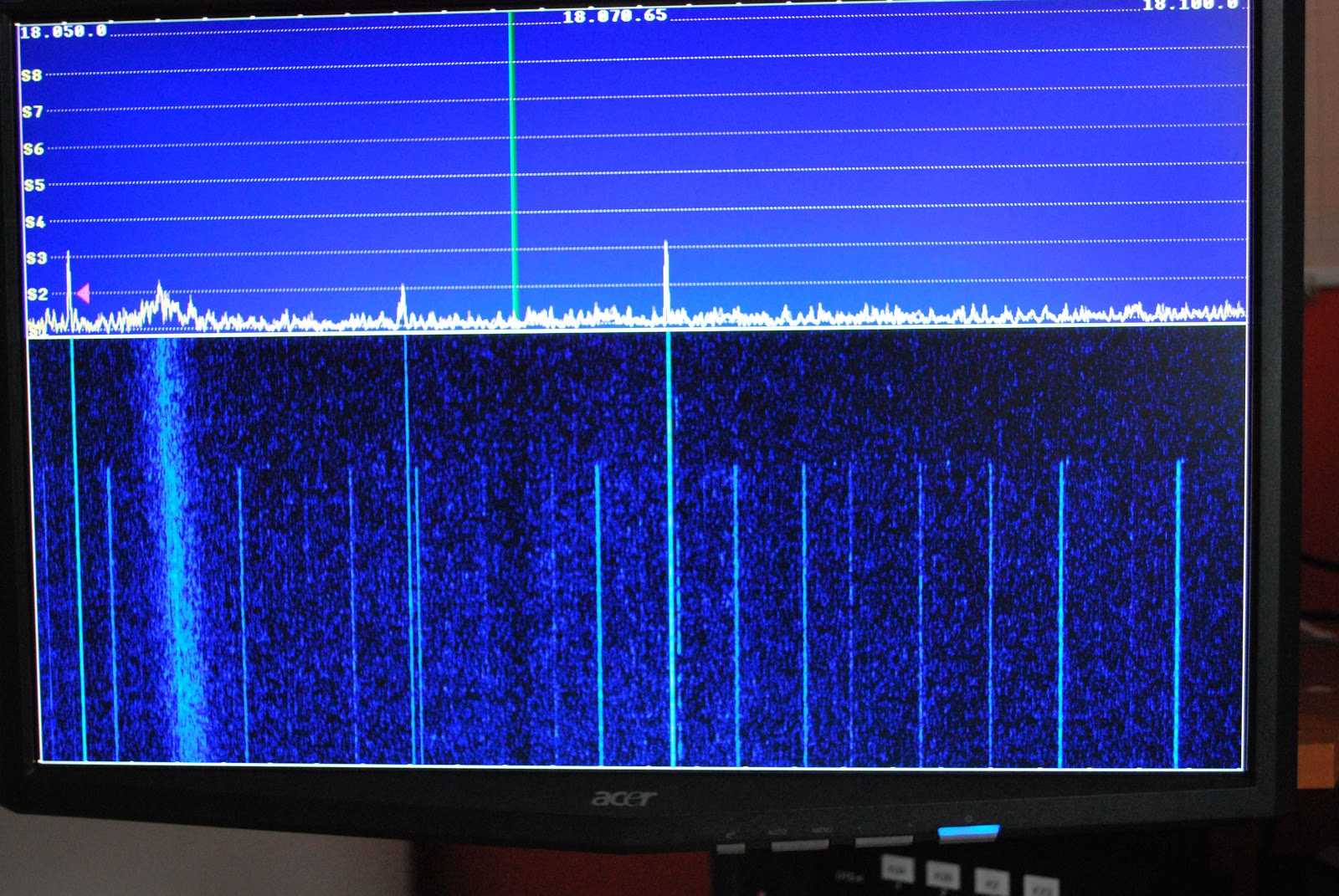 |
| Both monitors off |
Mike Weir, VE9KK, is a regular contributor to AmateurRadio.com and writes from New Brunswick, Canada. Contact him at [email protected].
Handiham World Weekly E-Letter for 27 February 2013
Pat Tice, WA0TDA, is the manager of HANDI-HAM and a regular contributor to AmateurRadio.com. Contact him at [email protected].
Name calling
Something that’s been puzzling me for the last couple of years, particularly on the digital modes, is the number of people who address me by name before I’ve told them. These are not stations I’ve worked before – KComm will alert me to those. But increasingly often when I reply to a station they will come right back with “Good afternoon, Julian.” I’ve even had people end JT65A contacts with “TU JULIAN 73”, despite the fact that the operator’s name is not part of the exchange.
I’m not egotistical enough to think that half of hamdom know my name because of my blog. I’ve had people address me as “Mr Julian Moss” which I think is a bit formal for the amateur bands. But it makes me suspect that some database is involved.
It would shake my faith in the parsimony of hams to think that 50% – because that’s about how often it happens nowadays – have stumped up for a subscription to QRZ. But if they haven’t, where do they get the information from? Is there a free callsign lookup database I haven’t heard of? And if there is, doesn’t the fact that you can access a station’s details at the click of a button render somewhat pointless the rest of the QSO?
Julian Moss, G4ILO, is a regular contributor to AmateurRadio.com and writes from Cumbria, England. Contact him at [email protected].
Show Notes @#100
Introduction:
- Promo: Listen to the Linux Basement Podcast.
- Happy Birthday, Richard!
- Yes, folks, it’s episode 100 of Linux in the Ham Shack. We’re now eligible for syndication!

Topics:
- In celebration of our 100th episode, several of our listeners in the chat room call in and participate in a roundtable discussion. Participants include Harrison (VE2HKW), Brian (K5BPC), and Jon (KT4KB). Unfortunately, noise on Jon’s connection prevented him from staying on the line.
- We received voice messages from listeners Michelle, Joy, Rich (KD0RG), Doug (N6LMX), Nick, Jon, “Major J”, and Harrison (VE2HKW).
- Feedback from Matt (KD8SZG), who asks which would be a better choice for a new HF user: a used IC-7000 or new FT-857D. The consensus is to choose the new FT-857D.
- Jon, KT4KB, asks how Russ and Richard met.
- Richard makes a shocking announcement!
- We have a short discussion of FreeDV vs. D-STAR, followed by a brief discussion of various Linux distributions.
- Richard makes a few final comments.
Contact Info:
- Contact Richard at [email protected], Russ at [email protected], or both at the same time at [email protected].
- Listen to the live stream every other Tuesday at 8:00pm Central time. Check the LHS web site for dates.
- Leave us a voice mail at 1-909-LHS-SHOW (1-909-547-7469), or record an introduction to the podcast.
- Sign up for the LHS mailing list.
- Sign up for the MAGNetcon mailing list.
- LHS merchandise is available at the Merch link on Web site. Check out the Badgerwear or buy one of the other LHS-branded items at PrintFection.com/lhs or Cafe Press. Thanks!
- Thanks to Dave from Gamma Leonis for the theme music.
Music:
- Gun Slinger by Daniel Worth.
Russ Woodman, K5TUX, co-hosts the Linux in the Ham Shack podcast which is available for download in both MP3 and OGG audio format. Contact him at [email protected].
100 years ago
Last night, I received an e-mail from Bob W3BBO about an item he saw in The County Hunter News. The article was written by Bob Voss N4CD, and it concerned a book written 100 years ago, entitled “Bert Wilson, Wireless Operator“. The book has been made available through Project Gutenberg.
Larry Makoski, W2LJ, is a regular contributor to AmateurRadio.com and writes from New Jersey, USA. Contact him at [email protected].
Amateur Radio Kit Roundup – Updated 2/26/2013

Splinter Transceiver from BreadboardRadio.com
Kit building appears to be on the rise again. With so many people talking about it lately I attempted to research sources for kits, only to find out that there wasn’t a single-source for Ham Radio kit suppliers.
I decided to put together a good list of sources for kits that are currently available. Many of these are for QRP operation, but a few are full-featured professional transceivers (Elecraft, DZ). On the beginners side there are a few sources that stand out: Hendricks has a great assortment of kits, including some SSB QRP equipment. QRPme offers the inexpensive, easy-to-build tuna-can products, and I would like to make special mention of the Four State QRP Group NS-40 which has the coils etched right into the PC board! What a great idea! I’ve covered trasmitters, transceivers, and some receivers here. Some accessories are mentioned in the source descriptions.
Revised 2/18/2013 Changes in Hendricks, YouKits, Tony Parks. Added CR KITS, and BreadBoard Radio.
Revised 2/20/2013 Added K5BCQ & K5JHF Kits
Revised 2/26/2013 Added Kit Radio Company, GQRP Club, Kenneke Comm., Walford Electronics, Kanga UK, QRP Project, Kits by EA3GCY, and OZ QRP
Enjoy, and feel free to add any corrections, or additions in the comments. The list can always be found at RadioKitGuide.com–Neil W2NDG
-Hendricks QRP Kits http://www.qrpkits.com/
- BitX20A/17A SSB Transceiver. The BitX20A and BitX17A are complete SSB kits with board, all parts, digital display and custom powder coated and punched case that is based on the BitX20 that was designed by Ashlan Farhan. Output is Read the rest of this post
Neil Goldstein, W2NDG, is a regular contributor to AmateurRadio.com and writes from New York, USA. Contact him at [email protected].
 Ham Radio Deluxe |
 W5SWL Electronics |
 Ham Radio Prep |
 KB3IFH QSL Cards  Hip Ham Shirts  HamRadioAuctions HamRadioAuctions Reliance Antennas Reliance Antennas Enigma Shop Enigma Shop |  morseDX  Ni4L Antennas  R&L Electronics R&L Electronics antennas.us antennas.us QRV QRV |
- Matt W1MST, Managing Editor
