 |
 Show Notes @#100
 26 February 2013 | by
 Introduction:
- Promo: Listen to the Linux Basement Podcast.
- Happy Birthday, Richard!
- Yes, folks, it’s episode 100 of Linux in the Ham Shack. We’re now eligible for syndication!

Topics:
- In celebration of our 100th episode, several of our listeners in the chat room call in and participate in a roundtable discussion. Participants include Harrison (VE2HKW), Brian (K5BPC), and Jon (KT4KB). Unfortunately, noise on Jon’s connection prevented him from staying on the line.
- We received voice messages from listeners Michelle, Joy, Rich (KD0RG), Doug (N6LMX), Nick, Jon, “Major J”, and Harrison (VE2HKW).
- Feedback from Matt (KD8SZG), who asks which would be a better choice for a new HF user: a used IC-7000 or new FT-857D. The consensus is to choose the new FT-857D.
- Jon, KT4KB, asks how Russ and Richard met.
- Richard makes a shocking announcement!
- We have a short discussion of FreeDV vs. D-STAR, followed by a brief discussion of various Linux distributions.
- Richard makes a few final comments.
Contact Info:
- Contact Richard at [email protected], Russ at [email protected], or both at the same time at [email protected].
- Listen to the live stream every other Tuesday at 8:00pm Central time. Check the LHS web site for dates.
- Leave us a voice mail at 1-909-LHS-SHOW (1-909-547-7469), or record an introduction to the podcast.
- Sign up for the LHS mailing list.
- Sign up for the MAGNetcon mailing list.
- LHS merchandise is available at the Merch link on Web site. Check out the Badgerwear or buy one of the other LHS-branded items at PrintFection.com/lhs or Cafe Press. Thanks!
- Thanks to Dave from Gamma Leonis for the theme music.
Music:
- Gun Slinger by Daniel Worth.
Russ Woodman, K5TUX, co-hosts the Linux in the Ham Shack podcast which is available for download in both MP3 and OGG audio format. Contact him at [email protected].
100 years ago
Last night, I received an e-mail from Bob W3BBO about an item he saw in The County Hunter News. The article was written by Bob Voss N4CD, and it concerned a book written 100 years ago, entitled “Bert Wilson, Wireless Operator“. The book has been made available through Project Gutenberg.
Larry Makoski, W2LJ, is a regular contributor to AmateurRadio.com and writes from New Jersey, USA. Contact him at [email protected].
Amateur Radio Kit Roundup – Updated 2/26/2013

Splinter Transceiver from BreadboardRadio.com
Kit building appears to be on the rise again. With so many people talking about it lately I attempted to research sources for kits, only to find out that there wasn’t a single-source for Ham Radio kit suppliers.
I decided to put together a good list of sources for kits that are currently available. Many of these are for QRP operation, but a few are full-featured professional transceivers (Elecraft, DZ). On the beginners side there are a few sources that stand out: Hendricks has a great assortment of kits, including some SSB QRP equipment. QRPme offers the inexpensive, easy-to-build tuna-can products, and I would like to make special mention of the Four State QRP Group NS-40 which has the coils etched right into the PC board! What a great idea! I’ve covered trasmitters, transceivers, and some receivers here. Some accessories are mentioned in the source descriptions.
Revised 2/18/2013 Changes in Hendricks, YouKits, Tony Parks. Added CR KITS, and BreadBoard Radio.
Revised 2/20/2013 Added K5BCQ & K5JHF Kits
Revised 2/26/2013 Added Kit Radio Company, GQRP Club, Kenneke Comm., Walford Electronics, Kanga UK, QRP Project, Kits by EA3GCY, and OZ QRP
Enjoy, and feel free to add any corrections, or additions in the comments. The list can always be found at RadioKitGuide.com–Neil W2NDG
-Hendricks QRP Kits http://www.qrpkits.com/
- BitX20A/17A SSB Transceiver. The BitX20A and BitX17A are complete SSB kits with board, all parts, digital display and custom powder coated and punched case that is based on the BitX20 that was designed by Ashlan Farhan. Output is Read the rest of this post
Neil Goldstein, W2NDG, is a regular contributor to AmateurRadio.com and writes from New York, USA. Contact him at [email protected].
Andalucia Day

I switched on the radio this afternoon, started up KComm, and the first station that printed up on the screen was EG7DCA, a special call to mark Andalucia Day. A rapid exchange of signal reports and he was in the logbook.
Andalucia Day, as this link will tell you, is the anniversary of a referendum held in 1980 in which people voted for the southern province of Spain, Andalucia, to become an autonomous region. This year that anniversary falls on 26 February, today.
I love Andalucia. The name immediately conjures up for me a vista of whitewashed villages nestling among rugged mountains, memories of walks on mountain paths and lazy days enjoying a glass or three of local wine in a tapas bar.
I often used to dream of living in an Andalucian village. I could happily have become one of the many British expats out there. But dreams don’t always turn out how you imagine. The endless sunshine seems irresistible but summers can be unbearably hot and as one gets older you start to need things like healthcare, which is good, free and English-speaking in Britain. In view of what has happened to me in the last two years it’s probably a good thing I didn’t become an expat!
Still, I can’t look at a picture like this without feeling nostalgic!
 |
| Canillas de Albaida, Andalucia |
Julian Moss, G4ILO, is a regular contributor to AmateurRadio.com and writes from Cumbria, England. Contact him at [email protected].
More Hexbeam
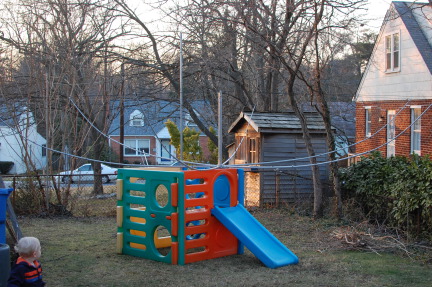
“What have you done to my play set?” This gym made a convenient place to string wires, etc. Two poles in the photo form part of the EWE RX antenna here at K8GU that was hastily erected before the NA Sprint CW. One of the poles is ty-wrapped to the play set. Doing my best to keep it klassy and impress the neighbors.
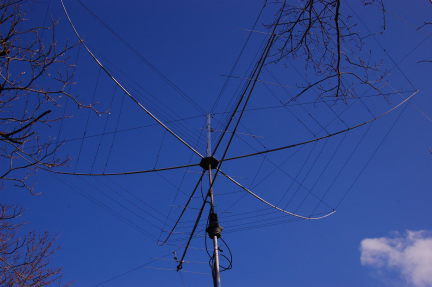
And, we’re up in the air! The M2 9M2SSB is a little bit out of alignment due to the hex getting tangled in one of the antennas that it was due to replace. I have already realigned that. So far, the antenna seems to have useful front-to-back. Gain is hard to tell since I took down all of the antennas it was to replace. But, it does seem to work. I’m suffering from high SWR (above 3) on both 21 and 50 MHz. G3TXQ warns of interaction between 18 MHz and 50 MHz. Do not yet know the cause, but I’m looking into it.
Although the antenna is relatively easy to handle, I don’t plan to make a habit of taking it down for work. Speaking of taking down, the 40m dipole whose center insulator is just visible behind the reflector of the 2-meter beam will be replaced by an as-of-yet-secret antenna.
Ethan Miller, K8GU, is a regular contributor to AmateurRadio.com and writes from Maryland, USA. Contact him at [email protected].
Is winter over yet?
December seems a long time ago. I had a different job and radio was still up there on the ‘things I do when I’m not at work’ list. Since then I haven’t stopped at my new job, its nice to be busy but its really interferring with my radio stuff! The cycle race I marshalled at last May (with my trusty Yaesu VX8-GE) has me as an entrant and my MSF reciver project has yet to be turned into a PCB.
its not looking good
but
Winter is almost over. I’m getting out on the bike in the mornings and evening going to and from work, which means, the evenings are free(er), which means I’ve uploaded my MSF receiver to circuits.io and there is progress with getting a PCB made up, it’s almost warm enough to think about re-cabling the minor antenna farm. The salty air is a continual problem with my antennas and it may be time to go ‘full stealth’ the aluminium ( note correct spelling  ).
).
All this points me in the direction of thinking about radio. If I’ve got time to think about it then I’m not far of ‘doing’ it. Very positive steps. Spring is on its way
Alex Hill, G7KSE, is a regular contributor to AmateurRadio.com and writes from Cumbria, UK. Contact him at [email protected].
A 40m transceiver kit
It has been a while since my soldering iron has been warmed up and I have been feeling the urge to build something. The challenge of building something from scratch has usually proved too much, so I have decided to build a kit. I’ve read a lot of good things about the “Iler 40” and its 20m brother so I decided to get one.
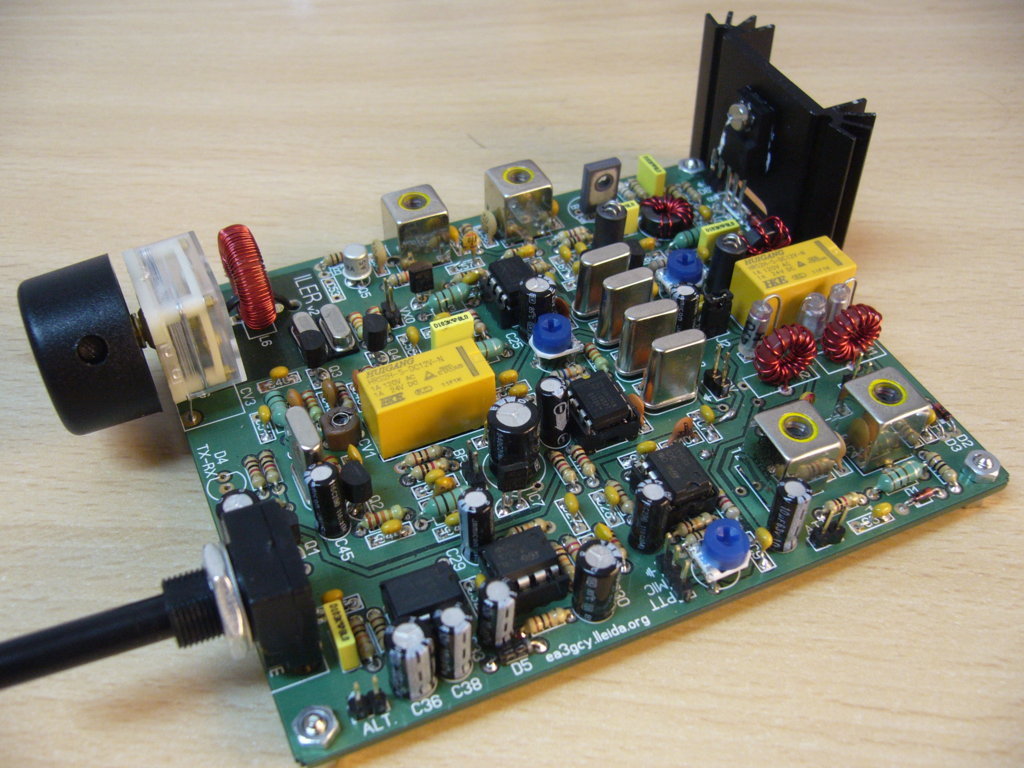 |
| Iler 40 transceiver (EA9GCY photo) |
I thought that this kit was sold on Ebay but a search for “Iler 20” came up blank. A more generic search produced some interesting hits including this 40m transceiver kit from a UK seller. This kit is quite a bit cheaper than the Iler kits but without any reviews it is a bit of an unknown quantity. I eventually found that the Iler kits can be bought from the maker’s own site. The excellent reviews plus a higher output (4w vs 1w) were the decider. I was a bit unsure of which version to go for but I eventually plumped for the 40m version. More to follow once it gets here.
Julian Moss, G4ILO, is a regular contributor to AmateurRadio.com and writes from Cumbria, England. Contact him at [email protected].
 Ham Radio Deluxe |
 W5SWL Electronics |
 Ham Radio Prep |
 KB3IFH QSL Cards  Hip Ham Shirts  HamRadioAuctions HamRadioAuctions Reliance Antennas Reliance Antennas Enigma Shop Enigma Shop |  morseDX  Ni4L Antennas  R&L Electronics R&L Electronics antennas.us antennas.us QRV QRV |
- Matt W1MST, Managing Editor
