 |
 Overmodulated JT65 on HF?
 19 April 2013 | by
 Sometimes it is crowded on JT65 on HF due to too little bandwidth. When only 2 kHz is available and each signal needs 175 Hz that’s understandable. But then others seem to complain that some overmodulate their transmitters so that they occupy more than the 175 Hz, making it even harder to fit an extra signal in the band.

My first impression from using the new JT9 mode is that the problem is much smaller there than for JT65, so maybe something like what I am discussing here has been done in the decoder software. But as far as I know, the source code has not been releasted into the public domain yet by K1JT, so I cannot verify it now.
But it seems clear to me that what looks like splatter has much less to do with overdriving and overmodulating transmitters than one may think, and more to do with the particular way that the spectral estimate is found in the JT65 decoder software. Combined with the variable propagation which is an intrinsic feature of HF and which may create a highly variable signal strength, this is what seems to create the spillover.
Sverre Holm, LA3ZA, is a regular contributor to AmateurRadio.com and writes from Norway. Contact him at [email protected].
On 40m at last… (Part I)
Using a Buddipole antenna (BP) for my SOTA activations leaves me high and dry when it comes to the 40 m band. I was never able to build an efficient BP for these frequencies and received many ‘complaints’ that I never activate on 40m, thereby leaving out the ‘local’ chasers. This is going to change now…
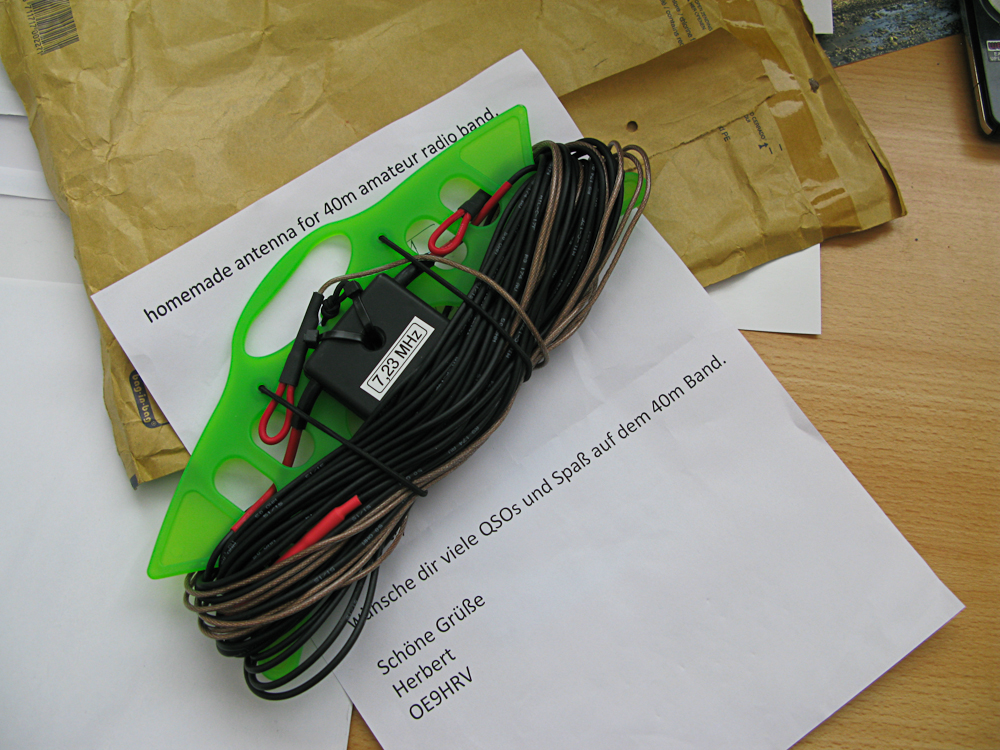
Yesterday I received a package from my buddy and SOTA Mountain Goat Herbert/OE9HRV, containing a home brew double Bazooka for 7 MHz based on RG174 coax. Herbert is my go-to guy when it comes to antennas. On our joint SOTA activations in OE he always carries an impressive assortment of home brew antennas to the summits, and due to this weight I would NOT want to carry his backpack – seriously. To see some examples of his creations, check out his FLICKR stream and/or QRZ page.
I had not known about double Bazookas before being educated by Herbert. It’s an efficient and quiet single band antenna based on 50 ohm coax cable, with the shield split at the center and feed line attache to it. It can be used in a flat top or inverted vee configuration – the latter more suitable for SOTA. To save on weight, Herbert made it out of RG174 with a BNC connector, and used a wire-winder to create a small and easy to manage package. The final antenna is around 310 g (~ 11 ounces) and about 25 cm x 8 cm (~ 9.5″ x 3″ ). With any luck you might hear me on 40m over the week-end.
For more pictures head over to my blog.
73, Matt/KØMOS
Matt Schnizer, KØMOS, is a special contributor to AmateurRadio.com and writes from Colorado, USA. Contact him at k0mos at schnizer.com.
Portable ops
We Radio Amateurs in general, and QRPers in particular, take so much for granted when we want to enjoy both our hobby and the great outdoors together. It really takes no effort at all to pop a small, lightweight radio into a backpack along with a lithium battery and a hunk of wire, and find yourself on the air – literally in minutes. What’s your pleasure? An Elecraft KX1, K1, KX3? A Sierra? A Yaesu FT817 or an Icom IC-703? A Steve Weber ATS or MTR? A Hendricks PFR3A? One of the HB radios from either YouKits or one the Ten Tec models? One of Dave Benson’s Small Wonder Labs models? There are many other models from other manufacturers that will fill the bill just as well, too.
But it wasn’t always this way. Before the days of transistors, ICs and other semi-conductors, radio equipment was (for the most part) big, bulky and destined to a life in an indoors environment. When radio equipment was needed for outdoor use by the military, conventional equipment was often modified for use outside, on the battlefield. Here’s the story of how Hallicrafters served our country during WWII:
Obviously, I’m comparing apples to oranges. First off, today’s military doesn’t rely on HF as in years past. A majority of military communications take place in the UHF and higher frequency parts of the radio spectrum. Also today’s military makes extensive use of satellite communications. But for the moment, let’s forget that. If HF was the still predominate playing field today, like it was during WWII, think what a small radio like a Yaesu FT857D (capable of 100W output), a small generator, or a deep cycle marine battery and an antenna like a Buddipole could do. This would be a lot more convenient (and portable) than the equipment shown in the YouTube video.
My point? We’ve come a long way, baby!
72 de Larry W2LJ
QRP – When you care to send the very least!
Larry Makoski, W2LJ, is a regular contributor to AmateurRadio.com and writes from New Jersey, USA. Contact him at [email protected].
Hints of Sporadic E and a QSO with a Ham Radio Hero!
Over the last few days there’s been a sense that a few Es openings have taken place. Last Saturday, some people caught an opening on 50MHz, but there was nothing here. It’s always nice to get the first 50MHz Es opening of the year in the log – a feeling that Summer is on the way!
This evening when I got back to the car at Didcot, I popped the 28MHz rig on and had a scan around. The EA4Q beacon from Madrid was coming through nicely and down on 27MHz, there were Spanish CBers coming in.
Changing the subject, last night I was on 14MHz JT9, using the WSJT-X program (which has become a firm favourite here). I was really delighted to work the Father of WSJT, WSPR and WSJT-X, Joe Taylor K1JT. Joe’s software is in virtually constant use here, so it was a pleasure and an honour to work him for the first time in a two way contact. Joe’s definitely one of my Ham Radio Heroes!
Tim Kirby, G4VXE, is a regular contributor to AmateurRadio.com and writes from Oxfordshire, England. Contact him at [email protected].
Classic Straight Key CW
http://www.youtube.com/watch?v=nVkLr0GyJPI
Test Questions;
What is a glass arm?
How long should you be able to send using proper form?
How far apart should the contacts be?
What are the working parts of the body when sending CW?
Mike Crownover, AD5A, is a regular contributor to AmateurRadio.com and writes from Texas, USA. Contact him at [email protected].
Checking Out A Baofeng UV-5RA
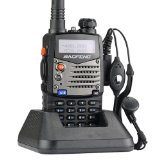 In the Winter 2013 issue of CQ VHF magazine, I wrote about some of the VHF/UHF handheld radios available from China. In that article, I reported on the measured performance of a few of the Wouxun and Baofeng transceivers. One of the Baofeng UV-5R radios that I tested showed harmonic distortion that was a bit high on the 2 Meter band, around -40 dBc.
I recently got my hands on a Baofeng UV-5RA, which is a newer version of the same radio (firmware BFB297), so I wanted to check its performance. Like the two UV-5R models I checked, the power output, transmit frequency and receiver sensitivity were all quite solid on both bands. I was more interested in the harmonic distortion present in the transmit signal.
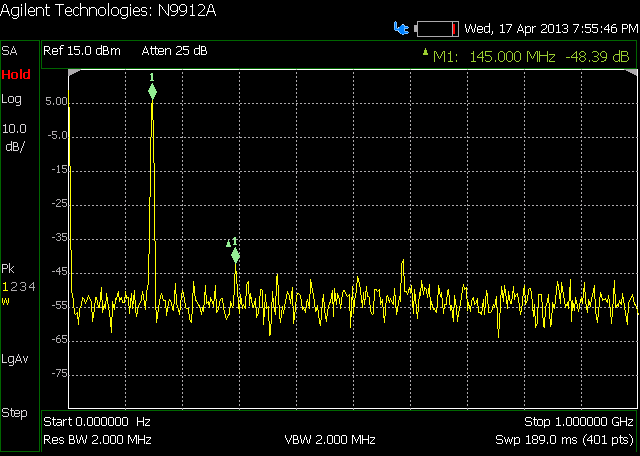
On the 2 Meter band, the 2nd harmonic measured -48.4 dB relative to the fundamental which is pretty good. Similar to the other radios I measured, the performance in the 70 cm band is a lot better (-56.1 dB).
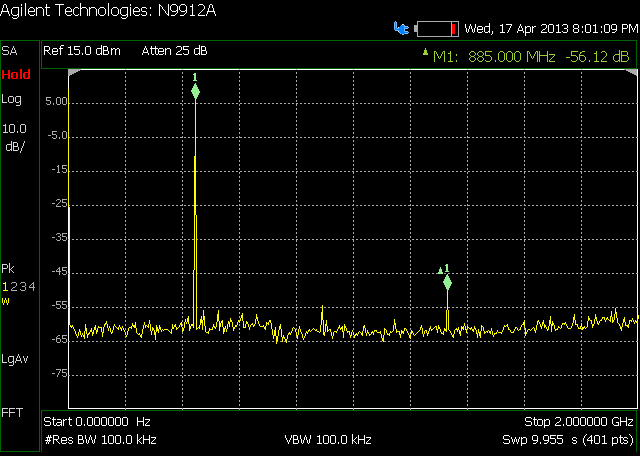
This radio has significantly better harmonic distortion than the older UV-5R radio. Of course, this is just a single sample, so performance of other radios may be different.
73, Bob K0NR
Bob Witte, KØNR, is a regular contributor to AmateurRadio.com and writes from Colorado, USA. Contact him at [email protected].
NJQRP Skeeter Hunt for 2013
Official announcement to come out in a few weeks. The date is confirmed, though – Sunday August 11th, so save the date!

New for 2013:
New theme for this year with bonus points.
SSB will be a category this year for folks who prefer that mode.
Extra points to be awarded for any WAE (Worked All Europe) contacts made, as it runs the same day and a few Skeeters and Hunters actually made DX contacts last year.
Stay tuned – more to come!
72 de Larry W2LJ
QRP – When you care to send the very least!
Larry Makoski, W2LJ, is a regular contributor to AmateurRadio.com and writes from New Jersey, USA. Contact him at [email protected].
 Ham Radio Deluxe |
 W5SWL Electronics |
 Ham Radio Prep |
 KB3IFH QSL Cards  Hip Ham Shirts  HamRadioAuctions HamRadioAuctions Reliance Antennas Reliance Antennas Enigma Shop Enigma Shop |  morseDX  Ni4L Antennas  R&L Electronics R&L Electronics antennas.us antennas.us QRV QRV |
- Matt W1MST, Managing Editor
