 |
 Good or Evuln?
 16 May 2013 | by
 A few weeks ago one of our websites was hacked. We didn’t notice for almost a week due to browsers caching the pages. The consequence of the hack was that every page accessed returned a 404 error meaning that the page was not found. During that week Google’s spiders visited with the result that almost the entire site was lost from the search engine.

I discovered the hack just in time to be able to restore from my web host’s oldest backup. It was a real hassle as well as a stressful time and I wanted to find a way to alert me more quickly if it happened again.
My first thought was to use ChangeDetection.com, the site I use to alert me when a change occurs to the IBP Beacon Status page. That was no good as both sites contain dynamic content that changes frequently.
A couple of days ago I was visiting some ham sites and I came across one with a badge stating that the site was scanned and malware free. I clicked on the badge and it took me to evuln.com, a site containing a lot of information about how to secure a website and offering tools to detect an attack.
Tools include a malware scanner that will check your site to see if it contains something bad. You can have this check run daily for free if you display a badge on the site. This appeared to be just what I was looking for, so I registered with the site and added the badge to both G4ILO’s Shack and ham-directory.com.
Evuln.com also offers a service to clean and fix websites. This is something I might well have used a few weeks ago if my web hosts’s support hadn’t been helpful in assisting me to identify the hacked files. But the cynic in me rang an alarm bell. It would be in evuln.com’s interest to claim that my site was hacked and then offer to clean it up for a fee. What a good scam! In fact the owners of a couple of sites that had been told they had been hacked thought it was a scam and that their site had been hacked by evuln.com!
So is evuln.com good or evil? I did a lot of digging. I think that if it was a scam I would have found a lot more evidence of people who had been scammed. Evuln.com has been running for several years and contains good information. The owner replies quickly and promptly to enquiries. There is an address and contact information on the site. I believe that evuln.com is a genuine attempt to provide a useful service.
I have since found other similar services such as ScanMyServer which do not offer a site cleanup service. Come to your own conclusion.
Julian Moss, G4ILO, is a regular contributor to AmateurRadio.com and writes from Cumbria, England. Contact him at [email protected].
A nice surprise
was in the mail when I got home from work – an envelope from the ARRL. I had recently updated my LOTW log and sent in an application for a bunch of DXCC entities that I had worked. That application put me over the 150 DXCC entities worked mark, so the League sent me a little “DXCC 150” sticker for my basic certificate. I am surmising that you can get an endorsement stickers for multiples of 50 DXCC entities worked, ie 150, 200, 250, 300 and finally 320 and then Honor Roll, I guess.
This submission brought me up to 151 confirmed. I actually have 3 or 4 more in the log with stations that do not use LOTW, so I will have to get their confirmations the old fashioned way.
In addition to those 3 or 4 I just mentioned, you can add another, as I worked SX5KL in the Dodecanese Islands for another new DXCC entity worked. I actually worked him twice (yes, I know I’m a hog) once QRO and then about 90 minutes later QRP. The first time, he was about a 579 here – 90 minutes later, he was blasting through at 599+ and the pileup wasn’t very fierce. So I took the chance and got through the second time with 5 Watts and thanked him for listening to my QRP signal.
On an entirely different note, I’d like to take this opportunity to extend my best wishes for a very safe journey to all of you out there who are traveling toward FDIM and Hamvention. I hope the weather is great for you and that you all have a great time. I wish that I could be with you guys at FDIM, and finally meet face to face with so many of you that I have come to consider to be good friends.
To paraphrase W.C. Fields – “All things considered, I’d rather be in Dayton”.
72 de Larry W2LJ
QRP – When you care to send the very least!
Larry Makoski, W2LJ, is a regular contributor to AmateurRadio.com and writes from New Jersey, USA. Contact him at [email protected].
Handiham World for 15 May 2013
Pat Tice, WA0TDA, is the manager of HANDI-HAM and a regular contributor to AmateurRadio.com. Contact him at [email protected].
A man walks into a bar…
A ham with a parrot on his shoulder walk into a bar.
Barkeeper asks “where did you get that?”
“Dayton” says the parrot.
Scott Hedberg, NØZB, is a regular contributor to AmateurRadio.com and writes from Kansas, USA. Contact him at [email protected].
Beauty is in the eye of the beholder
Do you want a treat? Some “eye candy”? Some really beautiful workmanship and craftsmanship? Do you want to see what really excellent home brewing looks like?
http://aa7ee.wordpress.com/2013/05/11/the-na5n-desert-ratt-2-regen/
All I can say is “Wow, I wish I could build stuff that looks this good!”
72 de Larry W2LJ
QRP – When you care to send the very least!
Larry Makoski, W2LJ, is a regular contributor to AmateurRadio.com and writes from New Jersey, USA. Contact him at [email protected].
As seen on TV
Well, actually, as seen on eBay. These are a few things I’ve seen on eBay that made me look twice (OK, maybe more than twice) :
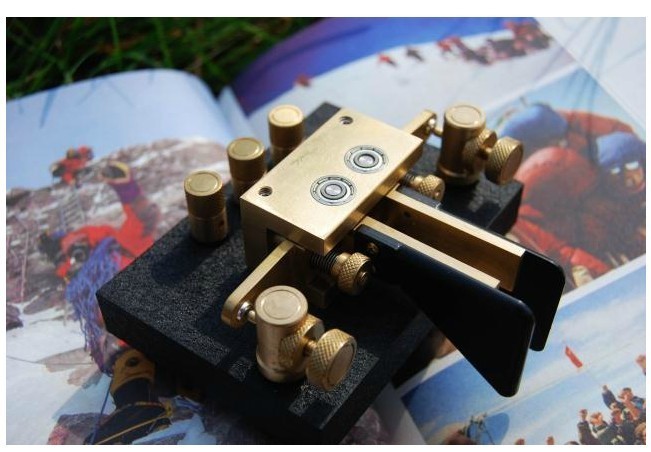
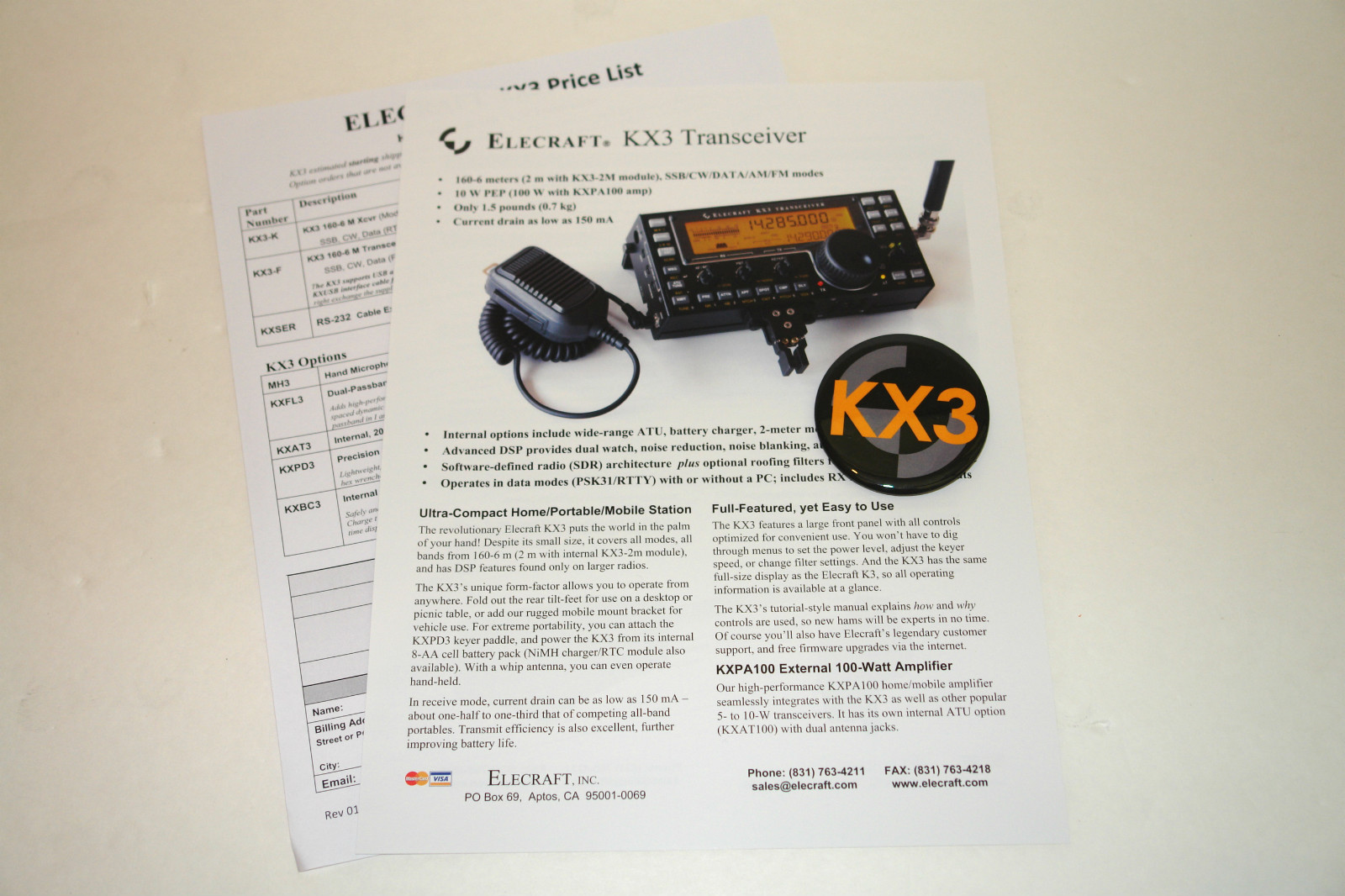
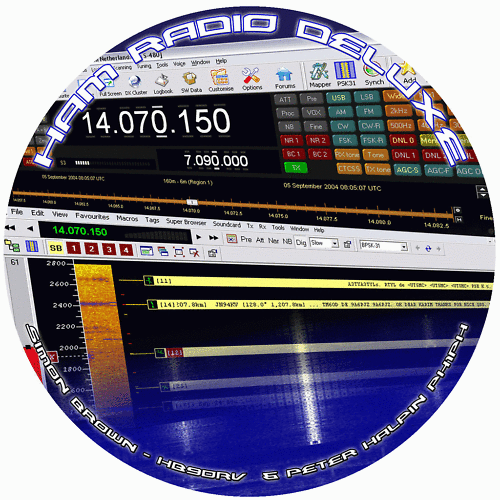
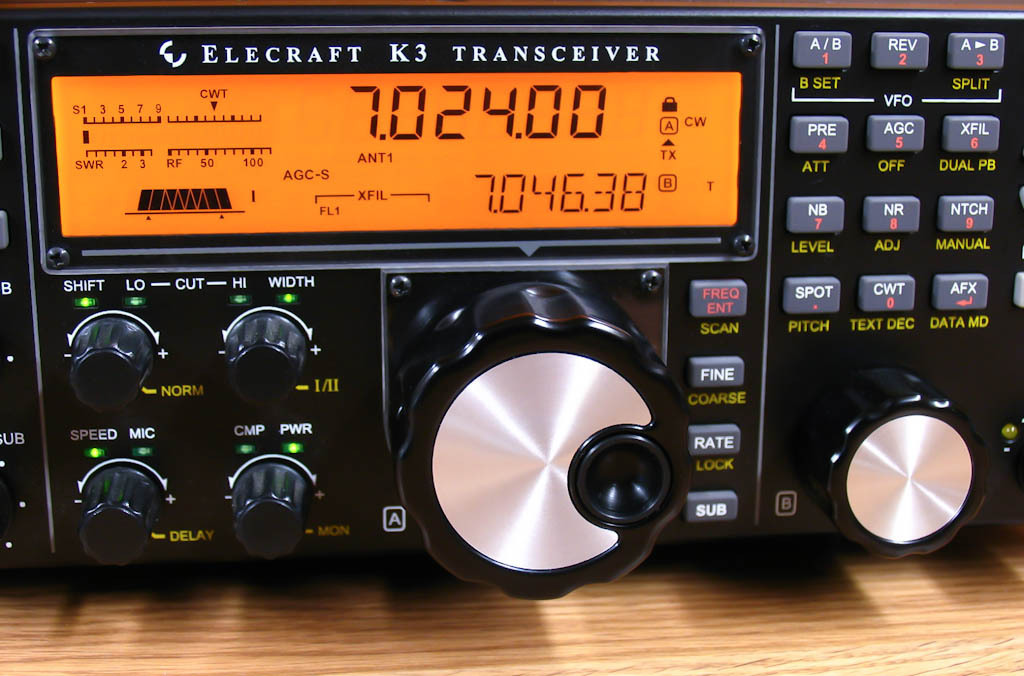
Larry Makoski, W2LJ, is a regular contributor to AmateurRadio.com and writes from New Jersey, USA. Contact him at [email protected].
David Cripe’s NM0S Cyclone 40 Meter Transceiver kit
Readers, check out the Cyclone 40 in this release:
A new kit from the Four State QRP Group and David Cripe (NM0S)

NM0S’s Cylcone 40M QRP transceiver. Look for it at Four Days in May!
Arising from Dave’s entry in QRP ARCI’s 72 Part Challenge Design Contest in 2010, the Cyclone 40 is an enhanced version of the original design. The transceiver designed for the design contest had 72 total parts, performed well, and won honorable mention. This improved version has less than 100 components and even better performance! The kit features all through hole parts and easy assembly. The receiver is a superhet design with very good sensitivity and selectivity, and tunes the entire 125 kHZ CW segment of the 40M Band – and does so at a comfortable tuning rate. A frequency readout is included so you know where you are at all times.
This is a complete kit, including the enclosure. A high quality board package includes the pc board, front and back panels, the sides, and top and bottom all of which make up the enclosure. The control and jack labels are silk screened in white letters and vividly contrast with the black solder mask, and the holes for the connectors and controls are pre-drilled. The ends are “dovetailed” together making a very rugged, easy to build, and attractive enclosure.
Features and Specifications
General
- Enclosure: A very nice predrilled and silkscreened enclosure is included. It’s easy to assemble and looks great.
- Ergonomics: Smooth solid tuning, a quiet receiver with QSK and well behaved AGC. Nicely laid out front and rear panels.
- VFO: The VFO is a simple PTO design, is very stable, and also quite easy to build
- Sidetone: Included!
- AGC: Audio derived, fast and smooth.
- Frequency Range: 7.000 – 7.125 typical.
- Tuning Speed: 10kHz/knob turn typical.
- Stability: 300 HZ the first 5 min after power up, less than 10 HZ/hour after that.
- QSK: Fantastic QSK! Full Break in, excellent muting, really fast!
- All Through Hole Parts There are NO SMT parts in this kit, and only three easy to wind toroids.
- Dimensions: 4.4 x 3.6 x 1.9″
- Power Connector: 2.5×5.5mm coaxial, center positive. Should be fused at 1A, fast blow at PS
- Antenna connector: BNC
Receiver
- Configuration: Superheterodyne, 11 MHZ IF, 4 Crystal IF Filter.
- Sensitivity: MDS (Minimum Discernable Signal) -125, Typical, below the normal 40M band noise level.
- Selectivity: Four crystal, 500 HZ IF filter
- IMD3: 90 dB typical, better than most commercial gear!
- IP3: +10 dBm typical – another very good number
- Frequency Readout: 3 or 4 digit CW, 1 kHz or 100 Hz resolution (user selectable), developed by Adrian Hill, KCØYOI.
- Band Edge Marker: A band edge marker is heard at 7.001 MHZ
- Headphone Jack: 1/8″ stereo, standard earbud/Walkman® headphone compatible
- DC Current consumption: 30 ma typical at 13.6 VDC.
Transmitter
- Configuration: Stable, Wide Range VFO (PTO design), Efficient Class E Final.
- Spectral Purity: All harmonics and spurs less than 50dB below the carrier.
- Output Power: approximately 4W into 50 ohms
- DC Current consumption: 500ma typical at 13.6 VDC Will operate down to 9v DC.
- Key Jack: 1/8″ stereo, grounded shell, switching the tip keys TX. Contacts accessible for an internal add-on keyer
Kits should be available at QRP ARCI’s Four Days in May conference at Dayton, and will be for sale on the Four State QRP Group’s web site approximately May 20th. The final price hasn’t been determined yet but should be less than $100 plus shipping.
Tom Witherspoon, K4SWL, is a regular contributor to AmateurRadio.com and writes from North Carolina, USA. Contact him at [email protected].
 Ham Radio Deluxe |
 W5SWL Electronics |
 Ham Radio Prep |
 KB3IFH QSL Cards  Hip Ham Shirts  QRV QRV Reliance Antennas Reliance Antennas |  morseDX  Ni4L Antennas  R&L Electronics R&L Electronics antennas.us antennas.us |
- Matt W1MST, Managing Editor
