 |
 Mobile rig for the price of a (Chinese) HT
 18 May 2013 | by
So cheap you just have to buy one! According to the the listing it’s VHF or UHF not dual band. Thanks to Steve G1KQH for the tip-off.
Julian Moss, G4ILO, is a regular contributor to AmateurRadio.com and writes from Cumbria, England. Contact him at [email protected].
6m 18 May 2013
This Saturday morning there was a big Sporadic-E opening on 6m. There were some pretty big signals, though once again I seemed to be on the edge of the opening. The Sporadic-E seemed centered over northern Europe and you can see from the map that it was pretty intense!.
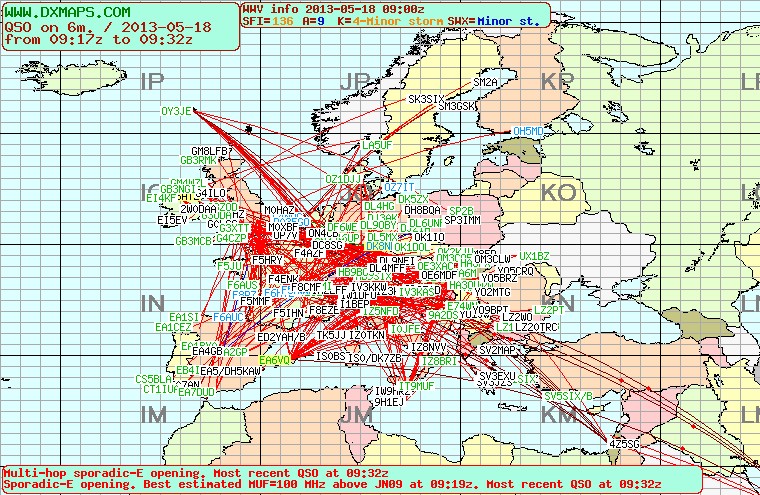 |
| 6m on 18 May 2013 at 0930z. Map from DXMaps.com |
I had KComm’s DX Cluster window open. I don’t use the cluster on HF and dislike it intensely, but spotting stations on the cluster (in a specific format with locators for both endpoints) is how VHF contact information gets to DXMaps.com.
I saw a couple of contacts from Ireland spotted on 2m so I switched bands.
 |
| 2m on 18 May 2013 at 0940z. Map from DXMaps.com |
As you can see, two lucky EI stations managed to work into northern Italy, one of them using a vertical antenna! Signals must have been strong but when I QSYed to 2m I didn’t hear anything. The Es must have been over the northern French coast and you can see that the same Es cloud must have permitted F6HTJ to spot the GB3ANG beacon and enabled DG7IG to work EA1CCM as the paths intersect at the exact same point..
I wasn’t lucky on 2m but I was a bit more successful on data and tuned to the PSK part of the 6m band just in time to catch a French station signing off with Tim, G4VXE. I managed QSOs with Gerard F4LKG and George EA4GB but I don’t think many stations were listening because my CQs went unanswered.
It seems as if the 2013 Sporadic-E season is off to a good start!
Julian Moss, G4ILO, is a regular contributor to AmateurRadio.com and writes from Cumbria, England. Contact him at [email protected].
You know it’s Dayton weekend when ……
the traffic on the e-mail reflectors goes down to practically nil.
But the advent of social media, especially Twitter means that we get news and views of new equipment all that much faster.
Jeff KE9V and others have been tweeting great photos of various things all day. TJ, W0EA has been putting video log reports on YouTube.
If you can’t be there, this is almost as good, thanks to the efforts of these fine gentlemen.
So far, I’ve seen great photos of TenTec’s new Rebel, which is a dual band rig featuring open source firmware for experimentation. For comprehensive details, visit “The QRPer” – the link is to the right.
Jeff KE9V also posted images of TenTec’s new auto tuner and some images of the new CrankIR portable antennas. Jeff also tweeted a mouthwatering photo of a lineup of Bengali keys.
With all the goodies available, maybe it’s a good thing that I didn’t make it out to Dayton. I probably would have come home a much poorer man.
I am going to get up early and take a ride to the OMARC hamfest in Wall Township, NJ tomorrow morning. It’s definitely not Hamvention, but it will be fun, anyway. There’s not anything that I have a real pressing need for, but it’s always good to stock up on PL-259s, power connectors, and things like that. Who knows? There’s always the chance to find a hidden treasure.
72 de Larry W2LJ
QRP – When you care to send the very least!
Larry Makoski, W2LJ, is a regular contributor to AmateurRadio.com and writes from New Jersey, USA. Contact him at [email protected].
Dayton = NEW STUFF!!!!
Mike Weir, VE9KK, is a regular contributor to AmateurRadio.com and writes from New Brunswick, Canada. Contact him at [email protected].
Hello Dayton !!!!
Are any of my readers at FDIM and/or Hamvention?
Do you have anything you’d like to share? Comments, stories, news items?
Anybody not at Dayton that wants to relate a favorite memory or anything else?
Just for this weekend, I’ve taken off some of the restrictions on commenting, including allowing anonymous comments – but please, give your name and call sign! (I will delete offensive or spam comments.)
72 de Larry W2LJ
QRP – When you care to send the very least!
Larry Makoski, W2LJ, is a regular contributor to AmateurRadio.com and writes from New Jersey, USA. Contact him at [email protected].
Cross-Country on Shute Hill
Today was fantastic. About 72F, sunny, with a stiff breeze. I hiked cross-country from Shute Hill to the Range Road running parallel to Hunkins Pond. The black flies were biting when I set up my gear, so I only made one quick contact with W5ZR in Louisiana before heading back.

Not far from the cemetery at the top of Shute Hill is a 5 acre beaver pond. I brought my APRS handie and transmitted my position as I hiked. You can see the beaver pond just above my call sign on the APRS map below.

After crossing the brook, the trail climbs steadily to the top of the hill. The trees along the trail radiate the yellow-green of new spring foliage.

This is an old logging trail, used mostly by snowmobiles now. I hiked about three miles to a spot where it runs into the old range road. Just across the old road is Swain’s north pasture. I set up under some maple trees along the stone wall. I thought I was going to operate on 15 meters, so I put up a 22 foot wire for that band. But 15 was dead and I switched to 20, even though the wire was a bit short. I was running about 4 watts with the ATS-4 and an Elecraft T-1 tuner. I called Bert, W5ZR in Louisiana when he called CQ. He was a strong 599, and he gave me a 559. The black flies were chewing on my ears and arms in spite of the repellent I put on. But who cares when the view looks like this…

After the quick QSO I packed up the gear and headed back up the trail. I reached my car in just about an hour. It was a perfect afternoon outing.
Jim Cluett, W1PID, is a regular contributor to AmateurRadio.com and writes from New Hampshire, USA. Contact him at [email protected].
10m 16 May 2013
 |
| 10m WSPR spots @ G4ILO 1242z 16 May 2013 |
By running WSPR day after day on the same band you start to get a feel for how propagation behaves that you don’t get from casual operation. It’s interesting to compare this map of WSPR spots for G4ILO around lunchtime today with the kind of results I was getting in November. Then I was getting DX spots throughout the day. Now I’m getting mostly local spots, within Europe.
In the autumn the picture changed slowly through the day. Now, in springtime, the picture changes all the time. Stations pop up for a few cycles and then disappear, never to be heard of again. The signal reports vary wildly as well, from just above the noise to +10dB or even higher in the space of a few minutes. This didn’t happen in November. It is a clear indication of Sporadic-E propagation: reflections from fast-moving clouds that are highly ionized and very reflective, creating a path with very little loss.
From time to time I pause the WSPR and tune the band to see what activity there is. I’ve also tried 6m for short periods. I’ve had a few spots on 6 (this is with 5W to my attic dipole) but the magic band is still fairly quiet at 55 degrees north. 10m is far from being wide open yet too. I’ve still to see what WSPR is like when the band is open and signals are romping in at S9+. So I will continue with my WSPR monitoring in the expectation that things will get even more interesting.
Julian Moss, G4ILO, is a regular contributor to AmateurRadio.com and writes from Cumbria, England. Contact him at [email protected].
 Ham Radio Deluxe |
 W5SWL Electronics |
 Ham Radio Prep |
 KB3IFH QSL Cards  Hip Ham Shirts  QRV QRV Reliance Antennas Reliance Antennas |  morseDX  Ni4L Antennas  R&L Electronics R&L Electronics antennas.us antennas.us |
- Matt W1MST, Managing Editor
