 |
 SOTA – Some Numbers
 25 April 2013 | by
  Among other things, one of the features of the Summits on the Air (SOTA) program that attracted me was that no QSL cards are required. All I needed was a brand new award program with literally tens of thousands of possible contacts that I needed QSL cards for to get the award. The founders of the program were right in finding a way around QSL's. I think the approach used by SOTAis very modern day and is a model that could duplicated by others.
Looking at the numbers above, I can't think of a program that would have a ratio of activators to chasers as small as this, almost one to one. Of course there are many who both chase and activate, but this is a very interactive program. It is also a ham radio activity that allows some exercise, something we could all use a little of.
The awards are too numerous to go into here. You have awards based on points, numbers of unique summits worked, number of different assoications worked and many others. There is something for everyone.
Mike Crownover, AD5A, is a regular contributor to AmateurRadio.com and writes from Texas, USA. Contact him at [email protected].
Is it just me?
For the last few weeks, when I browse the pages in G4ILO’s Shack using Google Chrome browser, they start displaying in a plain text sort of mode.
 |
| How pages look in Google Chrome |
 |
| How that page is supposed to look |
I think what’s happening is the CSS style sheet isn’t being loaded. So the pages are appearing without any formatting. But why? This doesn’t happen in Firefox. It didn’t used to happen in Chrome. And it doesn’t happen in Chrome after I clear the cache. After that the next few pages display OK until it eventually happens again.
Is it just me, or is this happening to everyone who visits my site using Google Chrome?
Julian Moss, G4ILO, is a regular contributor to AmateurRadio.com and writes from Cumbria, England. Contact him at [email protected].
LHS Episode #104: Propagation 101 with G0KYA
 We sometimes on this show attempt to bring you interesting interviews with people who are both computer literate and ham radio literate at the same time. In this case, we bring a scholar, physics buff, aerospace engineer and brilliant guy, Steve Nichols (G0KYA), to discuss the science of radio wave propagation. No need to turn the show off before it even begins. Steve makes understanding the Earth’s atmosphere, its magnetic field, and a ton of stuff about the sun simple and approachable. No mind-bending equations, no physics lectures, just some great information for anyone interested in learning how a radio signal gets from here to there. A bunch of follow-up information in the form of books and Web sites are provided as well, links to which will be in the show notes, for anyone who wants to further their education. Thank you as always to our loyal listeners. Make sure to tell a friend next time you’re out for a cold one. The more the merrier.
73 de The LHS Guys
Russ Woodman, K5TUX, co-hosts the Linux in the Ham Shack podcast which is available for download in both MP3 and OGG audio format. Contact him at [email protected].
Have you ever been listening to something that may not be there???

Mike Weir, VE9KK, is a regular contributor to AmateurRadio.com and writes from New Brunswick, Canada. Contact him at [email protected].
A few things
Two things pointed out to me by Bob W3BBO, who directed me to the “ARRL Contest Update” e-mail, which I had just kind of glossed over without reading properly:

Larry Makoski, W2LJ, is a regular contributor to AmateurRadio.com and writes from New Jersey, USA. Contact him at [email protected].
Handiham World for 24 April 2013
Pat Tice, WA0TDA, is the manager of HANDI-HAM and a regular contributor to AmateurRadio.com. Contact him at [email protected].
Multi-Band 4 Foot Magnetic Loop with Gamma Match

4 Foot Diameter Magnetic Loop In Operation
As my mag loop projects progress, I’m learning a lot about building them and using them. This antenna works on 17, 20, and 30 meters, with the best bandwidth on 20 meters. The bandwidth on 17 and 30 is quite small but usable. There is a 20 KHz bandwidth on 20 meters. I used a vacuum capacitor to build this particular loop for 100 watt operation. The air capacitors are good for QRP but will arc over using much power over QRP levels.

4 Foot Magnetic Loop Antenna with Gamma Match
This photo was taken before I trimmed the Gamma Match.
I didn’t know how long the Gamma Match should be, so I made it long enough to allow for trimming after the match to 50 Ohms was made.
This is the first mag loop that I made with a Gamma match. I like this match better than the usual Faraday feed loop that is featured in my previous mag loop antennas. Matching is easy and building the Gamma match is not difficult. I’m planning to build other smaller loops that will also feature the Gamma match. The smaller loops will target 10, 12, and 15 meters. Loop size determines which band its best suited too. Although it is possible to get more bands on one loop, the bandwidth is small and the tuning ‘dip’ is very sharp. I found it better to limit the number of bands in favor of wider bandwidth and antenna efficiency.
Please look up my previous posts for more details on parts and plans.

Here is a good close up of the clamp.
(Before Trimming)
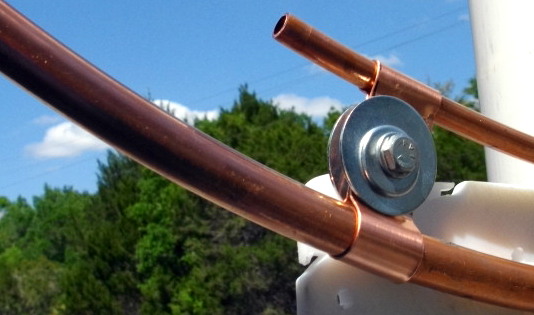
Gamma Match After Trimming. This enables a 50 Ohm Match for all three bands.

Gamma Match on the left, PL 259 in the center and, Tuning Aid Stick (PVC) pipe , on the right.
The vacuum capacitor is ‘tuned’ by twisting the PVC pipe that is attacked to it with a cotter pin.
Tuning the cap to the ‘loudest noise’ on the air will put you in the ball park for operating.
You can also use an antenna analyzer if you want to know the exact SWR, and RR of the antenna.
Tuning with a radio attached is fast and easy.

Making the clamp for the Gamma Match

Soldering The Back Plate and PL 259

Removing The Oxidation Before Soldering
The main loop is 5/8 inch, soft copper tubing.

Close Up of PL 259 to Gamma Match Joint
The center of the PL 259 had a #10 solid copper wire inserted and soldered in place.
The Gamma match is 3/8 inch soft copper tubing.
This part of the job was done with a soldering iron, the rest was done with a plumbers torch.

Handy ‘third hand’. A clamp to hold the Gamma match in place while I soldered it.
My town was going to hire a ‘Mad Scientist’ but it couldn’t afford one, so they settled for a ham radio operator instead. Me!
73 de AA1IK
Ernest Gregoire
Ernest Gregoire, AA1IK, is a regular contributor to AmateurRadio.com and writes from Florida, USA. Contact him at [email protected].
 Ham Radio Deluxe |
 W5SWL Electronics |
 Ham Radio Prep |
 KB3IFH QSL Cards  Hip Ham Shirts  HamRadioAuctions HamRadioAuctions Reliance Antennas Reliance Antennas Enigma Shop Enigma Shop |  morseDX  Ni4L Antennas  R&L Electronics R&L Electronics antennas.us antennas.us QRV QRV |
- Matt W1MST, Managing Editor
